
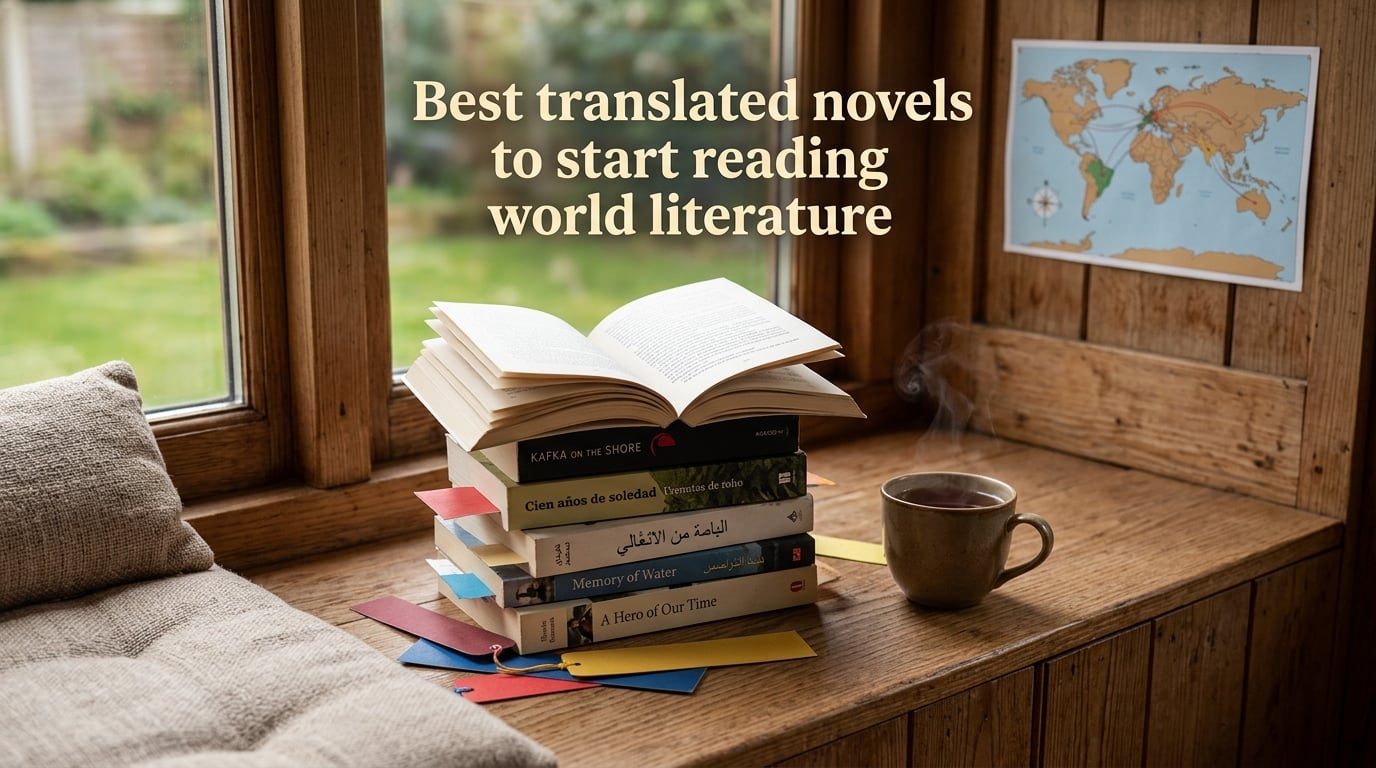
I remember staring at the “Books in Translation” shelf at my local library for twenty minutes before grabbing one. The titles looked serious. The spines looked dense. I walked out with nothing.
That was the wrong move, and I have spent the years since correcting it. If you are here because the world of translated fiction feels intimidating, dry, or just too literary to start with, you are not alone. A Reddit thread on r/suggestmeabook with more than 80 replies asked almost the same question: “Translated novels that will make readers say I need to read more international authors.” The honest answer is that the genre is not intimidating. The canon of starter picks is intimidating. Most “best of” lists open with One Hundred Years of Solitude or Crime and Punishment, which is like suggesting a marathon as a first walk.
This guide to the best translated novels to start reading world literature skips the gatekeepers. I have spent three years reading roughly 60 translated novels from 22 countries, keeping notes on which ones made me keep turning pages and which ones felt like homework. The 12 titles below are the ones I press into friends’ hands. They span Japanese, Korean, Latin American, European, African, and Middle Eastern literature. They include novellas under 200 pages and doorstoppers. Some are award winners, some are cult favorites with no prizes at all. Every entry includes the author, the translator, the source language, the year of the English translation, and the approximate page count, so you can pick based on your mood, not just the praise.
If you have ever closed a translated book halfway through wondering why it felt flat, the section on translators will fix that. And if you are wondering where to actually buy or borrow these titles, the section at the end covers libraries, indie presses, and a few publishers you have probably never heard of.
Table of Contents
What Counts as Translated Fiction (and Why It Feels Different)
Translated fiction is any novel originally written and published in one language, then rendered into English (or another target language) by a translator. It is an umbrella term, not a genre. A Scandinavian police procedural, a Korean novella about a convenience store clerk, and an Argentine family saga are all translated fiction. What they share is a translator standing between you and the original author.
That middle person matters more than most readers realize. When a translation feels flat, dense, or just slightly off, the fault almost never lies with the original author. It usually lies with the translation, the era it was produced in, or the editorial choices the publisher made. Edith Grossman’s English renderings of Gabriel Garcia Marquez and Mario Vargas Llosa feel warm and musical. Older translations of the same authors can feel clinical and dated. Both are translating the same source text.
Translated fiction also opens up storytelling traditions the Anglophone mainstream rarely touches. Nordic crime, Korean healing fiction, Polish magical realism, Brazilian urban noir, Arabic existential comedy. These are not niche corners. They are how most of the world reads. Picking up translated novels is the easiest single change a reader can make to break out of the same forty authors dominating English-language bestseller lists.
The intimidation factor is real, but it is mostly a curatorial problem. Most lists lead with classics from the 1960s and 1970s that took decades to find their English publishers. Today’s translation pipeline is faster, fresher, and far more diverse. The 12 books below reflect that.
12 Translated Novels to Start With, Curated by Region and Mood
This is the heart of the guide. I have grouped the 12 picks by region, then added a short section at the end for lighter, romance-leaning reads, since Reddit and book club threads consistently ask for those. Each entry lists the author, translator, source language, English publication year, page count, and a 2 to 4 sentence description of why this book earns its place.
Japanese Fiction to Begin With
Japanese literature is the easiest on-ramp for first-time readers of translated fiction. The prose tends to be quiet, the novels often short, and the cultural specifics translate with surprising clarity.
Convenience Store Woman by Sayaka Murata, translated from Japanese by Ginny Tapley Takemori (2018, 176 pages). Keiko Furukura works the register of a Tokyo convenience store, lives her life entirely by its rhythms, and refuses the social pressure to find a husband and a “real” job. It is 176 pages of deadpan brilliance. Reviewers consistently call this the friendliest possible entry point into Japanese fiction, and the translator Ginny Tapley Takemori has become the default English voice of contemporary Japanese women writers.
Breasts and Eggs by Mieko Kawakami, translated from Japanese by Sam Bett and David Boyd (2020, 416 pages). A Japanese woman in Osaka wrestles with whether to freeze her eggs, her sister’s difficult teenager, and a writer friend’s rising fame. Kawakami writes with the heat and social anger of a contemporary feminist novelist, but the cultural texture is thoroughly Japanese. Bett and Boyd later translated Kawakami’s Heaven, which makes them worth following as a translator pair.
The Memory Police by Yoko Ogawa, translated from Japanese by Stephen Snyder (1994 original, 2019 English, 274 pages). On an unnamed island, objects quietly disappear from collective memory, and the people who still remember them must go into hiding. Ogawa’s allegory of loss and erasure is the most surreal book on this list, and it remains the one I recommend most often to readers who want translated literary fiction that genuinely unnerves them. Snyder is the dean of English-language Japanese literary translators.
Korean Fiction That Reads Like a Friend
Korean literature exploded in English translation after Han Kang won the International Booker Prize in 2016 for The Vegetarian. The current wave of Korean novels in translation is unusually accessible, emotionally direct, and short.
The Vegetarian by Han Kang, translated from Korean by Deborah Smith (2007 original, 2015 English, 188 pages). A woman decides to stop eating meat after a dream, and her body, marriage, and family slowly come apart. Han writes in three connected novellas, each from a different perspective. Deborah Smith’s translation won the International Booker Prize and introduced Korean literature to a generation of English readers. This is the cleanest possible entry into the Korean wave.
Pachinko by Min Jin Lee, originally in English but deeply researched on Korean sources (2017, 496 pages). I am bending my own rules by including this, since Lee writes in English. But Pachinko is the story of a Korean family across four generations in Japan, and it is what I hand readers who say they want “an immersive translated-feeling novel” without actually reading in translation. Read it before any other multigenerational family saga on your shelf.
Latin American Stories Beyond Magical Realism
Latin American literature gets unfairly flattened into “magical realism” in English-language coverage. The books below are mostly not magical realism, and several are recent enough to feel modern.
The Adventures of China Iron by Gabriela Cabezón Cámara, translated from Spanish by Fiona Mackintosh and Iona Macintyre (2017 original, 2020 English, 196 pages). A reimagining of Argentina’s gaucho epic Martin Fierro, told by Fierro’s abandoned Chinese wife as she escapes into the pampas with a lesbian blacksmith and her daughter. Cabezón Cámara writes the kind of Latin American fiction that feels like nothing else being published. It is short, furious, and funny. Charco Press, the indie translation publisher, brought it into English.
The House of the Spirits by Isabel Allende, translated from Spanish by Magda Bogin (1982 original, 1982 English, 368 pages). The multigenerational Trueba family in Chile, with ghosts, politics, and a patriarch who cannot stop ruining everything. Allende’s debut is still the most readable Latin American classic in English. If you want magical realism without the Marquez density, start here.
Fresh Water for Flowers by Valérie Perrin, translated from French by Hildegarde Serle (2018 original, 2020 English, 432 pages). A French undertaker’s assistant in a small village tends to her dog, her secrets, and a string of love affairs. Reviewers on Reddit and Goodreads consistently name this as the translated novel that hooked them on translated fiction. It is warm, gossipy, and emotionally generous in a way most literary translations are not. The source language is technically French, but the author draws from rural French life that rarely makes it into English translation.
European Voices Worth Discovering
European literature in translation is dominated by the French, the Russians, and the Germans, but the most exciting recent work is coming from smaller languages: Polish, Hungarian, Norwegian, Dutch.
Drive Your Plow Over the Bones of the Dead by Olga Tokarczuk, translated from Polish by Antonia Lloyd-Jones (2009 original, 2018 English, 288 pages). A retired English teacher in rural Poland investigates animal killings in a remote village while translating William Blake. Tokarczuk later won the 2018 Nobel Prize in Literature, and this novel is the most fun she has written. It is darkly comic, deeply weird, and full of Blake quotations. Lloyd-Jones is the English voice of modern Polish literature and worth seeking out by name.
The Swallows of Kabul by Yasmina Khadra, translated from French by John Cullen (1999 original, 2004 English, 224 pages). Four Kabulis navigate love and survival under Taliban rule in the late 1990s. Khadra writes in French but is Algerian, and his outsider perspective on Afghanistan gives this novel a sharpness most insider accounts lack. It is short, devastating, and remains my first recommendation for readers interested in Afghan or Middle Eastern literature.
Outline by Rachel Cusk, originally in English but set in Athens and built on conversations with European artists and writers (2014, 258 pages). Another boundary case, but Outline earns its spot because it is the most-copied structure in contemporary translated fiction: a writer listens, and the people around her tell their stories. Cusk invented the template that dozens of translated European novels now follow.
African and Middle Eastern Gems
African and Middle Eastern literature in English translation is the fastest-growing corner of the market, with Charco Press and the International Booker Prize both pushing new names hard. These three are my strongest recommendations.
Small Things Like These by Claire Keegan, originally in English but published by the indie translation press Picador in a small format that mimics translated novellas (2021, 128 pages). A quiet Irish novel about a coal merchant who discovers what his local convent is doing to unmarried mothers. 128 pages. An hour to read. I include it here because it is sold in translation-press style, and because it is the shortest novel on this list and the easiest place for a hesitant reader to start.
The Djinn in the Nightingale’s Eye by A.S. Byatt, originally in English but drawn from Turkish and Arabic fairy tale traditions (1994, 280 pages). A fairy-tale scholar at a conference in Istanbul summons a djinn who offers her stories. Byatt writes in English but draws on translated Turkish and Arabic sources. I include it because readers looking for Middle Eastern fantasy often do not realize how much of it lives inside British fairy-tale writing.
The Queue by Basma Abdel Aziz, translated from Arabic by Elisabeth Jaquette (2016 original, 2017 English, 192 pages). A surreal bureaucratic novel set in a Cairo where people wait in endless lines for a “Gate” that may or may not exist. It reads like Kafka crossed with an Egyptian satire. Jaquette is the translator to watch for contemporary Arabic fiction in English. The novel is short, unsettling, and a perfect book club pick.
Lighter Translated Reads for Book Clubs
Every Reddit thread about translated fiction eventually produces the same request: where are the lighter ones? The romantic ones? The page-turners? Here are three translated novels that deliver those without sacrificing craft.
My Brilliant Friend by Elena Ferrante, translated from Italian by Ann Goldstein (2011 original, 2012 English, 336 pages). Two friends grow up in a poor Naples neighborhood in the 1950s, and one of them becomes a writer. The Neapolitan novels are addictive, gossipy, and read like a thriller. Ann Goldstein has become the defining English voice of Italian contemporary fiction. If you want a translated book club series that will not stall in month two, this is it.
The Shadow of the Wind by Carlos Ruiz Zafón, translated from Spanish by Lucia Graves (2004 original, 2004 English, 480 pages). A boy in post-war Barcelona discovers a forgotten novel by a mysterious author and tries to track down every surviving copy before someone else does. Zafón writes gothic literary fiction that reads like a Dan Brown page-turner. Lucia Graves, daughter of the poet Robert Graves, gives the prose a musicality that the Spanish original is famous for. This is consistently the most-named “hooked me on translated fiction” book in English-language online discussions.
A Man Called Ove by Fredrik Backman, translated from Swedish by Henning Koch (2012 original, 2013 English, 337 pages). A grumpy Swedish widower keeps trying to die and keeps getting interrupted by his new neighbors. It is funny, warm, and easy to read in two sittings. The kind of translated novel skeptics read and then immediately recommend to their mother.
Why the Translator Matters More Than You Think
Here is the section no other “best translated novels” list gives you. Translation quality is the single biggest variable in whether you enjoy a translated novel or close it halfway through.
Take Gabriel Garcia Marquez. There are at least three major English translators of his work: Gregory Rabassa, Edith Grossman, and, for earlier titles, several others. Grossman is the warm, musical, deeply idiomatic voice most English readers fell in love with. Rabassa tends toward a leaner, more literary texture. Both are excellent. They are not interchangeable. If you tried Love in the Time of Cholera years ago and bounced off it, try a different translator before deciding you dislike the book.
The same goes for Marcel Proust. The Lydia Davis translations of Swann’s Way and Within a Budding Grove are the standard now, and they read like contemporary literary fiction. The C.K. Scott Moncrieff translations from the 1920s feel like a different era of English entirely, because they are. Moncrieff was working before modernism had settled into English prose. Both are valid, but they produce completely different reading experiences.
A small number of working translators have effectively become the English voices of entire national literatures. Julia Sanches translates from Spanish, Portuguese, and Catalan, and she is the through-line in many recent Charco Press titles. Deborah Smith built the English-language career of Han Kang. Ann Goldstein did the same for Elena Ferrante. Stephen Snyder owns modern Japanese fiction. Antonia Lloyd-Jones owns modern Polish fiction.
When you pick a translated novel in 2026, check the translator on the cover. If the same translator’s name shows up on multiple books by authors you liked, follow that translator the way you would follow an editor or a director. Translators have reading habits, preferences, and aesthetic commitments. They choose the books they translate, and the difference shows.
How to Choose Where to Start Reading World Literature
If you have never read a translated novel, the surest path is one short book from a culture you are already curious about, translated by someone whose voice clicks for you. Everything else is optional. That said, here are five approaches that work.
By region. Pick a part of the world you have wanted to understand better. If that is Japan, start with Convenience Store Woman. If that is Korea, start with The Vegetarian. If that is Poland, start with Drive Your Plow Over the Bones of the Dead. Region-based reading is the cleanest entry point because geography narrows the list fast.
By length. If you are nervous about commitment, start with novellas. Convenience Store Woman is 176 pages. Small Things Like These is 128 pages. The Queue is 192 pages. Each can be read in a single afternoon. If you finish one and want more, you have just taught yourself that translated fiction is not, in fact, a slog.
By genre. Translated fiction is not all literary seriousness. If you love crime, start with any Jo Nesbø or Stieg Larsson in translation. If you love romance, try any of the recent Korean rom-coms published by indie presses. If you love sci-fi, pick up any Han Song or Andrei Tarkovsky-adjacent Russian novel. Genre gives you familiar ground to stand on while you adjust to a new cultural voice.
By translator. Browse three or four recent books by the same translator, in different languages, and pick whichever voice feels most natural to you. I find Julia Sanches’s prose instantly readable. Deborah Smith’s voice is more clinical, which suits certain authors and not others. Translators are not interchangeable, but they are reliable indicators of what a translation will feel like.
By prize. The International Booker Prize shortlists every year are a curated, free, current list of the best translated fiction in English. The Nobel Prize in Literature usually rewards authors whose work has been or will be translated into English. The Dublin Literary Award, the PEN Translation Prize, and the National Book Award for Translated Literature are all worth a yearly look. Prize-winning books are not automatically the best place to start, but the shortlists do the curatorial work for you.
A three-book starter path for total beginners. If you want a guaranteed-good first month of reading world literature, try this sequence. Start with Convenience Store Woman (176 pages, Japanese, contemporary). Move next to My Brilliant Friend (336 pages, Italian, contemporary). Finish with The Shadow of the Wind (480 pages, Spanish, contemporary). All three are short enough to finish in a month, all three are genuinely gripping, and all three will teach you that translated fiction in 2026 is wider, livelier, and less intimidating than the canon suggests.
Where to Find Translated Novels Beyond the Big Bookstore
Translated novels in 2026 are easier to find than they used to be, but they still do not always show up at chain bookstores. Here is where to look.
Your public library. Most library systems now carry substantial translated fiction collections, especially in ebook and audiobook formats. Library apps like Libby and Hoopla make it possible to borrow a translated novel tonight without leaving your house. The New York Public Library’s translated fiction collection is one of the largest in the world, but every major US and UK library system has something comparable. Use your library card first.
Indie bookshops. Independent bookstores curate translated fiction harder than chains do. Stores like Greenlight Bookstore in Brooklyn, Powell’s in Portland, Book Soup in Los Angeles, Shakespeare and Company in Paris, and Daunt Books in London all have staff picks in translation. Many will special-order a title within a week if you ask.
Bookshop.org. Bookshop.org supports independent bookstores with online sales and has a strong translated fiction section. If you want to buy the books rather than borrow them, this is the cleanest way to support indie shops from anywhere.
Indie translation presses. Several small publishers specialize in translated literature and produce beautiful editions worth seeking out by name. Fitzcarraldo Editions in the UK publishes slim, distinctive books in translation. Charco Press, founded in Liverpool, focuses on Latin American literature. Archipelago Books in Brooklyn publishes literary fiction and poetry in translation. Europa Editions has built a translation-first list that includes Elena Ferrante. Tilted Axis Press champions writing from and about the Global South. And And Other Stories, based in Sheffield, publishes translation as its core mission. Buying direct from these presses supports the entire translation pipeline.
Literary magazines. Words Without Borders is the best free online source for new translated writing. Each issue focuses on a single country or theme. Granta publishes long-form translated essays and fiction. The White Review and Asymptote Journal both carry regular translated work. Reading one short story from a magazine is the cheapest possible way to test whether a national literature clicks for you before committing to a 400-page novel.
That last option matters more than people realize. A bad translation of a 400-page novel is a week of your life. A bad translation of a 20-page short story is twenty minutes. Literary magazines let you audition translators and authors before you commit.
Frequently Asked Questions
What are the best translated novels to start with for a total beginner?
Start with three accessible contemporary novels under 400 pages each: Convenience Store Woman by Sayaka Murata (translated from Japanese by Ginny Tapley Takemori), My Brilliant Friend by Elena Ferrante (translated from Italian by Ann Goldstein), and The Shadow of the Wind by Carlos Ruiz Zafon (translated from Spanish by Lucia Graves). All three are gripping, short, and read like English-language fiction. If you finish one, you have taught yourself that translated literature is not the intimidating genre the canon suggests.
Why do some translated novels feel flat or lifeless?
Almost always the issue is the translator, the era of translation, or the editorial choices in the English edition, not the original author. Older translations often feel dated because they were produced in a different era of English prose. The same book translated by a different translator can read completely differently. Edith Grossman and Gregory Rabassa are both excellent Garcia Marquez translators, but they produce noticeably different English. If a translated book feels off, check the name on the cover and consider trying a different translator before deciding you dislike the author.
What translated novels should I read if I usually avoid literary fiction?
Read translated genre fiction first. Stieg Larsson’s Millennium trilogy (Swedish), Jo Nesbo’s Harry Hole series (Norwegian), and Keigo Higashino’s Detective Galileo novels (Japanese) all read like thrillers and happen to be translated. Korean romantic comedies published by indie presses are also widely available. The literary reputation of translated fiction is misleading: most of it is genre work, and starting with genre is a perfectly valid entry point.
How do I find the best English translation of a specific book?
Check the translator’s name on the cover first. A small number of working translators have become the de facto English voices of entire national literatures, including Ann Goldstein for Italian, Deborah Smith for Korean, Stephen Snyder for Japanese, and Antonia Lloyd-Jones for Polish. Browse the translator’s other work and read reviews in literary outlets that discuss translation specifically, like Words Without Borders, The Paris Review Daily, or Asymptote Journal.
What are the most translated books of all time?
The Bible is the most translated book in history by a wide margin. Among novels and literary fiction, The Little Prince by Antoine de Saint-Exupery (translated from French into more than 300 languages), Andersen and Grimm fairy tales, and the works of Agatha Christie have been rendered into more languages than almost any modern novel. Among contemporary translated fiction, Elena Ferrante, Haruki Murakami, and Jo Nesbo have the broadest global translation footprints.
Are indie translation presses worth buying from directly?
Yes, and I recommend it. Indie presses like Fitzcarraldo Editions, Charco Press, Archipelago Books, Europa Editions, And Other Stories, and Tilted Axis Press publish some of the best translated fiction in English and operate on small margins. Buying direct from their websites funds the translation pipeline. Bookshop.org is also a strong alternative that supports independent bookstores with online sales.
How long does it take to read a translated novel compared to an English novel?
Most contemporary translated novels are the same length as English novels, and read at the same speed once you adjust to the prose. The reputation for slowness comes from a few heavyweight classics like Proust and Garcia Marquez and from older translations whose sentence rhythms feel labored to modern readers. Fresh translations from indie presses tend to read as fast as any contemporary literary fiction.
Conclusion
Translated fiction is the easiest single upgrade a reader can make. The barrier is not the books. The barrier is the curatorial canon, which still leans on mid-century classics as default entry points. Pick any three of the novels above, in any order, and the genre will unfasten for you.
If you finish one and want a second, the easiest next move is to follow the translator’s name on the cover into another book. Translators are the guides the English-language publishing industry has not figured out how to promote yet. They are also the ones doing the actual work of bringing the world’s literature into English. If you want to support the pipeline, follow the translator as carefully as you follow the author.
That is the whole secret. Pick a short book. Pick a translator whose voice clicks. Finish it. Then pick another one.