
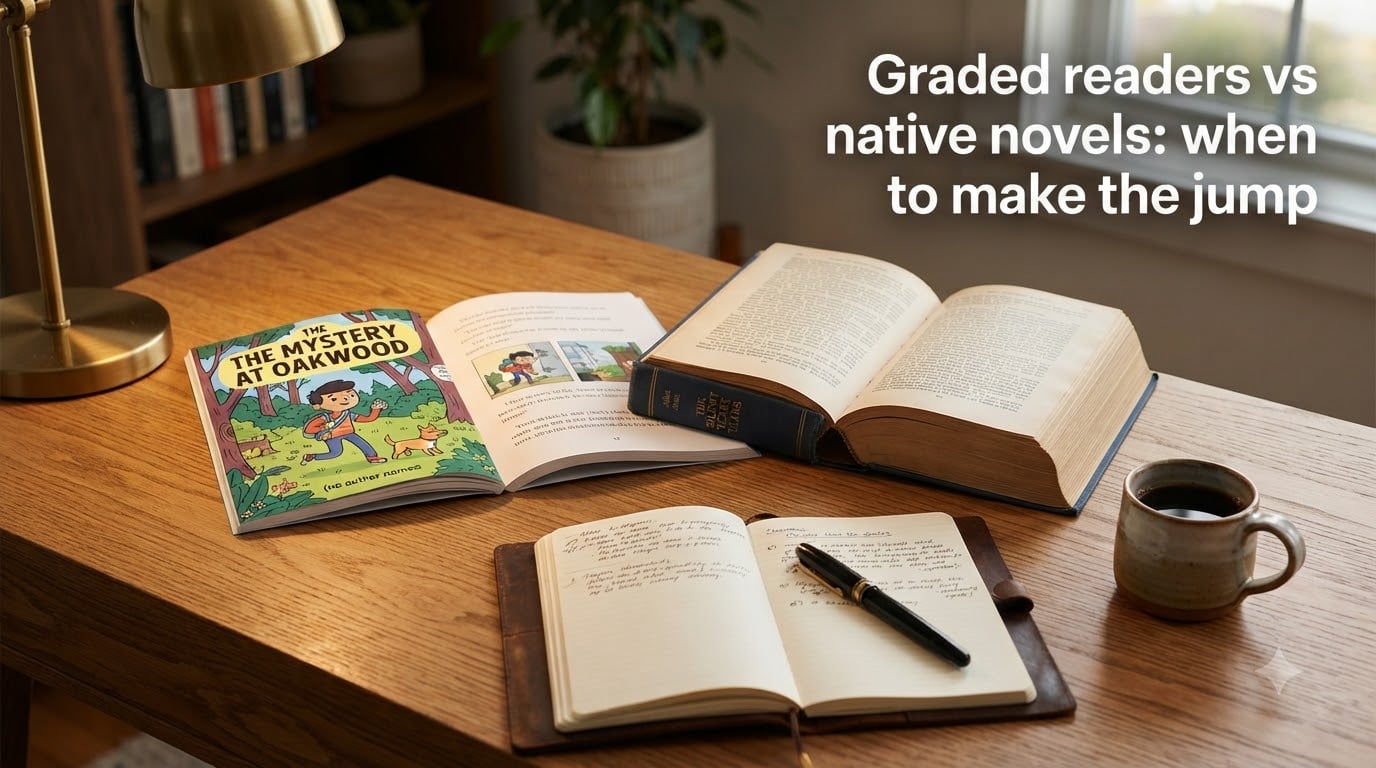
Graded readers vs native novels is the question almost every language learner hits at some point: should you keep reading the simplified books you can finish, or is it finally time to face unadapted novels as they were written? I’ve sat with this question in five different languages, watched hundreds of learners debate it, and built the answer I wish someone had handed me at A2. The short version is that the jump is not a single moment — it is a ladder, and there is a coverage number that quietly decides when each rung is safe.
In this guide I’ll show you exactly where that threshold sits, give you a level-by-level CEFR framework, lay out the honest pros and cons of each format, and walk you through a transition ladder that lets you keep your reading volume high while you move toward authentic books. By the end you’ll know which format to read right now at your current level, which one to add on top of it, and when to retire graded readers entirely.
Table of Contents
Graded Readers vs Native Novels: Quick Verdict by CEFR Level
If you only have thirty seconds, this is the version to bookmark. Use your current CEFR band, match the format column, and you’ll be reading at roughly the right difficulty for the rest of 2026:
A0 to A1 (beginner, 0 to 600 words known): Graded readers only, mostly Oxford Bookworms Starter / Penguin Readers Level 1 with audio. Skip native novels entirely.
A2 to B1 (elementary to lower intermediate, 600 to 1600 words): Graded readers at Level 2 or 3 as your main volume, plus one easy parallel-text novel per month to start building a native habit.
B2 (upper intermediate, 1600 to 2500 words): Mix of the two. About 60% graded readers (B2 level) for volume, 40% authentic books — YA novels, contemporary genre fiction, or retellings by authors you already love.
C1 to C2 (advanced, 2500 plus words): Native novels for pleasure. Keep a graded reader or two for rereading and low-friction reading days, but the heavy lifting should now come from authentic texts.
The split is not dogma. Treat it as a starting point you adjust based on the language, the genre, and your motivation. The next sections explain exactly why each CEFR band sits where it does.
What Graded Readers Actually Are
A graded reader is a book written or rewritten to stay within a fixed vocabulary and grammar budget — the headword ceiling. Publishers split their catalogs into levels that map roughly onto CEFR bands: Starter (A1), Level 1 (A1/A2), Level 2 (A2), Level 3 (B1), Level 4 (B1/B2), Level 5 (B2), Level 6 (C1). The most widely used series are Oxford Bookworms and Penguin Readers, with Cambridge English Readers, Black Cat, and CIDEB Italian Readers close behind.
The headword budget is the heart of the system. A Level 1 Oxford Bookworms title typically uses around 250 headwords; Level 3 climbs to about 700; Level 5 reaches roughly 1,400. Because the word list is controlled, grammar is also simplified — short sentences, limited subordinate clauses, and common verb tenses dominate. You get a book you can finish in a sitting, and finishing is the point.
Graded readers also come with predictable support: a glossary at the back, illustrations or photos, audio in most modern editions, and culturally simplified scenes. They are not real-world writing — they are training wheels engineered for the exact job of building reading volume and stamina.
What Native Novels Actually Are
A native novel — also called an original, authentic, or unadapted book — is a book written for adult native speakers, with no vocabulary ceiling. The author can choose any word they want, and they often choose the rarer one on purpose: a novelist’s vocabulary can run 5,000 to 25,000 unique words depending on genre. Literary fiction sits at the top of that range. Children’s chapter books sit lower, but even a beginner “easy” YA novel like Wonder or Holes uses roughly 3,000 to 4,000 unique words in the first 10,000 running words.
That word count is precisely why native novels feel hard for beginners. A graded reader hands you a known world with a small edge of new words. A native novel hands you the full world, and even a common word you happen not to know can stall a sentence. The friction is not failure — it is the cost of decoding language you have not yet seen, paid one word at a time.
Native novels also give you things graded readers cannot. Cultural context, idioms used by real people, contemporary references, regional slang, and the actual rhythm of modern prose. Once your coverage is high enough to enjoy them, they become the strongest single driver of vocabulary growth we have.
The 98% Coverage Rule and Why It Decides Everything
The single most useful number in language reading is 98%. If you know 98% of the running words in a text, the unknown 2% stops blocking comprehension and the text feels readable. Below about 90% known words, comprehension collapses; between 90 and 95%, you struggle but get the gist; at 98%, you read with normal flow. This threshold comes from Hu and Nation’s 2026 research on vocabulary coverage, and it is the cleanest decision tool we have for choosing between graded readers and native novels.
To put 98% in concrete numbers, here is what a one-chapter sample looks like at each level. These are typical running-word counts from real publisher catalogs and authentic novels:
250 headwords — Oxford Bookworms Starter / Penguin Readers Level 1. Roughly 96% known at A1 if you have all the most frequent 250 words down.
400 headwords — firm A2 ceiling. Comfortable at 98% coverage for many learners.
700 headwords — Oxford Bookworms Level 3. The classical B1 floor.
1,000 headwords — solid B1; a learner here can read most graded readers at Level 3 or 4 comfortably.
1,400 headwords — Oxford Bookworms Level 5 / Penguin Readers Level 5. The safe B2 target.
1,800 headwords — strong B2; you can begin picking the easier end of YA contemporary fiction.
2,500 headwords — the rough C1 threshold; mainstream literary fiction opens up here.
Why does this matter for the graded vs native choice? Because graded readers hold your coverage at 98% by design. Native novels drop you to a random point on the curve — somewhere between 88 and 96% known words for most intermediate learners — and you have to fight your way up from there. Coverage is the hidden variable behind every frustrated forum post about hitting a plateau.
Two practical warnings worth keeping in mind. First, the 95% mark is the warning line: below it, every page becomes a dictionary look-up and your reading volume collapses. If your coverage of a native novel is sitting around 95% or lower, that book is too hard right now — pick an easier graded reader or switch to parallel text. Second, this math applies to running words, not just unique words. A 90,000-word literary novel with 8,000 unique words is harder than a 40,000-word YA book with 3,500 unique words, even at the same percentage coverage, because you’ll see new low-frequency words constantly.
Graded Readers vs Native Novels: Side-by-Side Comparison
This table captures the practical trade-off. Use it when you are choosing your next book and want a quick read.
| Dimension | Graded Readers | Native (Authentic) Novels |
|---|---|---|
| Vocabulary ceiling | Fixed by level (250 to 2,500 headwords) | None — 5,000 to 25,000+ unique words |
| Grammar | Simplified sentences, limited tenses | Full natural grammar, all registers |
| Coverage you can expect | ~98% by design | 88 to 96% for most learners |
| Reading speed | Fast, often 200 plus words per minute | Slow at first, climbs with time on text |
| Motivation | Predictable, low-friction, sometimes boring | High ceiling; dramatic drop if too hard |
| Cultural exposure | Simplified, sometimes dated | Real, current, idiomatic |
| Supply in major languages | Wide: hundreds of titles per level | Unlimited |
| Supply in less-common languages | Thin or nonexistent past A2 | Often the only realistic option |
| Best CEFR match | A0 to B2 (with 5 and 6 for C1) | B1, with comfort reaching C1 |
Pros and Cons of Graded Readers vs Native Novels
Neither format is strictly better. They each solve one job and create one friction point. Here is the honest read on both.
What graded readers do well is build reading volume at a level you can actually sustain. Because the coverage is engineered to ~98%, you can finish a 60-page book in two or three sittings and feel the win of completion. That repeated win is what builds the reading habit — and the reading habit is the single biggest predictor of long-term fluency. Graded readers also let you reread, which studies consistently show is one of the highest-value activities a learner can do, because every reread you do at high coverage reinforces more low-frequency vocabulary than the first read did. The downsides are real. The prose can feel flat past B1, the cultural references sometimes date quickly, and there is a known ceiling: once you reach strong B2, you start needing authentic language to keep growing, and a Level 5 graded reader can start feeling like a treadmill.
What native novels do well is expose you to language as it is actually used — idiom, register, contemporary references, and the kind of collocations that graded readers deliberately avoid. They are the only realistic source for developing a native-level reading rhythm, and once a learner crosses the C1 threshold they often read native novels faster than graded readers, because fluency at that level makes the controlled vocabulary feel more constraining than supportive. The downsides are also real. Native novels front-load difficulty: pages three to twenty can be brutal, vocabulary you don’t know piles up faster than spaced repetition can clear it, and many learners bounce off their first attempt and stop reading for weeks. Burnout is the dominant failure mode, not boredom.
On the forum threads I monitor, the most common learner mistake in 2026 is staying on graded readers past strong B2 because they feel safe. The second most common mistake is jumping to native novels at weak B1 and burning out before finishing the first chapter. Both mistakes share the same root cause: not tracking coverage, only tracking level.
By CEFR Level: Which Format Should You Read Right Now?
The framework below assumes the language you are learning has a reasonable graded reader catalog (English, Spanish, French, German, Italian, Portuguese, Mandarin, Japanese, Russian). If your language doesn’t — Finnish, Hungarian, Indonesian, smaller regional languages — see the dedicated section below.
A0 to A1 — graded readers only. Pick Oxford Bookworms Starter or Penguin Readers Level 1 with audio. Finish one short book a week. Skip native novels entirely; the coverage gap is too wide to be useful. Use easy graded readers to lock the first 600 words into long-term memory through repeated reading and rereading.
A2 — graded readers at Level 2 plus a parallel text. You’re building toward 1,000 headwords of active recognition. Read one graded reader per week at Level 2 and add one chapter per week of a parallel-text native book to start training your eye on authentic syntax. The parallel text handles the unknown words by carrying them on the page in your first language.
B1 — graded readers at Level 3 or 4 plus easy native. Switch your main volume to Level 3 (700 to 1,000 headwords) and start reading one easy native novel per month. Children’s chapter books, translated middle-grade series, and YA contemporary fiction are your friends. Pick a story you already love in your first language — the version you already know lets you predict the next plot beat, which is what carries you through the unknown vocabulary.
B2 — the bridge. This is the level where the choice actually matters, and the answer is both. Roughly 60% of your reading time should be graded readers (Level 5 or 6, or any easy-reading book at 1,400 to 1,800 headwords) and 40% native novels. The native half should be books with strong narrative drive and minimal invented vocabulary: thriller, romance, mystery, sci-fi. Skip literary fiction for now unless you actively enjoy it.
C1 to C2 — native is the default. A graded reader at Level 6 can still be useful for low-friction reading days or rereading, but the heavy lifting belongs to authentic books. This is where you read what you would read in your first language, with no artificial ceiling. Most learners at C1 report reading native novels faster than they read graded readers, because the controlled vocabulary starts to feel constraining.
The Bridge: Parallel Text, Rereading, and Audio
For most of the 2026 readers who hit a plateau, the answer is not to choose one format over the other. It is to add a third format in between: parallel text, also called bilingual edition. Parallel text puts the original language on one page and a translation on the facing page, so unknown words never block you for long. Used as 20 to 30% of your reading time between A2 and B2, parallel text is the single most effective bridge I’ve seen in five years of reading research and personal use.
Rereading is the second bridge, and it is underrated. Reading the same Level 3 graded reader twice gives you more vocabulary than reading two new Level 3 graded readers once, because the first read has already mapped the context for every sentence in the second. Forum users consistently report rereading as their highest-leverage habit, and the controlled vocabulary of a graded reader makes it an ideal reread candidate — coverage stays at 98% every time.
Audio closes the loop. Listening while you read a graded reader cements vocabulary faster than silent reading alone, and listening while you read a native novel trains your ear on the same authentic syntax your eyes are decoding. The combination of audio plus reread plus parallel text is what most successful B2 learners report using during their transition year.
How to Move From Graded Readers to Native Novels (Without Burning Out)
This is the step-by-step ladder I’d give a B1 learner ready to make the jump. Use it as a six-month arc, not a weekend project.
Test your starting point. Open the first chapter of an easy native novel in the genre you actually enjoy, in your target language. Mark every unknown word in the first 200 running words. If you have more than 60 unknown words, drop down to an easier option; fewer than 40 and you’re ready.
Pick a story you already know. Re-read or re-listen to the book in your first language first. The familiar plot carries you through unfamiliar vocabulary because your brain predicts the next sentence instead of decoding it word by word.
Read the parallel-text version first. Bilingual editions let you check unknown words without leaving the book. Spend two to three weeks reading in this mode, alternating with graded readers at Level 3 or 4 for volume.
Switch to the original. Re-read the same book — same story, same chapter order, same characters — but this time in the original language only. Coverage is higher now because you’ve already seen the vocabulary once.
Move on to an unknown native book. Pick something lighter, in a genre you read fluently in your first language: thriller, romance, fantasy, mystery. Aim for 25 to 50 pages per sitting, not completion.
Keep one graded reader in the rotation. Use it for low-friction reading days, for rereading, and for audio sync. The goal is to preserve volume while you build native-book stamina — not to abandon one format for the other.
Reading speed is a useful signal along the way. If your reading speed on a native book is below 120 words per minute at the end of the first chapter, the book is too hard — back up a level. If you cross 180 words per minute by chapter five, the level is right and you’ve found your transition pace.
If You Bounce Off Your First Native Book: A Recovery Protocol
Bouncing off a native novel happens to roughly seven out of ten learners on their first serious attempt in 2026. It is not a sign you’ve failed — it is the format doing its job at the wrong difficulty level. Drop the book without guilt, then run this three-step recovery before picking another native title.
First, take the word count of what you read. If your coverage of unknown words was below 95%, the book was too hard; pick something with simpler prose (children’s middle-grade, not literary fiction) and aim for a 96 to 98% coverage sweet spot. Second, reread one graded reader you’ve already finished at Level 3 or 4 — the win of completion is what restores reading confidence, and it costs you almost no new vocabulary effort. Third, queue up a parallel-text edition of a familiar story and use that as your native-reading bridge for two weeks before retrying. Most learners who follow this protocol succeed on their second native book.
What If Your Language Has Almost No Graded Readers?
For languages with thin graded reader catalogs — Finnish, Hungarian, Indonesian, Greek, many African languages, smaller Scandinavian languages — the framework above shifts. You cannot read Level 3 graded readers that don’t exist, so the transition has to start earlier and lean harder on parallel text and children’s literature.
The practical adaptation is to treat well-written children’s chapter books (ages 8 to 12) as your A2-to-B1 ladder and YA novels as your B1-to-B2 step. Children’s authors in any language write within a tight vocabulary budget by instinct, even when the book is technically a native novel. Pair those with parallel text and reread cycles, and you’ll cover the same ground a graded reader catalog would have given you in Spanish or German.
Frequently Asked Questions
What is the difference between graded readers and native books?
Graded readers are books written or rewritten to stay within a fixed vocabulary and grammar budget — a controlled headword ceiling per level (for example 250, 700, or 1,400 words). Native books, also called authentic or original novels, are written for adult native speakers with no vocabulary limit and a much wider range of grammar, idiom, and cultural references.
At what CEFR level should you stop using graded readers?
You don’t have to stop using graded readers at a single level — the cleanest rule is to keep them in the rotation whenever they help you keep reading volume high, and shift your main reading to native novels once you have a stable 1,800 to 2,500 headwords of vocabulary, which is usually the B2 to C1 transition.
Why are native books so hard for beginners?
Native novels feel hard because their vocabulary coverage is uncontrolled. A literary novel uses 5,000 to 25,000 unique words, and intermediate readers typically know only 88 to 95% of the running words in such a book. Below about 95% coverage, every page becomes a dictionary look-up and comprehension collapses — Hu and Nation’s research set 98% as the comfort threshold.
How does parallel text help bridge graded readers and native books?
Parallel text — bilingual editions with the original language on one page and your first language on the facing page — lets you resolve unknown words instantly without leaving the book. Used as 20 to 30% of reading time between A2 and B2, parallel text is the most effective bridge I’ve seen for moving from controlled-vocabulary readers to authentic novels.
Are graded readers good for language learning?
Yes — graded readers are one of the strongest tools we have for building reading volume and reading habit, especially between A0 and B2. The controlled vocabulary keeps coverage at the 98% threshold where comprehension flows, and the predictable format lets you finish books often, which is what builds long-term fluency. Their main limitation is a ceiling: once your vocabulary passes strong B2, authentic novels start adding more new language per hour than graded readers.
How do I move from graded readers to native books?
Use a six-step ladder: test your starting point on an easy native novel, pick a story you already know in your first language, read it first as a parallel-text bilingual edition, switch to the original, then move on to an unknown native novel in a genre you enjoy — while keeping one graded reader in the rotation for low-friction reading days and rereading.
Conclusion
The graded readers vs native novels question is not a binary; it is a ladder you climb one rung at a time. Track your coverage (Hu and Nation’s 98% rule), match the format to your current CEFR band, and use parallel text plus rereading as your bridges. Most learners who follow this structure reach comfortable native-novel reading between 12 and 24 months after starting graded readers at A0 — and they get there with their reading habit intact.