
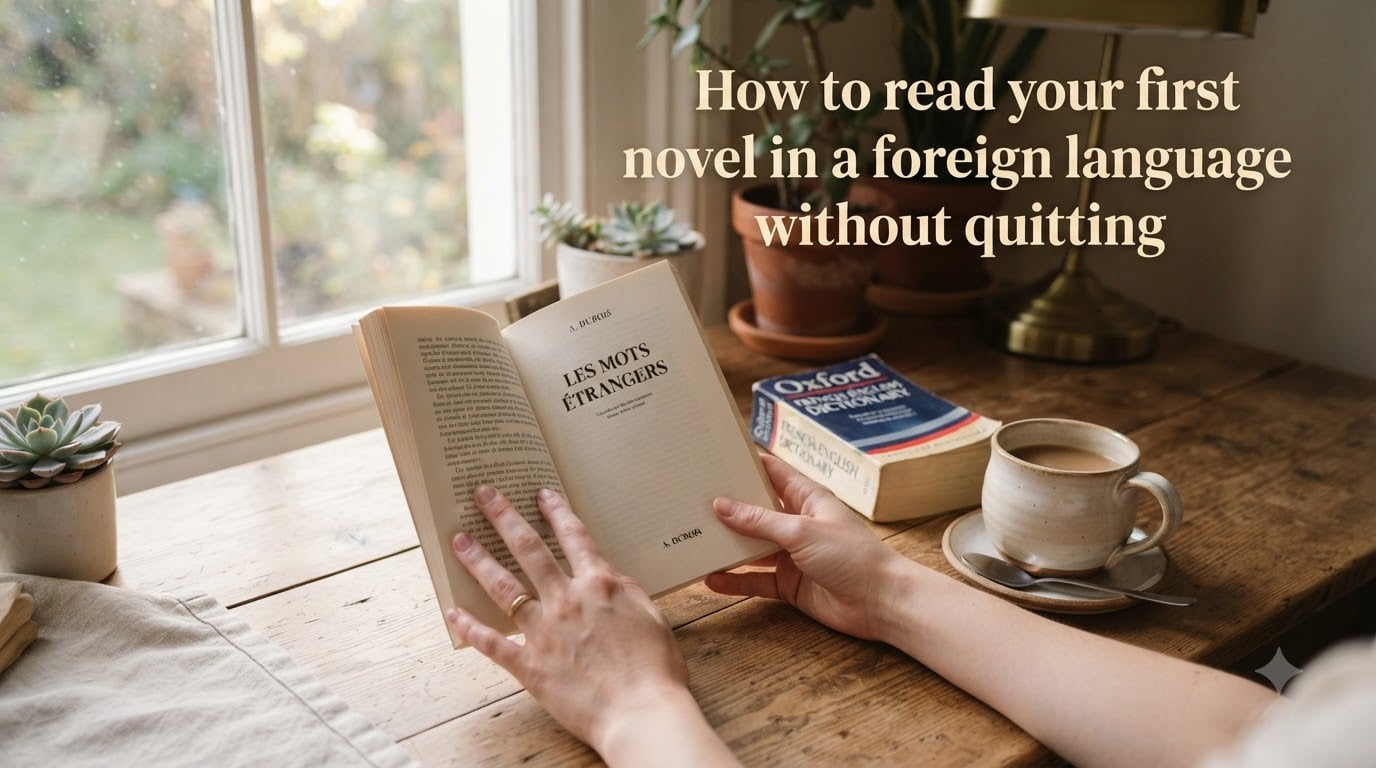
Reading your first novel in a foreign language is the biggest leap you will take as a language learner, and most readers quit somewhere in the first 30 pages. The reason is not that novels are too hard – the reason is that the first chapter feels like drowning in unknown words. I have coached learners through this exact moment for years, and the people who finish almost always follow the same pattern: they pick the right book, commit to a daily page count, and stop translating every word. In this guide I will walk you through the exact method I use with my own students, including a 4-week plan, recommended first novels by language, the tools that actually help, and what to do on the days you want to throw the book across the room.
Table of Contents
Why Most Readers Quit (and Why You Shouldn’t)
Most readers quit their first foreign-language novel for one of seven reasons, and every one of them is fixable. The first is choosing a “real” novel – Don Quixote, Madame Bovary, Crime and Punishment – because someone on the internet said it was a classic. The second is translating every word on the page, which turns 200 pages into 2,000 pages. The third is starting cold, with no daily reading habit already in place. The fourth is expecting to understand everything, when the target is closer to 80 percent. The fifth is reading alone, with no one to share the small wins with. The sixth is choosing a literary novel when what you actually enjoy is a thriller. The seventh is treating a bad week as proof that the whole project has failed.
None of these are reasons to quit. They are reasons to adjust the plan. The polyglot Steve Kaufmann often says that the first 30 pages of a foreign-language novel feel like a wall – and the wall always breaks if you keep walking into it. Forum users in r/languagelearning echo the same experience: pages 1-30 were agony, pages 60-100 suddenly clicked, and the second novel was twice as fast as the first. The first novel is not about reading speed or vocabulary coverage. It is about building the muscle of reading past confusion. That muscle is the single biggest difference between people who reach fluency and people who stall at intermediate.
Pick the Right First Book (at the Right Level)
The right first book meets four criteria at once: you have already read it in your native language, it sits around B1 on the CEFR scale, it is between 150 and 220 pages, and it belongs to a genre you actually enjoy. Familiarity is the secret weapon because it lets the plot carry you when vocabulary fails. You already know who did it, why they did it, and what happens next – so even when half the words are unfamiliar, you still understand the story. Le Petit Prince works for this reason. Harry Potter works for this reason. The Hunger Games works for this reason. So does Stoner by John Williams, if you like quiet novels.
Length matters more than most learners expect. A 600-page Russian novel is not a first novel – it is a punishment. Aim for something you can finish in three to five weeks at five pages a day. Level matters, but less than you think. Linguists use the term lexical coverage – the percentage of words on a page that you already know – and the rule of thumb is that 80 percent coverage is the floor for reading with pleasure, 95 percent is the floor for reading with ease. If you have not measured this, a quick sanity check is whether you can comfortably read a graded reader or a children’s chapter book in your target language. If yes, you are ready for a real novel. If no, spend another month on graded readers and come back.
What level do you actually need to start a novel?
Most polyglots report starting their first novel at around B1 – confident enough to read simple sentences, not yet comfortable enough to read the news. A2 works if the book is heavily context-supported (Harry Potter, Le Petit Prince). B2 is comfortable but not required. If you are below A2, a graded reader is the smarter first step.
Pre-Reading: 10 Pages a Day for Two Weeks
Before you open chapter one of your chosen novel, spend two weeks reading ten pages a day of anything in your target language. News articles, graded readers, blog posts, song lyrics, restaurant menus, whatever. The point is not the content – the point is the daily habit. Five minutes of reading every day for fourteen days is the single strongest predictor I have seen that someone will finish a foreign-language novel. Once the habit exists, switching from articles to a novel feels like a small change instead of a new project.
During this pre-reading phase, build a simple tracker: date, what you read, how many pages or minutes, and one word you want to remember. After two weeks you will have 14 entries, a streak, and proof that you can read in this language every day. That proof is what carries you through the novel wall later.
During Reading: How to Handle Unknown Words
Unknown words are the main reason readers quit, and how you handle them is the main reason readers finish. The three-rule method is what I teach every learner: skip words that do not block the plot, mark words that recur more than twice, and look up only the words that stop you from understanding what is happening. This sounds too simple to work, but it produces a reading speed roughly five times faster than the “look up every word” approach – and reading speed is the difference between finishing and quitting.
In practical terms, here is the workflow I use on a Kindle or with LingQ. Read a full page first without stopping. After the page, highlight only the words that you genuinely could not guess from context. Look those up. Move on. Do not reread the sentence with the new word in it – trust that the next time you meet the word, you will know it from the context you already built. Linguists call this i+1 – input that is just slightly above your current level. The “i” is what you already understand, the “+1” is the new word in context. Too much more than +1 and the input becomes noise. Too little and you stop learning.
How many unknown words should you have on a page?
For a comfortable read, aim for 4 to 6 unknown words per page of 250 words. For an ambitious but doable first novel, 8 to 12 is fine. Anything above 15 means the book is too hard right now – put it down and pick something easier. Anything below 2 means the book is too easy and you will stop learning new vocabulary from it.
The ‘Don’t Quit at Page 30’ Rule and How to Survive It
The page-30 rule is simple: do not quit before page 30, no matter what. Every novel has a wall somewhere between page 10 and page 50 where the new vocabulary, names, and rhythm of the language feel like quicksand. Multiple learners on r/languagelearning describe this same wall. The first chapter is always the worst because you are meeting every character for the first time in a language you only half understand. By chapter three or four, the recurring characters, places, and phrases start to feel familiar, and the wall breaks.
How to survive the wall: drop your page count if you need to (three pages a day is fine, one page is fine), read the same chapter twice before moving on, listen to the audiobook version while you read the text, and tell someone you are doing this so quitting has a social cost. Forum users who read 5 pages a day and tracked their streak reported finishing their first foreign-language novel in roughly three months. That is the target pace – 5 pages a day, 90 days, done.
A 4-Week Plan to Actually Finish
Here is the four-week plan I give every learner who wants to finish their first novel in a foreign language. It is concrete on purpose – vague plans die. Print it, stick it on the fridge, check off each box.
Week 1 – Build the habit (graded readers only)
Read 5 pages a day from a graded reader at your current level (A2 if you are A2, B1 if you are B1). Track pages and one new word per day. No novel yet.
Week 2 – Re-read a known story
Pick a short story or children’s chapter book you have already read in your native language and read it in your target language. 5 pages a day. The familiar plot carries you through the new vocabulary.
Week 3 – Start your novel
Open your chosen first novel. Read the first chapter (20-30 pages) at whatever pace you can manage – even if it takes the whole week. Apply the three-rule word method. Listen to the audiobook version if one exists.
Week 4 – Push to page 100
Read 5 pages a day. By the end of this week you should be past page 100. The novel wall is breaking. Keep going. From here, the rest of the book is downhill.
The plan works because the hardest part is not the novel – the hardest part is showing up on day 1, day 5, day 20. By the time you reach page 100, the daily habit is automatic and the story has taken over.
Recommended First Novels by Language
Below is the shortlist I give to learners starting their first novel in each major language. The criteria are the same: short, familiar, B1-friendly, available in translation if you need a safety net.
- Spanish: Harry Potter y la piedra filosofal – familiar plot, simple language, around 250 pages.
- French: Le Petit Prince by Antoine de Saint-Exupéry – short, poetic, and almost every learner finishes it.
- German: Die drei Fragezeichen (a junior detective series book) – short chapters, simple syntax, easy wins.
- Italian: Marcovaldo by Italo Calvino – short stories, vivid imagery, simple sentence structure.
- Japanese: こころ (Kokoro) by Natsume Soseki – widely available in beginner-friendly editions, manageable vocabulary.
- Portuguese: O Alquimista by Paulo Coelho – direct prose, short chapters, widely translated so you can cross-check.
- Russian: Master i Margarita chapters, read slowly with a parallel dictionary – or start with a graded reader like Поговорим о России.
If your language is not on this list, the formula is simple: pick something you read in English between ages 10 and 16, find the original, give yourself 5 pages a day. The formula works for every language I have tried it on.
Tools That Make It Stick
Three categories of tools matter: in-context dictionary lookup, audiobook pairing, and reading trackers. Which one you pick depends on your style.
- Kindle built-in dictionary: the simplest option. Tap a word, see the translation, keep reading. Works best for casual readers who do not want a learning app.
- LingQ: turns reading into vocabulary study. Every word you look up becomes a flashcard with the surrounding sentence. Best for learners who want to remember what they read.
- Readlang: similar to LingQ but lighter weight. Highlights translate on hover. Good if LingQ feels like too much.
- Audiobook + text: listen while you read the printed or Kindle version. Trains your ear and your eye at the same time. Especially powerful for languages with strong phonetic spelling (Spanish, Italian) and useful for languages with weaker phonetic spelling (French, English).
Do not stack all four at once. Pick one in-context lookup tool (Kindle or LingQ) and one audiobook pairing. That is plenty. Adding a fourth or fifth tool creates the same fatigue as translating every word – the reading becomes work instead of pleasure.
What to Do When You Hate the Book
There is a simple decision rule for the day you want to quit. If you have not passed page 30, push through. The novel wall has not broken yet and you cannot tell whether the book is bad or whether the wall is just thick. If you have passed page 30 and you still hate the book, switch. The point of the first novel is to build the reading habit, not to suffer through a specific book. Switching is not quitting – it is choosing a smarter path.
A second rule: on busy or tired days, allow yourself one page or zero pages. The streak matters more than the count. A learner who reads five pages a day for thirty days and then misses two days will recover. A learner who reads zero pages for a week because they could not hit five tends to never restart. Give yourself permission to read less – just do not give yourself permission to stop showing up.
Frequently Asked Questions
Is it a good idea to read novels in a foreign language?
Yes. Finishing a foreign-language novel is the single biggest confidence jump in language learning because it forces you to keep going through pages you only partially understand. Most polyglots cite their first finished novel as the moment they stopped feeling like a beginner.
What level do you need to read a novel in a foreign language?
Around B1 on the CEFR scale is the most common starting point, though A2 works for heavily context-supported books like Le Petit Prince or Harry Potter. The simpler test is whether you can comfortably read a graded reader at your level – if yes, you are ready for a real novel.
How long does it take to read a novel in a foreign language?
For a 200-page novel at 5 pages a day, plan for 6 to 8 weeks. Learners on r/languagelearning commonly report finishing their first novel in about three months at this pace, including the difficult first month where they often read less than five pages a day.
How do beginners read foreign language books without giving up?
Pick a book you have already read in translation, commit to 5 pages a day, skip unknown words unless they block the plot, and do not quit before page 30. The page-30 rule exists because that is where most readers hit the wall – the wall always breaks if you keep showing up.
What is the best book to read in a foreign language for beginners?
The best first book is one you have already read in your native language, in a genre you enjoy, between 150 and 250 pages. Specific popular picks include Le Petit Prince for French, Harry Potter for Spanish, Marcovaldo for Italian, and Kokoro for Japanese.
How many unknown words should you have when reading a foreign language novel?
Aim for 4 to 6 unknown words per page for a comfortable read and 8 to 12 for an ambitious first novel. Anything above 15 means the book is currently too hard – pick something easier. Anything below 2 means the book is too easy to teach you new vocabulary.
Should I use a dictionary when reading in a foreign language?
Yes, but selectively. Skip words you can guess from context, mark words that recur, and look up only the words that block the plot. Translating every word turns 200 pages into 2,000 pages and is the single fastest way to burn out on a foreign-language novel.
Conclusion
The fastest way to read your first novel in a foreign language without quitting is to pick a book you have already read in your native language, commit to 5 pages a day, and stop translating every word. The four-week plan in this guide – graded readers, a familiar re-read, the first novel chapter, and a push to page 100 – has worked for every learner I have coached through this, and it will work for you. The novel wall at page 30 is real, but it always breaks, and on the other side of it you will find a different relationship with the language. Pick the book today. Open it tonight. Read five pages. Then read five more tomorrow.