
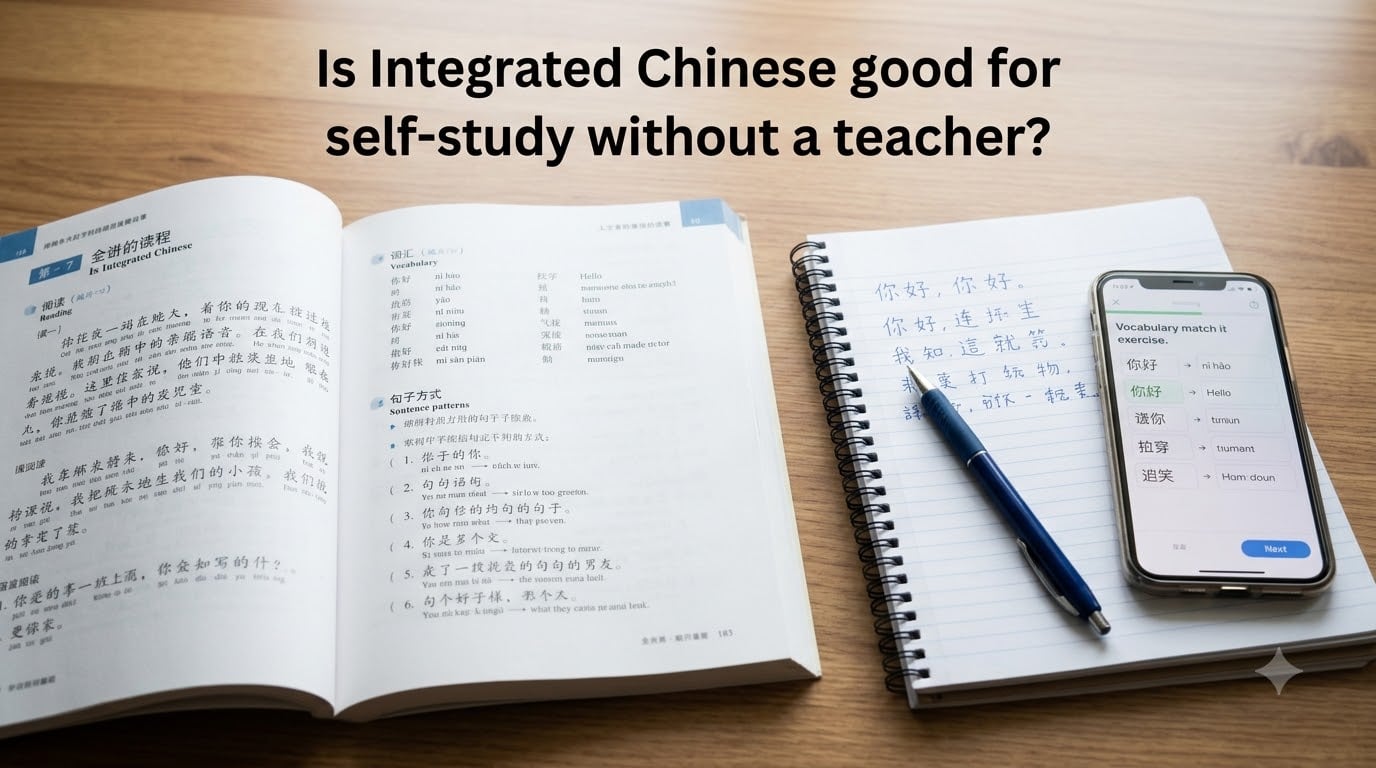
Yes, Integrated Chinese can work for self-study without a teacher — but it requires supplementary resources and a deliberate study strategy. The textbook offers structured dialogue-based lessons, audio support, and progressive vocabulary building that many independent learners find effective. However, its classroom-oriented design means you will need to fill gaps in pronunciation feedback, speaking practice, and exercise answers on your own.
In this guide, I break down exactly what Integrated Chinese offers self-learners, where it falls short, and how to build a study plan around it. I also compare it with alternative textbooks and recommend supplementary tools that make solo Mandarin learning more practical.
Table of Contents
What Is Integrated Chinese?
Integrated Chinese is a four-volume Mandarin Chinese textbook series published by Cheng and Tsui, now in its 4th edition. It is one of the most widely adopted Chinese language textbooks in North American colleges and high schools, covering beginning to intermediate levels equivalent to approximately HSK 1 through HSK 3.
The series teaches Mandarin through dialogue-based lessons. Each chapter introduces a conversation set in a practical scenario, then breaks down the vocabulary, grammar patterns, and character usage from that dialogue. Students progress through reading, writing, listening, and speaking exercises tied to each lesson.
Each volume includes three components: the main textbook, a workbook for written exercises, and a character workbook for practicing hanzi stroke order. Audio recordings for dialogues and vocabulary are available as downloads, which matters significantly for self-learners who lack a teacher to model pronunciation.
The 4th edition covers both simplified and traditional characters, giving learners flexibility depending on whether they plan to use Mandarin in mainland China or Taiwan. The vocabulary is practical but leans toward academic and college-life contexts — a point I will address in the cons section.
Why Integrated Chinese Works for Self-Study
Integrated Chinese was originally designed for classroom instruction, but several of its design choices actually benefit independent learners. Here is what works well.
Structured, Progressive Curriculum
One of the biggest challenges of self-study is knowing what to learn next. Integrated Chinese eliminates that problem entirely. Each chapter builds on the previous one, introducing new grammar patterns and vocabulary in a carefully sequenced order. You never have to wonder whether you are ready for a particular topic — the textbook progression handles that for you.
By the time you finish Book 1 (10 chapters), you will have learned roughly 500 vocabulary words and fundamental grammar structures. Book 2 pushes toward intermediate territory. That structured path is invaluable when you do not have a teacher mapping your learning journey.
Audio Support Included
The audio recordings that accompany each chapter are a major advantage for self-learners. You hear native speakers deliver the dialogues at natural speed, which helps train your ear and gives you a model to imitate. Many competing textbooks either lack audio or charge extra for it. Integrated Chinese provides downloads for all dialogue and vocabulary audio as part of the package.
For pronunciation practice, the audio is not a complete substitute for a teacher, but it gives you something concrete to work with. Paired with an app like Pleco for character lookup or a pronunciation-focused YouTube channel, the audio fills a critical gap.
Comprehensive Supplementary Materials
The workbook and character workbook are not optional add-ons — they are essential for self-study. The workbook reinforces grammar and vocabulary through exercises, while the character workbook teaches you stroke order and helps you build writing muscle memory. Having purpose-built practice materials means you spend less time searching for supplementary exercises online.
Widely Documented Online
Because Integrated Chinese is so popular in academic settings, you can find extensive online discussion about it. Forums like Reddit’s r/ChineseLanguage and Chinese-Forums.com have threads where learners share strategies, answer questions, and point out confusing sections. That community knowledge compensates somewhat for the absence of a teacher who could clarify difficult points.
Where Integrated Chinese Falls Short for Solo Learners
Despite its strengths, Integrated Chinese was not built with self-learners in mind. These limitations matter, and ignoring them will slow your progress.
Grammar Explanations Can Be Thin
Multiple self-learners report that the grammar explanations in Integrated Chinese do not always go deep enough. The textbook introduces grammar points through examples in the dialogue, then offers brief explanations. For a classroom student, a teacher would expand on those explanations and answer follow-up questions. For a solo learner, you are left to figure out nuances on your own.
This is manageable if you supplement with a grammar reference like the Chinese Grammar Wiki (AllSet Learning) or a dedicated grammar textbook. But it means Integrated Chinese alone is not sufficient for understanding why certain constructions work the way they do.
No Exercise Answer Key Included
This is perhaps the most frustrating limitation for self-study. The workbook and textbook exercises do not come with answers in the student edition. You need the Teacher’s Handbook (sold separately) or unofficial answer keys found online to check your work. Without feedback on whether your answers are correct, exercises lose much of their learning value.
The good news: community-created answer keys exist on sites like Quizlet and various Chinese learning blogs. The bad news: their accuracy varies, and you spend time searching instead of studying.
Speaking Practice Requires a Partner
Integrated Chinese includes speaking exercises designed for pair work in a classroom. When you study alone, those exercises are essentially unusable in their intended format. You can read dialogues aloud and record yourself, but you miss the interactive element of responding to unpredictable speech in real time.
This is not unique to Integrated Chinese — no textbook solves the speaking-practice-alone problem. But it is worth noting because the textbook’s dialogue approach creates an expectation of interactive practice that solo learners cannot fulfill without finding a language partner or tutor.
Some Vocabulary Feels Dated or Academic
The vocabulary and scenarios in Integrated Chinese reflect its academic origins. You will learn terms related to college life, dorm rooms, and campus activities that may not match your daily reality as an adult self-learner. Some Reddit users note that the vocabulary in Book 1 includes words that are not immediately practical for beginners.
This is a minor issue — the core grammar and high-frequency vocabulary are still valuable. But it means some of your study time goes toward words you may not use frequently outside of an academic context.
How to Self-Study with Integrated Chinese: A Step-by-Step Strategy
If you decide to use Integrated Chinese for self-study, following a structured approach will help you avoid the pitfalls above. Here is the strategy I recommend based on what experienced learners have shared.
Step 1: Get All Three Books
Purchase the textbook, workbook, and character workbook for whichever volume you are starting with. Skipping the workbooks is a common mistake that leaves gaps in your learning. Also download the audio files before you begin — they are available from the publisher’s website.
Step 2: Learn Pinyin and Tones First
Before diving into Chapter 1, spend one to two weeks on pinyin and tone drills. Use YouTube channels like Yoyo Chinese or Mandarin Corner for pronunciation fundamentals. Integrated Chinese assumes you have basic pronunciation skills from the start, and skipping this foundation will create problems that compound over time.
Step 3: Follow the Chapter Sequence
Work through each chapter in order. For each chapter, follow this routine:
First, listen to the dialogue audio without reading. Try to catch words and phrases. Then read the dialogue while listening. Next, study the vocabulary list and grammar explanations. Complete the workbook exercises. Finally, practice writing characters in the character workbook.
Step 4: Supplement with External Resources
Pair Integrated Chinese with these tools for a more complete learning experience:
Use Pleco (dictionary app) for looking up characters, hearing pronunciations, and reviewing flashcards. Add HelloChinese or Du Chinese for additional listening and reading practice outside the textbook. Join a language exchange through HelloTalk or Tandem to get speaking practice you cannot get from the textbook alone.
Step 5: Review Consistently
Use spaced repetition (Anki or Pleco’s built-in flashcards) to review vocabulary from previous chapters. Self-learners who only move forward without reviewing lose material quickly. Dedicate 15 to 20 minutes daily to vocabulary review on top of your new chapter work.
Best Chinese Textbook Alternatives for Self-Learners
Integrated Chinese is a solid choice, but it is not the only option. Depending on your learning style and goals, another textbook might serve you better.
New Practical Chinese Reader (NPCR) is the most common alternative. It follows a similar dialogue-based structure but includes more detailed grammar explanations, which some self-learners prefer. The series covers six volumes from beginner to advanced. However, it uses exclusively simplified characters, so it is not ideal if you want to learn traditional characters.
HSK Standard Course is designed around the HSK exam levels. If your goal is to pass the HSK, this series aligns directly with the test content. It includes workbook exercises with answer keys (a significant advantage for self-study) and comes with audio. The tradeoff is that it can feel overly test-focused and less natural in its language presentation.
Short-Term Spoken Chinese focuses heavily on conversational skills. Some Reddit users report enjoying it more than Integrated Chinese for practical speaking ability. However, it is less comprehensive for reading and writing, so it works best as a supplement rather than a primary textbook.
A Course in Contemporary Chinese is another option used in some university programs. It offers strong grammar coverage and cultural context but is less widely discussed in self-study communities, making it harder to find peer support and answer keys online.
Essential Supplementary Resources for Self-Study
No matter which textbook you choose, these resources fill the gaps that any classroom textbook leaves for solo learners.
Pleco is the single most important tool for any Chinese learner. It is a comprehensive dictionary app with handwriting recognition, audio pronunciations, flashcards, and a document reader. The free version covers most needs; the paid add-ons are worth it for serious learners.
For pronunciation: Yoyo Chinese (YouTube) offers clear video lessons on tones and pinyin. Forvo.com provides native speaker recordings of individual words. These resources address the pronunciation feedback gap that is hardest to fill without a teacher.
For listening practice: Mandarin Corner and ChinesePod offer graded listening content. Even 10 minutes of daily listening outside your textbook work dramatically improves comprehension.
For community support: The r/ChineseLanguage subreddit and Chinese-Forums.com are active communities where you can ask questions about confusing grammar points, share your progress, and get advice from learners who have been through the same textbook.
Frequently Asked Questions
Is Integrated Chinese good for beginners?
Yes, Integrated Chinese is well-suited for beginners. It starts from zero and builds vocabulary and grammar progressively across its chapters. The 4th edition covers approximately HSK 1-3 levels, making it appropriate for anyone starting Mandarin from scratch. The dialogue-based approach introduces practical language in context rather than isolated vocabulary lists.
What is the best Chinese textbook for self-study?
Integrated Chinese, New Practical Chinese Reader, and HSK Standard Course are the top three choices for self-study. Integrated Chinese offers the strongest audio support and community resources. New Practical Chinese Reader provides more detailed grammar explanations. HSK Standard Course includes exercise answer keys and aligns directly with the HSK exam. The best choice depends on whether you prioritize conversational ability, grammar depth, or test preparation.
How long does it take to finish Integrated Chinese?
Most self-learners complete one volume of Integrated Chinese in 4 to 6 months with consistent daily study of 45 to 60 minutes. Book 1 (10 chapters) typically takes a full semester in classroom settings, which translates to roughly 4 to 5 months of dedicated self-study. The entire four-volume series takes approximately 2 to 3 years at a steady pace.
What is the best way to self study Chinese?
The most effective approach combines a structured textbook like Integrated Chinese with daily vocabulary review using spaced repetition, regular listening practice through podcasts or YouTube, and weekly speaking practice with a language partner on apps like HelloTalk or Tandem. Consistency matters more than session length — 45 focused minutes daily beats 3-hour weekend sessions.
Final Verdict: Is Integrated Chinese Good for Self-Study?
Integrated Chinese is a strong choice for self-study, but it is not a complete solution on its own. Its structured curriculum, audio support, and supplementary workbooks give you a solid foundation that many competing textbooks lack. The widespread community discussion around the series means answers to your questions are rarely more than a forum search away.
The key is treating Integrated Chinese as the backbone of your study plan, not the entire plan. Supplement it with Pleco for vocabulary, a pronunciation resource for tone practice, and a language partner for speaking practice. With that approach, you can absolutely learn Mandarin effectively using Integrated Chinese without a teacher — it just takes more intentional effort than it would in a classroom setting.