
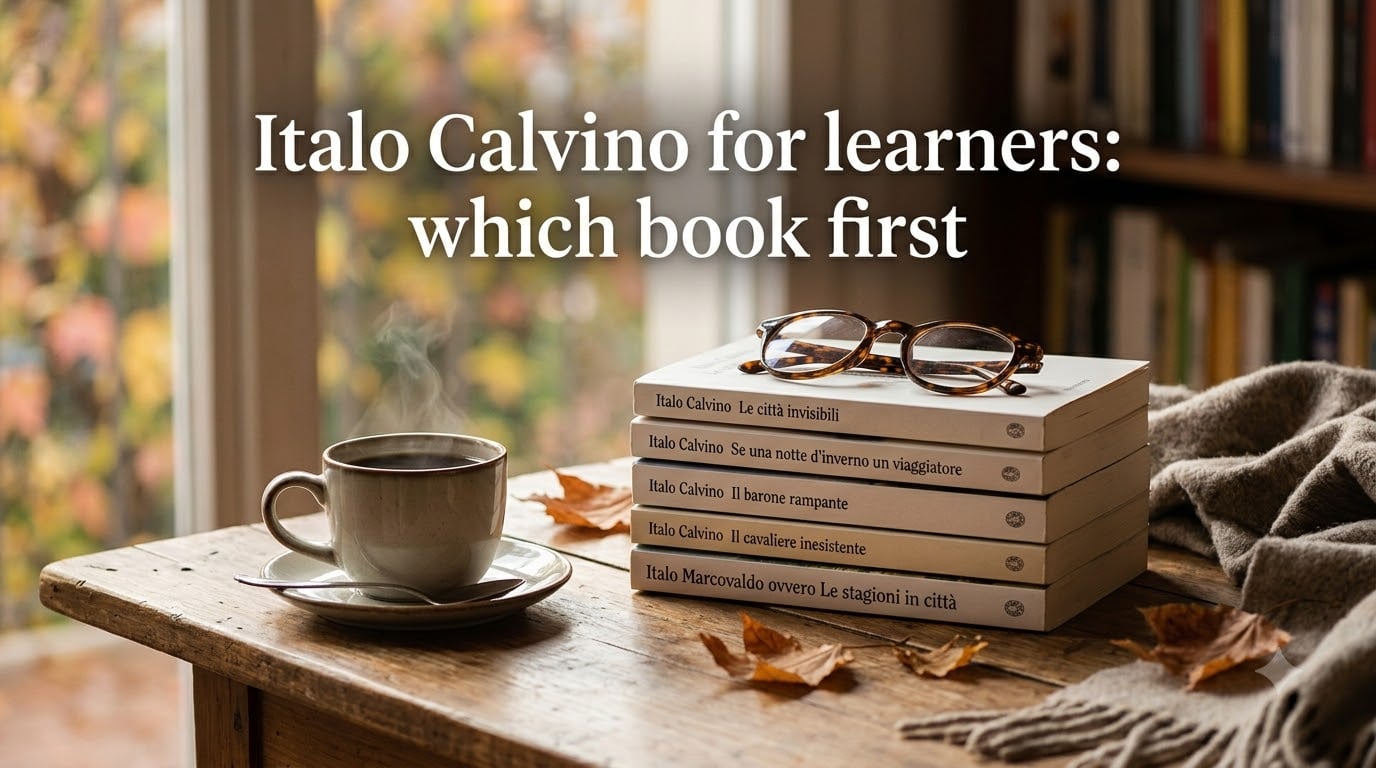
Italo Calvino is one of Italy’s most celebrated 20th-century authors, known for inventive fiction that blends fable, magical realism, and postmodern playfulness. If you’ve heard his name and want to start reading his work—especially as a language learner—you’re probably wondering: which Calvino book should you read first?
The short answer: start with The Baron in the Trees if you want a traditional novel with charm and adventure, or Marcovaldo if you prefer short, self-contained episodes that are gentler on your vocabulary. Both are widely recommended by Italian learners and literary readers alike, and I’ll explain why in detail below.
This guide covers the best Calvino books for beginners, how difficult each one really is, which translations to trust, and a reading path that takes you from your first Calvino to his most challenging works.
Table of Contents
Which Italo Calvino Book Should You Read First?
The best Italo Calvino book to start with is The Baron in the Trees (1957). It’s a warm, funny, adventure-driven novel about a boy who climbs into the trees at age twelve and never comes down. The plot is linear, the vocabulary is accessible, and the story moves quickly enough to keep you engaged even when you stumble over unfamiliar words.
If you’re an Italian-language learner at B1–B2 level, Marcovaldo (1963) is an even better starting point. It’s a collection of twenty short stories about a hapless city worker and his family, set across the seasons of a year. The episodes are self-contained, which means you can read one story in a sitting without losing the thread. The Italian is straightforward, and the book is actually used as a set text in Italian middle schools—a strong signal that the vocabulary sits within reach of committed learners.
For readers drawn to something more experimental and poetic, Invisible Cities (1972) is a famous entry point. But be warned: it’s built from short, fragmented prose poems rather than a traditional narrative. It rewards patience and rereading, but it can feel disorienting if you’re not used to Calvino’s voice yet.
The Top 5 Calvino Books for Beginners
I’ve ranked these by accessibility, with vocabulary difficulty notes for Italian learners and translation recommendations for English readers.
1. The Baron in the Trees (1957)
Cosimo Piovasco di Rondò climbs a tree at age twelve during an argument with his father and spends the rest of his life living among the branches. From there he fights bandits, falls in love, corresponds with Enlightenment philosophers, and witnesses the French Revolution—all without touching the ground.
Difficulty: Moderate. The sentences are longer than in Marcovaldo, but the narrative is linear and the stakes are clear. Vocabulary is standard literary Italian, with some 18th-century period terms that add flavor rather than confusion. In Italian, this is a realistic goal for B2-level learners; in English translation, it’s a breeze.
Translation: The classic English version is by Archibald Colquhoun, published by Harcourt (now Mariner Books). It’s widely available and captures Calvino’s playful tone well. A newer translation by Ann Goldstein (the translator of Elena Ferrante) appeared from Penguin Classics and is also excellent.
Why start here: It reads like a real novel. You get character development, plot momentum, and humor. If you’ve been intimidated by descriptions of Calvino as “difficult” or “experimental,” this book will change your mind. It’s the warmest, most welcoming thing he ever wrote.
2. Marcovaldo (1963)
Marcovaldo is a seasonal worker in an unnamed industrial city, raising six children in cramped quarters. Each of the twenty stories follows him through one season—hunting mushrooms, wrestling with a vacuum cleaner, trying to grow a garden on his balcony. The comedy is gentle and deadpan.
Difficulty: Easy to moderate. The vocabulary is concrete and everyday: nature words, city descriptions, family life. Calvino’s prose here is cleaner and more direct than in his later work. Italian learners at B1 level can tackle this with a dictionary at hand; B2 readers will find it comfortable.
Translation: William Weaver’s English translation (Harcourt/Mariner) is the standard and remains excellent. The stories are short enough to read in both languages side by side, which makes this an ideal study text.
Why start here: Each story stands alone. If you’re worried about committing to a full novel in Italian, you can read one Marcovaldo story per day and feel accomplished. The book rewards attention to small details—the natural world intruding on urban life—which makes it a good exercise in close reading.
3. Invisible Cities (1972)
Marco Polo describes fifty-five impossible cities to Kublai Khan. Each city is a short prose poem—sometimes a page or less—exploring themes of memory, desire, language, and the shape of human experience. There is no plot in the traditional sense, only a recurring dialogue between the two men that frames the city descriptions.
Difficulty: Moderate to challenging. The vocabulary is abstract and poetic. Sentences are often compressed and elliptical. For Italian learners, this is better suited to B2+ readers who are comfortable with metaphor and conceptual language. In English, it’s accessible but rewards slow, deliberate reading.
Translation: William Weaver’s version (Harcourt/Mariner) is definitive and beautifully rendered. This is the translation that made Calvino famous in the English-speaking world. If you’re reading in English, this is the edition to get.
Why start here (if you must): It’s Calvino’s most famous book, and the short-form structure means you can dip in and out. Borges fans especially love it. But I’d recommend reading at least one of the first two books on this list before Invisible Cities, so you’re calibrated to Calvino’s voice.
4. Cosmicomics (1965)
Twelve stories narrated by Qfwfq, an ancient being who has witnessed the formation of the universe, the age of dinosaurs, and the invention of the moon. Each story takes a scientific premise—how the moon was once close enough to touch, how the first color appeared—and spins it into a comic, deeply human tale.
Difficulty: Moderate. The vocabulary jumps between scientific terminology and colloquial, almost slapstick dialogue. The stories are energetic and funny, which carries you through passages where the language gets dense. Martin McLaughlin’s Penguin Classics translation captures the manic energy well.
Translation: The classic William Weaver translation (Harcourt/Mariner) is excellent and widely available. Martin McLaughlin’s newer Penguin Classics version is also strong, with more contemporary English phrasing.
Why start here: If you love science fiction or have a playful relationship with language, Cosmicomics will hook you immediately. It’s Calvino at his most joyful and inventive. The Qfwfq stories also appear in the companion volume t zero, so if you love this one, there’s more waiting.
5. If on a winter’s night a traveler (1979)
This is Calvino’s postmodern masterpiece: a novel about reading itself. The “you” (second-person narration) sits down to read a novel called If on a winter’s night a traveler, only to discover the book is defective. You go looking for the real text and encounter ten different novel openings, each in a different genre, each interrupted at a crucial moment.
Difficulty: High. The structure is deliberately fragmented, the second-person narration can feel disorienting, and the intertextual jokes require some literary background. This is not a beginner’s Calvino. But for readers who love metafiction, literary games, and the work of writers like Borges or Nabokov, it’s an unforgettable experience.
Translation: William Weaver’s English version is definitive and captures the playful, self-aware tone. The book has been in print continuously since 1981, so used copies are easy to find.
Why save this for later: It assumes you already trust Calvino as a writer. If you start here and bounce off it, you might conclude Calvino isn’t for you—when really you just haven’t found the right entry point. Read one or two of the earlier books first, then come back to this one with confidence.
A Reading Path: From Beginner to Calvino Devotee
Here’s a progression I’d recommend, based on difficulty and how each book builds on the one before it.
Stage 1 — Your first Calvino: Start with The Baron in the Trees for a novel or Marcovaldo for short stories. These teach you Calvino’s rhythms and sense of humor without overwhelming you.
Stage 2 — Expanding your range: Move to Cosmicomics or Invisible Cities. Both are accessible once you know Calvino’s voice, but they push toward more abstract and playful territory. Cosmicomics is better if you prefer narrative; Invisible Cities is better if you prefer poetry.
Stage 3 — The postmodern books: Now you’re ready for If on a winter’s night a traveler. By this point, you understand how Calvino uses structure as a storytelling tool, and the book’s metafictional games will feel like a natural extension of what you’ve already read.
Stage 4 — The deep cuts: The Cloven Viscount (1952), The Nonexistent Knight (1959), Mr. Palomar (1983), The Castle of Crossed Destinies (1969), and Italian Folktales (1956) are all worth exploring once you’re a committed Calvino reader. The Cloven Viscount and The Nonexistent Knight are the other two books in the Our Ancestors trilogy alongside The Baron in the Trees, and reading all three together is a rewarding experience.
A note on the Our Ancestors trilogy: The three novels—The Cloven Viscount, The Baron in the Trees, and The Nonexistent Knight—are linked thematically but not narratively. You don’t need to read them in order. I’d start with The Baron in the Trees, then circle back to the other two when you’re ready for more.
Reading Calvino in Italian vs. English Translation
This is one of the most common questions from language learners, and the honest answer depends on your level.
If you’re at B1 level (intermediate): read Calvino in English first, then reread in Italian. You’ll understand the story already, and the Italian text becomes a vocabulary-building exercise rather than a comprehension struggle. Marcovaldo and The Baron in the Trees are the best candidates for this approach.
If you’re at B2 level (upper intermediate): you can read Calvino in Italian directly, but keep a dictionary handy. Marcovaldo is the most forgiving entry point for Italian learners—it’s the book Italian schools assign to thirteen-year-olds, which tells you the vocabulary is manageable. The stories are also short enough that you won’t lose momentum.
If you’re at C1 level (advanced): you can read anything Calvino wrote in the original. At this stage, the challenge isn’t vocabulary—it’s Calvino’s style. He plays with sentence structure, uses irony and understatement, and sometimes writes in deliberately compressed or elliptical prose. Reading him in Italian at C1 is a genuine literary pleasure, not just a language exercise.
Which translations should you trust? William Weaver is the gold standard for Calvino in English. He translated Invisible Cities, If on a winter’s night a traveler, Cosmicomics, Marcovaldo, and many other works. His translations are elegant, readable, and capture Calvino’s tone—playful but never flippant. Martin McLaughlin’s translations for Penguin Classics (including The Baron in the Trees and Cosmicomics) are also excellent and use more contemporary English. Ann Goldstein’s newer translations are well-regarded. You can’t go wrong with any of these.
Which Calvino Book Matches Your Reading Taste?
If you’re still not sure where to start, use this quick guide based on what you already enjoy reading.
If you love Borges: Start with Invisible Cities or Cosmicomics. Both share Borges’s love of impossible premises, compressed prose, and philosophical puzzles.
If you love fantasy or fairy tales: Start with The Baron in the Trees or The Cloven Viscount. Both feel like grown-up fairy tales with real emotional stakes.
If you love literary fiction with a strong plot: Start with The Baron in the Trees. It’s the most traditionally “novelistic” of Calvino’s books.
If you love short stories: Start with Marcovaldo or Cosmicomics. Both are collections of linked but self-contained stories you can read at your own pace.
If you love postmodern fiction: Start with If on a winter’s night a traveler—but only if you’re already comfortable with fragmented narratives. If not, warm up with Invisible Cities first.
If you’re an Italian learner who wants to build vocabulary: Start with Marcovaldo. The concrete, everyday vocabulary (nature, food, city life) is more useful for conversation than the abstract language in Calvino’s later works.
Frequently Asked Questions
Which Italo Calvino book should I read first?
The best starting point is The Baron in the Trees (1957) if you want a traditional novel with adventure and humor, or Marcovaldo (1963) if you prefer short, self-contained stories. Both are accessible and showcase Calvino’s signature style without overwhelming new readers.
What is the easiest Italo Calvino book to read?
Marcovaldo is widely considered Calvino’s most accessible book. It’s used as a set text in Italian middle schools, and the vocabulary is concrete and everyday. The twenty short stories follow a simple seasonal structure, making it ideal for language learners and reading beginners.
Should I read Calvino in Italian or English?
It depends on your level. B1 learners should read in English first, then reread in Italian. B2 learners can attempt the original directly, starting with Marcovaldo. C1 readers can enjoy Calvino’s full range in Italian. William Weaver and Martin McLaughlin’s English translations are excellent.
What book made Italo Calvino famous?
Calvino’s first major success was The Path to the Nest of Spiders (1947), a Resistance novel that won the Premio Riccione. He became internationally famous with Invisible Cities (1972) and If on a Winter’s Night a Traveler (1979), both translated by William Weaver.
Conclusion
Calvino’s work is generous—it meets you wherever you are and gives you something worth reading. Whether you’re an Italian learner looking for accessible prose or a literary reader ready for postmodern games, there’s a book on this list for you. Start with The Baron in the Trees or Marcovaldo, trust the process, and let Calvino’s voice pull you in. You’ll know within fifty pages whether he’s your kind of writer—and if he is, you have a lifetime of extraordinary books ahead.