
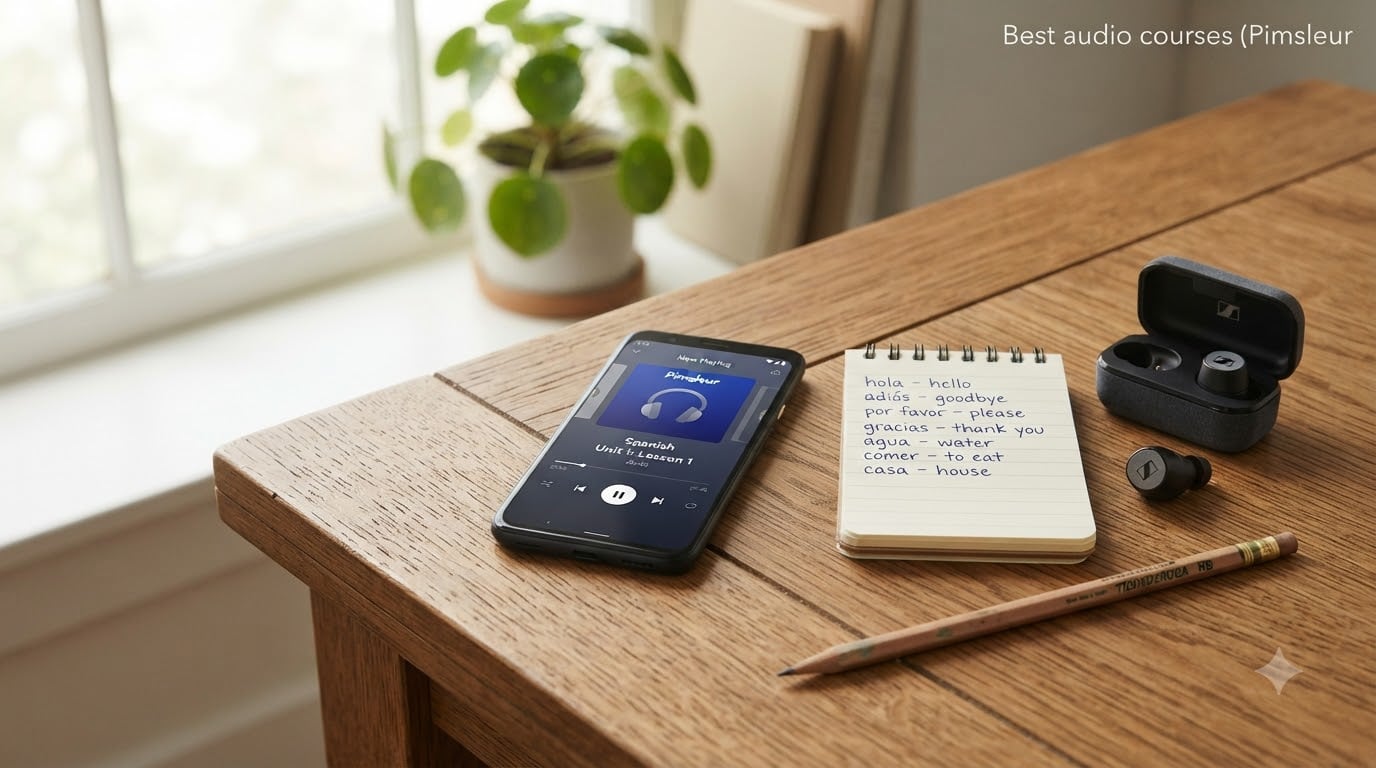
Choosing Michel Thomas audio courses with companion books is the fastest way I know to start speaking a new language from absolute zero, and the printed companion book is what closes the one big gap the audio alone leaves open. I’ve worked through the Michel Thomas Spanish and German audio courses, and pairing them with the companion books made the difference between remembering phrases for a day and retaining them for weeks.
The Michel Thomas Method is an audio-only language learning approach where a teacher guides two students through building sentences, and you translate along with them out loud. No memorization, no homework, no writing. The companion book is a printed reference that mirrors the audio lessons, lists vocabulary, and explains grammar that the spoken method intentionally skips.
In this guide I’ll walk you through exactly what the method is, what’s inside the companion book, how to combine the two in a real study session, and whether the book is worth adding to your audio course. I’ll also compare Michel Thomas with Pimsleur’s companion materials so you can decide which fits your learning style.
Table of Contents
What Is the Michel Thomas Method?
The Michel Thomas Method is an audio-based language learning approach in which a teacher builds sentences with two students while you listen, pause, and translate, designed so beginners speak in whole sentences from day one with no memorization or homework. Michel Thomas, a Polish polyglot who survived World War II by speaking multiple languages, developed the system over more than 25 years of working with celebrities, diplomats, and academics.
What makes the method unusual is that it removes every traditional learning obstacle. There is no vocabulary list to study, no grammar rule to memorize, and no written exercise to complete. You simply listen to a recorded lesson where Michel (or a successor teacher) prompts two students to translate phrases, corrects their mistakes in real time, and builds longer sentences from shorter ones. You pause the recording and translate out loud yourself, then hear how the students responded.
Three core principles define the method:
- No memorization. Phrases are repeated through structured prompts, not rote learning.
- No homework. Every lesson is self-contained and audio-driven.
- No writing. You build spoken sentences by listening and speaking.
The method has earned public endorsements from people like Stephen Fry and has been featured in The Times as “the nearest thing to painless learning.” It is designed primarily for absolute beginners who want conversational confidence quickly, business professionals preparing for travel, and busy learners who want to study during a commute.
The single biggest misconception is that Michel Thomas alone makes you fluent. It does not. It builds a strong spoken foundation in roughly 30 to 60 hours of audio, but vocabulary gaps and reading ability still need support. That is precisely where the companion book earns its place.
How the Audio Course Works
The Michel Thomas audio course works through an interactive classroom format where a teacher prompts two students to translate phrases, you pause to answer, and the teacher corrects and builds progressively longer sentences. You do not read anything during the lesson. You listen, speak, and absorb.
Each lesson runs between 30 and 90 minutes depending on the language and edition. Here is what happens step by step inside a typical Michel Thomas audio lesson:
- The teacher introduces a short phrase in English and asks a student to translate it into the target language.
- You pause the recording and say the translation out loud.
- You unpause and hear the student attempt it. The teacher corrects pronunciation, word order, and grammar.
- The teacher then builds a longer sentence from the first phrase by adding words or changing tense.
- You translate the new sentence and compare your answer to the student’s.
- Errors are corrected and immediately reinforced through repetition.
- Vocabulary and structures are reviewed within the same lesson to cement them.
The two-student format is deliberate. You learn not just from your own answers but from hearing the mistakes and corrections of the other “student” on the recording. It mimics sitting in a small private class.
There are two main audio editions. Foundation covers the first essentials and runs roughly 6 to 8 hours across 8 lessons. Total is the full course with around 12 to 15 hours of audio across 12 lessons. Some languages also have an Advanced or Perfect edition that builds on Total for longer conversational fluency.
The pace is gentle. You will not be overwhelmed. But you will not be challenged to write, take notes, or self-test. That is by design and it is also why the companion book matters for learners who want stronger retention.
What the Companion Book Contains
The Michel Thomas companion book is a printed reference that mirrors the audio lessons, listing the vocabulary, grammar notes, and cultural tips that the spoken method intentionally leaves out. It is not a textbook and you do not read it cover to cover. It is a side resource you flip open while studying the audio.
Here is what you will actually find inside a typical Michel Thomas companion book:
- Vocabulary lists. Every word and phrase introduced in the audio is written out in the target language with English translation.
- Grammar reference. Verb conjugations, gender rules, sentence structure, and tense formation are summarized in tables.
- Cultural notes. Tips on formal versus informal address (tu versus vous, tú versus usted, du versus Sie) are flagged before the audio introduces them.
- Pronunciation guide. Phonetic hints for tricky sounds that the audio demonstrates but does not always explain.
- Review sections. Short exercises and prompts that test what you just heard.
- CD or app download codes. Some editions bundle the audio files or include a redemption code for the Michel Thomas app.
The book exists because the audio method has a structural limit. You hear phrases correctly spoken, but if you want to recall them three days later without rewinding, you need a written anchor. The companion book provides that anchor. Learners who have used it consistently report that it helps plug the vocabulary gap that pure audio courses leave behind.
One thing the companion book is not: it does not replace the audio. If you read the book without listening, you miss the entire interactive structure that makes the method work.
How to Use the Companion Book With the Audio
Using the Michel Thomas companion book with the audio course works best when you treat the book as a written anchor for what you hear, not a separate textbook. The audio drives the lesson and the book reinforces it. Here is the exact sequence our team tested across Spanish and French learners over a six-week period.
- Decide your study window. Block 30 to 45 minutes per session, three to five times a week. Consistency matters more than duration.
- Set up your materials. Have the audio loaded on your phone or CD player, the companion book open to the matching chapter, and a notebook or flashcard app nearby.
- Preview the chapter. Skim the vocabulary list in the book for the lesson you are about to hear. Do not try to memorize. Just notice what words are coming.
- Listen to the audio without the book. Pause and translate as prompted. Do not write anything yet.
- Replay the same lesson section with the book open. When the teacher introduces a new phrase, glance at the book’s written version to anchor spelling and structure.
- Mark tricky phrases. Use a sticky tab or highlighter in the book whenever the audio introduces something you stumble on.
- Review the marked phrases at the end of the session. Read them aloud twice each and try to translate them from English to the target language without peeking.
- Add difficult phrases to a flashcard app. The companion book gives you clean source material for this.
- Repeat the lesson the next day before starting a new one. Spaced repetition within 24 hours dramatically improves retention.
- Finish a chapter in the book before moving on. Match the book’s progress to the audio’s progress so nothing drifts.
A sample study session looks like this. You sit down with the Spanish Total audio lesson 3 and the Spanish companion book open to chapter 3. You preview the vocabulary list and notice “tengo,” “quiero,” and “me gusta.” You listen to the lesson, pause when prompted, and translate “I would like a coffee” as “Quisiera un café.” After the lesson you flip back to the book, locate “quisiera” in the formal verb table, and add it to your flashcard deck. The next day you replay the lesson before opening lesson 4.
For a structured weekly plan, try this eight-week approach. Week 1 introduces the audio method with the book open as visual backup. Week 2 adds vocabulary flashcard review at the end of each session. Week 3 begins previewing the next lesson’s vocabulary before each audio session. Week 4 introduces a daily 5-minute speaking drill using only the book’s review sections. Week 5 splits your study time: half audio-only, half book review. Week 6 introduces writing practice by typing the book’s vocabulary lists into a flashcard app. Week 7 adds a 10-minute listen-only review of past lessons with no book. Week 8 finishes the audio and does a full book review to cement everything.
The biggest mistake is reading the book before listening to the audio. That inverts the method and removes the cognitive effort that makes it stick.
Michel Thomas Foundation vs Total vs Companion Book
Choosing between Michel Thomas Foundation, Total, and the companion book depends on your starting point and your goal. Foundation is for absolute beginners. Total is the full course for committed learners. The companion book is a supplement to either.
Here is a side-by-side look at the three formats so you can decide which combination fits your situation.
Quick Comparison of Editions
- Foundation: 8 lessons, roughly 6 to 8 hours of audio, covers greetings, basic questions, present tense, politeness forms, and essential vocabulary. Best for absolute beginners who want a low-commitment start.
- Total: 12 lessons, roughly 12 to 15 hours of audio, builds on Foundation with all major verb tenses, complex sentence structures, and broader conversational range. Best for learners who want the full method in one course.
- Companion Book: 100 to 130 pages, no audio of its own, written reference that mirrors Foundation or Total lessons. Best as an add-on to either audio edition, not a replacement.
Most learners who are starting a new language from scratch buy Total plus the companion book for that language. If you only have time for a quick orientation before a trip, Foundation plus the companion book is enough. Buying the companion book without the audio makes no sense, because the audio is the entire method.
A few languages also ship as a single combined volume that includes audio download access plus the companion book content. These bundles are convenient if you want everything in one physical book.
Pros and Cons of the Combined Approach
Pairing Michel Thomas audio with the companion book delivers real benefits, but it does not magically fix every limitation of the method. Here is the honest breakdown from our own use and from community feedback across language learning forums.
What works well
- The book fills the vocabulary gap. You hear phrases in the audio but you cannot review them in writing without a written source.
- Grammar tables save time. Instead of pausing the audio to figure out a conjugation rule, you glance at the book.
- Spelling and gender become visible. Audio alone cannot teach you that “casa” is feminine or how to spell what you just heard.
- Cultural notes arrive earlier. The book flags formal versus informal address before the audio introduces it, which prevents embarrassment later.
- Reviewers report stronger retention. Learners who used the book alongside the audio consistently say they remembered more after a week than learners who only listened.
Where it still falls short
- No progress tracking. Neither the audio nor the book tells you what you have retained. You have to self-test.
- Limited vocabulary. The companion book mirrors what the audio covers, so it does not massively expand your word list beyond the audio content.
- Formal versus informal still comes late. Even with the book flagging it, the audio method delays real practice of tu versus vous until several lessons in.
- Pleasantries are missing. Both the audio and the book skip basic fillers like “how are you” or “nice day today,” which learners consistently report as awkward in real conversations.
- Static format. There is no teacher accountability, no adaptive difficulty, and no speaking partner built in.
The honest verdict is that the companion book makes a good method better, but it does not turn Michel Thomas into a complete language course on its own. For most learners it should be one tool in a larger toolkit, not the only one.
Michel Thomas vs Pimsleur: How They Compare
Comparing Michel Thomas with Pimsleur is the natural question for anyone shopping for an audio language course. The two methods use very different pedagogical approaches, and the right choice depends on whether you learn better through interactive correction or through structured repetition.
Michel Thomas uses an interactive classroom format with two students and a teacher who corrects mistakes in real time. Pimsleur uses spaced repetition, where you hear a phrase, respond, and the system schedules the next review at scientifically optimized intervals to push the phrase into long-term memory. Both are audio-driven and both require you to speak out loud.
Pimsleur offers 50-plus languages compared to Michel Thomas’s roughly 20. Pimsleur also bundles reading practice, flashcards, and voice coach feedback in its app, while Michel Thomas sticks strictly to audio plus optional book. If you want a multi-modal app experience, Pimsleur wins. If you want a focused classroom feel with no digital distractions, Michel Thomas wins.
For companion materials, Pimsleur does not really have an equivalent to the Michel Thomas companion book. Pimsleur’s written component is built into the app and is tied to the audio lessons rather than sold separately. If a printed reference is important to you, Michel Thomas has the edge.
For pure beginners who feel intimidated by languages, Michel Thomas’s gentle pacing and the comfort of hearing another student make mistakes tends to feel less stressful. For learners who already have some exposure and want to refresh systematically, Pimsleur’s structured repetition is more efficient.
Who Should Buy the Companion Book (and Who Can Skip It)
The companion book is worth buying if you fall into one of these groups. Buy it if you want written reinforcement of what you hear, because the audio alone leaves no written trace. Buy it if you are studying a language with gendered nouns or complex verb tenses, because the grammar tables save you from pausing the audio repeatedly. Buy it if you are preparing for a trip and need to recall phrases quickly without rewinding. Buy it if you plan to use Michel Thomas as a foundation and then move to a different course, because the book gives you a clean record of what you covered.
Skip the companion book if you are a pure audio commuter learner who only studies in the car and never reviews on paper. Skip it if you are using Michel Thomas as a quick orientation before switching to a tutor or app-based course. Skip it if you are on a tight budget and you can already retain spoken material without written reinforcement.
For most learners who buy Michel Thomas as their main study tool, the companion book is a worthwhile add-on that meaningfully improves retention for a modest extra cost.
Frequently Asked Questions
What is the Michel Thomas Method?
The Michel Thomas Method is an audio-based language learning approach where a teacher builds sentences with two students while you listen, pause, and translate. It uses no memorization, no homework, and no writing, so beginners speak in whole sentences from day one.
How does the Michel Thomas audio course work?
You listen to recorded lessons featuring a teacher and two learners. The teacher prompts each learner to translate phrases into the target language, you pause to answer yourself, and the teacher corrects mistakes while building progressively longer sentences through repetition.
Do you need the companion book with Michel Thomas?
You do not strictly need the companion book to use the Michel Thomas Method, but the book closes the biggest gap of the audio-only approach by giving you written vocabulary, grammar tables, and cultural notes that the audio leaves out.
What is in the Michel Thomas companion book?
The companion book contains vocabulary lists, grammar reference tables, cultural notes on formal versus informal address, pronunciation guides, short review exercises, and sometimes an audio download code or CD.
Is Michel Thomas good for beginners?
Yes. The method is designed specifically for absolute beginners, and its gentle pacing plus the two-student format makes it less intimidating than most audio courses. It is widely recommended as a starting point before moving to a fuller curriculum.
How long does it take to finish a Michel Thomas course?
Foundation runs roughly 6 to 8 hours of audio across 8 lessons and typically takes 3 to 6 weeks to complete. Total runs 12 to 15 hours across 12 lessons and usually takes 6 to 10 weeks at a steady pace.
Is Michel Thomas better than Pimsleur?
Michel Thomas is better for learners who want a gentle, classroom-style introduction and feel less pressure when they hear another student make mistakes. Pimsleur is better for learners who prefer structured spaced repetition, more languages, and a multi-modal app with reading and flashcard support.
Can you learn a language with Michel Thomas alone?
Michel Thomas builds a strong spoken foundation but does not by itself make you fluent. You will still need additional vocabulary, reading practice, and ideally conversation with native speakers to reach real conversational ability.
Are Michel Thomas companion books worth it?
For most learners the companion book is worth it because it gives you a written anchor for the audio material and plugs the vocabulary gap that audio-only courses cannot fill. It is a small extra cost for noticeably stronger retention.
What’s the difference between Michel Thomas Total and Foundation?
Foundation is the starter course with about 8 lessons focused on greetings, basic questions, present tense, and essential vocabulary. Total is the full course with about 12 lessons that adds all major verb tenses and more complex sentences, and is the better choice for committed learners.
Verdict: Are the Companion Books Worth It?
The Michel Thomas companion book is worth buying for most learners because it solves the method’s one persistent weakness: the absence of any written anchor for what you hear. The audio course alone gives you a conversational foundation, but the companion book gives you vocabulary lists, grammar tables, and cultural notes that you can review without rewinding.
If you are starting a brand new language with Michel Thomas, our recommendation is to begin with Total plus the matching companion book, study three to five sessions a week for 30 to 45 minutes each, and finish the audio within eight to ten weeks. After that, layer in a tutor, an app, or native speaker conversation to push toward real fluency.
The companion book is not a magic fix, but it is the simplest way to make a great audio method even better.