
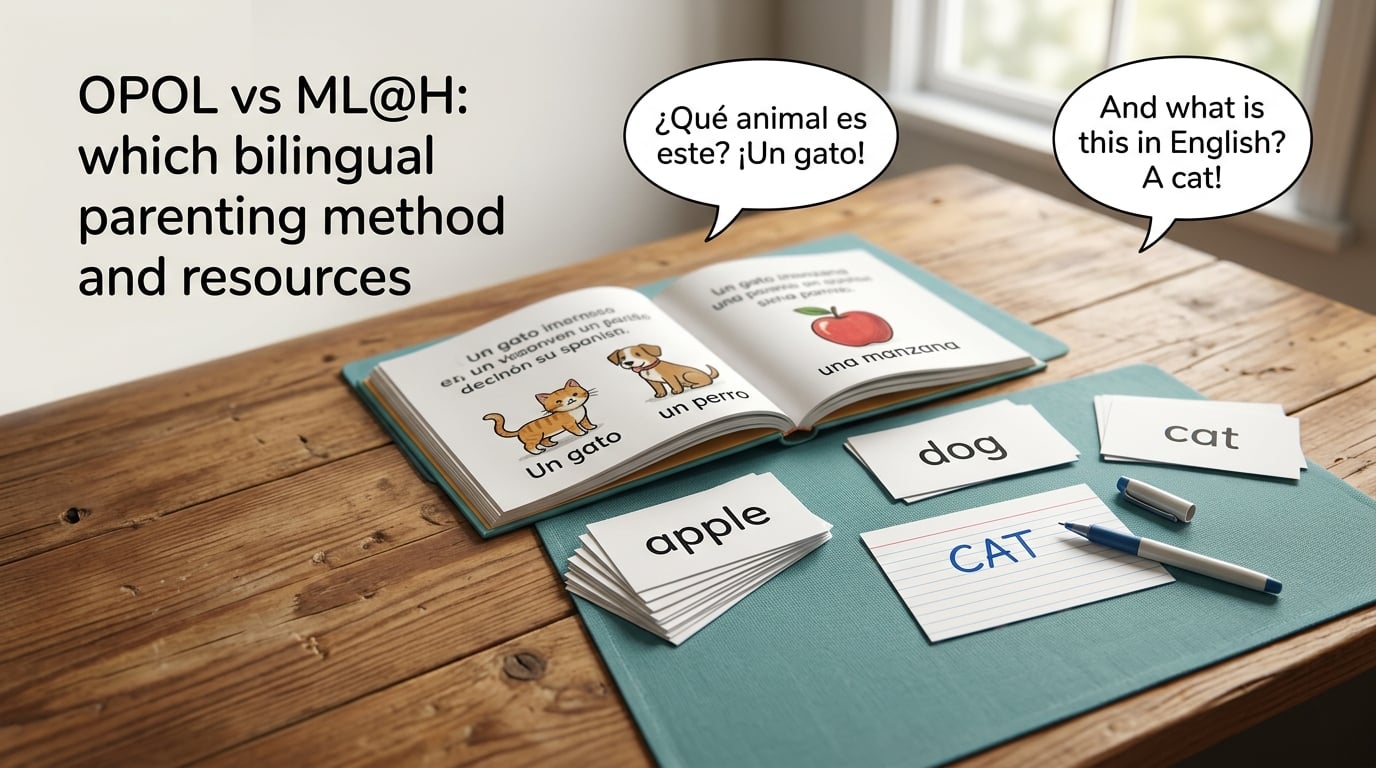
If you’ve typed “OPOL vs ML@H” into a search bar at 11 p.m. with a sleeping baby on your chest, you’re in the right place. These two acronyms sit at the center of nearly every bilingual parenting debate, and choosing between them is less about picking the “right” label and more about matching a strategy to your family’s actual hours, fluency, and goals.
In this guide I’ll walk you through what each method really means, what the research actually says, and how to pick (or blend) the approach that your family can sustain for years. By the end, you’ll have a clear framework, a comparison table, a myth-busting checklist, and a short list of resources worth your time.
Table of Contents
What Are OPOL and mL@H? Quick Definitions
OPOL (One Parent, One Language) means each parent consistently speaks a different language to the child, regardless of context. Mom always speaks Spanish, Dad always speaks English, and the child learns to associate a person with a language from day one.
mL@H (Minority Language at Home) means both parents speak the minority language (often the heritage or non-community language) to each other and to the child inside the home, while the child picks up the majority community language outside through school, friends, and media.
Both are strategies, not laws. They guide how you split your family’s language input, and they only work as well as the consistency behind them.
OPOL: One Parent, One Language in plain English
OPOL was popularized by linguist Suzanne Barron-Hauwaert and remains the most cited bilingual parenting method. The core idea is language-person association: a child knows that one specific adult speaks Language A, so requests, stories, and bedtime chats happen in that language. The other adult speaks Language B. Where the conversation happens (kitchen, park, supermarket) doesn’t matter; who is speaking does.
mL@H: Minority Language at Home in plain English
mL@H treats the home as a language sanctuary. Both parents use the minority or heritage language with each other and with the child inside the home. The community language (the one spoken by neighbors, shops, and school) is reserved for outside interactions. This method is most common when both parents already share the same heritage language but live in a country where another language dominates.
OPOL vs mL@H: Side-by-Side Comparison
The clearest way to see the trade-offs is to lay them next to each other. Use this table as your quick reference.
| Dimension | OPOL (One Parent, One Language) | mL@H (Minority Language at Home) |
|---|---|---|
| Who speaks what | Each parent sticks to their assigned language with the child | Both parents speak the minority language at home |
| Where exposure happens | Anytime the parent is around, in any setting | Inside the home; outside is for the community language |
| Best fit | Bilingual couples raising a child in a third country; families with clearly fluent minority-language parent | Same-language parents abroad; immigrant families with strong home network |
| Hardest part | Sustaining it when one parent is the primary caregiver and isn’t fluent in their assigned language | Keeping the home language alive once the child enters school in the community language |
| Biggest risk | Uneven input if one parent is rarely present or less comfortable | Minority language erodes when outside influences dominate |
| Hybrid option | Blend with Time and Place for outings | Blend with OPOL for one-on-one time with each parent |
The Pros and Cons of OPOL
OPOL is popular because the rule is simple: one person, one language, every time. That simplicity is also where most of its strengths come from.
Why families pick OPOL
- Clear roles remove daily guesswork for parents and grandparents alike.
- Strong language-person association helps children code-switch early and naturally.
- Works well in trilingual setups where one parent speaks the heritage language, the other speaks the community language, and a third language comes from school or media.
- Backed by named research from Barron-Hauwaert, De Houwer, and Pearson as a viable input strategy.
Where OPOL struggles
- If the minority-language parent is rarely home (work, travel), the child gets too little input.
- Consistency fatigue sets in, especially when extended family visits and the parent keeps switching.
- A non-native parent can feel insecure teaching a language they are still learning.
- When both parents happen to speak the same language fluently, OPOL often wastes the strongest resource you have.
The Pros and Cons of mL@H
mL@H converts the home into a full-immersion environment, which can be powerful when both parents are aligned.
Why families pick mL@H
- Maximum minority-language exposure whenever the family is together.
- Children hear the minority language modeled between parents, not just directed at them.
- Reduces the cognitive load on the non-fluent parent to perform in a second language.
- Works well for heritage-language families who want the child to read, joke, and argue in the family’s mother tongue.
Where mL@H struggles
- Once the child enters preschool or school in the community language, the home language can feel like the “school subject,” not the language of life.
- Both parents must genuinely agree; one slip into the community language in front of the child undermines the strategy.
- It assumes the home is a meaningful language bubble, which is harder to maintain in regions with no heritage-language community.
- Less suited to bilingual couples who each want to pass on their own native language.
What the Research Actually Says
The honest answer is that strategy labels matter less than the quantity, quality, and consistency of language input. Still, several researchers give us real numbers and patterns worth knowing.
Koelewijn on parental strategies and outcomes
In a 2025 study on how parents think about multilingual upbringing, I. M. Koelewijn found that strict OPOL households tended to produce stronger minority-language outcomes than families where parents freely mixed languages. The catch: results depended heavily on how much actual minority input the child received, not just the rule the parents adopted.
De Houwer, Pearson, and Barron-Hauwaert on exposure
Annick De Houwer’s longitudinal work shows that children need consistent, rich exposure to both languages to develop active skills. Barbara Pearson’s research on One Parent, One Language in bilingual families confirms that OPOL works well when the minority-language parent is highly present. Suzanne Barron-Hauwaert’s surveys of bilingual families offer practical playbooks for both OPOL and mL@H households.
The big reveal: exposure hours beat strategy labels
A widely cited guideline suggests a child needs roughly 15 to 25 waking hours per week of meaningful minority-language input, about 20 to 30 percent of their awake time, to actively use a language rather than only understand it. Below that, you get receptive or passive bilingualism. Above it, you get active production. The strategy is a delivery mechanism; the hours are the actual medicine.
Hybrid Strategies Beyond OPOL and mL@H
Most real families don’t fit a pure label. Here are the hybrid models worth knowing.
Time and Place (T&L)
Time and Place assigns a language to a specific context, like “English at school and with friends, Spanish on weekends and at grandma’s house.” It works when parents share a language but want the child to also hear and use the community language naturally outside the home.
Mixed System 1 (MS1) and Mixed System 2 (MS2)
Mixed System 1 mirrors OPOL but lets parents occasionally use the other language when needed. Mixed System 2 mirrors mL@H but allows the minority language to drop in some home contexts. Both are real-world compromises that researchers describe as workable when life gets in the way of purity.
Mixed Language Policy (MLP)
A Mixed Language Policy treats both languages as fully usable in any setting, with parents code-switching as natural. This is common in bilingual communities where neither language is “minority” inside the social network.
External exposure / resource-based strategy
When parents cannot provide enough minority input themselves, they add it through caregivers, language classes, weekend heritage schools, regular video calls with grandparents, and age-appropriate media. This is a legitimate fourth strategy often combined with any of the above.
How to Choose: A Decision Framework
Skip the label debate and answer five questions in order. Your answers will reveal the strategy that fits your family this year.
- Map your caregiver time. Who is actually with the child for the most waking hours? That person carries the heaviest language load, so their fluency decides what’s realistic.
- Check each parent’s minority-language fluency. “Survival” or “rusty” is not the same as “fluent.” Honest self-rating here prevents months of guilt later.
- Identify the community language. The language your child will hear at the playground, in daycare, and on TV is your free input source. Your job is to balance it, not duplicate it.
- Decide your goal. Heritage preservation, balanced bilingualism, and pre-migration return to the home country each imply different priorities.
- Pick a sustainable method and write a Family Language Policy. A one-page written plan with language assignments, exposure hours, and review dates turns vague intentions into something you can actually follow.
What If Only One Parent Speaks the Minority Language?
Yes, you can absolutely raise a bilingual child even when one parent is not fluent. Many expat and immigrant families do it successfully.
Yes, you can still raise a bilingual child
Children learn a language from any consistent, warm, rich source. The minority-language parent does not need to be perfect; they need to be present and persistent. Mistakes and a smaller vocabulary are fine; silence and switch-offs are not.
Practical tips for the non-native parent
- Set a small daily rule, like 30 minutes of minority-language playtime or one storybook.
- Use media the child loves (songs, cartoons) in the target language to boost input.
- Schedule regular calls or visits with native-speaker relatives so the child hears fluent models.
- Celebrate effort over accuracy. Children imitate confidence before grammar.
How many exposure hours are realistic
One non-fluent parent typically delivers 5 to 10 hours of meaningful minority-language input per week. Add weekend immersion, classes, or a caregiver and you can credibly reach the 15-hour threshold for active bilingualism. Below that, expect strong receptive skills and slower production.
Common Myths About Bilingual Parenting
Reddit threads and well-meaning relatives keep several myths alive. Here is what the evidence actually shows.
Myth: bilingual kids start speaking later
No. Bilingual children reach the same milestones within the same age ranges as monolingual peers. They may mix sentences during the early years, but that’s a sign of bilingual development, not delay.
Myth: mixing languages means the child is confused
No. Code-switching between two languages in one conversation is a sophisticated skill. It shows the child understands which language belongs to which context, which is exactly what bilingual parenting aims for.
Myth: kids need a strict 50/50 split
No. The 50/50 split is one possible ratio, not a requirement. Many healthy bilingual children run 30/70 or 40/60 splits and remain fully bilingual for life.
Myth: bilingualism raises IQ
Not in the dramatic way the internet claims. Bilingualism offers small, real cognitive advantages in attention and task-switching. Treat it as a life enrichment, not a guaranteed cognitive shortcut.
Myth: OPOL or mL@H guarantees success
No strategy guarantees success without consistent input. Families who switch methods but keep exposure steady often do better than families who rigidly follow the wrong method.
Myth: the minority-language parent must be a native speaker
False. A committed non-native parent who uses the language regularly produces better outcomes than a reluctant native speaker who gives up after a year.
Myth: switching methods wastes prior progress
False. Language is stored in the child, not in the parent’s rulebook. You can pivot from OPOL to mL@H (or back) without losing what your child has already learned.
Troubleshooting: When the Method Stops Working
Even a great plan hits rough patches. Here is how to handle the four most common ones.
Your child refuses the minority language
Stay calm and keep exposure without forcing speech. Read aloud, watch shows, and play games in the language without demanding replies. Most refusals pass within a few months if you keep the language emotionally positive.
You keep slipping back to the majority language
Choose one anchor routine (bath time, breakfast, the drive to school) and protect only that. Building consistency in one slot is easier than fixing everything at once.
You want to switch methods after years
This is more common than the internet suggests, and it is not a failure. Announce the change clearly, role-model the new pattern yourself for two weeks, and lower the bar on output for the first month.
Grandparents, school, or a nanny add a third variable
Treat them as input multipliers, not threats. Ask grandparents for bedtime video calls, align the nanny’s language with the method’s minority language, and check with the school about the dominant language at recess.
Best Resources for Bilingual Families
Since you asked specifically about resources, here is a curated short list. None of these are affiliate picks; they are simply what experienced bilingual parents and coaches recommend.
Books
- Bringing Up a Bilingual Child by Suzanne Barron-Hauwaert – the most cited OPOL playbook.
- Maximum City Child: Raising a Bilingual Child by Barbara Zurer Pearson – research-grounded and reassuring.
- Bilingual Children: A Guide for Parents by Jane Lyons – practical case studies across language pairs.
Podcasts
- The Bilingual Family Podcast – interviews with linguists and parents.
- Multilingual Matters – episodes on heritage language maintenance.
- Small Humans, Big Questions – short episodes on early-childhood language input.
Online communities
- r/multilingualparenting on Reddit – active, evidence-aware, and honest about struggles.
- Multilingual Parenting Facebook group – large, language-pair specific sub-rooms.
- Multicultural Kid Blogs network – activity ideas by heritage language.
Coaches and language planners
Family language coaches like Rita Rosenback offer one-on-one strategy sessions. They are useful if your situation involves trilingual inputs, frequent moves, or a child who is resisting the minority language.
Frequently Asked Questions
Does the OPOL method work?
Yes, OPOL works well when the minority-language parent is fluent, consistently present, and comfortable using their language with the child. Research by Koelewijn, Barron-Hauwaert, and De Houwer confirms it as a viable strategy, but only if the child actually receives enough exposure hours per week.
OPOL vs mL@H: which should we choose?
Choose OPOL when each parent wants to pass on their own native language and one of those languages is the minority language. Choose mL@H when both parents share the same heritage language and live in a country where a different language dominates. If neither fits cleanly, blend with Time and Place or Mixed Systems.
What if only one parent speaks the minority language?
You can still raise a bilingual child. The non-native parent should aim for a daily minimum of about 30 minutes of minority-language play or reading, and you can boost total weekly input to the 15 to 25 hour range with media, classes, and regular contact with native-speaker relatives.
Do bilingual children start speaking later?
No. Bilingual children reach speech and language milestones within the same age ranges as monolingual children. Mixing two languages in one sentence is a normal stage of bilingual development, not a sign of confusion or delay.
How many hours per week does a child need in the minority language?
A commonly cited guideline is 15 to 25 waking hours per week of meaningful minority-language input, roughly 20 to 30 percent of awake time. Below that range, expect strong receptive skills and slower active production. Above it, expect active bilingual use.
Choosing Between OPOL and mL@H: The Bottom Line
The OPOL vs ML@H bilingual parenting method question doesn’t have a universal winner. What it has is a clear answer once you map your caregiver hours, your fluency, your community language, and your real goal.
OPOL gives you structure when each parent owns a different language. mL@H gives you intensity when both parents share a heritage language and want to flood the home with it. Hybrid models like Time and Place and the Mixed Systems exist for the many families who live between those poles, which is most of us.
Pick a method you can sustain, write a one-page Family Language Policy this week, and revisit it every six months. If something stops working, change it. The label matters less than the conversations you keep having with your child, in whatever language feels alive that day.