
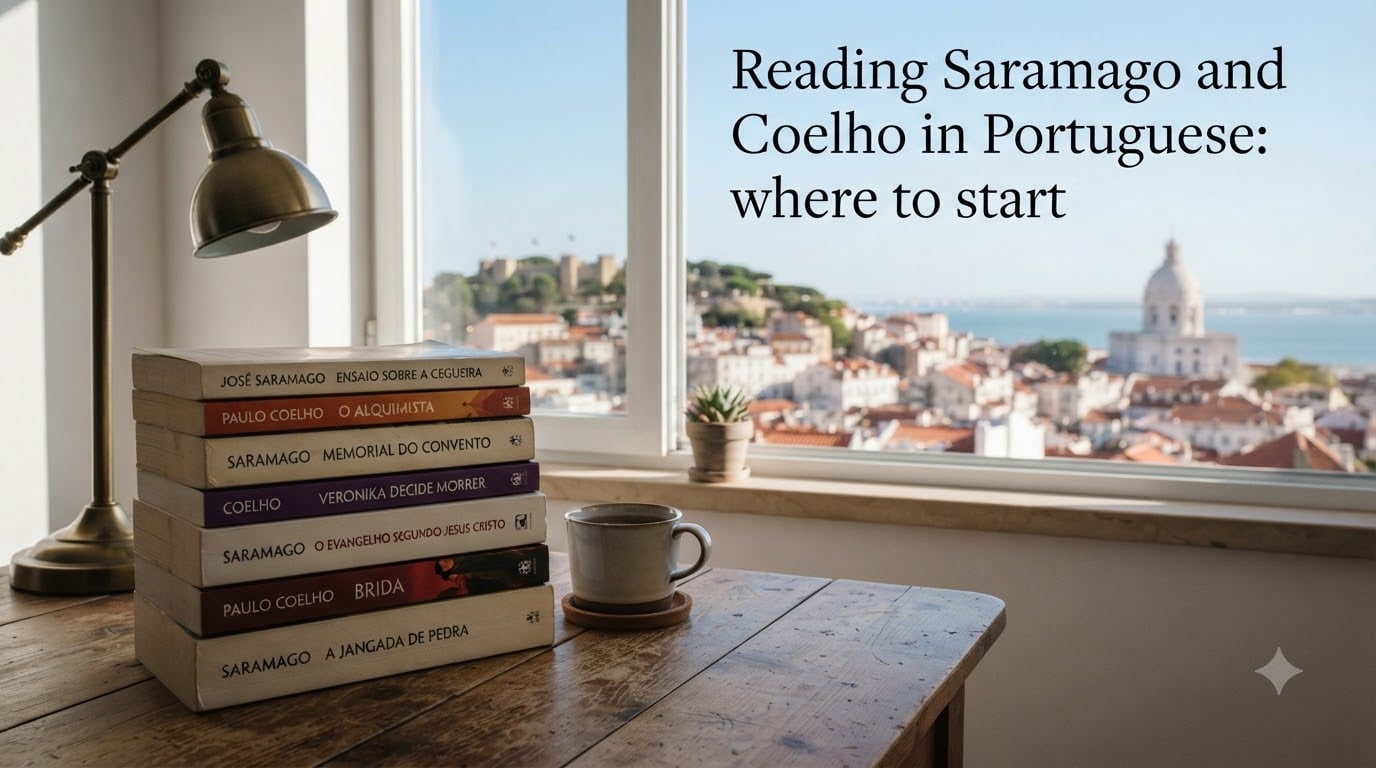
So you want to read José Saramago and Paulo Coelho in Portuguese—but where do you actually start? These two giants of Lusophone literature couldn’t be more different, and choosing the wrong entry point can leave you frustrated or bored. This guide breaks down exactly which books to pick up first, how their writing styles compare, and how to build a reading path that matches your Portuguese level.
Whether you’re a language learner looking for authentic material or a literature lover exploring Portuguese fiction, understanding the distinction between Saramago’s Nobel Prize-winning prose and Coelho’s globally accessible storytelling will save you months of trial and error.
Table of Contents
Who Are Saramago and Coelho?
José Saramago (1922–2010) remains Portugal’s only Nobel Prize laureate in literature, awarded in 1998. His novels blend philosophical depth with political allegory, earning him a reputation as one of the 20th century’s most innovative fiction writers. Saramago wrote exclusively in European Portuguese and resisted having his work translated into Brazilian Portuguese.
Paulo Coelho, born in Rio de Janeiro in 1947, became a global phenomenon with The Alchemist (1988), which has sold over 150 million copies worldwide. His writing draws on spirituality, self-discovery, and accessible prose that resonates with readers across cultures. Coelho writes in Brazilian Portuguese and has published over 30 books translated into 80 languages.
Together, they represent the two poles of Portuguese-language literature: Saramago as the literary heavyweight, Coelho as the universally approachable storyteller. Both are worth reading in the original Portuguese, but for very different reasons.
Saramago vs Coelho: Key Differences
Before diving into specific books, understanding how these authors differ will help you choose the right starting point. Their writing styles, themes, and reading difficulty are worlds apart.
| Aspect | José Saramago | Paulo Coelho |
|---|---|---|
| Writing Style | Long, flowing sentences with minimal punctuation. No quotation marks for dialogue. Stream-of-consciousness passages. | Short, direct sentences. Conversational tone. Easy-to-follow narrative structure. |
| Difficulty (Portuguese) | Advanced. Vocabulary is literary, sentence structures are complex. | Beginner to intermediate. Accessible vocabulary, everyday language. |
| Themes | Political allegory, dystopia, philosophy, history, faith, human condition. | Spirituality, self-discovery, love, destiny, personal legends. |
| Nobel Prize | Yes (1998) | No |
| Portuguese Variant | European Portuguese | Brazilian Portuguese |
| Best For | Advanced readers seeking literary depth and language challenge. | Beginners wanting engaging stories with accessible Portuguese. |
| Most Famous Work | Blindness (Ensaio sobre a Cegueira) | The Alchemist (O Alquimista) |
The difference in sentence structure alone is significant. Saramago will write an entire paragraph as one sentence, weaving dialogue into narration without punctuation markers. Coelho uses clean, short sentences that even A2-level Portuguese learners can follow.
Where to Start with Saramago
Reading Saramago in Portuguese is challenging but deeply rewarding. His prose demands attention, and you’ll need at least a B2 level to appreciate the original text. Here are the best entry points, ranked by difficulty:
1. Blindness (Ensaio sobre a Cegueira)
This is Saramago’s most famous novel and the one most readers recommend as a starting point. The premise is gripping: an epidemic of “white blindness” sweeps through an unnamed city, and society collapses. The novel won the Nobel committee’s attention and remains his most widely translated work.
Difficulty: Advanced. The long sentences and lack of punctuation markers are present, but the plot is so compelling that you’ll push through. Start here if you’re serious about Saramago.
Why start here: The narrative tension keeps you engaged even when the Portuguese gets dense. It’s also his most discussed work online, so you’ll find plenty of reading companions and analysis.
2. The Gospel According to Jesus Christ (O Evangelho Segundo Jesus Cristo)
A controversial reimagining of Jesus’s life from his own perspective. Banned in Portugal for its portrayal of God as a cruel manipulator, this novel showcases Saramago’s ability to blend historical fiction with philosophical provocation.
Difficulty: Advanced. The biblical references and philosophical passages require solid Portuguese comprehension, but the story is more linear than some of his other works.
3. Baltasar and Blimunda (Memorial do Convento)
Set in 18th-century Portugal during the construction of the Mafra National Palace, this novel weaves historical fiction with magical realism. Two lovers—a soldier and a woman with supernatural powers—navigate religious persecution and royal ambition.
Difficulty: Intermediate-advanced. The historical vocabulary is specialized, but the love story provides emotional grounding. A good choice if you enjoy historical fiction.
4. All the Names (Todos os Nomes)
A clerk at the Central Registry discovers records of a woman he becomes obsessed with finding. This Kafkaesque novel explores identity, bureaucracy, and the search for meaning. The premise is simpler than Saramago’s other works.
Difficulty: Intermediate-advanced. More accessible than Blindness because the plot is a straightforward mystery. Good stepping stone before tackling his denser novels.
5. The Double (O Homem Duplicado)
A history teacher discovers his exact physical double living in the same city. This psychological thriller explores identity and existential dread. It was adapted into the film Enemy (2013) starring Jake Gyllenhaal.
Difficulty: Intermediate-advanced. The plot-driven narrative makes it one of Saramago’s more accessible works, though the philosophical undertones still require careful reading.
Where to Start with Coelho
Coelho’s accessible writing style makes him ideal for Portuguese learners at any level. His vocabulary is everyday Brazilian Portuguese, and his narrative structures are straightforward. Here are the best starting points:
1. The Alchemist (O Alquimista)
The obvious starting point—and for good reason. Santiago’s journey from Spain to the Egyptian pyramids is a parable about following your dreams. The prose is clean, the vocabulary is manageable, and the story is universally appealing.
Difficulty: Beginner-intermediate. Perfect for B1-level Portuguese learners. You can read this as one of your first full novels in Portuguese.
Why start here: You’ve probably already read it in English, so you’ll know the plot. This familiarity lets you focus on the Portuguese without getting lost in the story.
2. Veronika Decides to Die (Veronika Decide Morrer)
Set in Ljubljana, Slovenia, this novel follows a young woman who attempts suicide and wakes up in a psychiatric hospital. Coelho explores what makes life worth living through her remaining days. It’s more grounded in reality than The Alchemist.
Difficulty: Beginner-intermediate. The vocabulary is slightly more varied than The Alchemist, but still accessible. Recommended by language teachers as a solid second Coelho read.
3. The Pilgrimage (O Diário de um Mago)
Coelho’s account of walking the Camino de Santiago, blending memoir with spiritual lessons. This is his first major work and provides insight into the experiences that shaped his later fiction.
Difficulty: Intermediate. The mix of narrative and reflective passages offers good practice for different Portuguese registers.
4. Eleven Minutes (Onze Minutos)
The story of a Brazilian prostitute’s journey through love and sexuality. More mature in theme than his other works, it showcases Coelho’s ability to tackle complex subjects with accessible prose.
Difficulty: Intermediate. The subject matter is adult, but the Portuguese remains approachable.
5. The Valkyries (As Valquírias)
A desert journey with his wife to confront personal demons. Less famous than his other works, but it offers a more intimate look at Coelho’s spiritual philosophy.
Difficulty: Intermediate. Good for readers who want to explore beyond his most famous works.
European Portuguese vs Brazilian Portuguese
This distinction matters when choosing your reading material. Saramago wrote in European Portuguese; Coelho writes in Brazilian Portuguese. The differences are similar to British vs American English, but more pronounced in vocabulary and some grammar.
European Portuguese (Saramago): More formal register, different vocabulary for everyday objects (e.g., “autocarro” instead of “ônibus” for bus), distinct pronunciation conventions in written form. Saramago’s prose reflects educated, literary European Portuguese.
Brazilian Portuguese (Coelho): More informal, conversational tone. Uses contractions and colloquialisms that European Portuguese avoids. Coelho’s writing captures everyday Brazilian speech patterns, making it easier for learners who studied Brazilian Portuguese.
Which should you learn? If you’re starting from scratch, Brazilian Portuguese has more learning resources globally. But if you plan to live in Portugal or study Portuguese literature seriously, European Portuguese is essential. Either way, reading both authors gives you exposure to both variants.
Reading Path Recommendations
Here’s a structured approach to reading Saramago and Coelho based on your current level:
Beginner Path (A2-B1 Portuguese)
Start with Coelho. Read O Alquimista first, then Veronika Decide Morrer. These books will build your confidence with full-length Portuguese novels without overwhelming you. After two Coelho books, try O Diário de um Mago for a slight step up in complexity.
Intermediate Path (B1-B2 Portuguese)
Alternate between authors. Start with Blindness (Saramago) for a challenge, then switch to Eleven Minutes (Coelho) for a lighter read. This alternating pattern prevents burnout while expanding your vocabulary across both European and Brazilian Portuguese.
Advanced Path (B2+ Portuguese)
Tackle Saramago’s full bibliography. Start with Baltasar and Blimunda for its historical richness, move to The Gospel According to Jesus Christ for philosophical depth, and finish with All the Names for Kafkaesque complexity. Sprinkle in Coelho’s lesser-known works like The Valkyries for variety.
Where to Find Portuguese Books
Finding books in Portuguese outside of Portugal and Brazil used to be difficult, but several resources have made it much easier:
Amazon: Both amazon.com and amazon.com.br carry Portuguese editions. Search for the Portuguese titles listed above. Kindle editions are often cheaper and available immediately.
Estante Virtual: Brazil’s largest used book marketplace (estantevirtual.com.br). You can find Portuguese editions at a fraction of the cover price, though shipping times vary.
Bookshops in Lisbon and Porto: If you’re visiting Portugal, Livraria Bertrand (the world’s oldest operating bookstore, founded 1732) and Livraria Lello in Porto are essential stops.
Free Resources: Domínio Público (dominio publico.gov.br) offers free Brazilian editions of works in the public domain. Some Saramago works are available in Portuguese on Open Library. Librivox has volunteer-read audiobooks in Portuguese.
Frequently Asked Questions
What is José Saramago’s most famous book?
Blindness (Ensaio sobre a Cegueira), published in 1995, is Saramago’s most famous novel. It depicts an epidemic of blindness that destroys social order and won the Nobel Prize committee’s attention. The novel has been translated into over 30 languages and adapted into a 2008 film starring Julianne Moore.
What is the best Paulo Coelho book for beginners?
The Alchemist (O Alquimista) is the best starting point for beginners. Its simple prose, universal themes, and familiar story make it ideal for Portuguese learners. Most readers have already encountered it in translation, which helps with comprehension when reading the original Brazilian Portuguese.
Should I read Saramago or Coelho first?
Start with Coelho if you’re a beginner or intermediate Portuguese learner. His accessible vocabulary and straightforward narratives build confidence. Move to Saramago once you reach B2 level and want a literary challenge. Advanced readers can start with either, but Coelho is still a gentler introduction to Portuguese fiction.
Is Paulo Coelho good for learning Portuguese?
Yes, Coelho is excellent for learning Portuguese. His vocabulary is everyday Brazilian Portuguese, his sentences are short and clear, and his narratives are engaging enough to keep you reading. Language teachers frequently recommend The Alchemist as one of the first full novels for Portuguese learners.
Is Saramago difficult to read in Portuguese?
Yes, Saramago is considered advanced reading in Portuguese. His long sentences, minimal punctuation, and literary vocabulary require at least B2-level proficiency. However, readers consistently report that the effort is worthwhile—his prose is beautiful, and the challenge significantly improves your Portuguese comprehension.
What Portuguese books should I read first?
Start with Paulo Coelho’s The Alchemist (O Alquimista) if you’re a beginner. It’s accessible, engaging, and available everywhere. For intermediate readers, try Veronika Decides to Die or The Pilgrimage. Advanced readers can jump straight into Saramago’s Blindness or Baltasar and Blimunda.
Where can I buy books in Portuguese?
Amazon (both US and Brazilian sites) carries Portuguese editions with Kindle options. Estante Virtual is Brazil’s largest used book marketplace. In Portugal, Livraria Bertrand in Lisbon and Livraria Lello in Porto are iconic bookshops. Free options include Domínio Público for public domain Brazilian works.
What is the best book for learning Brazilian Portuguese?
Paulo Coelho’s The Alchemist (O Alquimista) is widely considered the best book for learning Brazilian Portuguese. Its simple, conversational prose mirrors everyday Brazilian speech. For a slight step up, try Veronika Decides to Die, which introduces more varied vocabulary while remaining accessible to intermediate learners.
Conclusion
Reading Saramago and Coelho in Portuguese is one of the best ways to deepen your language skills while experiencing two of the most important voices in Lusophone literature. Coelho offers an accessible entry point with everyday Brazilian Portuguese, while Saramago rewards advanced readers with Nobel Prize-winning prose that will challenge and transform your understanding of the language. Where you start depends on your level—but wherever you begin, you’re stepping into a rich literary tradition that spans continents and centuries.