
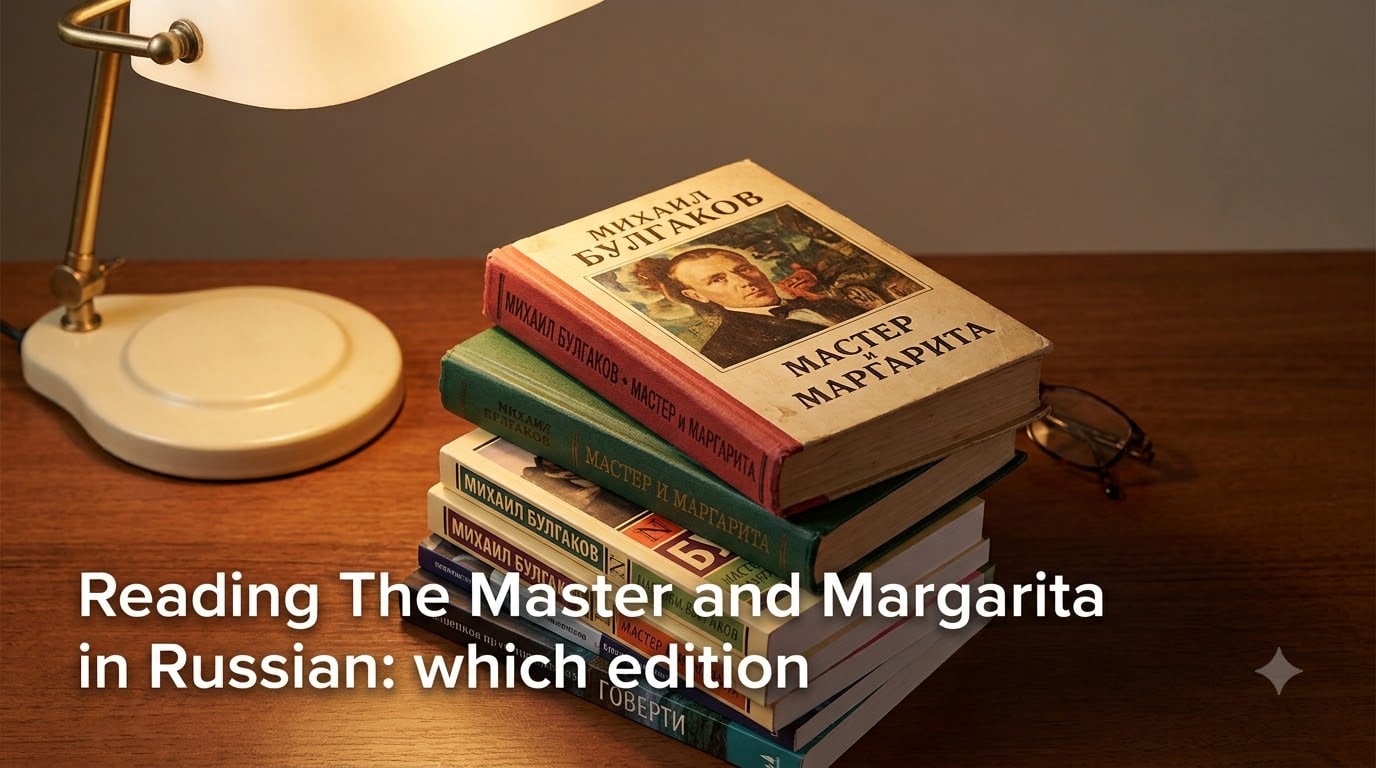
If you want to read The Master and Margarita (Мастер и Маргарита) in Russian, the edition you should pick is one based on the 1973 Khudozhestvennaya Literatura text edited by Anna Saakiants. This was the first uncensored Russian publication, restoring roughly 23,000 words that Soviet editors had cut from the 1966–67 Moskva magazine serialization. The Saakiants text remains the scholarly standard and forms the basis for most reliable modern reprints from publishers like AST, Eksmo, and Azbuka.
Choosing the wrong Russian edition is surprisingly easy. Dozens of cheap reprints on Amazon and AbeBooks reproduce the shorter, censored text without telling you. Readers who assume every Russian copy is “complete” end up missing entire passages of Bulgakov’s sharpest satire—housing-crisis jokes, Margarita’s nude flight, Nikanor Ivanovich’s dream sequence. This guide explains exactly how to tell the editions apart, which modern Russian publishers are trustworthy, and how to actually tackle Bulgakov’s notoriously rich vocabulary if your Russian is anything less than native.
Table of Contents
Why the Right Russian Edition of The Master and Margarita Matters
The Master and Margarita exists in two fundamentally different Russian texts: censored and uncensored. The difference is not minor wording tweaks—it is roughly 12 percent of the novel, some 23,000 words excised by Soviet editors before the work could appear in the literary journal Moskva in 1966–67.
The cuts removed passages that directly satirized Soviet bureaucracy, housing allocation, and the literary establishment. Entire scenes were shortened or rewritten to tone down Bulgakov’s anti-Soviet edge. If you read only the censored version, you are reading an incomplete work that Bulgakov never intended.
The uncensored text was first published outside the USSR by YMCA Press in Paris (1967) and then inside the Soviet Union by Khudozhestvennaya Literatura in 1973, under editor Anna Saakiants. A second scholarly compilation by Lidiya Yanovskaya appeared in 1989–90 as part of Bulgakov’s five-volume collected works. Both are considered canonical, and both restore the full manuscript.
For any serious reader—whether you are a Russian literature enthusiast, a language learner pushing into native texts, or a scholar—starting with the uncensored edition is non-negotiable. The rest of this guide helps you find one.
Publication History: From Manuscript to Modern Printings
Bulgakov wrote The Master and Margarita between 1928 and 1940, the year of his death. He burned an early draft in 1930 after learning his play was banned, then rewrote the novel multiple times with the help of his wife, Elena Bulgakova. The manuscript was still unfinished at his death—Elena continued editing and preserving it through the Stalin years.
The novel circulated in samizdat (hand-typed underground copies) for decades before any official publication. Here is the key timeline:
1928–1930: First draft written and burned by Bulgakov after his artistic suppression.
1931–1940: Rewritten multiple times; final version nearly complete at Bulgakov’s death in March 1940.
1966–67: First published in the Soviet journal Moskva, heavily censored—roughly 23,000 words removed.
1967: YMCA Press in Paris publishes the first book-form edition, closer to the full text but based on an early editorial pass.
1969: Possev Verlag in Frankfurt publishes an edition with additional reinserted passages.
1973: Khudozhestvennaya Literatura (Moscow) publishes the first Soviet uncensored edition, edited by Anna Saakiants—widely considered the scholarly standard.
1989–90: Lidiya Yanovskaya compiles a definitive text for Bulgakov’s five-volume collected works, cross-referencing all surviving manuscripts.
Since the 1990s, Russian publishers like AST, Eksmo, Azbuka-Klassika, and smaller houses such as Rech have reprinted both the Saakiants and Yanovskaya texts in various formats—paperback, hardcover, annotated, and pocket-sized.
How to Spot a Censored vs Uncensored Russian Edition
The most common mistake buyers make is picking up a cheap reprint without realizing it contains the censored 1966–67 Moskva text. Forum discussions on Reddit’s r/RussianLiterature repeatedly warn about this. Here is how to tell the difference before you buy:
Signs of an uncensored (complete) edition:
Page count of 350–480 pages (depending on font size and commentary). Shorter editions under 300 pages are almost always censored.
Editor credit to Anna Saakiants or Lidiya Yanovskaya on the title page.
The phrase “полное издание” (complete edition) on the cover or title page.
Publisher is Khudozhestvennaya Literatura, AST, Eksmo, Azbuka-Klassika, or Rech.
Publication year is 1973 or later for Soviet editions, or post-1990 for modern reprints.
Signs of a censored (abridged) edition:
Page count under 280 pages with no commentary section.
No editor credit, or credit to the Moskva journal editorial board.
Publisher is Createspace or another print-on-demand service with minimal metadata.
ISBN starting with 1542830869 or similar Createspace-era prefixes—a commonly cited censored reprint.
Publication year between 1966 and 1972 (Soviet-era censored printings).
When in doubt, check the first few pages of Book Two. If the Nikanor Ivanovich dream sequence or Margarita’s flight over Moscow is missing or drastically shortened, you have a censored text.
The Best Russian Editions of The Master and Margarita
Modern Russian readers have several excellent options. Your choice depends on whether you want a scholarly reference, a comfortable reading copy, or a collectible hardback.
For Scholarly Study: Saakiants 1973 / Yanovskaya 1989–90
The Anna Saakiants edition from Khudozhestvennaya Literatura (1973) is the gold standard. It was the first uncensored Soviet publication and includes Saakiants’ detailed commentary on textual variants. The Lidiya Yanovskaya compilation (1989–90, five-volume set) is equally authoritative and draws on additional manuscript sources Elena Bulgakova made available after the political thaw.
If you are doing academic work or want the most thoroughly documented Russian text, seek out modern reprints of the Saakiants edition. Look for Khudozhestvennaya Literatura reissues from the 2000s and 2010s, or AST editions crediting Saakiants as editor.
For Everyday Reading: AST, Eksmo, or Azbuka-Klassika Paperbacks
The major Moscow publishers AST and Eksmo both offer affordable paperback editions of the uncensored text. These are widely available on Russian marketplaces and through international booksellers. Page counts typically range from 380 to 450 pages, and most include brief footnotes for archaic or Soviet-specific terms.
Azbuka-Klassika publishes a well-regarded paperback that balances readability with textual fidelity. This is the edition many Russian-language readers recommend on forums as a first complete copy—it is inexpensive, the font is comfortable, and the text is the full Saakiants or Yanovskaya version.
For Collectors: Soviet-Era Hardbacks and Illustrated Editions
Soviet-era hardback editions from the 1980s Khudozhestvennaya Literatura print runs are prized by collectors. These feature period typography, sometimes include illustrations, and are often found on eBay, Etsy, and AbeBooks at prices ranging from modest to quite steep depending on condition.
Modern illustrated editions—such as those from Folio Society or specialty Russian art publishers—also appeal to collectors who want a beautiful object alongside the complete text. Be aware that some illustrated editions may use the censored text; always verify the editor and page count.
For Annotated Reading
Editions with extensive footnotes and commentary are invaluable for non-native readers. The J.A.E. Curtis Reader’s Companion (English-language companion volume) and Ellendea Proffer’s notes are frequently cited as helpful scaffolding. Some Russian editions from Rech publishing house include modern annotations that explain 1930s Soviet cultural references without requiring a separate companion volume.
Reading The Master and Margarita in Russian: Difficulty and Tips
The Master and Margarita is not a beginner’s Russian text. Community consensus on Quora and Reddit’s r/RussianLiterature places it at B2 to C1 level on the CEFR scale. Readers with intermediate Russian (B1) can attempt it, but expect to pause frequently.
The difficulty comes from three sources:
Archaic vocabulary. The Pontius Pilate chapters are written in a deliberately elevated, almost 19th-century literary register. Words like “прокуратор” (procurator), “геморрой” used in its classical context, and Yeshua Ha-Notsri’s biblical phrasing will trip up learners expecting modern conversational Russian.
Советизмы (Sovietisms). Bulgakov saturates the Moscow chapters with Soviet-era institutional terms: МАССОЛИТ (the literary bureaucracy), Берлиоз (the chairman’s name punning on the composer), Варьете (the variety theater), жилтоварищество (housing cooperative). These terms are opaque even to some modern Russian readers and are rarely taught in language courses.
Non-linear narrative. The novel alternates between the Woland-in-Moscow plotline and the Pontius Pilate subplot with minimal transitional signaling. Readers accustomed to linear storytelling may find the structure disorienting.
Tips for learners tackling the Russian text:
Read shorter Russian works first to build stamina. Chekhov’s short stories, Gogol’s Dead Souls, and Dostoyevsky’s Notes from Underground are commonly recommended bridge texts.
Use an annotated edition with footnotes. The extra context saves hours of dictionary lookups.
Consider a parallel-text strategy: read a chapter in Russian, then check the Pevear/Volokhonsky or Burgin/O’Connor English translation to confirm your understanding.
Listen to the Russian audiobook narrated by Vladimir Samoylov (available on Audible, approximately 17 hours runtime). Hearing the rhythm of Bulgakov’s prose helps with comprehension even when individual words are unfamiliar.
Where to Buy Russian Editions Outside Russia
Finding Russian-language editions of The Master and Margarita outside Russia is easier than you might expect, though prices vary widely depending on edition and condition.
New copies: Amazon and AbeBooks both list Russian-language editions, including AST and Eksmo paperbacks shipped from international sellers. Book Depository (now integrated into other platforms) previously offered free worldwide shipping on Russian editions and some sellers still honor similar terms.
Used and collectible copies: AbeBooks is the strongest marketplace for Soviet-era hardbacks and first printings. Prices range from under 5 dollars for reading copies to over 100 dollars for pristine 1970s Khudozhestvennaya Literatura editions. eBay and Etsy also carry Soviet-era books, often bundled with other Russian literature.
Digital editions: Russian-language ebooks are available on LitRes (Russia’s dominant ebook platform) and occasionally on Kindle. The text quality depends on the publisher—AST and Eksmo digital editions are generally reliable, while free Project Gutenberg-style downloads may reproduce older censored texts.
Audiobook: The Samoylov-narrated Russian audiobook on Audible is the most accessible option for international listeners. Free Russian readings also exist on YouTube and Spotify, though audio quality and completeness vary.
Frequently Asked Questions
Which Russian edition of The Master and Margarita should I read?
The best Russian edition is based on the 1973 Khudozhestvennaya Literatura text edited by Anna Saakiants, which was the first uncensored Soviet publication. The Lidiya Yanovskaya 1989-90 compilation is equally authoritative. Modern reprints from AST, Eksmo, and Azbuka-Klassika use these texts and are widely available.
How can I tell if my Russian copy is censored or uncensored?
Check the page count: uncensored editions are 350-480 pages, while censored versions are typically under 280 pages. Look for editor credits to Anna Saakiants or Lidiya Yanovskaya, and the phrase полное издание (complete edition) on the title page. Createspace print-on-demand editions and any book published between 1966 and 1972 are likely censored.
Is The Master and Margarita hard to read in Russian?
Yes, it requires roughly B2 to C1 Russian proficiency. The Pontius Pilate chapters use archaic 19th-century literary Russian, and the Moscow chapters are dense with советизмы (Soviet-specific terms). Annotated editions and bridge reading of Chekhov or Gogol help significantly.
Are there Russian audiobooks of The Master and Margarita?
Yes. The most well-known Russian audiobook is narrated by Vladimir Ivanovich Samoylov, available on Audible with a runtime of approximately 17 hours. Free Russian readings also exist on YouTube and Spotify, though quality and completeness vary.
What is the difference between the Saakiants and Yanovskaya editions?
Both restore the full uncensored text. The Saakiants 1973 edition was the first Soviet uncensored publication and includes detailed commentary on textual variants. The Yanovskaya 1989-90 compilation draws on additional manuscript sources Elena Bulgakova made available and is part of Bulgakov’s five-volume collected works. Either is an excellent scholarly choice.
Is there a bilingual Russian/English edition of The Master and Margarita?
Parallel Russian/English print editions are rare and not widely in print. The most practical alternative is to read the Russian text alongside a separate English translation. The Pevear/Volokhonsky and Burgin/O’Connor translations are the most commonly recommended English companions for checking comprehension.
Conclusion
Reading The Master and Margarita in Russian is one of the most rewarding experiences a lover of 20th-century literature can have. The key is starting with the right edition: look for the Saakiants 1973 text or the Yanovskaya 1989–90 compilation, verify your copy is at least 350 pages, and do not settle for a censored reprint. With an annotated edition, a good dictionary, and patience for Bulgakov’s layered prose, you will encounter the novel as Bulgakov wrote it—not as Soviet censors permitted it.