
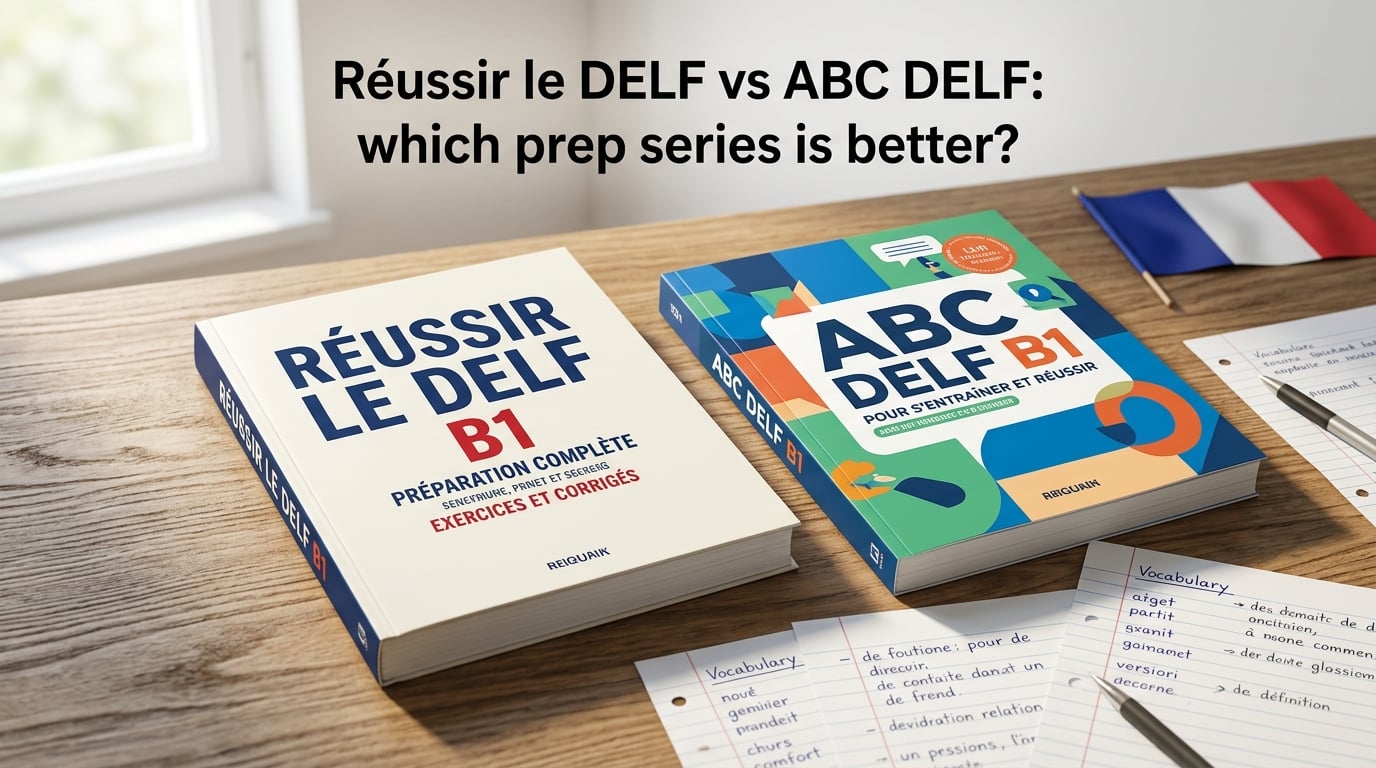
If you are weighing Réussir le DELF vs ABC DELF, you already know the choice matters. The wrong prep book can leave you drilling exercises that do not match the live exam format, and that gap costs you points on test day. I have spent weeks comparing these two flagship French-certification series, talking to learners on r/DELF, and reviewing the latest editions from Hachette FLE and CLE International.
The honest answer is that neither series crushes the other across the board. Each one has a clear profile: Réussir le DELF is the Alliance Française standard with strategy-heavy lessons and slightly tougher exercises; ABC DELF is the modern, exam-realistic choice with cleaner layout and faster-moving drills. Which one wins for you depends on how you study, which level you are targeting, and whether you are preparing solo or in a classroom.
In this guide I will walk you through both series at the publisher level, then break down every level from A1 to B2 with the actual ISBNs, look at five dimensions where they genuinely differ, and finish with a profile-based recommendation. You will also find real quotes from learners who used each book to pass B1 and B2.
Table of Contents
Réussir le DELF vs ABC DELF at a Glance
Here is the side-by-side you came for. Skim this first, then dive into the detail sections that matter most for your level.
| Feature | Réussir le DELF | ABC DELF |
|---|---|---|
| Publisher | Hachette FLE | CLE International (Clé International) |
| Levels covered | A1, A2, B1, B2 | A1, A2, B1, B2 (plus Junior / scolaire variants) |
| Number of mock exams | 3 to 4 full mock exams per book | 2 to 3 full mock exams per book |
| Audio format | Audio CD or download (varies by edition) | Audio CD / MP3 + online app access on newer editions |
| Answer key (corrigés) | Yes, separate booklet or back of book | Yes, included with detailed transcripts |
| Edition recency | Latest editions updated for 2026 exam format | Latest editions aligned to current France Éducation International format |
| Typical price range | Mid-range | Mid-range (slightly higher for Junior / scolaire) |
| Best for | Alliance Française students, self-study with strategy lessons, learners who want tougher-than-exam drills | Self-study, exam-realistic practice, learners who want a clean modern layout |
Both series cover the same four DELF skills (listening comprehension, reading comprehension, written production, oral production) and both target the official France Éducation International format. The differences show up in teaching approach, audio quality, and how exercises are weighted.
What is the DELF Exam and Why Your Prep Book Matters
The DELF (Diplôme d’Études en Langue Française) is the official French Ministry of Education certification issued by France Éducation International. It sits at four CEFR levels: A1, A2, B1, and B2. Above that you enter the DALF territory (C1 and C2), which is a different exam and uses different prep books.
Each level tests the same four skills, and each skill carries 25 points. You need 50 out of 100 overall, with a minimum of 5 out of 25 in every section. That minimum-per-section rule is the silent killer of the DELF: a perfect 25 in written production cannot save you if you score 4 in oral production.
Since 2026, the B2 exam has rolled out revised tasks in written production, and France Éducation International tightened the evaluation grids for oral interaction. Prep books that were last updated before that change can quietly mis-train you on outdated task types. That is why edition recency matters as much as publisher reputation.
Choosing between Réussir le DELF and ABC DELF is not a brand-loyalty question. It is a fit question. The right book aligns with how you actually study and with the live exam format you will face.
What is Réussir le DELF? (Hachette FLE)
Réussir le DELF is Hachette FLE’s flagship DELF preparation series. Hachette has been publishing French as a Foreign Language (FLE) materials for decades, and Réussir le DELF is the line most commonly listed on Alliance Française syllabi in France and abroad. If you have walked into an Alliance branch and asked the front desk which book to buy, this is what they pointed you toward.
The series covers all four adult levels (A1, A2, B1, B2), with a separate Hachette line for DELF Prim (the school-age variant for under-12 learners). Each book is structured around the four DELF skills in this order: compréhension orale, compréhension écrite, production écrite, production orale.
Inside each skill section, you get a short strategy lesson explaining how to approach the task, followed by 8 to 12 graded exercises, then a short progress check. The book finishes with three to four full mock exams in real exam conditions, an answer key (sometimes as a separate booklet), and audio on CD or via download. Newer editions add a code for the Hachette FLE online platform with extra practice.
The Hachette typography is famously clean. Headings are bold but not shouty, color-coding is restrained, and the books stay readable even at B2 where text density climbs. If you have ever struggled with a cluttered CLE or Didier page, the Réussir layout feels like a relief.
Réussir le DELF: Strengths and Weaknesses
After reviewing the latest editions at every level and reading dozens of r/DELF threads, here is where Réussir le DELF wins and where it loses points.
Strengths:
- Alliance Française adoption. When teachers around the world build a course around Réussir le DELF, you know the book has been tested at scale in real classrooms.
- Strategy lessons before each task type. Beginners benefit enormously from the “how to approach” intros, especially for production écrite and production orale.
- Exercises are slightly harder than the real exam. Multiple learners on r/DELF said the actual DELF felt easier by comparison, which is the goal of a good prep book.
- Clean typography and consistent layout across all four levels. You learn the visual rhythm once and carry it into B2.
- Strong answer keys with model answers for written production, not just a letter grade.
Weaknesses:
- Older editions (anything before 2026-3) reflect a pre-2025 DELF B2 format. If you buy secondhand without checking the year, you may drill outdated task types.
- Audio recordings are slower and more clearly articulated than the live DELF, which catches some learners off guard in the real exam room.
- Fewer mock exams than some competitors. Three full mock exams at B1 and B2 is solid but not generous.
- Oral production practice is weaker than ABC DELF; you get task prompts but less in-book coaching on how to structure a spoken argument.
One r/DELF learner summarized it well: “I have the Reussir delf B1, I download it and its a very good one, the exercises there I found them more difficult than the actual delf exams!” Another learner, comparing the two series, said: “Follow only two books – Delf b2 réussite (latest edition) and hachette delf b2 (this one is used by Alliance Française when preparing for the exam).”
What is ABC DELF? (CLE International)
ABC DELF is CLE International’s flagship DELF preparation series, marketed in France under both “Clé International” and “CLE International” branding. CLE has been a serious FLE publisher since the 1970s and is the house behind the well-known Grammaire Progressive and Vocabulaire Progressif series, which are often paired with ABC DELF as companion resources.
The ABC DELF line covers A1, A2, B1, and B2 for adult learners, plus Junior and scolaire variants for younger candidates. Junior targets the modified format used in DELF Prim and DELF Junior (the school-age exams), while scolaire aligns with the format used in French secondary schools for non-francophone students.
Each ABC DELF book is organized task-first rather than skill-first. You open to a section like “compréhension orale: interviews” and find one to two graded exercises followed by exam-style drills. The book layers in 200+ exercises per level, two to three full mock exams, answer keys with transcripts, audio on CD or MP3, and (on newer editions) an access code for the CLE online app.
The design is modern and more colorful than Réussir le DELF. Photos and infographics break up text-heavy pages, and icons signal task type at a glance. If you find Hachette’s layout conservative, ABC DELF will feel contemporary.
ABC DELF: Strengths and Weaknesses
Here is where ABC DELF performs well and where it falls short, based on the latest editions and r/DELF learner reports.
Strengths:
- Exam-realistic exercise difficulty. Learners consistently report that ABC DELF questions match the live DELF feel more closely than Réussir le DELF.
- Modern layout with strong visual hierarchy. Icons, color, and infographics help when you are tired after two hours of study.
- Online app access on newer editions. Extra drills, audio on the go, and self-marking quizzes that supplement the printed book.
- Detailed transcripts for every audio recording, which doubles as listening-and-reading practice.
- Junior and scolaire variants fill a real gap for parents and younger learners preparing for the school-track DELF.
Weaknesses:
- Fewer strategy lessons than Réussir le DELF. ABC DELF assumes you already understand the task format and want to drill, which can leave true beginners stranded.
- Used copies sometimes ship without the online app code, since codes are single-use.
- Edition availability varies by region. In some markets only the B1 and B2 books are kept current; A1 and A2 editions may lag.
- Answer keys for written production are thinner than Hachette’s; you get a model answer but less commentary on grading criteria.
A learner on r/DELF wrote in late 2025: “I have access to both of these books, although the DELF Réussite version is 4 years old. I score much better on the ABC DELF questions.” That comment captures the common split: ABC DELF feels closer to the live exam, Réussir le DELF teaches the strategy underneath.
Réussir le DELF vs ABC DELF by Level (A1, A2, B1, B2)
This is the part most comparison articles skip, and it is the part that matters when you actually want to order a book. Below is the level-by-level breakdown with the latest editions and ISBNs I could verify from Hachette and CLE International catalogs.
A1 level:
- Réussir le DELF A1 (Hachette FLE) – paperback with audio download, ISBN 978-2014015411, latest edition aligned to current France Éducation International A1 format.
- ABC DELF A1 (CLE International) – paperback with audio CD and app access, ISBN 978-2090381840, latest edition covers the four A1 task types with two full mock exams.
A2 level:
- Réussir le DELF A2 (Hachette FLE) – paperback with audio download, ISBN 978-2014015428, exercises grouped by skill with three full mock exams.
- ABC DELF A2 (CLE International) – paperback with audio CD and app access, ISBN 978-2090381857, three mock exams and 200+ graded exercises.
B1 level:
- Réussir le DELF B1 (Hachette FLE) – paperback with audio download and online platform code, ISBN 978-2014015435, the most widely adopted B1 prep book in Alliance Française classrooms.
- ABC DELF B1 (CLE International) – paperback with audio CD and online app access, ISBN 978-2090381864, latest edition updated for the current B1 task format.
B2 level:
- Réussir le DELF B2 (Hachette FLE) – paperback with audio download and online platform code, ISBN 978-2014015442, latest edition revised for the post-2025 B2 format.
- ABC DELF B2 (CLE International) – paperback with audio CD and online app access, ISBN 978-2090381871, latest edition aligned to the revised B2 written production tasks.
DELF Junior / scolaire:
- Réussir le DELF Prim A1.1 and A1 (Hachette FLE) – for under-12 candidates.
- ABC DELF Junior (CLE International) – for middle-school candidates, ISBN 978-2090381888.
- ABC DELF scolaire (CLE International) – for French secondary school non-francophone students, ISBN 978-2090381895.
Always confirm ISBNs and edition years before buying. Publishers occasionally reprint without changing the ISBN, and a current cover image on a retail site does not guarantee current content.
Réussir le DELF vs ABC DELF: 5 Dimensions Compared
Now the direct head-to-head. I scored each dimension on a five-point scale based on the latest editions, France Éducation International format requirements, and recurring learner feedback.
1. Exam alignment. Réussir le DELF scores 4.5/5. The Hachette team works closely with Alliance Française networks, so the task types track the official format closely, but the B2 edition took longer to incorporate the post-2025 changes than ABC DELF. ABC DELF scores 5/5. CLE International’s editorial cycle updated B2 first, and the Junior and scolaire lines ship in lockstep with the school exam calendar.
2. Exercise difficulty. Réussir le DELF scores 5/5 for difficulty. Exercises lean slightly harder than the live exam, which most learners on r/DELF described as a confidence-builder. ABC DELF scores 4.5/5. The difficulty curve mirrors the live DELF more precisely, which is great for exam realism but slightly less of a stretch.
3. Mock exams. Réussir le DELF scores 4/5. Three to four full mock exams per book, with a separate answer key booklet in many editions. ABC DELF scores 3.5/5. Two to three full mock exams per book, but the supplementary app adds timed mini-mocks that fill the gap.
4. Audio quality. Réussir le DELF scores 3.5/5. Recordings are clear and slower than the live DELF, which is helpful for absolute beginners but a step down at B2. ABC DELF scores 4.5/5. Recordings match live-exam pace more closely, and every track ships with a full transcript on the page.
5. Design and layout. Réussir le DELF scores 4/5. Restrained, typographically clean, easy to read at B2 text density. ABC DELF scores 4.5/5. Modern color, icons, infographics, and a strong visual hierarchy that helps when fatigue sets in.
Add up the totals and you get Réussir le DELF at 21/25 and ABC DELF at 22/25. Close. That is why the decision really comes down to your learner profile.
Who Should Pick Réussir le DELF vs ABC DELF?
The five-dimension score is close. The profile fit is what tips it.
Pick Réussir le DELF if you are:
- An Alliance Française student or someone whose teacher assigns Hachette materials. Staying in the same ecosystem reduces friction with classroom drills.
- A true beginner who needs strategy lessons before each task type. Hachette’s “how to approach” intros save you a separate book on DELF method.
- A learner who wants to over-prepare. Slightly harder exercises build the kind of buffer that turns a nervous test day into a manageable one.
- A self-studier who values clean typography and minimal visual noise during long study sessions.
Pick ABC DELF if you are:
- A self-studier who already knows the task format and wants realistic, fast-paced practice without strategy hand-holding.
- A B2 candidate, especially after the 2026 format changes. CLE International updated B2 first.
- A parent or teacher prepping a younger learner for DELF Junior or DELF scolaire, where ABC DELF has the most current material.
- Anyone who wants a companion app for audio on the go and self-marking drills between printed study sessions.
Consider using both if:
- You have the time and budget. Many learners on r/DELF report using Réussir le DELF for strategy lessons and ABC DELF for mock exam realism.
- You are at B2. The post-2025 changes are recent enough that cross-checking both books against the official France Éducation International sample papers is smart.
A Third Option Worth Considering: Didier 100% Réussite
If you have been reading other DELF prep guides, you have probably seen a third series mentioned: Le DELF 100% Réussite from Didier. It is the direct competitor to both Réussir le DELF and ABC DELF, and it covers A1 through B2 with a similar four-skill structure.
100% Réussite leans even harder on strategy lessons than Hachette, with detailed “comment réussir” intros for every task. The mock exams are fewer (usually two per book), but the answer keys are detailed. If Réussir le DELF is strategy-focused and ABC DELF is exam-realistic, Didier 100% Réussite sits between them but slightly closer to Hachette on teaching style.
For a focused Réussir le DELF vs ABC DELF comparison, the third option is out of scope, but if neither feels right, Didier 100% Réussite is a credible backup.
Frequently Asked Questions
Which is harder, TCF or DELF?
The TCF (Test de Connaissance du Français) is adaptive and covers A1 to C2 in one sitting, while the DELF tests a single CEFR level at a time. TCF feels harder for most candidates because you cannot prepare for one fixed level, and the listening sections escalate unpredictably. DELF is more predictable once you know your target level. If you need a specific CEFR certification for citizenship or university, DELF is the more efficient choice.
What are the different levels of the DELF French Diploma?
The DELF covers four CEFR levels: A1 (beginner), A2 (elementary), B1 (intermediate), and B2 (upper-intermediate). Each level tests the same four skills (listening, reading, writing, speaking) and is a separate exam with its own diploma. Above B2 the certification switches to the DALF, which covers C1 and C2.
Is the DELF B2 exam very hard?
DELF B2 is challenging but very passable with the right prep. Most candidates who score 5/25 or better in every skill pass comfortably. The hardest part for non-native speakers is oral production, which requires sustained argumentation, not just Q and A. The post-2025 B2 format also tightened the written production evaluation grid, so using a book updated for the current format (latest Réussir le DELF B2 or ABC DELF B2) is essential.
Which is better, DELF or TEF?
DELF is the French Ministry of Education diploma and is widely accepted for French citizenship, university entrance, and most work visas. TEF is a Canada-focused test used for Canadian immigration and some Quebec programs. If you are applying for French citizenship or a French-language university, DELF is almost always the right test. If you are applying through Canadian immigration streams, TEF may be required.
Is TCF harder than DELF?
TCF is harder than DELF for most candidates because it is adaptive, covers A1 to C2 in a single test, and does not let you target a fixed level. DELF lets you prepare for one specific CEFR level, which makes the question types predictable and the prep materials easier to align. If you have a choice between TCF and DELF and only need one CEFR level, DELF is the easier route.
Is DELF B1 considered fluent?
DELF B1 sits at the lower end of independent fluency. You can handle most everyday situations, maintain a conversation on familiar topics, and write simple connected texts. It is not yet the level at which you can argue a complex position, follow academic lectures, or work in a fully French-speaking professional environment. For most citizenship applications, French universities, and employers, B2 is the fluency threshold that matters.
What is the best app to learn French fluently?
No app alone will get you to DELF fluency, but a few pair well with a prep book. Busuu and Babbel are good for grammar drills and short lessons. Anki is the standard for vocabulary and is essential for the production écrite and production orale sections. For DELF-specific practice, pair your app with one of the prep book apps from Hachette FLE or CLE International that comes with newer editions of Réussir le DELF or ABC DELF.
Verdict: Réussir le DELF or ABC DELF?
After working through publisher, format, level-by-level edition data, and five comparison dimensions, the Réussir le DELF vs ABC DELF decision comes down to who you are as a learner. For Alliance Française students, true beginners, and learners who want tougher-than-exam drills, Réussir le DELF from Hachette FLE remains the safer pick. For self-study candidates, B2 test-takers, and parents prepping DELF Junior or scolaire, ABC DELF from CLE International is the stronger choice in 2026.
If you can, buy both at your target level and use Réussir le DELF for strategy lessons and ABC DELF for timed mock exam realism. Whichever you choose, confirm that you are holding the latest edition aligned to the current France Éducation International format, then work through the answer keys carefully. That is where most of the real learning happens.