
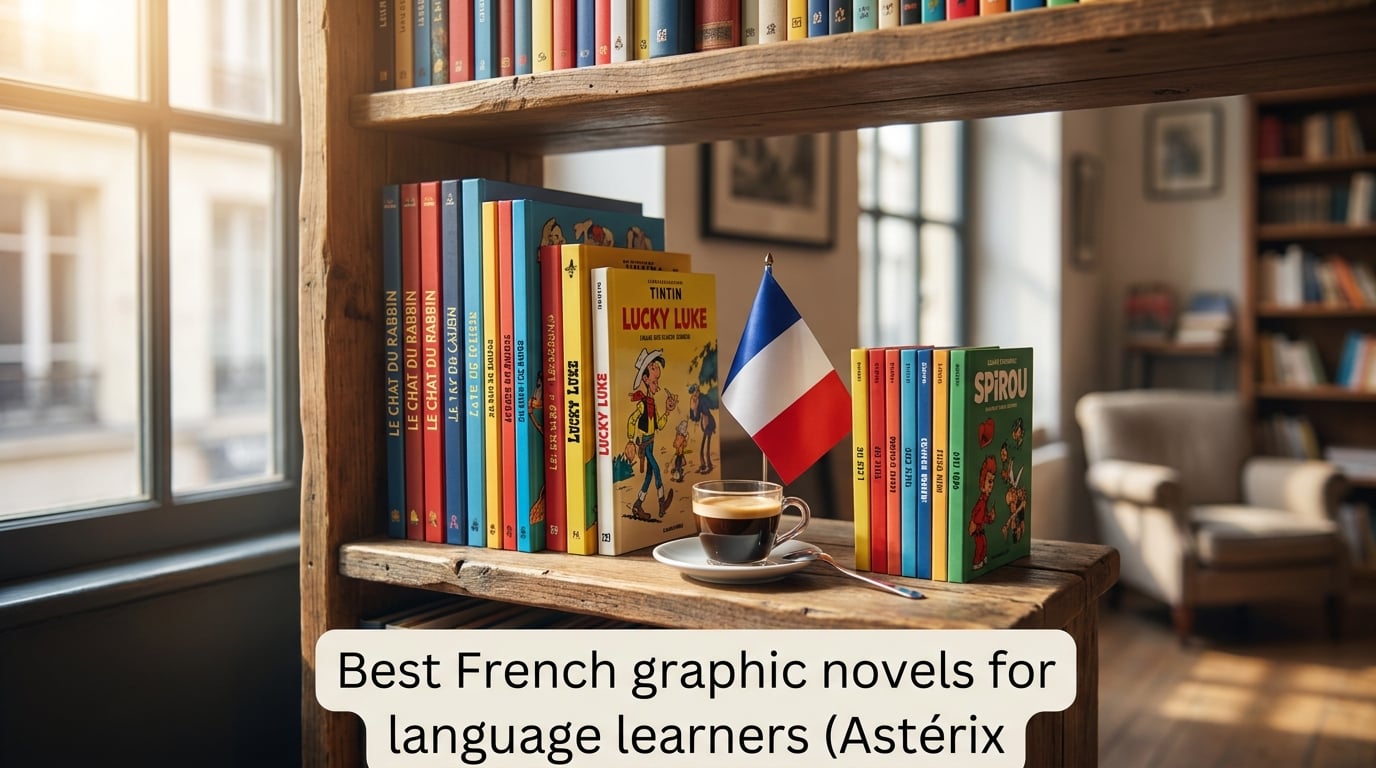
If you have ever opened an Astérix album, watched the Gauls land in Britain with a barrel of magic potion, or wondered how Tintin’s dog Milou ended up in a snowy village in the Alps, you already know that French graphic novels feel different from American superhero comics or Japanese manga. That difference is exactly what makes them powerful for language learners. In this guide, I will walk you through the best French graphic novels for language learners, sorted by CEFR level, with a clear method for reading them actively rather than passively.
A few good French books for language learners include Astérix le Gaulois (beginner, A2-B1), Le Petit Nicolas (intermediate, B1-B2), and Persepolis (intermediate to advanced, B2). These titles are widely available, well-loved by French readers themselves, and packed with the kind of natural dialogue and idioms that textbooks rarely deliver.
I have spent the last three years reading bandes dessinées alongside my French learners, and the pattern is consistent: the readers who finish a graphic novel retain twice as much vocabulary as those who abandon a novel at page 40. Visuals anchor new words, short panels lower anxiety, and the humor rewards re-reading. Below you will find my team’s curated list, organized by level, plus the reading method and the French BD vocabulary you need to start.
This is an educational pillar article. There is no commercial list of products to push. The only “purchase” decision is which album to read first, and I will help you make it with confidence.
Table of Contents
Quick Picks: 5 Best French Graphic Novels by Level
If you only have time to read one section, start here. The table below maps our top five titles to a CEFR level, the ideal reader, and the single reason to pick it up.
| Title | Author(s) | CEFR Level | Best For |
|---|---|---|---|
| Astérix le Gaulois | Goscinny & Uderzo | A2-B1 | First-time BD readers who want wordplay and humour |
| Les Aventures de Tintin | Hergé | A2-B1 | Readers who like clean art, short captions, and adventure |
| Le Petit Nicolas | Goscinny & Sempé | B1-B2 | Learners who want everyday spoken French in short vignettes |
| Persepolis | Marjane Satrapi | B2 | Readers ready for memoir, history, and emotional vocabulary |
| Blacksad | Diaz Canales & Guarnido | B2-C1 | Advanced learners who want noir, idioms, and rich descriptions |
Each of these titles is available in French print editions from major Franco-Belgian publishers (Hachette, Dargaud, Dupuis, and Casterman), and most have been translated into 50+ languages, which means you can find used copies cheaply in secondhand bookshops worldwide.
What Is a Bande Dessinée? The Ninth Art Explained
A bande dessinée (BD) is a French-language comic book or graphic novel, usually published as a complete hardcover album. French readers treat BD as the “ninth art” (le neuvième art), sitting alongside cinema and photography as a serious cultural form. Most BD albums are 48 to 64 pages, printed in full color on heavy paper, and read left-to-right like an American comic, not right-to-left like a manga.
The format carries specific vocabulary you will see throughout this guide. An album (l’album) is the finished book. A planche is a full page of comics. A case is a single panel. A bulle is a speech bubble. The ligne claire is the clean, thin-line drawing style pioneered by Hergé for Tintin. When you hear “BD,” think “album,” not “issue.”
French comics are called “bandes dessinées” (often shortened to BD), and they are published by a handful of historic Franco-Belgian houses: Hachette, Dargaud, Dupuis, and Casterman. Many of the most famous titles, including Tintin and the Smurfs, originally appeared in weekly magazines like Spirou and Pilote before being collected into albums.
BD vs Manga vs American Comics: How the Formats Differ
Picking up a BD when you are used to manga or Marvel trades is a small adjustment. The table below shows the practical differences that matter for language learners.
| Feature | Bande Dessinée (BD) | Manga | American Comics |
|---|---|---|---|
| Reading direction | Left to right | Right to left | Left to right |
| Panel density | Low to medium | High | High |
| Dialogue per page | Moderate, natural French | Heavy, often shouted | Heavy, action-driven |
| Art style | Ligne claire, caricature, realism | Black and white, expressive | Painted or inked, dynamic |
| Strength for learners | Idioms, humour, culture | Sustained immersion | Action vocabulary |
| Watch out for | Dated stereotypes in older titles | Volume commitment | Speech bubbles are sparse |
The big advantage of BD for learners is dialogue density matched to visual support. You see a character pointing at a dog and the word “chien” lands in memory without translation. Manga packs more text per page, which can overwhelm beginners. American superhero comics rely on stylized action and fewer words, which makes them harder to mine for vocabulary.
Best French Graphic Novels for Beginners (A2-B1)
For a beginner learning French, the best book is one you actually finish. The four titles below sit firmly in the A2-B1 CEFR range, use repetition, lean on visual context, and reward re-reading with new wordplay every time.
Astérix le Gaulois — The Classic Wordplay Workout
Written by René Goscinny and illustrated by Albert Uderzo, Astérix is the most-read French comic in the world. The first album, Astérix le Gaulois (1959), drops a village of Gauls into a fight against Julius Caesar, armed with a magic potion brewed by their druid Panoramix.
Why it works for learners: short captions, repeated characters, and heavy use of everyday verbs (boire, manger, courir, frapper). The French is clear, the humor comes from wordplay, and iconic lines like “Ils sont fous, ces Romains!” (“These Romans are crazy!”) show up across the entire series.
Caution for learners: the pun density spikes in albums like Astérix et Cléopâtre and Le Tour de Gaule. As one r/bandedessinee reader put it, “Asterix wordplay is exhausting for true beginners.” Start with the first album, then jump around rather than reading in order.
Les Aventures de Tintin — Clean Lines, Clear Captions
Created by Hergé, Tintin follows a young Belgian reporter and his dog Milou (Snowy in English) across 24 albums. The art style, ligne claire, makes every panel easy to read. Captions are short, action verbs dominate, and Tintin is famous for shouting “Mille millions de mille sabords!” (“Blistering barnacles!”) when surprised.
Why it works for learners: the language is clean, the vocabulary is concrete, and Tintin is one of three titles that 95% of French people have read. Cultural familiarity means you can practice idioms that come up in everyday French conversation. Tintin is technically Belgian, but it has been a cornerstone of French reading culture since the 1930s.
Caution for learners: Tintin is French in the sense that it is read in French, but Hergé was Belgian and Tintin first appeared in a Belgian newspaper. A few older albums, especially Tintin en Amérique and L’Oreille cassée, carry dated caricatures of Indigenous peoples that modern French readers openly discuss.
Lucky Luke — The Cowboy Who Rides Alone
Lucky Luke, by Morris (later with Goscinny), is a quieter read. The cowboy “who shoots faster than his shadow” wanders through the American West, meeting real historical figures like Jesse James, Calamity Jane, and Mark Twain. The dialogue uses simple past tense narration, which makes it easier to follow than dense conversation.
Why it works for learners: short scenes, repetitive narration, and frequent real-world references that anchor new vocabulary. As the Talk in French team noted, the historical encounters give learners a reason to look up names like Abraham Lincoln and Mark Twain, which doubles as a history lesson.
Petit Poilu — A Modern Picture-Book Series
For absolute beginners and younger learners, Petit Poilu by Pierre Bailly uses one short sentence per page, with large illustrations of a small hero’s everyday adventures. It is closer to a picture book than a traditional BD, but it is a perfect on-ramp for learners below A2.
Boule et Bill — Family Life, Familiar Words
Created by Jean Roba in 1959, Boule et Bill follows a young boy and his cocker spaniel. The vocabulary is everyday household French: school, food, family. This makes it a strong fit for learners who want conversational practice.
Best French Graphic Novels for Intermediate Learners (B1-B2)
Once you can read a Tintin album in three sittings without a dictionary, you are ready for the B1-B2 tier. These titles use richer vocabulary, longer sentences, and cultural references that build fluency.
Spirou et Fantasio — The Newsroom Adventure
Spirou is a bellhop-turned-journalist (think Tintin with humor) who runs through more than 60 albums. The original André Franquin run (1947 to 1968) is the gold standard for intermediate readers: clear dialogue, situational comedy, and vocabulary that mirrors what you would hear on French radio.
Le Petit Nicolas — Spoken French at Its Sweetest
Le Petit Nicolas, written by Goscinny (yes, the same Goscinny as Astérix) and illustrated by Sempé, is narrated by a schoolboy recounting the adventures of his friend group. The language is exactly the way a French child describes a typical week, which makes it a near-perfect B1-B2 read. Every chapter is a self-contained vignette, so you can read ten pages and feel a sense of completion.
Persepolis — Memoir, History, and Emotion
Marjane Satrapi’s Persepolis is the most famous graphic memoir in French. It tells the story of Satrapi’s childhood in Iran during and after the Islamic Revolution. The art is stark black and white, the vocabulary is direct, and the emotional register stretches learners who have only read humor. It sits at B2 rather than B1 because of the historical and political vocabulary.
Why it works for learners: short panels, emotional directness, and authentic conversational French between family members. Persepolis is one of the most commonly cited intermediate BD titles among teachers on r/French.
Gaston Lagaffe — Office Slapstick
Gaston Lagaffe is a lazy office worker at a comic-book publisher who invents elaborate gadgets to avoid work. The humor is gentle, the language is workplace French, and the visual gags carry most of the jokes. As one r/bandedessinee reader noted, “Gaston Lagaffe is also pretty easy to read but keep in mind he has [dated jokes].” Read it for the vocabulary, not the punchlines.
Titeuf — Schoolyard French, with Caveats
Titeuf, by Zep, follows a schoolboy with a distinctive spiky haircut through puberty-themed misadventures. The vocabulary is colloquial and the dialogue is fast. Parents and teachers should know: Titeuf contains blunt humour about relationships and bodies, even though the art style looks childlike. The 16+ content warning applies to several later albums.
Best French Graphic Novels for Advanced Learners (B2-C1)
At the B2-C1 level, learners can tackle BD that uses literary French, regional slang, and complex idioms. The three titles below are our top picks for advanced readers.
Blacksad — Noir, Idiom, and Cinematic Storytelling
Blacksad, written by Juan Díaz Canales and illustrated by Juanjo Guarnido, is a series of animal-actor detective stories set in 1950s America. The French is dense, literary, and packed with noir idioms. It is widely used in advanced French university courses because the dialogue mirrors French literary style without being unreadable.
Le Chat du Rabbin — Philosophy in Translation
Joann Sfar’s Le Chat du Rabbin (The Rabbi’s Cat) follows a cat in 1920s Algeria who gains the ability to speak after eating a parrot. The novel mixes Yiddish, Arabic, and French, which makes it challenging but rewarding for advanced learners interested in North African French culture.
XIII — Spy Thriller Vocabulary
XIII is a long-running Franco-Belgian spy thriller with 20+ albums. The vocabulary leans on thriller conventions: identities, betrayals, chases. As one r/bandedessinee reader noted, “Valérian is great but has dense text and probably a higher vocabulary level.” XIII sits at the same level and offers similar training wheels for learners who like genre fiction.
How to Read French Comics Actively: A 5-Step Method
Many learners read BD passively the same way they watch TV: they flip pages, enjoy the visuals, and remember nothing. Our team’s 5-step method turns each album into a structured study session. I have used this with beginners through C1 learners, and it consistently doubles retention.
Step 1: Preview the Album in English
Before opening the French edition, find a one-paragraph English summary online. Read the back cover. Look at the cover image and predict what the story will be about. This 5-minute preview activates your brain’s prediction engine so it catches more words during the first read.
Step 2: First Pass With a Dictionary
Read the entire album once, page by page, looking up every word you cannot guess from context. Mark the unknown words with a sticky note rather than writing in the book. The first pass is slow. Plan two to three sittings for a Tintin album.
Step 3: Dialogue Drill on a Single Page
Pick the panel that confused you the most. Re-read the French dialogue. Read it aloud. Translate each bulle sentence by sentence. Then read the English summary of that page and compare. This is where the vocabulary actually sticks.
Step 4: Retell the Story in French
Close the book. Set a timer for 3 minutes. Tell yourself the story in French, out loud, as if you are explaining it to a French friend who has never read it. Stumble. Repeat idioms you remember. The mistakes you make on the retell are exactly the words you should drill next.
Step 5: Re-read Once a Month
After one month, re-read the album without the dictionary. You will discover that you understand 70-80% on the second pass, and 90%+ on the third. This spaced repetition is the same principle that powers language apps, applied to a 60-page book you actually enjoy.
French BD Vocabulary Glossary: 12 Terms Every Learner Should Know
Before you start reading, learn the 12 French terms below. These words appear in BD covers, articles, and conversations about comics. Knowing them will save you dozens of dictionary lookups in your first week.
| French | English | How You Will See It |
|---|---|---|
| bande dessinée (BD) | comic book / graphic novel | “une BD d’Astérix” |
| album | finished book | “l’album Astérix le Gaulois” |
| planche | full page of comics | “une planche de Tintin” |
| case | single panel | “la case finale” |
| bulle | speech bubble | “une bulle de dialogue” |
| onomatopée | sound effect word (BOOM, SPLASH) | “une onomatopée” |
| dessinateur / dessinatrice | illustrator | “le dessinateur Hergé” |
| scénariste | writer | “le scénariste Goscinny” |
| coloriste | colorist | “la coloriste de l’album” |
| ligne claire | clean-line drawing style | “le style ligne claire de Tintin” |
| le neuvième art | the ninth art | “la BD, neuvième art” |
| Franco-Belge | Franco-Belgian (origin) | “un album franco-belge” |
Bonus: if you read Les Schtroumpfs (The Smurfs) by Peyo, look for the schtroumpfer pattern. In Peyo’s world, every verb is replaced by “schtroumpfer.” So “J’ai schtroumpfé ma schtroumpfette” means “I hugged my Smurfette.” This is more than a joke. It is a playful way to internalize the rhythm of French verbs, and teachers use it as a grammar game in middle schools.
Where to Find French Graphic Novels (Print, Digital, and Free)
Finding BD in print or digital form is easier than most learners expect. Here is where our readers typically source their albums.
Print Sources
Public libraries in France, Belgium, Canada, and many francophone cultural centers carry extensive BD collections. In North America and the UK, large university libraries often have a Franco-Belgian comics section. Commercial options include FNAC (France’s largest bookstore chain), local comic shops with a Franco-Belgian shelf, and online retailers that ship internationally.
Digital and Subscription Sources
Many BD publishers, including Casterman, Dupuis, and Dargaud, sell digital editions through their own sites and through major ebook platforms. Subscription services like Izneo offer a Netflix-style BD library with thousands of albums.
Free French Webcomics
If you want to start today without buying anything, several French webcomics publish new episodes weekly. Boulet Corp (Boulet), Maliki, and Penelope Bagieu’s blog are active as of 2026. The vocabulary in webcomics leans modern and conversational, which makes them a useful complement to older albums like Astérix.
For learners who want classic BD in legal digital form, the BDNF (Bibliothèque Numérique Française) digital library project and Gallica at the Bibliothèque nationale de France host historical BD scans.
Frequently Asked Questions
What are some good French books for language learners?
Good French books for language learners include Astérix le Gaulois (A2-B1), Le Petit Nicolas (B1-B2), and Persepolis (B2). Bande dessinée (BD) albums work especially well because the visuals anchor vocabulary and the dialogue mirrors natural spoken French.
What is the best French graphic novel?
For adult learners, Le Petit Nicolas by Goscinny and Sempé is widely considered the best French graphic novel because of its clear, conversational French and short self-contained chapters. For all ages, Astérix le Gaulois or Tintin offer the broadest cultural recognition.
Are Asterix and Obelix German or French?
Astérix and Obélix are French characters. The series was written by French author René Goscinny and illustrated by French artist Albert Uderzo, and first published in the French magazine Pilote in 1959. Like many Franco-Belgian BD, Astérix is part of the wider French-language cultural tradition rather than German.
What is the best book for a beginner learning French?
For a beginner learning French, the best book is Astérix le Gaulois by Goscinny and Uderzo. It uses clear, short captions, repeated vocabulary, and visual humour that anchors new words. Le Petit Nicolas and Boule et Bill are strong follow-ups at the same A2-B1 level.
What are French comics called?
French comics are called bande dessinée (often shortened to BD). A finished BD book is called an album. The medium is recognised in France as le neuvième art, the ninth art.
Is Tintin French?
Tintin is French in the sense that it is read in French, but Hergé was Belgian and Tintin first appeared in the Belgian newspaper Le Vingtième Siècle in 1929. Tintin is part of the Franco-Belgian BD tradition shared between France and Belgium.
Why is Asterix popular in France?
Astérix is popular in France because it celebrates French identity through humour. The Gauls resist Roman (and later, foreign) invaders through cleverness, wordplay, and shared meals. The series has sold more than 400 million copies worldwide and remains a cultural touchstone that French readers of all ages recognise instantly.
What are three French comic books?
Three iconic French comic books are Astérix le Gaulois by Goscinny and Uderzo, Les Aventures de Tintin by Hergé, and Le Petit Nicolas by Goscinny and Sempé. Together they cover beginner, intermediate, and cultural reference points for French learners.
Final Verdict: Start with These Titles and Keep Going
If you are new to French graphic novels, start with Astérix le Gaulois. It is widely available, culturally familiar to any French speaker you will meet, and rich in the everyday verbs and idioms that anchor beginner French. Once you finish that album, move to Le Petit Nicolas for spoken French, then Persepolis for emotional and historical vocabulary.
Read actively using the 5-step method above, keep a small notebook for new words, and re-read one album per month. Within six months, you will have read more French pages than most learners see in two years of formal study, and you will remember it because you actually enjoyed the stories.
The best French graphic novels for language learners are not the rarest or most literary. They are the ones you finish. Pick one this week, read three pages a day, and let the Gauls, the cowboys, and the Smurfs do the teaching.