
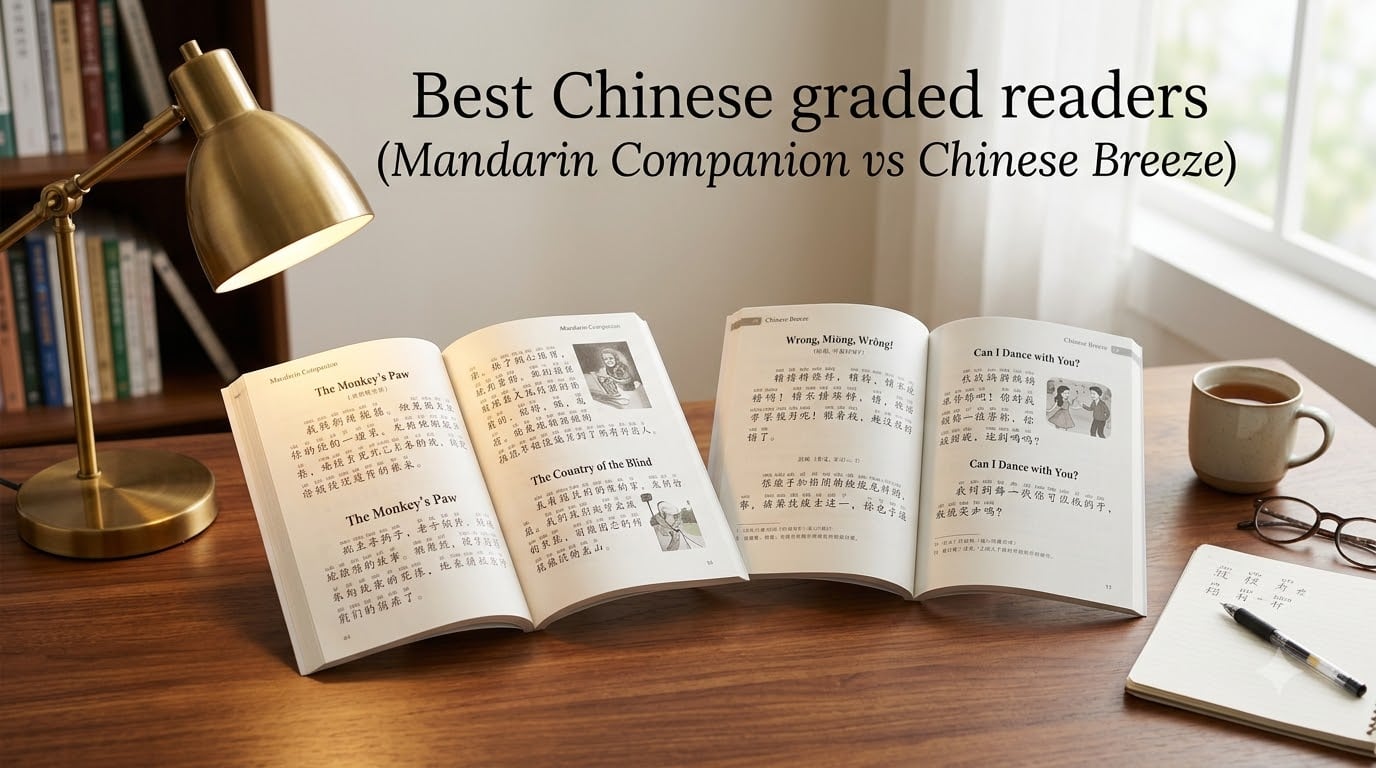
If you’re learning Mandarin and want to actually read in Chinese — not just study textbooks — graded readers are the fastest path there. Chinese graded readers are books written with controlled vocabulary so you can read real stories at a level that matches what you already know. The two most popular print series are Mandarin Companion and Chinese Breeze, and they take fundamentally different approaches to how they limit vocabulary, structure their levels, and deliver audio support.
I’ve spent months reading through both series, and this guide breaks down exactly how they compare. We’ll look at every level, the pinyin and audio differences, traditional character support, and which series fits which type of learner. By the end, you’ll know exactly which one to pick — or whether buying both is actually the smartest move.
Table of Contents
How Do the Major Chinese Graded Reader Series Compare?
Before diving into the two main series, here’s how the full landscape looks. Mandarin Companion and Chinese Breeze are the dominant print options, but they’re not the only ones worth knowing about.
| Series | Levels | Vocabulary | Format | Pinyin | Audio | Best For |
|---|---|---|---|---|---|---|
| Mandarin Companion | 3 (Breakthrough / Level 1 / Level 2) | 150 / 300 / 450 core characters | Paperback, ebook | No (footnotes only) | Separate audiobook purchase | Story-driven beginners who want adapted classics |
| Chinese Breeze | 4 (Level 1 / 2 / 3 / 4) | 300 / 500 / 750 / 1100 controlled words | Paperback, ebook | Yes (full pinyin in some editions) | MP3 via QR code (second edition) | Value-focused learners wanting genre variety |
| Rainbow Bridge | Multiple (150–1200 words) | 150–1200 words per level | Paperback | Yes | CD included | Younger learners and classroom use |
| Du Chinese | HSK 1–6+ | Graded by HSK level | App (digital) | Toggle on/off | Built-in audio | Daily reading habit and mobile learners |
| The Chairman’s Bao | HSK 1–6+ | Graded by HSK level | Web + app | Toggle on/off | Built-in audio | News-based reading and exam prep |
This comparison focuses on Mandarin Companion and Chinese Breeze because they’re the two series that most self-study learners end up choosing between. Both are well-established, widely available, and designed specifically for extensive reading practice.
Mandarin Companion Deep Dive
Mandarin Companion is a graded reader series published by Imagin8 Press that adapts classic stories and original fiction into simplified Chinese with a tightly controlled character set. The series currently has 18 books across three levels, and it’s become the go-to recommendation for absolute beginners who want to read actual stories rather than textbook dialogues.
Levels and Character Counts
The series uses three levels based on unique characters known:
- Breakthrough Level (150 characters) — For true beginners who know roughly 150 unique Chinese characters. These are the easiest entry point in the entire graded-reader market. Titles include adaptations of Sherlock Holmes stories and original mysteries.
- Level 1 (300 characters) — For learners who know around 300 characters. Stories get longer and more complex. This level includes adaptations of classic Western literature reimagined in Chinese settings.
- Level 2 (450 characters) — For upper-elementary to low-intermediate learners. The stories here feel more like real novels with subplots and character development.
One thing that trips up new learners: Mandarin Companion counts unique characters, not words. A character (hanzi) is a single written unit; a word can be one or two characters. So “300 characters” in Mandarin Companion terms covers more vocabulary than you might expect because many common words are made from those same characters in different combinations.
Pinyin and Reading Support
Mandarin Companion does not include pinyin above the text. Instead, difficult words are glossed in footnotes at the bottom of each page with English definitions. This is an intentional design choice — the publishers believe that pinyin above characters creates a crutch that slows down character recognition.
If you’re someone who absolutely needs pinyin to read, this will feel challenging at first. But many learners report that after 2-3 books, they stop needing the footnotes as much because the controlled vocabulary forces natural repetition.
Audio and Formats
Audiobook editions are available for most Mandarin Companion titles, but they’re sold separately — not bundled with the print book. The audiobooks are narrated at natural speed, which works well for listening practice but might be too fast for beginners following along.
Both paperback and ebook formats are available. The ebooks work well on Kindle and other e-readers, though the footnote system is less convenient in digital format than on paper.
Traditional Character Support
Mandarin Companion publishes in both simplified and traditional Chinese. This is a major advantage for learners studying traditional characters, especially those planning to study in Taiwan or interested in classical Chinese texts. Not many graded reader series offer traditional editions.
HSK Alignment
Mandarin Companion doesn’t map directly to HSK levels, but here’s the rough alignment:
- Breakthrough (150 characters) ≈ HSK 1-2
- Level 1 (300 characters) ≈ HSK 2-3
- Level 2 (450 characters) ≈ HSK 3-4
This isn’t exact because HSK tests vocabulary words while Mandarin Companion controls unique characters. A learner at HSK 3 might find Level 1 comfortable but Level 2 challenging depending on which specific characters they’ve studied.
Story Genre and Quality
Mandarin Companion’s strongest feature is story quality. The series adapts well-known Western classics — Sherlock Holmes, The Secret Garden, The Wizard of Oz — into Chinese settings with Chinese characters and cultural context. They also publish original fiction. Multiple Reddit users in r/ChineseLanguage describe these as “the best reading experience so far” for beginners, praising the plot quality over typical textbook fare.
The trade-off is that the catalog is small. With only 18 books total, motivated learners can finish the entire series in a few months. This is the single biggest complaint about Mandarin Companion in forums and reviews.
Chinese Breeze Deep Dive
Chinese Breeze is published by Peking University Press and takes a different approach. Rather than counting unique characters, it controls the total number of vocabulary words at each level. The series has four published levels with roughly 20 titles, making it the broader catalog of the two.
Levels and Word Counts
Chinese Breeze uses four levels based on controlled word count:
- Level 1 (300 words) — For beginners with around 300 known words. Stories are short and straightforward.
- Level 2 (500 words) — For early-intermediate learners. Plots become more complex.
- Level 3 (750 words) — For intermediate learners. Longer stories with more nuanced themes.
- Level 4 (1100 words) — For upper-intermediate learners approaching HSK 4-5 territory.
The distinction between “characters” and “words” matters here. Chinese Breeze counts compound words — so a two-character word like 电话 (telephone) counts as one word but two characters. This means Chinese Breeze’s 300-word level actually uses more unique characters than Mandarin Companion’s 300-character level, because some of those 300 words contain two characters each.
Pinyin Support
This is where Chinese Breeze gets complicated. Pinyin availability depends on the edition and the specific title. Some Chinese Breeze books include full pinyin above every character. Others only provide pinyin for difficult words in footnotes. And older editions may have different annotation styles than newer printings.
Before buying, check the specific ISBN. The second-edition printings generally have better annotation, but not all titles have been updated. If pinyin is essential for your reading level, verify the edition before purchasing.
Audio Delivery
Second-edition Chinese Breeze books include audio delivered via QR code on the inside cover. Scan the code with your phone to access MP3 files at two speeds — normal and slow. This is convenient and doesn’t require a separate purchase.
However, the same edition caveat applies. Older printings may have CD audio or no audio at all. Forum users on chinese-forums.com have flagged this as a frustration — it’s hard to know what you’re getting without checking the ISBN first.
Traditional Character Support
Chinese Breeze is published in simplified Chinese only. If you’re studying traditional characters, this series won’t work for you as a primary resource. This is a significant limitation that isn’t always made clear in reviews.
HSK Alignment
Like Mandarin Companion, Chinese Breeze doesn’t map exactly to HSK. The rough comparison:
- Level 1 (300 words) ≈ HSK 2-3
- Level 2 (500 words) ≈ HSK 3-4
- Level 3 (750 words) ≈ HSK 4
- Level 4 (1100 words) ≈ HSK 4-5
Note that Chinese Breeze Level 1 starts at a higher vocabulary level than Mandarin Companion’s Breakthrough. If you’re an absolute beginner with fewer than 200 known characters, Chinese Breeze Level 1 may feel too difficult to start with.
Story Genre and Variety
Chinese Breeze covers a wider range of genres than Mandarin Companion. Titles include mystery, romance, science fiction, folk tales, and contemporary fiction. Some stories are original; others are adaptations. The variety is a strength — if you don’t like one story, there’s likely another at the same level with a different tone.
The flip side, as noted on Chinese forums and Reddit, is that some titles feel “childish or formulaic” compared to Mandarin Companion’s more literary approach. The writing quality varies more across the catalog. That said, titles like “Mother and Son” and “Green Phoenix” are frequently recommended by learners as standouts.
Mandarin Companion vs Chinese Breeze: Head-to-Head
Here’s the direct comparison on the dimensions that matter most when choosing between these two series.
| Feature | Mandarin Companion | Chinese Breeze |
|---|---|---|
| Vocabulary method | Unique characters (150/300/450) | Controlled words (300/500/750/1100) |
| Number of levels | 3 | 4 |
| Total books | 18 | ~20 |
| Pinyin | No (footnotes only) | Varies by edition |
| Audio | Separate audiobook purchase | QR code MP3 (second edition) |
| Traditional Chinese | Yes | No (simplified only) |
| Genre variety | Classics adaptations + original fiction | Wide range (mystery, romance, folk tales) |
| Entry level | 150 characters (true beginner) | 300 words (early beginner) |
| Upper level | 450 characters | 1100 words |
| Story quality consistency | High — consistently well-reviewed | Variable — some titles much better than others |
The core trade-off comes down to this: Mandarin Companion gives you a better reading experience at lower levels with a smaller catalog, while Chinese Breeze gives you more range — more levels, more titles, more genres — at a lower per-book cost.
The Character vs Word Count Difference
This is the most confusing part for new learners, so let me clarify. Mandarin Companion’s “300 characters” means 300 unique hanzi. Those 300 characters combine into many more words. Chinese Breeze’s “300 words” means 300 vocabulary items, some of which are two characters each.
In practice, this means Mandarin Companion Level 1 (300 characters) and Chinese Breeze Level 1 (300 words) are roughly comparable in difficulty, even though the numbers look similar. The actual reading experience feels similar too — both are appropriate for learners who’ve completed a basic Chinese course or studied for 6-12 months.
Cost Considerations
Chinese Breeze books are generally more affordable per title, and the included QR audio means you’re not paying extra for listening practice. Mandarin Companion’s separate audiobook purchase adds to the total cost if you want audio alongside reading.
However, if you factor in that Mandarin Companion’s Breakthrough level lets you start reading at just 150 characters (saving you months of study before you can begin), the time-value calculation shifts. Starting earlier has real compounding benefits for character recognition.
Who Should Choose Which Series?
Your ideal choice depends on where you are in your Chinese learning journey and how you prefer to study. Here’s a breakdown by learner profile.
Absolute Beginners (Under 200 Known Characters)
Pick: Mandarin Companion Breakthrough. There’s no equivalent entry point in Chinese Breeze. Mandarin Companion’s 150-character level lets you start reading real stories almost immediately. The lack of pinyin forces you to build character recognition faster, which pays off long-term.
Traditional Character Learners
Pick: Mandarin Companion. This isn’t even a close call. Mandarin Companion publishes in both simplified and traditional. Chinese Breeze is simplified-only. If you’re studying traditional characters — for heritage reasons, Taiwan study plans, or personal preference — Mandarin Companion is your only print option between the two.
Audiobook-Focused Learners
Pick: Chinese Breeze (second edition). The QR code audio is built into the book purchase, giving you two-speed listening practice at no extra cost. Mandarin Companion’s audiobooks are sold separately, which adds friction and expense. If you learn best by listening while reading, Chinese Breeze is more convenient.
Classroom Teachers and Curriculum Planners
Pick: Both. Use Mandarin Companion Breakthrough for absolute beginners and Chinese Breeze Level 1-2 for students who’ve moved past the 200-character mark. The different vocabulary methods actually complement each other in a classroom setting — students get exposure to both character-based and word-based thinking.
Pinyin-Dependent Readers
Pick: Chinese Breeze (verify edition first). If you can’t read without pinyin above the text, Mandarin Companion won’t work for you at this stage. Chinese Breeze offers pinyin support in some editions, though you need to check the specific ISBN before buying. Better yet, consider using Du Chinese app alongside either print series — it offers toggleable pinyin on every story.
Genre-Hungry Readers Who Get Bored Easily
Pick: Chinese Breeze. With mystery, romance, folk tales, science fiction, and contemporary stories, Chinese Breeze offers much more variety. If you’re the type of learner who abandons books that don’t hook you, having options at the same level keeps you reading.
What Comes After Mandarin Companion Level 2?
This is one of the most searched questions about Mandarin Companion, and the answer is straightforward: there is no Mandarin Companion Level 3. The series currently caps at Level 2 (450 unique characters), which creates a gap for learners who’ve finished all 18 books and want to keep progressing.
Here’s what to read next after completing Level 2:
- Chinese Breeze Level 2-3 (500-750 words) — The natural next step if you want to stay in graded-reader territory. The vocabulary jump from Mandarin Companion’s 450 characters to Chinese Breeze’s 500-word level is manageable.
- Du Chinese app (HSK 3-4 content) — Digital graded reading with tap-for-definition and built-in audio. Great for building daily reading habits at the intermediate level.
- The Chairman’s Bao (HSK 3-4 content) — News-based graded reading that exposes you to real-world Chinese while still controlling vocabulary difficulty.
- Simple native content — Children’s books, simple news articles, and Chinese social media posts become accessible around 500-750 known characters. This is where extensive reading starts feeling like real-world Chinese.
The key insight is that finishing Mandarin Companion Level 2 puts you at a level where Chinese Breeze Level 2-3 feels comfortable, giving you another 10-15 books to read before moving to native content.
Combining Both Series: The Buy-Both Strategy
Here’s something most reviews don’t mention: you don’t have to choose just one series. Mandarin Companion and Chinese Breeze complement each other well, and using both gives you more reading volume at each level.
A smart progression looks like this:
- Months 1-3: Start with Mandarin Companion Breakthrough (150 characters). Read all 4-5 titles.
- Months 3-6: Move to Mandarin Companion Level 1 (300 characters) and Chinese Breeze Level 1 (300 words) simultaneously. The overlapping vocabulary reinforces learning from different angles.
- Months 6-12: Mandarin Companion Level 2 (450 characters) alongside Chinese Breeze Level 2 (500 words). You’ll have 15+ books to read at roughly the same difficulty.
- Months 12+: Chinese Breeze Level 3-4 (750-1100 words) and transition to native content.
The total investment across both series gives you roughly 35-40 books of graded reading material — enough to build genuine reading fluency before moving to ungraded Chinese text.
Digital Alternatives Worth Knowing About
Mandarin Companion and Chinese Breeze are print-first series, but digital reading apps have become serious alternatives. Here’s a quick context:
- Du Chinese — The most popular Chinese graded reading app. Stories from HSK 1-6+, with tap-for-definition, toggleable pinyin, built-in audio, and spaced-repetition flashcards. Good for daily reading habits and mobile learners. The subscription model means unlimited access rather than per-book purchases.
- The Chairman’s Bao (TCB) — News-based graded reading organized by HSK level. Uses real news topics adapted for each level. Strong for exam prep and learning current vocabulary. Web and app access.
- Literate Chinese — A newer digital platform with corpus-data grading. Their coverage thresholds (e.g., “300 characters covers 80% of text”) are based on analysis of their story library.
These apps work well as supplements to print reading. Many learners use Du Chinese for daily practice and Mandarin Companion or Chinese Breeze for deeper weekend reading sessions.
Frequently Asked Questions
What are the best graded readers for Chinese?
The two most recommended print series are Mandarin Companion (150/300/450 characters, 18 books) and Chinese Breeze (300/500/750/1100 words, ~20 titles). Mandarin Companion is best for absolute beginners and traditional character learners; Chinese Breeze offers more levels and genre variety. For digital reading, Du Chinese and The Chairman’s Bao are popular app alternatives.
Is Mandarin Companion good for beginners?
Yes — Mandarin Companion is specifically designed for beginners. Its Breakthrough level starts at just 150 unique characters, making it the easiest entry point among print graded readers. The stories are adapted from well-known classics and original fiction, so they’re engaging rather than textbook-like. Multiple learners describe them as the best reading experience for beginners.
What HSK level is Chinese Breeze?
Chinese Breeze roughly aligns with HSK 2-5 depending on the level: Level 1 (300 words) maps to HSK 2-3, Level 2 (500 words) to HSK 3-4, Level 3 (750 words) to HSK 4, and Level 4 (1100 words) to HSK 4-5. There is no official HSK conversion published by either series, so these are approximate.
Does Mandarin Companion have pinyin?
No — Mandarin Companion does not include pinyin above the text. Difficult words are glossed in English footnotes at the bottom of each page. This is an intentional design choice to build character recognition without the pinyin crutch. If you need pinyin, Chinese Breeze (in some editions) or Du Chinese app are better options.
Does Chinese Breeze have pinyin?
It depends on the edition. Some Chinese Breeze books include full pinyin above every character, while others only provide pinyin for difficult words in footnotes. Second-edition printings generally have better annotation, but you should check the specific ISBN before purchasing to confirm pinyin availability.
Does Mandarin Companion have a Level 3?
No — Mandarin Companion currently has three levels: Breakthrough (150 characters), Level 1 (300 characters), and Level 2 (450 characters). There is no Level 3 published. After finishing Level 2, the recommended next step is Chinese Breeze Level 2-3 (500-750 words) or digital apps like Du Chinese at the HSK 3-4 level.
Are Chinese graded readers worth it?
Yes — graded readers give you comprehensible input at the right level, which research shows requires roughly 98% character coverage to learn from reading effectively. Native Chinese text can’t provide this below about 1,500 known characters. Graded readers bridge that gap, letting you build reading fluency through actual stories rather than isolated vocabulary drills.
What are the best Chinese graded readers for beginners free?
For free options, Du Chinese offers a limited number of free stories at each HSK level. The Chairman’s Bao has some free content for registered users. For print, most graded readers require purchase, but some Mandarin Companion titles offer free preview chapters on their website so you can test your level before buying.
Conclusion
Choosing between Mandarin Companion and Chinese Breeze comes down to where you are and what you value most. Mandarin Companion is the better starting point for absolute beginners and traditional character learners, with superior story quality but a smaller catalog. Chinese Breeze offers more levels, more titles, and built-in audio at a lower per-book cost, but requires checking editions carefully for pinyin support.
For most learners, the best approach to Chinese graded readers is to start with Mandarin Companion at the Breakthrough level, then bring in Chinese Breeze once you hit 300 characters. Reading both series gives you the volume you need to build real fluency — and by the time you’ve finished everything both series offer, you’ll be ready for native Chinese text.