
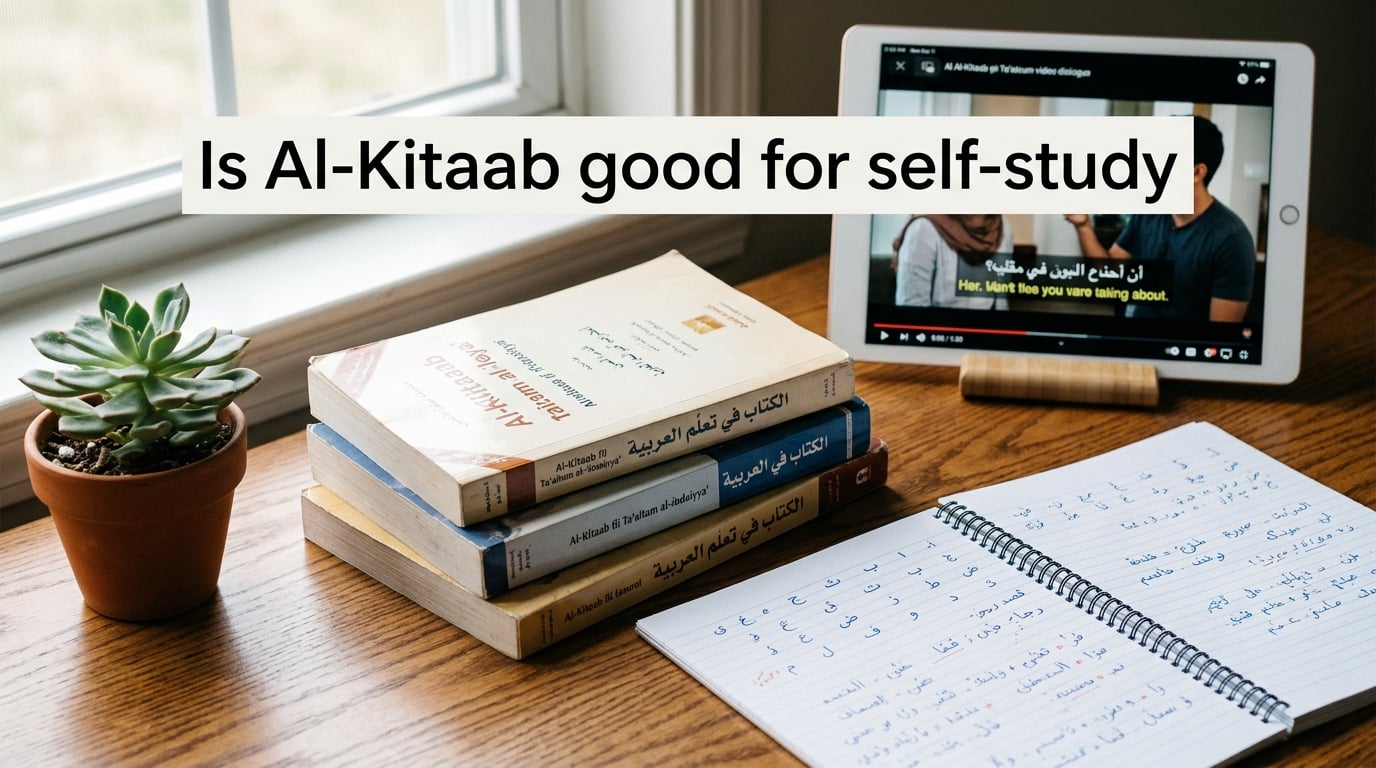
Short answer: Al-Kitaab fii Ta’allum al-‘Arabiyya can work for self-study, but only if you go in with eyes open about its classroom-first design. I have spent more than three years working through the series both solo and with tutors, and the honest take is this: the textbook’s content quality is excellent, but it assumes a teacher is standing next to you.
Independent learners who succeed pair the books with the companion website, a weekly iTalki session, and a disciplined schedule of at least five hours per week. If you want a gentle, low-effort introduction, choose Mastering Arabic instead. If you want comprehensive Modern Standard Arabic plus Egyptian or Levantine dialect and you are willing to put in the work, Al-Kitaab is one of the strongest self-study paths available in 2026.
Table of Contents
Quick Answer: Is Al-Kitaab Good for Self-Study?
Al-Kitaab is good for self-study if you are a disciplined adult learner who already knows the Arabic alphabet or is willing to finish Alif Baa first. It works best when paired with the companion website, at least one weekly conversation session on iTalki, and a structured weekly plan. It is not ideal if you want zero speaking feedback, no tutor, or a casual pace. In those cases, Mastering Arabic or the Madinah Arabic Books are friendlier entry points.
That quick answer is the one I wish someone had given me on day one, because the official publisher description tends to overstate how smoothly the books work without an instructor. The honest answer involves three trade-offs most reviewers skip: grammar explanations are terse, several exercises require a partner, and the speaking portions cannot be self-corrected from the page alone. Get those three things handled with supplements, and the series becomes one of the most rewarding self-study Arabic programs available.
Before deciding, ask yourself four questions:
- Do I already know the Arabic alphabet, or am I willing to spend 4 to 6 weeks on Alif Baa?
- Can I commit to at least 5 hours per week for 6 to 9 months to work through Part One?
- Am I willing to budget for at least one iTalki session per week for speaking feedback?
- Do I want Modern Standard Arabic plus a real spoken dialect (Egyptian or Levantine), not Quranic Arabic?
If you answered yes to all four, Al-Kitaab is a strong choice. If you hesitated on two or more, keep reading to compare the alternatives before committing.
What Is Al-Kitaab fii Ta’allum al-‘Arabiyya?
Al-Kitaab fii Ta’allum al-‘Arabiyya is a bestselling Modern Standard Arabic textbook series published by Georgetown University Press. It is the de facto standard Arabic program at more than 600 universities worldwide, including most North American institutions with serious Arabic programs. The full name translates to “The Book in Learning Arabic,” and the series has been through multiple editions, with the third edition of Alif Baa and Parts One and Two currently in use.
Three authors created the series, and the trio’s academic credentials matter for self-study because they explain why the content is rigorous but not always self-explanatory:
- Kristen Brustad – Associate Professor of Arabic at the University of Texas at Austin
- Mahmoud Al-Batal – Professor of Arabic at the University of Texas at Austin
- Abbas Al-Tonsi – Visiting Professor at Georgetown and longtime instructor at the American University of Beirut
The authors designed the series for university classroom use, which is both its strength and its main self-study limitation. The content is authoritative, the cultural material is rich, and the dialect integration is more sophisticated than any competing textbook. The trade-off is that explanations are often compressed because a teacher is expected to fill in the rest.
What Type of Arabic Does Al-Kitaab Teach?
Al-Kitaab teaches Modern Standard Arabic (MSA), also known as Fus’ha, integrated with Egyptian and Levantine spoken dialects. This is an important distinction because the three terms get confused constantly by beginners.
Modern Standard Arabic (Fus’ha) is the formal written and spoken variety used in news media, official speeches, academic writing, and literature across the Arab world. It is the language of newspapers in Cairo, Riyadh, and Beirut alike. Fus’ha is what you need to read books, understand newscasts, and write professionally.
Egyptian Arabic (Ammiyya) is the spoken dialect of Cairo and is the most widely understood spoken variety in the Arab world because of Egypt’s film and TV industry. Levantine Arabic covers Syria, Lebanon, Jordan, and Palestine, and is the variety you hear in major soap operas and political coverage.
Al-Kitaab color-codes dialect passages: Egyptian is usually shown in pink or red shading and Levantine in green, with MSA in plain black. As a self-learner, you choose which color to follow for the spoken sections. The grammar instruction stays in MSA throughout, which is what makes the series academically useful.
What Al-Kitaab does not teach is Quranic Arabic or Classical Arabic in the traditional religious-studies sense. If your primary goal is to read the Quran in the original without a teacher, the Madinah Arabic Books or a dedicated classical program like al-Azhar curricula will serve you better. Al-Kitaab’s Modern Standard Arabic is the same root language as Classical Arabic, but the grammar, vocabulary, and style targets are contemporary.
How the Series Is Structured
The series is made up of four books, designed to be used in sequence. Each one has a specific role, and skipping any of them creates problems that compound later.
Alif Baa: Introduction to Arabic Letters and Sounds
Alif Baa is a multimedia introduction to the Arabic alphabet, basic sounds, and writing system. It is not the alphabet itself. Alif Baa teaches you how the letters look, how they connect, how to write them by hand, and how the short vowels (harakat, tashkeel) work. It also introduces you to listening to native speakers through video dialogues.
For self-study, plan on 4 to 6 weeks for Alif Baa if you are starting from zero. The book is short, but the writing practice takes real time, especially if your handwriting is not yet fluent. Most self-learners rush this stage and regret it when they hit Part One and cannot read the connected-script text quickly enough to follow grammar explanations.
Al-Kitaab Part One: Building the Foundation
Part One is the heart of the series. It introduces the root-and-pattern morphology system, basic sentence structure, present-tense verbs, possession, and the first several hundred vocabulary items. The third edition is current and includes a significantly expanded video library and a redesigned companion website.
Realistic self-study pace for Part One: 6 to 9 months at 5 to 7 hours per week. The first three chapters are the steepest learning curve because everything is new. After chapter 4 or 5, the spiral method starts paying off and grammar recycles rather than piles up.
Al-Kitaab Part Two: Intermediate Grammar and Longer Texts
Part Two picks up where Part One ends and pushes into more complex morphology, conditional sentences, and longer reading passages. The texts in Part Two are noticeably more authentic and culturally rich than Part One. Self-study pace: 6 to 9 months at the same intensity.
Al-Kitaab Part Three: Advanced Reading and Composition
Part Three is the only volume that has not yet been updated to a third edition. It focuses on reading authentic articles, writing short compositions, and engaging with unedited media Arabic. Self-study pace: 4 to 6 months. Part Three is where many solo learners stall out, because the materials become genuinely difficult and there is less hand-holding.
Teaching Methodology Behind Al-Kitaab
Two methodological choices define the Al-Kitaab experience and explain both why it works and why it frustrates solo learners.
The Communicative Approach
The series uses a communicative language teaching approach. Grammar is taught in service of communication rather than as an end in itself. New structures appear first in dialogues and reading passages, and grammar explanations follow. This is excellent for building reading and listening skills, and it is the methodology most modern language programs have adopted.
For self-study, the communicative approach is a double-edged sword. You get authentic language from day one, but you also need to infer a lot of grammar from context, which is exactly the job a teacher would normally do for you.
The Spiral Grammar Method
Spiral grammar means each grammar topic is introduced simply, then revisited at increasing levels of complexity across chapters. You do not learn a verb form once and never see it again. You learn the present tense, then the past, then the subjunctive, then the conditional, each time deepening the same root system.
For self-study, spiral grammar is actually a gift. It gives you multiple exposures to each structure, which is exactly how memory consolidation works. The frustration is that early chapters can feel deceptively easy, then later chapters suddenly feel overwhelming because so many recycled structures now appear in complex combinations.
The Companion Website and Lingco Platform
Every new copy of Al-Kitaab Part One, Two, and Three includes an access code for the companion website, which now runs on the Lingco platform. The site hosts audio for every reading, streaming video for dialogues, and a growing number of self-correcting exercises. Independent learners receive 18 months of access starting after a free 14-day grace period, which is a significant chunk of time if you pace yourself.
Who Al-Kitaab Is Designed For (and Who It Is Not)
The series is designed for university-level adult learners working through a structured program over several semesters. It assumes access to a teacher, peers for pair work, and an institutional schedule. None of those are requirements for the content to work, but they are the assumptions baked into the explanations.
Al-Kitaab works very well for self-study if you are:
- A disciplined adult learner who has finished Alif Baa or already knows the script
- Someone who wants MSA plus a real dialect (not a “tourist phrasebook” approach)
- A learner who can commit to at least 5 hours per week for 9 to 18 months
- Someone willing to budget for one weekly iTalki session (or another tutor) for speaking feedback
- A self-learner who likes structure and does not mind dense academic content
Al-Kitaab is not the right self-study choice if you are:
- A complete beginner who has never seen the Arabic alphabet and wants a gentle on-ramp
- Someone whose goal is conversational Egyptian or Levantine only, with no need for MSA
- A learner studying primarily for religious reasons (Quranic Arabic or hadith reading)
- A casual learner who wants to “pick up a few phrases” for travel
- Someone who cannot afford the supplement stack (tutor sessions, Anki, website access)
Honest Pros of Using Al-Kitaab for Self-Study
After working through Part One and Part Two as a solo learner, here are the benefits I found genuinely valuable.
- Authoritative, university-grade content. The grammar explanations are accurate, the cultural notes are thoughtful, and the vocabulary is curated for genuine communication rather than tourist phrases.
- Dialect integration from early chapters. Few competing textbooks expose you to real spoken Egyptian or Levantine this early. Al-Kitaab does, and that early exposure pays off when you start listening to podcasts or watching TV.
- Self-correcting exercises on the companion website. The Lingco platform now includes auto-graded exercises for most chapters. This is the single biggest improvement for self-learners between the second and third editions.
- Spiral grammar builds genuine retention. Each structure returns multiple times. You do not learn something once and forget it; you relearn it at increasing depth, which matches how memory actually works.
- Authentic reading passages from chapter 1. The texts use real Arabic, slightly graded for level, rather than artificial “textbook Arabic.” By Part Two, you are reading newspaper-style material with confidence.
- Widely adopted, so finding help is easy. When you get stuck, r/learn_arabic, language exchange partners, and iTalki tutors all know Al-Kitaab. That ecosystem is a self-study advantage no smaller textbook can match.
Honest Challenges of Self-Studying Al-Kitaab
The challenges below are real and were flagged consistently by reviewers on r/learn_arabic and other forums. Going in with these in mind keeps you from getting derailed when they appear.
- Grammar explanations are terse and assume a teacher is present. Several reviewers noted the book “never explains [things] enough.” Independent learners need to fill gaps with YouTube lectures, an Arabic grammar reference, or a tutor.
- Many exercises require a partner or instructor. Speaking drills, pair work, and some writing prompts are designed for two students. As a solo learner, you must improvise with self-talk, recording yourself, or language exchange partners.
- No full answer key for every exercise. The companion website has self-correcting activities, but not every chapter exercise is graded. Self-learners sometimes get stuck on a problem with no way to verify their answer.
- Speaking and pronunciation feedback require a tutor. The page cannot tell you whether your kha is guttural enough or whether your idafa structure sounds natural. This is the single biggest gap in any pure solo setup.
- Dialect track decision feels arbitrary without guidance. The series offers both Egyptian and Levantine, but does not explain how to choose. Most self-learners default to Egyptian because of media availability, which is a reasonable but uninformed choice.
- Full series investment is significant. Buying Alif Baa, three parts, the answer keys where available, and website access is a meaningful financial commitment before you have proven you will stick with it.
- Part Three has not been updated. The third edition covered Alif Baa and Parts One and Two. Part Three is still on the second edition, and its companion materials feel dated compared to the newer volumes.
Al-Kitaab vs Mastering Arabic vs Madinah Arabic for Self-Study
The question “What is the best Arabic textbook for self-study?” comes up constantly, and the honest answer is that it depends on your goal. Here is a direct comparison of the three most common choices.
Al-Kitaab vs Mastering Arabic vs Madinah Arabic: At a Glance
- Al-Kitaab — Best for comprehensive MSA plus Egyptian or Levantine dialect; designed for classroom use but works for disciplined solo learners with supplements.
- Mastering Arabic — Best for absolute beginners; gentle pace, full answer key in the back, designed by Jane Wightwick and Mahmoud Gaafar. Easier on-ramp but shallower dialect coverage.
- Madinah Arabic Books — Best for Quranic and Classical Arabic focus; widely used in Islamic schools worldwide; strong grammar drills but limited conversation and dialect content.
Choose Al-Kitaab if your goal is academic MSA plus a real dialect and you are willing to put in the work. Choose Mastering Arabic if you want the gentlest possible entry into reading and writing Modern Standard Arabic without dialect overhead. Choose Madinah Arabic Books if your primary goal is reading Islamic texts in Arabic.
One thing worth clarifying is the name confusion around “Al-Kitaab.” There is also a series called Al-Kitab al-Asasi (sometimes written “Al-Kitaab Al-Asasi”), published in Egypt and oriented toward Egyptian Arabic specifically. It is a different program with a different approach. If a tutor or bookstore recommends “Al-Kitaab,” confirm which one they mean before buying.
How Long It Takes to Self-Study Through Al-Kitaab
Arabic is classified by the U.S. Foreign Service Institute as a Category IV language, meaning it takes approximately 2,200 classroom hours for an English speaker to reach professional working proficiency. That is a long runway. Self-study typically takes 30 to 50 percent longer than classroom pace because you lose the in-class speaking practice.
Realistic self-study pacing per book:
- Alif Baa: 4 to 6 weeks at 4 to 5 hours per week
- Part One: 6 to 9 months at 5 to 7 hours per week
- Part Two: 6 to 9 months at 5 to 7 hours per week
- Part Three: 4 to 6 months at 5 to 7 hours per week
Total realistic commitment for the full series via self-study is roughly 18 to 30 months of consistent work. That is a long time, and it is the reason most solo learners either quit during Part Two or commit to a multi-year project. Treat it as a multi-year project and you will not be surprised by the pace.
How to Set Up the Companion Website as an Independent Learner
One of the gaps in most online guides is a clear walkthrough of how to actually use the companion website without being enrolled in a class. Here is what independent learners need to know.
Each new copy of Al-Kitaab Part One, Part Two, and Part Three includes a one-time access code printed inside the front cover. Alif Baa’s companion materials have historically been open access and do not require a code. To redeem your access:
- Go to the Lingco platform at alkitaabtextbook.com and create a learner account.
- Enter the access code from your book when prompted.
- You receive a 14-day grace period before the 18-month access countdown begins, so redeem the code only when you are ready to start working.
- Bookmark the chapter you are on so you can return directly to audio, video, and self-correcting exercises.
What is included in the companion access: streaming audio for every reading passage, video dialogues with native speakers, a growing number of self-correcting exercises (multiple choice, fill in the blank, drag and drop), and instructor-recorded grammar mini-lectures for selected chapters. Activities that require manual grading, such as free writing, are uploaded by your instructor in classroom settings, which means independent learners do not receive feedback on those.
Common Mistakes Self-Study Learners Make with Al-Kitaab
After comparing notes with other solo learners and reviewing what gets posted on r/learn_arabic, these are the mistakes that derail people most often.
- Skipping Alif Baa and jumping straight to Part One. Without solid alphabet and handwriting practice, the first three chapters of Part One feel impossible.
- Choosing the wrong dialect track and switching midstream. Pick one (Egyptian is the safer default because of media) and stick with it for at least Part One before experimenting.
- Doing only written work and skipping speaking practice. Speaking requires a tutor or partner, but skipping it leaves a permanent gap.
- Underutilizing the companion website. Many self-learners treat the website as optional. It is not. It is the closest thing you have to a built-in answer key.
- Reading passively instead of actively. Highlighting without producing output does not build retention. Read aloud, summarize in your own words, and write shadow sentences.
- Doing too much in one sitting. Five focused hours per week beats two 10-hour weekend marathons. Spaced repetition is the whole point.
- Avoiding grammar references. When Al-Kitaab’s explanation is too terse, reach for a reference like Wright’s Arabic Grammar or YouTube grammar lectures rather than guessing.
- Quitting at chapter 4 of Part One. The spiral method creates a noticeable difficulty spike around chapters 4 and 5. Almost every dropout I have seen happens here. Push through to chapter 6 and the curve flattens.
- Neglecting listening practice. Al-Kitaab’s audio is high quality. Listen to every dialogue three times: once without text, once with text, once shadowing the speaker.
- Ignoring handwriting practice. Even if your goal is reading and speaking, handwriting reinforces letter recognition and morphology. Skimping on it hurts later.
- Not budgeting for a tutor. “Free self-study” is a myth for Arabic. One weekly iTalki session at 60 minutes is the cheapest insurance against the gaps the textbook leaves open.
- Comparing progress to classroom students. Classroom learners get 4 to 5 hours per week of structured input plus homework feedback. You will move slower. That is normal.
Recommended Supplement Stack for Solo Learners
The minimum viable supplement stack for self-studying Al-Kitaab successfully includes four tools, and each one fills a specific gap the textbook leaves open.
- Anki (free) — Use it for vocabulary and verb conjugations. Build a deck of every new word from each chapter and review daily. Spaced repetition is what makes vocabulary stick long-term.
- Forvo (free tier) — Use it to hear native pronunciation of any word you encounter. The textbook audio is excellent but does not cover every vocabulary item.
- iTalki or another tutor platform — Budget at least one 60-minute session per week. Use it for speaking drills, grammar clarification, and the partner-activities the textbook assumes a teacher will run.
- YouTube grammar lectures — Channels like ArabicPod101, Learn Arabic with Maha, and several university-recorded lectures fill in the gaps where the textbook’s explanations are too terse.
One optional but high-value add-on is a dedicated grammar reference. A Reference Grammar of Modern Standard Arabic by Ryding is the standard companion reference. You will not read it cover to cover, but you will pull it off the shelf whenever a textbook explanation stumps you.
Sample 3-Month Self-Study Schedule
Below is a realistic schedule for the first 12 weeks of Al-Kitaab self-study, assuming 5 to 6 hours per week and a starting point of zero Arabic knowledge.
Month 1: Alif Baa (weeks 1-4)
- Week 1: Letters alif through ya, basic short vowels, handwriting practice 30 minutes daily
- Week 2: Remaining letters, connected forms, sukkun and shadda
- Week 3: All videos and listening exercises in Alif Baa
- Week 4: Review, self-correcting exercises on the website, light start of Part One chapter 1 vocabulary
Month 2: Part One chapters 1-3 (weeks 5-8)
- Week 5: Chapter 1 full read, dialogue shadowing, build Anki deck for chapter 1 vocabulary
- Week 6: Chapter 1 self-correcting exercises, start chapter 2, first iTalki session
- Week 7: Chapter 2 full read and exercises, reinforce Anki deck, second iTalki session
- Week 8: Chapter 3, including the first grammar section on the idafa construction
Month 3: Part One chapters 4-6 (weeks 9-12)
- Week 9: Chapter 4 grammar on present-tense verbs; this is the difficulty spike; do not skip review
- Week 10: Continue chapter 4 exercises, third and fourth iTalki sessions focused on speaking the new verb forms
- Week 11: Chapter 5, past tense, and the cultural reading passages
- Week 12: Chapter 6, cumulative review of chapters 1-6, mock self-test on vocabulary and verb conjugation
By the end of month 3, a disciplined self-learner should have a working alphabet, roughly 300 vocabulary items, a solid grasp of idafa, present-tense verbs, and past-tense verbs, plus several hours of recorded speaking practice. That is a strong foundation for continuing into Part One chapters 7 through 12 and beyond.
Frequently Asked Questions
Is it possible to learn Arabic by yourself?
Yes, but Arabic is a Category IV language, meaning it requires roughly 2,200 classroom hours to reach professional working proficiency. Self-study usually takes 30 to 50 percent longer than classroom pace, so plan on 18 to 30 months of consistent work to complete a full textbook series. Independent learners who succeed typically pair a textbook with a tutor platform, a flashcard system like Anki, and a community for accountability.
What is the best Arabic textbook for self-study?
For absolute beginners, Mastering Arabic by Jane Wightwick and Mahmoud Gaafar is the friendliest self-study option because it includes a full answer key in the back and progresses gently. For learners who want comprehensive Modern Standard Arabic plus a real spoken dialect, Al-Kitaab fii Ta’allum al-‘Arabiyya is the strongest choice if you are willing to add a tutor and the companion website. For Quranic or Classical Arabic focus, the Madinah Arabic Books are the most widely used option.
Can I learn Arabic in 3 months?
In 3 months of consistent self-study (around 5 to 6 hours per week), you can realistically finish Alif Baa and the first 3 chapters of Al-Kitaab Part One, building a working alphabet, roughly 300 vocabulary items, and a foundation in present-tense verbs. You will not be conversational in 3 months. Reaching a comfortable intermediate level usually takes 12 to 24 months of consistent study.
How long does it take to learn Alif Baa?
Alif Baa typically takes 4 to 6 weeks of self-study at 4 to 5 hours per week if you are starting from zero Arabic knowledge. The book is short, but handwriting practice and audio shadowing are where the real time goes. Rushing through Alif Baa creates problems in the first chapters of Part One, so it is worth taking the full month even if the content feels simple.
Is Alif Baa the same as the Arabic alphabet?
No. Alif Baa is an introductory textbook that teaches you how to recognize, pronounce, and write the Arabic alphabet. The Arabic alphabet itself is the 28-letter writing system. Alif Baa includes the alphabet plus handwriting instruction, basic sound practice, short-vowel marks, and short video dialogues to start training your ear.
Is Al-Kitaab hard for beginners?
Al-Kitaab Part One is challenging for beginners because the grammar explanations are terse and assume a teacher is present. Beginners who complete Alif Baa first, work through chapters at the recommended pace, and use the companion website regularly report the difficulty spike around chapters 4 and 5 as the main obstacle. Pushing through to chapter 6 usually settles the curve.
Do I need a teacher for Al-Kitaab?
You do not strictly need a teacher to use Al-Kitaab, but independent learners get noticeably better results with at least one weekly tutor session. A tutor fills in the gaps where grammar explanations are too compressed, runs the speaking drills the textbook assumes, and gives feedback on pronunciation and writing. The cheapest way to add this support is a weekly 60-minute iTalki session.
Final Verdict: Should You Self-Study Al-Kitaab?
Yes, if you are a disciplined adult learner with realistic expectations and a willingness to add the supplement stack Al-Kitaab assumes a teacher would provide. The textbook’s content is the best you can find for comprehensive Modern Standard Arabic plus Egyptian or Levantine dialect, and the third-edition companion website makes independent use more feasible than it has ever been.
No, if you are a complete beginner who wants a gentle entry into Arabic, want zero tutor support, or are studying primarily for Quranic reasons. In those cases, Mastering Arabic or the Madinah Arabic Books are better fits.
If you decide Al-Kitaab is right for your self-study goals, the next step is to order Alif Baa and Part One together, set up the Lingco companion access right away, and book a trial iTalki session before you hit chapter 4 of Part One. That combination gives you the strongest chance of finishing the series in 2026 or the year ahead.