
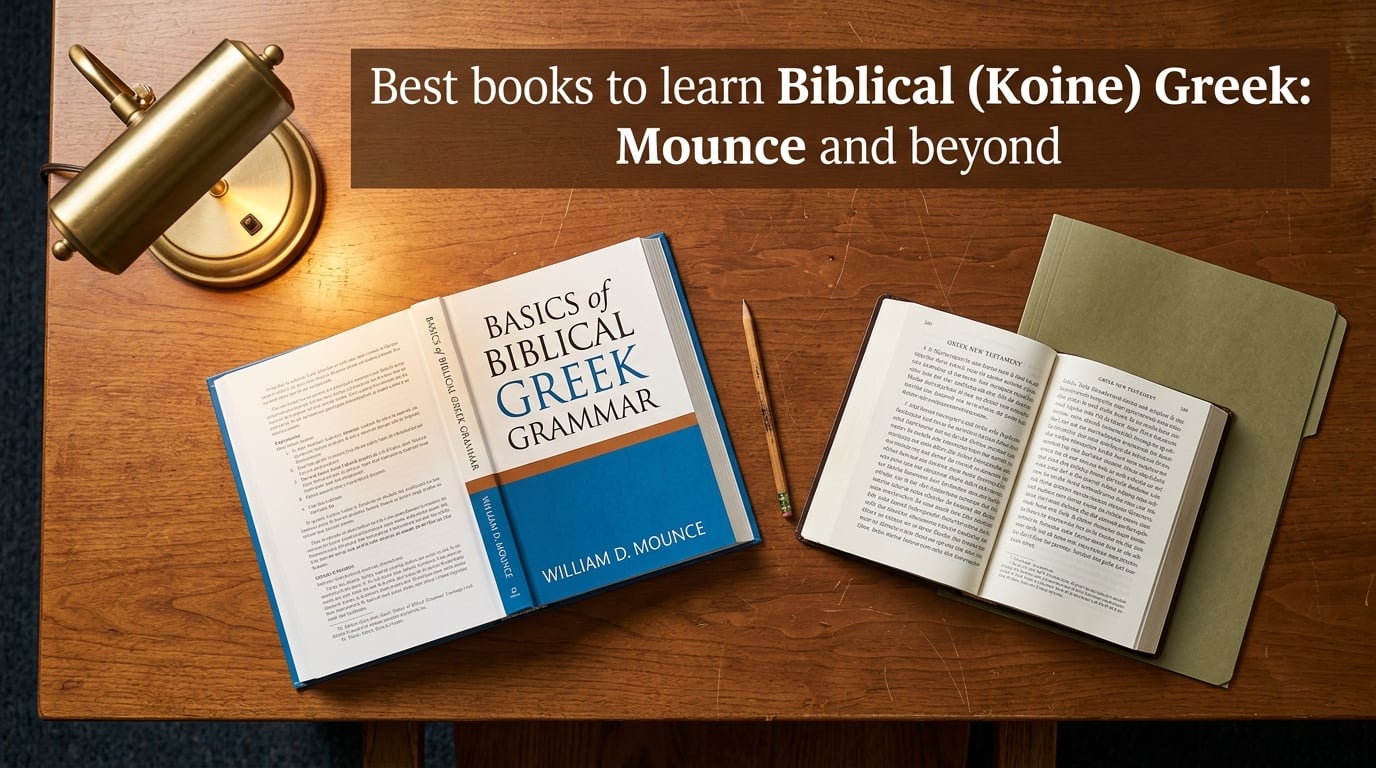
Picking the best books to learn Biblical Greek feels overwhelming the first time you open a New Testament Greek catalog. Dozens of grammars promise fluency, seminaries swap textbooks every decade, and the forums are full of strong opinions.
The good news: a small cluster of well-regarded grammars covers most learners. This guide maps that cluster, walks through the standard Mounce-led path and its alternatives, and gives you a realistic pacing plan so you can actually finish a grammar instead of stalling at chapter 10.
Biblical (Koine) Greek is the common supra-regional form of Greek used in the Septuagint and the New Testament. It descended from the Hellenistic dialect that spread after Alexander the Great’s conquests and survived through the early church fathers.
Below, you will find a ranked quick-reference list, deep dives into Mounce’s BBG and Wallace’s intermediate grammar, alternative beginner grammars, devotional bridge books, lexicon recommendations, and a self-study roadmap grounded in real learner experiences.
Table of Contents
Top Picks at a Glance: Best Books to Learn Biblical Greek
Here are the five most-used, most-recommended books to learn Biblical Greek right now, drawn from seminary syllabi, publisher catalogs, and learner forums. Each entry names the author, the level, and the kind of student it fits best.
- Basics of Biblical Greek by William D. Mounce — the default first-year grammar used in dozens of M.Div. programs, ideal for self-study.
- Greek Grammar Beyond the Basics by Daniel B. Wallace — the standard intermediate grammar that follows BBG and unlocks serious exegesis.
- Learn to Read New Testament Greek by David Alan Black — an analytic-translation approach that gives faster early wins for motivated beginners.
- Greek for the Rest of Us by William D. Mounce — a devotional bridge book for lay readers who want the payoff of Greek without full grammar drills.
- Going Deeper with New Testament Greek by Andreas J. Köstenberger and Benjamin L. Merkle — an intermediate grammar that doubles as a workbook for self-learners moving past BBG.
That lineup covers the vast majority of learners. If you only buy one book, BBG is the safest starting point. If you want a different route, the sections below show you the alternatives.
What Is Biblical (Koine) Greek and Why Is It Different?
Biblical Greek is the everyday Hellenistic dialect found in the Septuagint and the New Testament, distinct from the literary Classical (Attic) Greek of Plato and Thucydides. Linguists usually call this dialect Koine, a shared common language that bound the Mediterranean world together from around 300 BCE to 300 CE.
The differences from Classical Greek matter practically. Koine simplified some Attic noun endings, used fewer optative moods, and absorbed vocabulary from Hebrew, Aramaic, and Latin. For learners, that means Classical Greek textbooks are usually the wrong tool — they over-teach forms that never appear in the New Testament.
Biblical Greek also pulls in three specific sub-dialects. New Testament Greek is the core corpus. Septuagint Greek carries the translation style of the Jewish scriptures. Patristic Greek extends into the early church fathers. A good New Testament grammar covers the first one solidly and gives you enough footing to read the second with help.
Mounce’s Basics of Biblical Greek: The Standard Entry Point
Basics of Biblical Greek (BBG) by William D. Mounce is the most widely adopted first-year Biblical Greek grammar in English, used in M.Div. programs at Dallas Theological Seminary, Gordon-Conwell, and many other schools. It is the default answer to “what is the best book to learn Biblical Greek?” for good reason.
BBG is structured around 30+ chapters that move from the alphabet through nouns, adjectives, the indicative mood, participles, and infinitives. Each chapter includes vocabulary lists, parsing exercises, translation drills, and a summary that recycles earlier material. The third edition adds clearer verb-tense diagrams and an expanded workbook.
Mounce uses a frequency-based vocabulary approach. The first 200 words cover roughly 50 percent of the New Testament, and the first 500 words cover about 80 percent. That sequencing lets learners read real passages in the Gospel of John by chapter 20, which keeps motivation high. The companion FlashWorks app and the Mounce.com course make the vocabulary work easier than flashcards alone.
BBG works best for self-study learners who can commit 30 to 45 minutes a day. It is also a strong fit for seminary students who want a textbook that doubles as a reference long after the course ends. It is less ideal for learners who want devotional Greek without grammar drills — for those readers, Greek for the Rest of Us is the better bridge.
Wallace’s Greek Grammar Beyond the Basics: The Intermediate Counterpart
Once you have finished BBG, the next standard step is Daniel B. Wallace’s Greek Grammar Beyond the Basics. Wallace is a PhD-trained New Testament scholar whose syntax work is cited across evangelical and academic seminaries, and his grammar is the bridge from translation exercises to serious exegesis.
Greek Grammar Beyond the Basics is not a beginner book. It assumes you can parse nouns and verbs confidently and pushes you into argument-structure analysis, verbal aspect theory, and the kind of sentence-diagramming that feeds commentaries. Most seminaries assign chapters from Wallace in second-year Greek.
For self-study, Wallace is a tougher climb than BBG because it has fewer practice sentences. Self-learners often pair it with Going Deeper with New Testament Greek by Köstenberger and Merkle, which reads more like a workbook and reinforces the same concepts.
On forums, former M.Div. students consistently say the BBG-then-Wallace path is the backbone of pastoral exegesis. If you only complete one grammar in your lifetime, finish BBG. If you complete two, finish Wallace after. That second finish is what separates translation-checking pastors from devotional readers.
Alternative Beginner Grammars Worth Knowing
BBG is the default, but it is not the only valid starting point. Several alternative grammars use different pedagogical methods, and for some learners they fit better.
Learn to Read New Testament Greek by David Alan Black
Black’s grammar uses an analytic-translation method. Instead of memorizing paradigm tables first, you translate carefully selected sentences and reverse-engineer the grammar from the patterns you see. Learners report faster initial wins and lower chapter-10 drop-off.
The trade-off is shallower morphology training. Students who finish Black often need a supplementary parsing resource before they can tackle Wallace, which is why Black is sometimes used as a bridge into BBG rather than a full replacement.
Greek for the Rest of Us by William D. Mounce
This is Mounce’s devotional bridge book, written for lay readers who want the payoff of Greek without the verb-tense density. It teaches you enough Greek to catch word-play in the Sermon on the Mount and the Johannine literature, but it does not prepare you to read unglossed passages.
It is the right book for pastors who never plan to take seminary Greek, Bible study leaders, and devotional readers. It is the wrong book if your goal is exegesis.
Bible Study Greek by William D. Mounce
Bible Study Greek is Mounce’s smaller companion workbook to Greek for the Rest of Us. It targets about 90 minutes of basic Greek learning and is designed for small-group Bible study cohorts rather than solo learners.
Learn Biblical Greek by John H. Dobson
Dobson’s primer is one of the oldest analytic-translation grammars still in print. It is short, dense, and runs about 50 lessons. It is a strong fit for self-motivated beginners who want a less expensive option than BBG and are willing to add a vocabulary app on the side.
Analytic-Translation vs. Traditional Grammar: Which Method Wins?
Two pedagogical camps compete in Biblical Greek. Traditional grammars (Mounce BBG, Wallace) teach morphology and syntax deductively, drilling paradigm tables before translation. Analytic-translation grammars (Black, Dobson) flip the order, asking learners to translate first and discover grammar from context.
Analytic-translation learners report faster initial momentum and a stronger sense of reading real Greek early. Traditional-grammar learners report stronger parsing skills by the end and easier transitions into Wallace and commentaries.
Neither method is wrong. If you have a logical mind and like clean tables, BBG’s deductive approach will feel natural. If you bounced out of high school language classes, Black’s analytic approach may keep you moving. Many seminaries now use BBG with an analytic-translation supplement in the first month to combine both strengths.
Companion Reference Works: Lexicons and Interlinears
A grammar teaches you the rules. A lexicon teaches you the words. You will need both, and the lexicon choice matters more than beginners expect.
BDAG (A Greek-English Lexicon of the New Testament)
BDAG stands for Bauer-Danker-Arndt-Gingrich, the four editors across its editions. It is the standard scholarly lexicon for New Testament Greek and is cited in nearly every serious commentary. It is also expensive and intimidating for beginners. Most self-study learners buy BDAG after finishing BBG, not before.
Thayer’s Greek-English Lexicon of the New Testament
Thayer’s is the 19th-century lexicon that BDAG effectively replaced. It is now public-domain and available free online. It is reliable for vocabulary lookups but reflects older scholarship, so use it for word meanings, not for cutting-edge semantic debates.
LSJM (Liddell-Scott-Jones-McKenzie)
LSJM is the massive Classical Greek lexicon. It includes New Testament vocabulary but gives Classical definitions first. Most New Testament students use LSJM only when BDAG is missing a rare word or when reading the Septuagint.
Mounce’s Complete Exhaustive Concordance of the Old and New Testaments
Mounce’s concordance pairs Greek words with English translations and counts occurrences. It is a faster lookup tool than BDAG for verse-level searches and is more beginner-friendly. Logos Bible Software bundles it with BDAG at a discount.
Free Online Lexicons
Blue Letter Bible, BibleHub, and the Perseus Project all host free Greek lexicons. They are good enough for self-study at the BBG level and let you delay the BDAG purchase until you know you will stick with Greek.
Self-Study Pacing: A Realistic Roadmap
Beginners consistently ask how long it takes to learn Biblical Greek. The honest answer from former seminarians on Reddit’s r/AcademicBiblical and the Biblical Greek Forum is roughly 9 to 12 months for BBG at 30 minutes a day, plus another 6 to 9 months for Wallace.
Here is a month-by-month pacing plan that fits a 30-minute daily commitment.
Months 1 to 2: Alphabet and Nouns
Learn the alphabet, pronounce it out loud, and master first-declension nouns. Aim for chapter 5 of BBG. Use FlashWorks on day one to start building vocabulary alongside the grammar.
Months 3 to 4: Verbs and the Present Indicative
Move through present-active indicative verbs and second-declension nouns. BBG chapters 6 through 14 cover this. This is the most common drop-off point. Plan a weekly review cycle where you re-translate two earlier chapters to lock in earlier material.
Months 5 to 7: Middle Voice, Participles, and Pronouns
BBG chapters 15 through 23 introduce middle and passive voices, participles, and personal pronouns. By the end of month 7, you should be able to read simple John verses without a parser.
Months 8 to 9: Remaining Tenses and Subjunctive
BBG chapters 24 through 30 cover aorist, future, perfect, and subjunctive moods. This is the second drop-off point because the paradigms multiply. Slow down here and review regularly.
Months 10 to 12: Wallace and Real Exegesis
Begin Greek Grammar Beyond the Basics. Pair it with a small reading goal, like translating one chapter of 1 John per week. By month 12, you should be able to read most of the Johannine literature with only a lexicon at hand.
Digital Tools That Make Self-Study Easier
FlashWorks is Mounce’s free flashcard app for the BBG vocabulary list. It runs on web and mobile and tracks which words you keep forgetting. Self-study learners on Reddit consistently credit it as the single biggest reason they finished BBG.
The Mounce.com course includes video lectures that walk through each BBG chapter. It is a paid resource, but it removes the isolation of self-study. Logos Bible Software integrates FlashWorks, BDAG, and the Mounce concordance in one workspace and is the long-term tool of choice for pastors who keep studying Greek after seminary.
For free options, BibleHub’s interlinear New Testament and Blue Letter Bible’s parsing tool cover most beginner needs. TekniaGreek is a free Greek font that lets you type and read Koine on any computer.
How to Choose the Right Book for Your Situation
Your learner profile matters more than publisher reputation. If you are a seminary-bound M.Div. student, BBG plus Wallace plus BDAG is the safe path. If you are a self-study pastor, BBG plus FlashWorks plus the Mounce.com course is the most survivable path.
If you are a lay devotional reader, skip BBG entirely. Start with Greek for the Rest of Us and Bible Study Greek, then add a vocabulary app. You will learn enough Greek to enrich your devotions without the verb-tense grind.
If you are a translator checking English renderings, Wallace plus BDAG plus Logos is the right starting kit. You do not need BBG if you can already read Greek from a prior degree.
If you are a homeschool parent teaching a high schooler, Dobson’s analytic-translation grammar is shorter and cheaper. Pair it with a free interlinear and a Greek alphabet poster.
Frequently Asked Questions
What is the best book to learn Biblical Greek?
Basics of Biblical Greek by William D. Mounce is the most widely recommended first-year grammar and is used in dozens of M.Div. programs. For learners who want a non-seminary devotional bridge book, Mounce’s Greek for the Rest of Us is the stronger choice.
Is Basics of Biblical Greek good for beginners?
Yes. BBG assumes no prior Greek and walks learners through the alphabet, vocabulary, and grammar in roughly 30 chapters. Self-study learners consistently finish it in 9 to 12 months at 30 minutes a day, especially when paired with the FlashWorks vocabulary app.
How long does it take to learn Biblical Greek with Mounce?
Most learners finish BBG in 9 to 12 months at about 30 minutes a day. Adding Wallace’s intermediate grammar takes another 6 to 9 months. Lay learners who only want devotional Greek can finish Greek for the Rest of Us in 8 to 10 weeks.
What is the difference between Mounce and Wallace’s Greek grammar?
BBG is a first-year grammar that teaches morphology, vocabulary, and basic syntax from zero. Wallace’s Greek Grammar Beyond the Basics is an intermediate grammar that assumes BBG-level fluency and pushes into argument structure, verbal aspect, and exegesis.
Can I learn Biblical Greek on my own?
Yes, with caveats. Self-study works best with a structured grammar like BBG, a vocabulary app like FlashWorks, a weekly review cycle, and a realistic 9 to 12 month commitment. Joining an online study group helps with motivation during the chapter-10 to chapter-14 drop-off zone.
What is the best Greek lexicon for Biblical Greek?
BDAG is the standard scholarly New Testament lexicon. Beginners can start with Thayer’s (free online) or Mounce’s Complete Exhaustive Concordance, then upgrade to BDAG once they finish BBG. Logos Bible Software bundles BDAG with related tools.
Choosing the Best Books to Learn Biblical Greek for 2026
The best books to learn Biblical Greek in 2026 are still the ones that have anchored seminary curricula for two decades: Mounce’s Basics of Biblical Greek for first-year, Wallace’s Greek Grammar Beyond the Basics for intermediate, and BDAG for word-level research. That core trio covers roughly 90 percent of learner profiles.
If you want a faster analytic-translation route, pair David Alan Black’s Learn to Read New Testament Greek with BBG. If you want devotional Greek without the grammar grind, Mounce’s Greek for the Rest of Us and Bible Study Greek will get you there in weeks. Pick the book that matches your goal, set a realistic 9 to 12 month commitment, and add FlashWorks so the vocabulary actually sticks.
Greek is a long project, but it is not a hard one. The hardest chapter is the one you do not start. Open BBG chapter 1 today, and you will be reading John in Greek by next summer.