
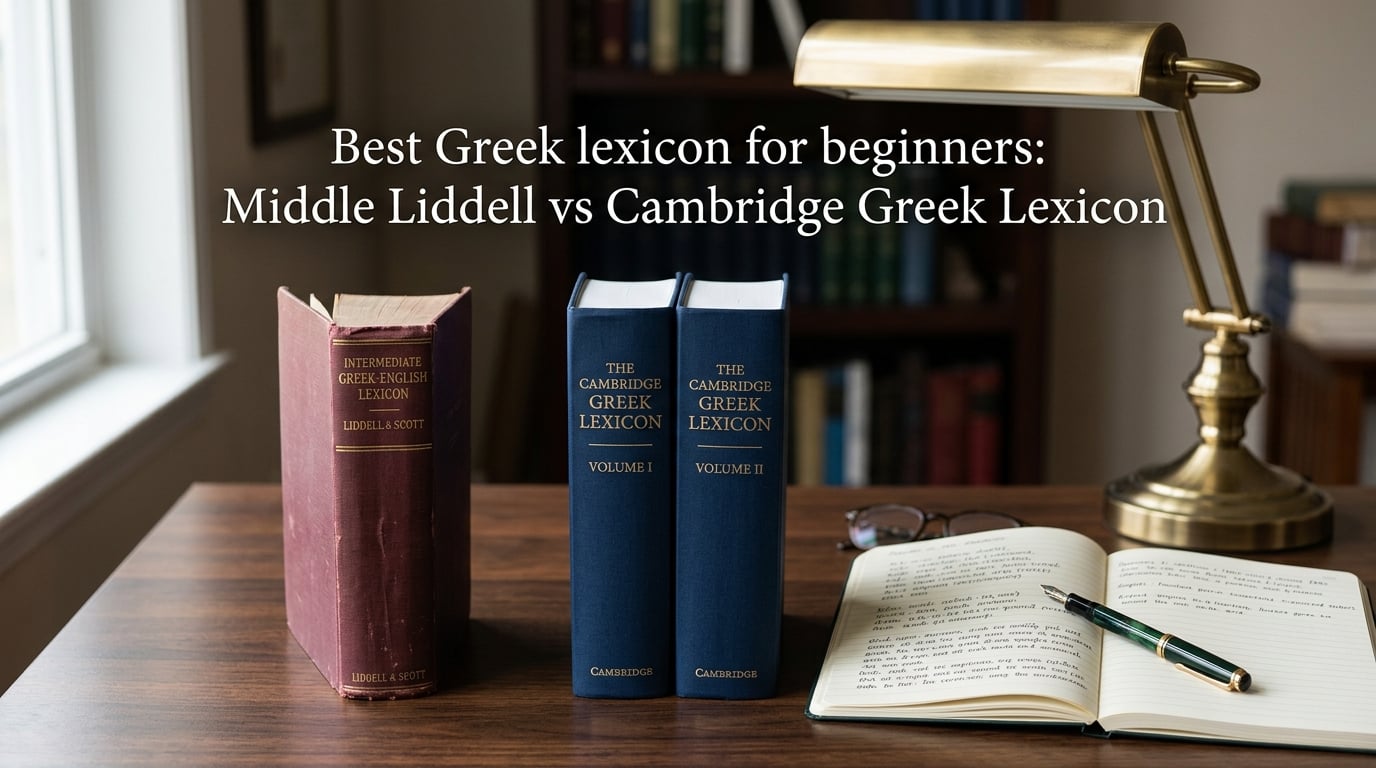
If you have just started learning Ancient Greek, the best Greek lexicon for beginners is the Cambridge Greek Lexicon for most learners, with the Middle Liddell as a strong low-cost alternative. Both are widely used by students, and the right pick depends on what you read and how you study.
I have spent the last several months reviewing scholarly reviews, forum threads, and beginner guides to write this comparison. Our team compared the two leading student lexicons head to head, sampled entries in each, and cross-checked opinions from named scholars (Dirk Jongkind, Peter Gurry, Alexander Thomson, and the BMCR review by Huitink and Nijk). Below you will find what each lexicon actually does, where it shines, where it falls short, and a simple decision guide to pick the right one for your first year.
Table of Contents
What Is a Greek Lexicon (and How Is It Different from a Dictionary)?
A Greek lexicon is a reference work that lists Ancient Greek words alphabetically, with detailed definitions, principal parts, citations, and usage notes that go far beyond a pocket dictionary. Where a beginner dictionary might translate a word in two or three short glosses, a lexicon groups every sense of a word by meaning, marks irregular forms, and points you to the contexts where the word actually appears.
Three terms matter as you start. A headword (sometimes called a lemma) is the dictionary form you look up, like δοξάζω. Principal parts are the six standard forms of a Greek verb that show you every tense and voice stem you will meet in real texts. Ekthesis is the convention of printing a final consonant outside the line when Greek moves to lowercase, a small typographic detail that helps you spot new entries on the page.
For a beginner, the practical difference is this: a dictionary helps you translate a sentence; a lexicon teaches you how a word behaves across centuries of Greek. You will use both, but a good lexicon is the one you keep on your desk for years.
A Short History of Liddell-Scott Lexicography
To understand these two books, you need to know they are cousins. Henry Liddell and Robert Scott published the first edition of their Greek-English Lexicon in 1843, and it quickly became the standard English-language reference for Classical Greek. By 1889, the editors released an abridged version called the Intermediate Greek-English Lexicon, nicknamed the Middle Liddell, aimed squarely at students rather than specialists.
The full lexicon went through eight more editions and was revised by Henry Stuart Jones in 1940, producing what scholars now call LSJ (Liddell-Scott-Jones). The 1996 ninth edition added a substantial supplement, but the core entries of LSJ still rest on scholarship that is well over a century old.
In 1997, the Cambridge classicist John Chadwick proposed a fresh revision of the Middle Liddell, but the project grew into something larger. After Chadwick’s death, James Diggle took over and led a team that built an entirely new lexicon from scratch, the Cambridge Greek Lexicon, published by Cambridge University Press in 2021. That origin matters: CGL was born as an attempt to fix the Middle Liddell and ended up replacing it for many readers.
Middle Liddell: The Classic Abridged Student Lexicon
The Middle Liddell (full title: An Intermediate Greek-English Lexicon) is the abridgment of LSJ designed for students of Classical Greek. It covers Greek literature from Homer through the early second century AD, including the major Classical authors (Homer, Herodotus, Thucydides, the tragedians, Plato, Xenophon, Aristotle, the orators, Plutarch), but it stops short of most New Testament and Patristic usage.
Its entry structure follows the older LSJ tradition. You find the headword in uncial (capital) Greek, the part of speech and gender for nouns, principal parts for verbs, and then numbered senses grouped by meaning. Each sense is supported by a Greek quotation with an author citation, so you can see the word in context and verify the editor’s gloss. That quoting approach is one of the Middle Liddell’s quiet strengths: when in doubt, you can read the example sentence yourself.
Its limitations are honest ones. The last full revision was in 1889, with a 1989 reprint adding a small supplement by P. G. W. Glare. New papyrus discoveries, post-Classical vocabulary, and modern editorial readings of the corpus are not reflected. The typography is dense by today’s standards, abbreviations for authors are Latin, and the binding of older reprints is fragile. For studying only the New Testament or Septuagint, you will find important gaps.
The Middle Liddell fits best when you want the lowest-cost printed reference for a first Classical Greek course, when you mostly read the standard Classical canon, and when you appreciate seeing Greek quotations as part of every entry.
Strengths of the Middle Liddell
- Compact single volume, easy to carry and hold open on a desk.
- Includes actual Greek quotations with author citations.
- Long familiarity in classrooms; most professors know its abbreviations.
- Lowest cost among the standard printed lexicons.
- Covers the entire Classical canon from Homer through Plutarch.
Limitations of the Middle Liddell
- Last fully revised in 1889; modern scholarship is not reflected.
- Abbreviations and dense typography feel old-fashioned to new readers.
- Limited coverage of New Testament, Septuagint, and Patristic Greek.
- Older reprints have weak bindings; buying a fresh print run matters.
Cambridge Greek Lexicon: The Modern Successor
The Cambridge Greek Lexicon (often called CGL) is the most important new Greek reference in a generation. It runs to two volumes totaling 1,529 pages, published by Cambridge University Press in 2021 under the general editorship of James Diggle, with a team that included associate editors and contributors from across the UK and Europe. The project was funded by the Arts and Humanities Research Council and printed on heavy paper with sewn bindings, a production quality that reviewers consistently praise.
CGL’s chronological scope is broader than the Middle Liddell’s. It runs from Homer to the early second century AD for Classical texts, then adds the New Testament (Gospels and Acts specifically, plus some Revelation), the Apostolic Fathers, and selected papyri and inscriptions. That makes it more useful if you straddle Classical and early Christian Greek, though reviewers note that serious New Testament study still calls for BDAG.
Its editorial method is the most distinctive shift from the older tradition. Where LSJ and the Middle Liddell quote Greek examples, CGL summarizes: it tells you who used a sense (with an author abbreviation like Soph. for Sophocles or NT for New Testament) without printing the Greek sentence. Definitions are written in modern English, contemporary and direct (a reviewer noted that CGL renders the verb χέζω plainly as “defecate, shit,” which older reference works tended to soften). Each entry is organized semantically, so the most common senses come first.
For a beginner, this approach has two big payoffs. You read cleaner, more accessible English, and you reach the core meaning of a word faster. The trade-off is that without quoted examples, you must trust the editors’ judgment, and scholars like Peter Gurry have voiced exactly that concern on the Evangelical Textual Criticism blog.
CGL fits best when you want a modern, clear, single-investment reference for both Classical and New Testament Greek, when you study at intermediate or advanced beginner level, and when contemporary English glosses matter more to you than classical density.
Strengths of the Cambridge Greek Lexicon
- Modern English definitions written for today’s students.
- Semantic-first entry order: common meanings come first.
- Includes New Testament Gospels and Acts plus Apostolic Fathers.
- Two-volume sewn binding, sturdy production, sturdy slipcase.
- Based on fresh readings of the corpus, not 19th-century scholarship.
Limitations of the Cambridge Greek Lexicon
- No Greek quotations or specific citations inside entries.
- New Testament coverage is partial (Gospels and Acts; not the whole NT).
- Two volumes cost more than the Middle Liddell and can feel unwieldy on a small desk.
- Margins are narrow, so writing notes in the book is awkward.
- Some Classical prose authors (Plutarch’s Moralia, much of the Hippocratic corpus) are thinly covered.
Side-by-Side Comparison: Middle Liddell vs Cambridge Greek Lexicon
The clearest way to see the difference is to put the two books next to each other. The table below compares the features that matter most to a beginner.
| Feature | Middle Liddell (1889) | Cambridge Greek Lexicon (2021) |
|---|---|---|
| Publisher | Clarendon / Oxford University Press | Cambridge University Press |
| Format | Single abridged volume | Two-volume set |
| Corpus | Homer to early 2nd c. AD (Classical) | Homer to early 2nd c. AD plus NT Gospels/Acts, Apostolic Fathers |
| Entry order | Traditional, often historical | Semantic, common senses first |
| Examples | Greek quotations with author citations | Author abbreviations, no quoted Greek |
| Language of definitions | Older English, some Latin glosses | Contemporary English, direct |
| Best for | First-year Classical Greek, low budget | Intermediate learners, mixed Classical and NT |
| Typical price tier | Lower | Mid-range, two-volume investment |
| Notable gap | Limited New Testament / Septuagint coverage | No Greek quotations, partial NT |
Two summary lines: the Middle Liddell gives you more raw evidence (quotations you can read) at the cost of dated scholarship and denser layout. CGL gives you cleaner, modern English and a wider chronological reach at the cost of having to trust the editors’ judgment.
How to Choose: A Beginner Decision Guide
Here is the simple decision guide I wish someone had handed me on day one. Match your main use case to a recommendation.
If you study Classical Greek (Homer, Plato, Xenophon, tragedy)
Start with the Cambridge Greek Lexicon. Its modern English and semantic-first ordering will save you time on every lookup, and its Classical coverage is excellent. If your budget is tight, the Middle Liddell still does the job for standard Classical authors.
If you study the New Testament
Neither of these is your primary tool. For New Testament Greek, the field consensus (including the r/AcademicBiblical community and major seminary recommendations) points to BDAG or Danker’s Concise Greek-English Lexicon. Add CGL only as a secondary reference for Classical echoes in the Gospels.
If you study the Septuagint (LXX)
Use a Septuagint-specific lexicon like Lampe or the Lexicon of the Greek and Roman Cities and Places. The Middle Liddell has gaps here, and CGL’s Septuagint coverage is too thin to lean on. If you must choose only one general lexicon to pair with these specialized works, pick CGL for its Apostolic Fathers entries.
If you are on a tight student budget
Buy the Middle Liddell as your printed reference and use Logeion (free online) as your daily lookup tool. That combination costs very little and covers more than either book alone.
If you are in a first-year classroom
Ask your instructor which abbreviation system they expect. Many departments still teach with the Middle Liddell because it has been around for generations. Others have switched to CGL for its modern English. Match the lexicon to the syllabus and the professor’s expectations.
If you are a self-learner working alone
Pick CGL. The clear modern English definitions matter more when you have no professor to translate the entries for you. Pair it with free online lookups on Logeion for words you cannot find quickly in print.
How to Look Up a Word in Each Lexicon
Both lexicons are alphabetical by Greek headword, but the lookup experience differs. The steps below assume you are looking up the verb δοξάζω (to glorify).
In the Middle Liddell
- Reorder the letters to remove ekthesis if needed (δοξάζω stays as is).
- Find δοξάζω in the Δ section. The headword appears in uncial Greek with the principal parts beneath it.
- Read the part of speech and tense stem label (verb, future δοξάσω, aorist ἐδόξασα, perfect δεδόξακα).
- Work through the numbered senses. Each sense includes a Greek quotation from a named author; if the citation is unclear, use the front-of-book abbreviation list.
- Note the cross-references at the end of the entry to related words like δόξα.
In the Cambridge Greek Lexicon
- Find δοξάζω in the Δ section of Volume 1.
- Look at the bold headword with ekthesis (where applicable) and the principal parts immediately below.
- Read the modern English gloss at the top of the entry; the most common sense (“believe, hold an opinion”) typically comes first.
- Scan the author abbreviations (Xen., NT, Arist.) to see where each sense appears.
- If you want a Greek quotation, cross-check the same word on Logeion or in the full LSJ.
Sample entry comparison (δοξάζω)
The Middle Liddell lists δοξάζω with senses “think, suppose; expect; glorify,” each supported by a short Greek quotation from Plato, the New Testament, and the Septuagint respectively. CGL for the same word lists “believe, suppose; form an opinion; expect; glorify,” with author abbreviations but no quoted Greek. The CGL entry is shorter on the page but uses modern English like “believe” and “form an opinion” that beginners find easier to act on than the older “think, suppose” pair.
Tips for productive lookups
Always begin with the principal parts to confirm you have the right verb form. If a headword is missing, try the simple present root without augment or prefix. When a definition feels wrong for your context, check a related word at the bottom of the entry under cross-references. And when in doubt, look the word up in both lexicons: the slight disagreement between them is itself useful information about how a word is used.
Alternatives and Free Online Supplements
A printed lexicon does not have to be your only tool. Three free resources are worth pairing with whichever book you buy.
- Logeion (logeion.uchicago.edu) is the best free online Greek lexicon, combining LSJ, Middle Liddell, and other references in one search box. Fast, clean, and ideal for daily lookups.
- Perseus Digital Library (perseus.tufts.edu) hosts the full LSJ plus the Greek texts themselves, so you can verify a quotation in seconds.
- Wiktionary Ancient Greek entries are surprisingly good for vocabulary and etymology and link to the major reference works.
Beyond these free tools, more advanced learners eventually add the full LSJ for Classical depth, BDAG for New Testament study, or Franco Montanari’s Brill Dictionary of Ancient Greek (an excellent modern single-volume alternative to both Middle Liddell and CGL that covers Homer through late antiquity). For Latin readers, the Diccionario Griego-Español is the most thorough ongoing Greek lexicon project, though it is in Spanish.
Frequently Asked Questions
What is the best Greek lexicon for beginners?
For most beginners, the Cambridge Greek Lexicon is the best choice because of its modern English definitions and semantic-first ordering. If you are on a tight budget or mostly read standard Classical Greek, the Middle Liddell is a strong low-cost alternative, and you can pair either printed book with the free online tool Logeion.
What is the difference between the Middle Liddell and the Cambridge Greek Lexicon?
The Middle Liddell is a single-volume abridgment of LSJ last fully revised in 1889, with Greek quotations in every entry. The Cambridge Greek Lexicon is a new two-volume work published in 2021 that uses modern English, semantic-first entries, and author abbreviations rather than quoted Greek, with complementary coverage of New Testament Gospels and Acts.
Is the Cambridge Greek Lexicon worth it?
Yes, for most students who can afford the two-volume investment. It is the first new major Greek-English lexicon in a generation, with contemporary English glosses, fresh readings of the corpus, and sturdy sewn binding. Its main limitation is the absence of quoted Greek examples, which means you rely on the editors’ judgments.
Is the Middle Liddell outdated?
The Middle Liddell’s last full revision was in 1889, with a 1989 reprint adding only a short supplement. Its core scholarship is old, and post-Classical vocabulary, papyri, and modern editorial readings are not reflected. For standard Classical authors it is still usable, but it has been superseded for serious work by LSJ, CGL, and Montanari’s Brill Dictionary.
Is there a free online Greek lexicon available?
Yes. Logeion (logeion.uchicago.edu) combines LSJ, the Middle Liddell, and other references in one free search box. The Perseus Digital Library hosts the full LSJ alongside Greek texts, and Wiktionary’s Ancient Greek entries are useful for vocabulary and etymology. These tools complement but rarely replace a printed lexicon for long study sessions.
What is Liddell and Scott’s Greek lexicon?
Liddell and Scott’s Greek-English Lexicon, often called LSJ after the 1940 revision by Henry Stuart Jones, is the standard scholarly reference for Classical Greek in English. First published in 1843, it covers Greek from Homer through the close of the ancient period and runs to a hefty single volume (with a 1996 supplement). The abridged Middle Liddell (1889) is the student-friendly version of LSJ.
Final Verdict
For most beginners choosing their first Greek lexicon, the Cambridge Greek Lexicon is the right starting point, with the Middle Liddell as the smart budget alternative. Pick the one that matches what you actually read, pair it with Logeion for daily lookups, and you will have everything you need for a strong first year of Ancient Greek.