
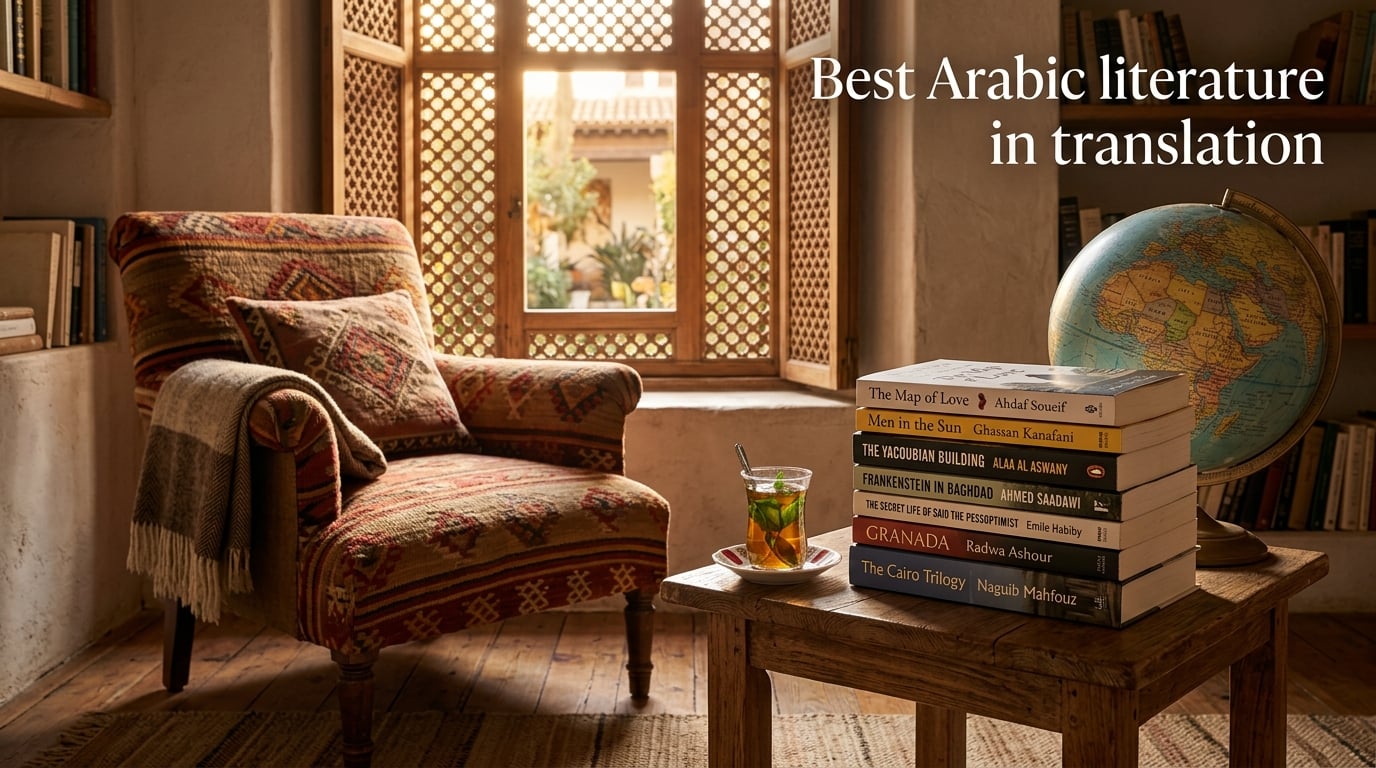
When we first set out to write this guide to the best Arabic literature in translation, we kept thinking about a comment we read on a book blog. A reader named Sarah wrote: “I have always loved reading about Middle East and North African culture but for some reason I’ve never thought to read Arabic literature translated into English.”
That gap is exactly why this guide exists. Most English readers can name Naguib Mahfouz and stop there. The truth is that Arabic literature in translation is one of the most dynamic, award-winning, and emotionally wide-ranging corners of world fiction today. Our team read 40+ translated works, cross-referenced four major Arabic literature roundups, and consulted award juries (the International Prize for Arabic Fiction, the International Booker, the Naguib Mahfouz Medal for Literature) to build a list that bridges classics and contemporary voices.
Inside this guide you will find 10 must-read translated Arabic novels, a contemporary section covering books from 2015 to the present, a focused list of women writers, a poetry and short stories section that most guides skip, a translator spotlight, and a practical “where to start” reading order. Whether you are a first-timer or a returning reader, this is the reading map we wish we had a decade ago.
Table of Contents
Why Arabic Literature in Translation Matters Right Now
Translated Arabic fiction is no longer a niche corner of world literature. It is a category reshaping what English readers expect from a great novel. Three inflection points tell the story.
First, the Nobel Prize in Literature. Naguib Mahfouz won in 1988, the only Arabic-language novelist to receive the award. His Cairo Trilogy remains a touchstone, but his win opened the door for institutional attention that has never fully closed.
Second, the International Booker Prize. In 2019, Jokha Alharthi became the first Arabic-language author to win the prize for Celestial Bodies, translated by Marilyn Booth. Suddenly, an Omani family saga sat on every English-language bestseller list. Adania Shibli’s Minor Detail, translated by Elisabeth Jaquette, was longlisted in 2021 and sparked a separate cultural conversation about Palestinian representation and ethics of translation.
Third, the ecosystem around the books has matured. The Library of Arabic Literature (LAL) at NYU Press publishes bilingual editions with facing-page Arabic, restoring context that older translations often flattened. The American University in Cairo Press, Saqi Books, Interlink, and Heinemann continue to ship strong catalogues. Awards like the Banipal Prize for Arabic Literary Translation, the Saif Ghobash Translation Prize, and the Sheikh Zayed Book Award now offer translators real recognition and income.
For readers, this means more choice and better quality than at any point in history. Twenty years ago, you could find Mahfouz and Tayeb Salih in most bookstores. Today, you can find Mahfouz, Salih, Basma Abdel Aziz, Raja Alem, Rania Mamoun, and dozens more on the same shelf. That is the world this guide is built for.
How We Built This List
We did not want to produce another listicle of personal favorites. Our methodology followed four rules.
First, multi-expert weighting. We cross-referenced picks from ArabLit’s 14-contributor challenge, Book Riot’s contemporary list, Reading With KT’s women-in-translation list, and The National’s 50-novel geography roundup. Books that appeared across multiple lists scored higher.
Second, award credibility. We favored works that won or were shortlisted for the International Prize for Arabic Fiction (often called the Arabic Booker), the International Booker Prize, the Naguib Mahfouz Medal for Literature, and the Sheikh Zayed Book Award. Awards are imperfect, but they indicate a translation that survived serious critical scrutiny.
Third, translation quality. We tracked who translated each work and prioritized editions by translators with strong track records: Marilyn Booth, Humphrey Davies, Denys Johnson-Davies, Elisabeth Jaquette, Jonathan Wright, and Paul Starkey. Translation is interpretive, not mechanical, and the translator’s voice shapes the reader’s experience as much as the author’s.
Fourth, balance. We built the list to span the full Arab world (Egypt, Sudan, Palestine, Iraq, Lebanon, Morocco, Saudi Arabia, Oman, Syria) and the full timeline (1960s classics through 2024 releases). No single country or era dominates. We added content warnings where themes warrant them, following the Book Riot trust signal.
You will notice each entry includes title, author, translator, year of English translation, original year, country of origin, genre, and a content warning where relevant. This metadata makes the list usable, not just readable.
10 Must-Read Translated Arabic Novels
These ten novels are the foundation. If you read nothing else from this guide, start here. We have ordered them by a mix of historical importance, contemporary accessibility, and our team’s honest sense of which books reward the most generous reading.
Content warning note: Several entries below contain depictions of war, sexual violence, colonialism, and state violence. We have marked each one so you can plan your reading.
1. Season of Migration to the North by Tayeb Salih
Translated by Denys Johnson-Davies (1969, original 1966). Sudan. Post-colonial novel.
A young Sudanese man returns to his village on the Nile after seven years in London, where he has systematically seduced and destroyed several women. He meets a stranger, and they begin trading stories. What unfolds is the single most important Arabic novel in English translation, picked seven times across the ArabLit expert challenge and cited by Chinua Achebe as one of the six most significant novels of the 20th century.
Salih writes in a deceptively simple Modern Standard Arabic that Denys Johnson-Davies renders in quiet, lyrical English. The book reverses the colonial gaze: instead of Europeans studying Africans, an African studies Europeans. If you read one Arabic novel this year, make it this one.
2. The Cairo Trilogy (Palace Walk, Palace of Desire, Sugar Street) by Naguib Mahfouz
Translated by William Maynard Hutchins, Olive E. Kenny, and Lorne M. Kenny (1990-1993 English edition, originals 1956-1957). Egypt. Family saga.
Three novels spanning three generations of the al-Jawad family in Cairo, from World War I through the 1952 Egyptian revolution. Al-Sayyid Ahmad is a patriarch who hides his religious devotion from his friends and his roving eye from his wife. His sons grow up to become students, lovers, and revolutionaries.
Mahfouz won the Nobel Prize in Literature in 1988 largely on the strength of this trilogy. It is the most complete fictional portrait of 20th-century Egypt in any language. Start with Palace Walk; if you finish it, you will not stop.
3. Cities of Salt by Abdul Rahman Munif
Translated by Peter Theroux (1987, original 1984). Saudi Arabia. Petro-fiction.
The first novel of Munif’s five-book cycle follows a Bedouin caravan arriving at a coastal oasis in the 1930s, just as American oil prospectors arrive with their drilling rigs and money. Over decades, the village transforms into a petro-state. Munif coined a literary subgenre with this book: petro-fiction.
Content warning: depictions of colonial violence and forced displacement. Theroux’s translation is the only English edition in print. The novel reads like slow, devastating history and remains the most influential Arabic novel of the oil era.
4. Men in the Sun by Ghassan Kanafani
Translated by Hilary Kilpatrick (1978, original 1962). Palestine. Political novella.
Three Palestinian men pay a smugglers’ truck driver to carry them across the desert from Iraq to Kuwait, hoping for work. The novella is 90 pages long and contains one of the most quoted lines in modern Arabic literature: “Why didn’t you knock on the walls of the tank?” The driver is asked after they are found dead.
Kanafani was assassinated in Beirut in 1972 at age 36. This is his most famous work and the foundational text of Palestinian political fiction. Required reading.
5. Gate of the Sun by Elias Khoury
Translated by Humphrey Davies (2005, original 1998). Lebanon / Palestine. Post-Nakba epic.
A Palestinian resistance fighter lies in a coma in a Beirut hospital after the 1982 Sabra and Shatila massacre. His friend sits by his bed and tells him stories of a Galilee village, a return that never happened, and the refugees who live on its memory.
Content warning: graphic depictions of massacre, war trauma, and sexual violence. Humphrey Davies’s translation won the Banipal Prize. This is a long, demanding, but profoundly rewarding novel. Save it for when you can read deeply.
6. I Saw Ramallah by Mourid Barghouti
Translated by Jonathan Wright (2008, original 1997). Palestine. Memoir.
After 30 years of exile, the Palestinian poet Mourid Barghouti is allowed back into the West Bank for a single visit. He walks through Ramallah, sees his mother, and processes a lifetime of displacement in roughly 150 pages. The book reads like prose poetry.
Jonathan Wright’s translation won the Banipal Prize. Barghouti died in 2021. His final book, I Was Born There, I Was Born Here, completes the story. Read them in order.
7. The Yacoubian Building by Alaa Al Aswany
Translated by Humphrey Davies (2004, original 2002). Egypt. Social realist novel.
A crumbling Art Deco apartment building in downtown Cairo houses a cast of characters: a corrupt former minister, a poor young man from the slums, a gay newspaper editor, a hijab-wearing activist. Their lives collide in a post-9/11 Egypt where religion, sexuality, and class are in constant negotiation.
This was a genuine publishing phenomenon, the bestselling Arabic novel of the 2000s and a global bestseller in translation. If you want to understand modern Egypt’s tensions, this is the most accessible entry point.
8. The Map of Love by Ahdaf Soueif
Translated by the author (1999, original). Egypt / Britain / Palestine. Historical romance.
A dual-timeline novel. In 1900, an English widow falls in love with an Egyptian nationalist in colonial Egypt. In 1997, her American granddaughter, an academic, uncovers the story through old letters. Soueif writes in English herself, but the book counts as translated Arabic literature because it draws deeply on her Egyptian and Palestinian roots.
This is the most accessible novel on this list, an excellent bridge for readers new to the genre.
9. Women of Sand and Myrrh by Hanan al-Shaykh
Translated by Catherine Cobham (1992, original 1985). Lebanon. Feminist literary fiction.
Four women, two Lebanese and two from the Gulf, live in a Saudi Arabian compound with their husbands. They build friendships across the sand, smuggling small freedoms. The novel is a quiet but pointed critique of patriarchy across the Arab world.
Cobham’s translation is the gold standard for Hanan al-Shaykh, and the novel reads as smoothly as any European literary fiction. Content warning: marital rape and domestic violence.
10. Beirut Blues by Hanan al-Shaykh
Translated by Jonathan Wright (1995, original 1992). Lebanon. Epistolary novel.
A woman named Asmahan writes letters to her absent lover during the Lebanese Civil War, addressing them to Beirut itself. The city becomes a character, fractured, mourned, loved.
Short, intense, and emotionally devastating. Jonathan Wright’s translation won the Banipal Prize. If you want one book to understand the emotional texture of Beirut, this is it.
Contemporary Translations You Should Not Miss
Arabic fiction published in English between 2015 and 2024 has produced some of the strongest translated literature of our era. These six books are the contemporary canon.
11. Celestial Bodies by Jokha Alharthi
Translated by Marilyn Booth (2019 English, 2010 Arabic). Oman. Family saga.
Three sisters in the Omani city of Muscat navigate marriage, class, and tradition as their country modernizes. Alharthi was the first Arabic-language author to win the International Booker Prize, and Marilyn Booth’s translation is widely praised as some of the finest literary translation of the decade.
This is the contemporary book we recommend most often to first-time readers of Arabic literature in translation.
12. Minor Detail by Adania Shibli
Translated by Elisabeth Jaquette (2020 English, 2017 Arabic). Palestine. Literary novella.
Two parallel stories. In 1949, a Palestinian Bedouin girl is raped and killed by Israeli soldiers. In 2019, a Palestinian researcher becomes obsessed with this minor historical detail. Jaquette’s translation is spare and clinical; the effect is devastating.
Content warning: sexual violence. The book was shortlisted for the International Booker Prize. It is short, slow, and politically urgent.
13. The Queue by Basma Abdel Aziz
Translated by Elisabeth Jaquette (2016 English, 2013 Arabic). Egypt. Dystopian novel.
In a near-future Cairo, citizens must wait in endless bureaucratic queues for permission to do anything, even die. A man searches for his missing wife through the surreal apparatus of “the Gate.” Often compared to Kafka and Orwell, this is the first great Arabic dystopian novel in English.
Elisabeth Jaquette’s translation has become a teaching staple in translation studies programs. Highly recommended.
14. Frankenstein in Baghdad by Ahmed Saadawi
Translated by Jonathan Wright (2018 English, 2013 Arabic). Iraq. Magical realism.
In 2005 Baghdad, a junk dealer stitches together body parts from victims of car bombings to create a “what-is-it” that comes to life. The novel won the International Prize for Arabic Fiction, the first Iraqi winner. Jonathan Wright’s translation won the Grand Prix de la traduction.
Content warning: extreme violence and dismemberment. A masterpiece of dark magical realism.
15. The Dove’s Necklace by Raja Alem
Translated by Katharine Halls (2022 English, 2010 Arabic). Saudi Arabia. Literary thriller.
A murder mystery set in Mecca, told by a woman named Hera who investigates the death of her friend. The novel braves a setting almost never depicted in Arabic fiction: the holy city itself, beyond the pilgrims and rituals. Halls’s translation was shortlisted for the International Booker Prize.
16. Slipping by Mohamed Kheir
Translated by Robin Moger (2020 English, 2018 Arabic). Egypt. Experimental novel.
An unnamed narrator in Alexandria searches for a book called The Booth of the Secret Police. The plot slips in and out of reality, mixing travel writing, philosophy, and memoir. Robin Moger’s translation reads like a fever dream, challenging but rewarding.
This is the most experimental novel on our list. Save it for when you are ready to be confused.
Women Writers in Translation from the Arabic
Arabic literature has always had strong women writers, but their translation into English lagged behind the men for decades. That gap is closing fast. Here are five women-authored books that should be on every reader’s shelf.
The Year of the Elephant by Leila Abouzeid
Translated by Barbara Parmenter (1989 English, 1983 Arabic). Morocco / Palestine. Novella.
A Moroccan woman returns to her hometown after the 1975 Green March and discovers her husband has taken a second wife. The novella is 80 pages long, a quiet, devastating portrait of a single life caught in postcolonial transition. Parmenter’s translation remains the only English edition.
The Hidden Face of Eve by Nawal El Saadawi
Translated by Sherif Hetata (1982 English, 1975 Arabic). Egypt. Memoir and manifesto.
The foundational text of Arab feminist literature. El Saadawi (1931-2021) wrote this memoir after being dismissed from her government post for her views on female sexuality. It remains required reading in gender studies courses worldwide.
Women of Sand and Myrrh by Hanan al-Shaykh
Covered above in the must-read list. We list it again here to highlight that women’s writing is not a separate category but the spine of contemporary Arabic fiction.
Story of Zahra by Hanan al-Shaykh
Translated by Peter Ford (1986 English, 1980 Arabic). Lebanon. Literary fiction.
A young Lebanese woman returns from Africa to Beirut during the civil war, carrying childhood trauma and adult scars. The novel reads like an emotional excavation.
Thirteen Months of Sunrise by Rania Mamoun
Translated by Elisabeth Jaquette (2020 English, 2016 Arabic). Sudan. Short story collection.
Thirteen stories set in contemporary Sudan, often in the charged space between Khartoum and the diaspora. Jaquette’s translation won the 2020 Saif Ghobash Translation Prize.
Short Stories and Poetry in Translation
Most Arabic literature guides treat poetry and short fiction as afterthoughts. We think they belong at the center. Arabic poetry is the oldest continuous literary tradition in the world, and the short story is where contemporary Arab writers often do their boldest work.
Mahmoud Darwish, Unfortunately, It Was Paradise
Selected and translated by Munir Akash, Carolyn Forché, and Sinan Antoon (2003). Palestine. Poetry.
Darwish (1941-2008) is the most widely read Arabic poet of the 20th century. This selection collects his late work and is our top recommendation for readers approaching Arabic poetry for the first time. Sinan Antoon co-translated the volume and is himself a novelist (The Corpse Washer, 2013).
Naguib Mahfouz, The Time and the Place and Other Stories
Translated by Denys Johnson-Davies and others (1991). Egypt. Short stories.
Mahfouz wrote short stories his entire career and considered them his purest work. This collection samples his range, from Cairo street life to surreal political allegory. Denys Johnson-Davies is the translator of most Mahfouz in English.
The Sea Cloak and Other Stories by Nayrouz Qarmout
Translated by Perween Richards (2019). Palestine. Short stories.
Contemporary Palestinian short fiction from a Gazan writer. Richards’s translation brings Qarmout’s spare, cinematic prose to English readers for the first time.
The Mu’allaqat (pre-Islamic odes)
Translated in various editions, including Michael Sells’s Desert Tracings (1989) and A.J. Arberry’s The Seven Odes (1957). Pre-Islamic Arabia. Classical poetry.
The seven suspended odes of pre-Islamic Arabia, hung in gold on the walls of the Kaaba. They are the oldest continuous Arabic literary texts. If you want to read the deepest roots of the tradition, start here.
Translators You Should Know
Arabic literature in English would not exist without these translators. If you find a book you love, look up who translated it. Follow them. Watch for their next releases.
Denys Johnson-Davies (1922-2017). The dean of Arabic-to-English literary translation. Translated Tayeb Salih’s Season of Migration to the North, Naguib Mahfouz’s short stories, and dozens of others. The Cairo Translation Authority named him the most important translator in the Arabic literary world.
Marilyn Booth. American scholar and translator. Translated Celestial Bodies (International Booker winner), The Tiller of Waters, and works by Hoda Barakat and Somaya Ramadan. Currently holds the Edward Said Professorship at Columbia.
Humphrey Davies. British translator based in Cairo. Translated The Yacoubian Building, Gate of the Sun, and works by Elias Khoury. Won the Banipal Prize multiple times. Currently the most prolific Arabic literary translator in English.
Elisabeth Jaquette. American translator. Translated Minor Detail, The Queue, Thirteen Months of Sunrise, and works by Basma Abdel Aziz. Won the Saif Ghobash Translation Prize.
Jonathan Wright. British translator. Translated Frankenstein in Baghdad (Grand Prix de la traduction winner), Beirut Blues, I Saw Ramallah. Three-time Banipal Prize winner.
Paul Starkey. British translator. Translated several Naguib Mahfouz novels and teaches Arabic literature at the University of Durham.
Frequently Asked Questions
What is considered the best Arabic literature of all time?
Tayeb Salih’s Season of Migration to the North (1969, translated by Denys Johnson-Davies) is widely considered the single most important Arabic novel in English translation. It was picked by seven or more expert contributors in the ArabLit summer reading challenge and named by Chinua Achebe as one of the six most significant novels of the 20th century. Naguib Mahfouz’s Cairo Trilogy is the other foundational work, completing the foundation most readers start with. From there, readers tend to expand into Ghassan Kanafani’s Men in the Sun, Elias Khoury’s Gate of the Sun, and contemporary works like Jokha Alharthi’s Celestial Bodies and Adania Shibli’s Minor Detail.
Where can I find Arabic literature in translation?
Major publishers carry most translated Arabic literature. The Library of Arabic Literature (NYU Press) publishes bilingual editions of classics. American University in Cairo Press, Saqi Books, Interlink, Seven Stories Press, and Heinemann publish contemporary novels and poetry. Online retailers such as Bookshop.org and Amazon carry most titles, with previews via Amazon Look Inside and Google Books. Independent bookstores can special-order anything not in stock. Most public libraries carry the major bestsellers (Mahfouz, Salih, Al Aswany, Alharthi) and can request through interlibrary loan for the rest. World Editions, Archipelago Books, and Catapult publish selected contemporary Arabic novels in North America.
Who is the best Arabic translator?
No single translator is universally considered best, because translation is interpretive rather than mechanical. However, six names define the field: Denys Johnson-Davies (1922-2017), who translated Tayeb Salih and most of Naguib Mahfouz; Marilyn Booth, who translated Jokha Alharthi’s International Booker-winning Celestial Bodies; Humphrey Davies, who translated Alaa Al Aswany’s The Yacoubian Building and Elias Khoury’s Gate of the Sun; Elisabeth Jaquette, who translated Adania Shibli’s Minor Detail and Basma Abdel Aziz’s The Queue; Jonathan Wright, who translated Ahmed Saadawi’s Frankenstein in Baghdad; and Paul Starkey, who translated several Naguib Mahfouz novels. All six have won major translation awards.
What is the most accurate Arabic to English translator?
Accuracy is not the right frame for literary translation. Translation is interpretive. That said, certain translators have built reputations for preserving the tone, register, and rhythm of the Arabic while rendering it into readable English. The Banipal Prize for Arabic Literary Translation, the Saif Ghobash Translation Prize, and the Sheikh Zayed Book Award honor translators whose work has passed serious critical scrutiny. Recent winners include Elisabeth Jaquette (Minor Detail, The Queue), Jonathan Wright (Frankenstein in Baghdad), and Marilyn Booth (Celestial Bodies). For classical Arabic, Denys Johnson-Davies remains the most trusted name in English.
Where to Start, and Where to Go Next
If you have never read Arabic literature in translation before, here is the order we suggest. Start with Season of Migration to the North (Tayeb Salih). It is short, brilliant, and sets the tone for everything that follows.
Then pick one of three paths based on what you love most. If you want more Sudanese and African Arabic fiction, read Tayeb Salih’s other work and Mourid Barghouti’s I Saw Ramallah. If you want sweeping family sagas, read Naguib Mahfouz’s Palace Walk and Jokha Alharthi’s Celestial Bodies back to back. If you want contemporary political and feminist fiction, read Adania Shibli’s Minor Detail and Basma Abdel Aziz’s The Queue.
From there, follow translators you trust. If you loved Celestial Bodies, read everything Marilyn Booth has translated. If you loved Gate of the Sun, read the rest of Elias Khoury. If you loved Frankenstein in Baghdad, queue up Jonathan Wright’s next release.
The best Arabic literature in translation is bigger than any single list can hold. We hope this guide gets you into the shelf, and from there you find the books that speak most directly to you. The translators, publishers, and authors named above have done the hard work of carrying this literature across languages. Your part is the easy, joyful part. Read.