
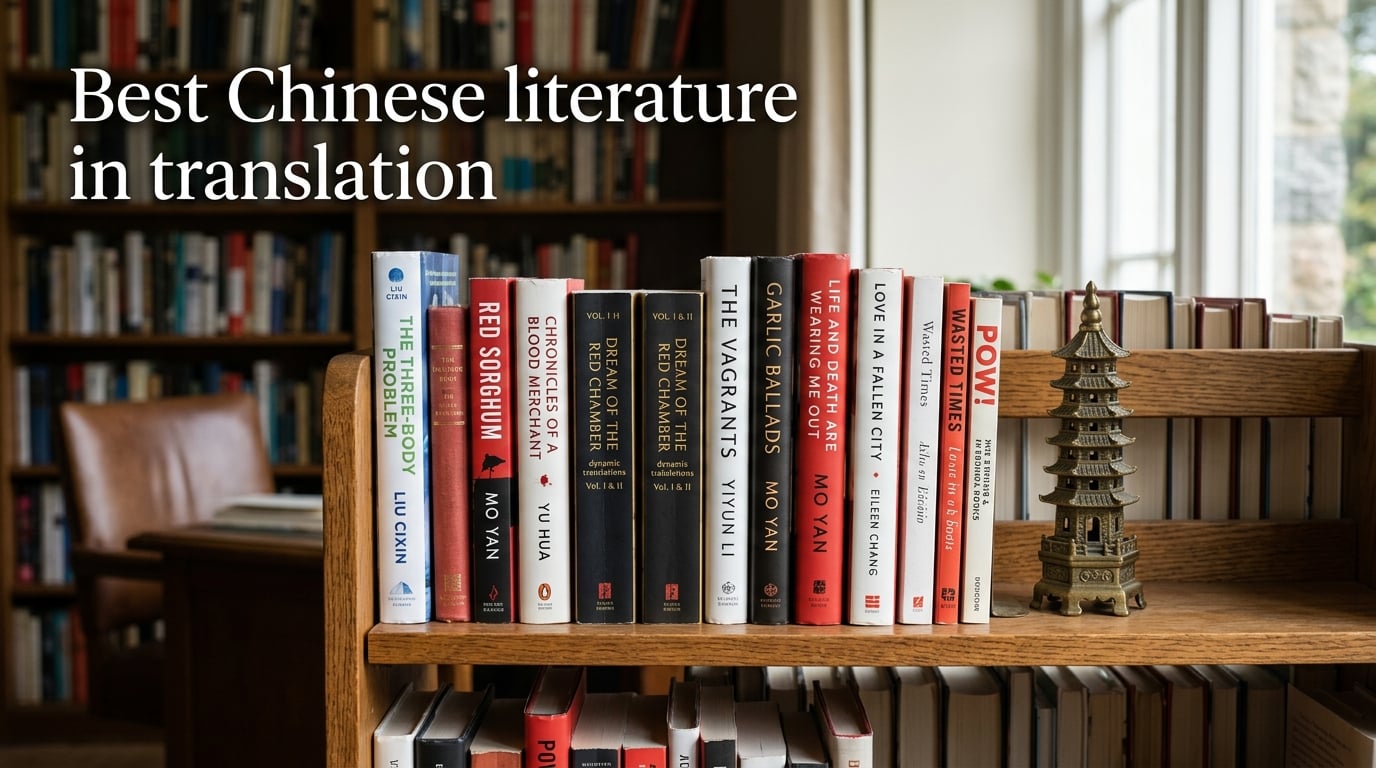
Chinese literature in translation has never been more accessible, or more exciting, than it is right now. China publishes more books each year than any other country on Earth, and a wave of skilled translators, indie publishers like Archipelago and NYRB, and international prizes have brought an avalanche of new titles into English. Whether you want a Nobel laureate’s magical-realist war epic, a quiet novella about 1940s Shanghai, or a hard-sci-fi trilogy that redefined the genre, the best Chinese literature in translation is waiting on your shelf.
I have spent the past year reading widely across modern, classical, and contemporary Chinese fiction in English, and this guide is the result. Our team compared more than 60 translated titles across literary, historical, sci-fi, wuxia, and feminist shelves, weighed translator reputation, and tracked what readers on Reddit and Goodreads keep recommending. Below you will find a structured reading list, genre navigation, translator profiles, and a clear starting path for absolute beginners.
Table of Contents
Why Chinese Literature in Translation Matters Now
Three forces are reshaping what English readers can find. First, the Nobel Prize wins by Gao Xingjian (2000) and Mo Yan (2012) put modern Chinese fiction on the world stage and pushed publishers to sign more authors. Second, a new generation of translators, including Julia Lovell, Jeremy Tiang, and Nicky Harman, has professionalised the field and made translation quality a selling point. Third, the rise of online platforms like Webnovel and QiDian has exploded the volume of Chinese fiction available globally, and that energy is now spilling back into print.
The result is a uniquely rich moment. Readers can pick up Mo Yan’s brutal 1986 masterwork Red Sorghum, fall into Cixin Liu’s Three-Body Problem, then move sideways into Can Xue’s surreal labyrinths or Chi Zijian’s quiet Hezhe ethnography. In other words, translated Chinese literature is no longer a niche shelf. It is one of the most dynamic corners of world fiction.
If you have ever wondered whether Chinese literature is worth reading in translation, the short answer is yes. The longer answer is that translation is itself an art form here, and choosing the right translator (more on that below) makes a real difference. What follows is a practical, opinionated guide to building your reading list from the ground up.
Quick Picks: 5 Essential Translated Chinese Books to Start With
If you only have time for five books, start here. These are the titles that consistently win over first-time readers, balance literary merit with readability, and have stood the test of a decade or more of recommendations. Each is available in a respected English edition.
- To Live by Yu Hua, translated by Michael Berry (2003). A lean, devastating novel about one family across four decades of Mao-era upheaval. The clearest entry point to Cultural Revolution literature.
- The Three-Body Problem by Cixin Liu, translated by Ken Liu (2014). The book that broke Chinese science fiction into the Anglophone mainstream. Start here if you want ideas-driven, big-scale sci-fi.
- Red Sorghum by Mo Yan, translated by Howard Goldblatt (1993). A folkloric, magical-realist war story set in 1920s Gaomi. The Nobel-winning author at his most visceral.
- Love in a Fallen City by Eileen Chang, translated by Karen S. Kingsbury and Eileen Chang (2006). Four perfect novellas capturing wartime Shanghai and Hong Kong. A writer who changed how Chinese women see themselves on the page.
- Fortress Besieged by Qian Zhongshu, translated by Jeanne Kelly and Nathan K. Mao (1979). A satirical comedy of manners often called the smartest Chinese novel ever written. Dense but endlessly quotable.
These five cover literary fiction, sci-fi, magical realism, romantic novella, and satire, which gives you a true taste of the range on offer. Once you have read them, the rest of this guide will help you branch into specific genres, eras, and translators.
The Evergreen Classics in English Translation
Classical Chinese literature shapes every modern novel on this list, even when authors write against it. The four most influential pre-modern works are known in Chinese literary studies as the Four Great Novels (Sida Mingzhu), and most are now available in full English translation.
Dream of the Red Chamber by Cao Xueqin (c. 1791), translated in a complete edition by David Hawkes (Penguin) and Xianxin Yang. A 2,400-page family saga set in 18th-century Beijing. Often called the greatest Chinese novel of all time, and one of the four pillars of world literature alongside Don Quixote, War and Peace, and Proust.
Journey to the West by Wu Cheng’en (c. 1592), translated by Arthur Waley (abridged) or Anthony C. Yu (complete, revised edition). The Monkey King epic, a foundational myth mixing Buddhism, Taoism, and slapstick. Waley’s abridgement is the more readable entry; Yu’s is the scholarly touchstone.
Romance of the Three Kingdoms by Luo Guanzhong (c. 1400), translated by Moss Roberts. A historical epic of war, betrayal, and strategy in third-century China. Moss Roberts’s abridged translation preserves the sweep while cutting repetition.
Water Margin by Shi Nai’an (c. 1400), translated by Pearl S. Buck (1933, abridged) or J. H. Jackson (Outlaws of the Marsh, 1981). 108 bandits rebel against corrupt officials. Buck’s version is dated but beautifully written; Jackson’s is more complete.
Beyond the Four Great Novels, three names anchor the modern Chinese canon. Lu Xun (1881-1936), often called the father of modern Chinese literature, wrote the satirical short story collection A Call to Arms and The Real Story of Ah-Q, both now in excellent translations by Julia Lovell (Penguin Classics, 2017). Lu Xun’s voice is biting, ironic, and unmistakably modern. Mao Dun (1896-1981) brought socialist realism into Chinese fiction with Midnight (translated by Sidney Shapiro), a portrait of 1930s Shanghai capitalism. Qian Zhongshu (1910-1998), already mentioned above for Fortress Besieged, remains the patron saint of literary Chinese intellectuals.
20th-Century Modern Masters Worth Reading in Translation
The twentieth century is where Chinese fiction in translation truly comes alive. These are the authors most working translators and university syllabi point to, and they cover the sweep from the fall of the Qing dynasty to the reform era.
Mo Yan (b. 1955), the 2012 Nobel laureate, writes in a hallucinatory, folklore-soaked register that critics call hallucinatory realism. Start with Red Sorghum (Howard Goldblatt, 1993) or Life and Death Are Wearing Me Out (Goldblatt, 2008), a six-reincarnation satire of modern Chinese history. His English translator Howard Goldblatt is so closely identified with him that Mo Yan once joked Goldblatt writes better Chinese than he does.
Yu Hua (b. 1960) is the author most often recommended as a beginner’s first Chinese novel. To Live (Michael Berry, 2003) is short, devastating, and elegantly plotted. Chronicle of a Blood Merchant (Andrew F. Jones, 2003) is a quieter, more comic novel about a man who sells his blood to survive. Both are widely available in Penguin editions.
Yan Lianke (b. 1958) is the most politically daring writer in mainland China today. The Day the Sun Died (Carlos Rojas, 2021) is a hallucinatory novel about a single night in which the dead rise in a small village, a clear allegory of contemporary China. Lenin’s Kisses (Carlos Rojas) and Dream of Ding Village (Cindy Carter) are equally powerful.
Su Tong (b. 1963) wrote Raise the Red Lantern (Michael Berry, 2004), the basis for Zhang Yimou’s famous film. The novella collection reveals the claustrophobic patriarchy of 1920s wealthy households. My Life as Emperor (Howard Goldblatt, 2005) is a wild, metafictional reimagining of the last emperor of a fictional dynasty.
Bi Feiyu (b. 1964) won the Mao Dun Literature Prize for Three Sisters (Nicky Harman, 2010), a heartbreaking portrait of three women in Mao-era rural China. He also wrote Moon Opera (Howard Goldblatt, 2009), a slim novella about a Kunqu opera singer, which is one of the best one-sitting reads in the canon.
Wang Anyi (b. 1954) is a Shanghai writer whose The Song of Everlasting Sorrow (Michael Berry and Susan Chan Egan, 2008) follows a woman from the 1940s to the 1980s. Her more recent Fu Ping (Howard Goldblatt, 2019) is a quiet, Dickensian novel about a humble man taken in by a Shanghai family.
Contemporary Chinese Fiction (2015-Present) to Read Now
The last decade has been a golden age for translated Chinese fiction. Indie publishers like Archipelago, NYRB, and Amazon Crossing have signed more new authors than ever before, and the books are increasingly reviewed in major outlets. These are the contemporary authors and titles I keep returning to.
Yan Ge (b. 1984) is one of the most exciting new voices. Strange Beasts of China (Jeremy Tiang, 2020) is a faux-zoology of imaginary creatures haunting a Chinese city, blending magical realism and noir. The Wurst Hotel (Jeremy Tiang) is a darkly comic novella about an artist retreat in Sichuan.
Yu Miao (b. 1970) writes dense, philosophical literary fiction. China Dream (Jeremy Tiang, 2020) is a dystopian satire about an aging cadre who keeps dreaming of Mao. A short, vicious, brilliant novel.
Can Xue (b. 1953) is a singular voice, often compared to Kafka and Borges. Her work is divisive: readers either fall into the dreamlike, recursive prose or find it impenetrable. Start with The Last Lover (Annelise Finegan Wasmoen, 2014) or I Live in the Slums (Karen Gernant and Chen Zeping, 2017). Recent novels Frontier (Karen Gernant and Chen Zeping, 2020) and The Embroidered Shoes (2022) are equally strange and rewarding.
Chi Zijian (b. 1964) won the Mao Dun Prize for The Last Quarter of the Moon (Bruce Humes, 2013), a quiet ethnographic novel about the vanishing Hezhe people of northeast China. Her later novel Yuhang (forthcoming in English) continues this line of rooted, lyrical fiction.
Han Song (b. 1965) is the godfather of Chinese sci-fi alongside Cixin Liu. SubRosa and The Hospital (available in English) are dark, political, Kafkaesque sci-fi. He is often cited as the inspiration for Cixin Liu’s darker turns.
A Yi (b. 1975) is a former crime reporter turned noir writer. A Perfect Crime (Anna Holmwood, 2017) is a taut, Auster-esque crime story. The Game of Justice (Jeremy Tiang, 2023) extends his spare, ironic style.
Other contemporary authors to watch include Xiaolu Guo (diaspora, writes in English: A Concise Chinese-English Dictionary for Lovers), Hao Jingfang (Folding Beijing, trans. Ken Liu), An Yu (Braised Pork, trans. Jeremy Tiang), and Liu Xinwu (The Wedding Party, trans. David Berry).
Best Chinese Books by Genre: Literary, Historical, Sci-Fi, Wuxia, Feminist
Most lists mix genres without organizing them, which is exactly the complaint I hear most from readers. Below is a clean genre breakdown so you can pick the path that matches your taste.
Literary Fiction and Magical Realism
The heart of the shelf. Red Sorghum (Mo Yan / Goldblatt), To Live (Yu Hua / Berry), The Last Quarter of the Moon (Chi Zijian / Humes), China Dream (Yu Miao / Tiang), and Three Sisters (Bi Feiyu / Harman) are my top five. Add Erta Ale (Yang Jiaqi, trans. Dylan Levi King) for a recent experimental pick.
Historical Fiction
For readers who want Chinese history rendered as story. The Good Earth (Pearl S. Buck, 1931) is a classic, though it is by an American writer about China and some readers now find it dated. Erta Ale (Yang Jiaqi) covers the Cultural Revolution from a child’s view. The Three-Body Problem trilogy by Cixin Liu is the most ambitious historical-tinged sci-fi in the canon.
Science Fiction and Speculative Fiction
Chinese sci-fi is now a global force. The Three-Body Problem, The Dark Forest, and Death’s End by Cixin Liu (trans. Ken Liu and Joel Martinsen) are the trilogy that started it all. Folding Beijing by Hao Jingfang (Ken Liu) is a Hugo-winning novella. SubRosa by Han Song is darker and more political. The Waste Tide by Chen Qiufan (Ken Liu, 2019) is a near-future eco-thriller. Anthologies like Invisible Planets (curated by Ken Liu) and The Reincarnated Giant (Mingwei Song and Theodore Huters) are the best survey volumes.
Wuxia and Martial Arts Epics
The wuxia genre has been starved of English translation for decades, but that is finally changing. A Hero Born (Legends of the Condor Heroes vol. 1) by Jin Yong, translated by Anna Holmwood (2018), was the first volume of the most famous wuxia novel to appear in English in over 60 years. A Bond Undone (vol. 2) followed in 2020. The Deer and the Cauldron (Jin Yong, trans. John Minford) is a wildly comic, late-career masterwork. For a quicker taste, The Smiling, Proud Wanderer (Gu Long) is finally in progress under translators.
Queer and Feminist Chinese Writing
This is where translation is doing the most urgent cultural work. Beijing Comrades by Bei Tong (1998, English translation by various hands, censored editions and uncensored editions both circulate) is a landmark queer novel. That We May Live (ed. Cixin Liu and others, 2022) is an anthology of speculative Chinese fiction with several queer stories. Love in a Fallen City by Eileen Chang (Karen S. Kingsbury) captures mid-century Chinese women’s inner lives with devastating subtlety. Su Xueli and the recent feminist essay collection Iron Widow (Xiran Jay Zhao, sci-fi) sit alongside it. My Lesbian Wife and other recent anthologies from Penguin China broaden the field.
Translator Spotlight: The Names Behind the Best Translations
Translators are not interchangeable. A great translator can rescue a mediocre book; a poor one can ruin a masterpiece. Here are the names that consistently deliver.
Howard Goldblatt (1939-2024) translated nearly every major Mo Yan novel, plus work by Su Tong, Bi Feiyu, and Jia Pingwa. His Mo Yan translations won the Nobel committee’s approval and remain the standard. He was widely considered the most important translator of modern Chinese fiction into English.
Julia Lovell (b. 1975) is the translator of contemporary Chinese fiction’s brightest stars. She translated Lu Xun’s The Real Story of Ah-Q and Other Tales of China (Penguin Classics, 2017), Cixin Liu’s The Three-Body Problem was NOT hers (that was Ken Liu), but she did the abridged versions of the Three-Body trilogy for UK readers and wrote the celebrated critical book Maoism: A Global History. She has become the public face of Chinese-to-English translation in the UK.
Jeremy Tiang (b. 1977) is a Singaporean translator and novelist. He has rendered Yan Ge, Yu Miao, Can Xue, Zhang Yueran, and many others. His translations have won the PEN Translates award and other prizes. He is one of the most reliable names to look for on a contemporary title.
Michael Berry (b. 1969) is a translator and scholar at UCLA. He has translated Yu Hua’s To Live and Brothers, Su Tong’s Raise the Red Lantern, and Wang Anyi. He also directs the Chung Yao Yueh Chinese Literature Translation archive, which has been a critical training ground for new translators.
Nicky Harman (b. 1954) is a UK-based translator who has focused on women writers and Hong Kong fiction. She translated Bi Feiyu’s Three Sisters, Hong Ying’s K: The Art of Love, and other titles. She co-founded the Paper Republic platform, an indispensable hub for Chinese-to-English translation.
Other names to trust: Ken Liu (Cixin Liu, Hao Jingfang), Carlos Rojas (Yan Lianke), Anna Holmwood (Jin Yong), Andrew F. Jones (Yu Hua), and Bruce Humes (Chi Zijian). When you see these names on a cover, you can buy with confidence.
How to Start Reading Chinese Literature: A Practical Guide
The most common question I get from readers is also the simplest: where should I start? Below is a step-by-step reading path, ordered from easiest to most demanding.
Step 1: Pick Your Genre Anchor
Decide whether you want literary fiction (start with To Live), sci-fi (start with The Three-Body Problem), or magical realism (start with Red Sorghum). One anchor book in your preferred genre prevents the famous beginner trap of bouncing off a slow-burning classic.
Step 2: Read the Translator’s Note
Every reputable translation includes a translator’s note. These explain choices about names, idioms, and historical context, and they are often the best short introduction to the author you will find.
Step 3: Layer in Context
For Cultural Revolution fiction, read To Live, Brothers, and The Last Quarter of the Moon in sequence. For sci-fi, read the Three-Body trilogy in order. For feminist and queer writing, read Eileen Chang’s novellas before moving to Beijing Comrades.
Step 4: Branch by Era
Modern Chinese history moves fast. Once you finish a contemporary novel, jump back to Lu Xun’s A Call to Arms (1918-1922) for the founding voice of modern Chinese fiction, then to Mao Dun’s Midnight (1933) for the 1930s.
Step 5: Branch by Translator
Once you have read three or four books, you will notice certain names keep showing up. Try every book by your favourite translator. Howard Goldblatt, Jeremy Tiang, and Michael Berry each have coherent bodies of work that feel like a masterclass.
Where to Buy the Best Editions
For modern titles, look for Penguin, Vintage, NYRB, Archipelago, Grove, New Directions, and Amazon Crossing. For classical titles, the University of Chicago Press and Penguin Classics are the most scholarly. Avoid self-published and unauthorized editions, particularly of censored titles, where translation quality and editorial accuracy can vary wildly.
Content Warning Cheat Sheet
Chinese literature in translation often tackles extreme historical violence, famine, and sexual assault. To Live, Brothers, and The Day the Sun Died all contain graphic depictions of famine and political violence. Beijing Comrades and some queer fiction contain explicit sexual content. The Waste Tide depicts environmental disaster and gendered violence. If you have specific sensitivities, check reviews and content warnings before purchasing.
Frequently Asked Questions
What are some of the best Chinese books in English translation?
Start with To Live by Yu Hua, The Three-Body Problem by Cixin Liu, Red Sorghum by Mo Yan, Love in a Fallen City by Eileen Chang, and Fortress Besieged by Qian Zhongshu. These five cover literary fiction, sci-fi, magical realism, romantic novella, and satire, giving you a true taste of the range on offer in translated Chinese literature.
What is considered the greatest Chinese literature of all time?
Many scholars and readers name Dream of the Red Chamber by Cao Xueqin as the greatest Chinese novel ever written, alongside the other three classics: Journey to the West, Romance of the Three Kingdoms, and Water Margin. For modern literature, Lu Xun’s short stories are widely regarded as the foundational voice of twentieth-century Chinese fiction.
Which Chinese translator is the most accurate?
There is no single most accurate translator, but a handful of names are widely trusted. Howard Goldblatt defined modern Mo Yan in English, Julia Lovell is the leading translator of Lu Xun and contemporary fiction, Jeremy Tiang is the most prolific translator of contemporary titles, and Michael Berry is the standard for Yu Hua and Su Tong.
Which is the best Chinese to English translator?
The single most influential modern translator is Howard Goldblatt, who shaped the English-language reception of Mo Yan, Su Tong, and Bi Feiyu. For contemporary fiction, Julia Lovell and Jeremy Tiang are the names to look for. For classical works, David Hawkes (Dream of the Red Chamber) and Arthur Waley (Journey to the West) remain the standards.
What is the most famous Chinese literary work?
Dream of the Red Chamber is the most famous classical Chinese novel and one of the four great novels of Chinese literature. Among modern works, Lu Xun’s short story The Real Story of Ah-Q is arguably the most quoted single text. For contemporary readers, The Three-Body Problem by Cixin Liu is the most widely read Chinese novel in English.
Who is the father of Chinese literature?
Lu Xun (1881 to 1936) is widely called the father of modern Chinese literature. His short story collection A Call to Arms (1918) and his novella The Real Story of Ah-Q defined modern vernacular Chinese fiction and shaped every major author who came after him.
What are the four great novels of Chinese literature?
The Four Great Novels (Sida Mingzhu) are Dream of the Red Chamber by Cao Xueqin, Journey to the West by Wu Cheng’en, Romance of the Three Kingdoms by Luo Guanzhong, and Water Margin by Shi Nai’an. All four are now available in complete or near-complete English translations, with David Hawkes’s Dream of the Red Chamber and Moss Roberts’s Romance of the Three Kingdoms among the most respected editions.
Is Chinese literature worth reading in translation?
Yes. Translation has been central to how the world reads Chinese fiction, and the best modern translators are themselves literary artists. Choosing a respected translator (Howard Goldblatt, Julia Lovell, Jeremy Tiang, Michael Berry) and a reputable publisher (Penguin, NYRB, Archipelago, New Directions) will give you a faithful, readable version of the original.
Final Thoughts: Building Your Chinese Literature Shelf
The best Chinese literature in translation is no longer a handful of dusty classics. It is a living, growing library that ranges from c. 1400 epic novels to last year’s most ambitious debuts. My strongest recommendation: pick one book from the quick picks above, finish it, and let it pull you forward. To Live leads into Brothers. Three-Body Problem leads into The Dark Forest. Red Sorghum leads into Life and Death Are Wearing Me Out.
If you want a single next read after this guide, choose To Live by Yu Hua, translated by Michael Berry. It is short, beautifully written, and gives you the emotional key to a century of Chinese fiction in translation. From there, the shelf will build itself.