
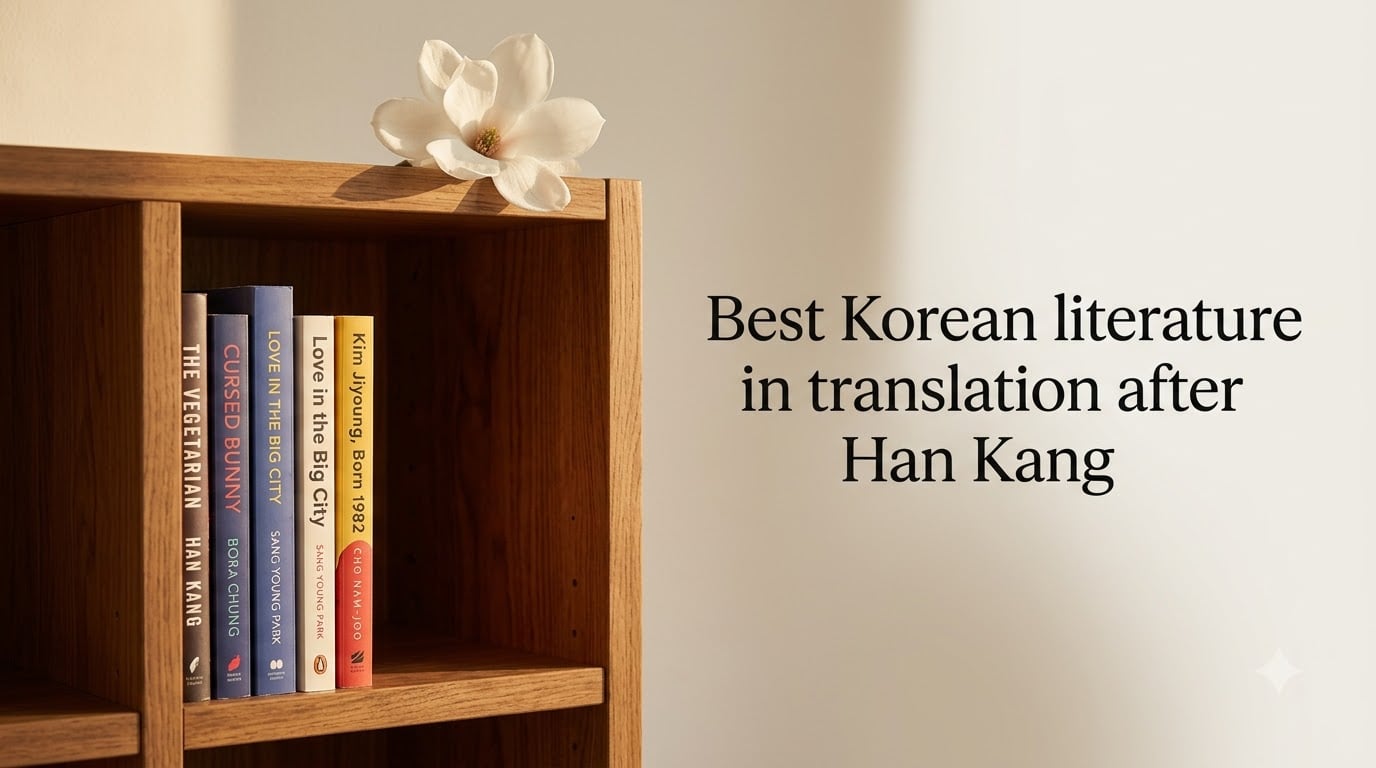
If you finished The Vegetarian and wondered what to read next, this guide is for you. The best Korean literature in translation has exploded since Han Kang won the Nobel Prize in Literature in 2026, and English readers now have more Korean novels on the shelf than at any point in history.
I have spent the last few years tracking which translated Korean novels actually land with English-speaking readers, and which translators make the difference. This guide walks you through the eight essential contemporary novels, the classics worth anchoring your shelf with, the new wave of speculative fiction, the gentle healing genre, and a four-step roadmap so you never stare at a TBR pile again.
Table of Contents
Why Korean Literature in Translation Is Booming Right Now
Korean literature in translation is booming because Han Kang’s Nobel win in 2026 gave the entire ecosystem a megaphone. Independent presses like Dalkey Archive, Archipelago Books, Tilted Axis, Hogarth, and Two Lines Press spent the last decade quietly commissioning bilingual translators. When the Nobel committee named Han Kang, the books those translators had been preparing were already at the printer.
Today, Anton Hur, Deborah Smith, Sora Kim-Russell, e. yaewon, Chi-Young Kim, and Jamie Chang are household names among readers who follow K-lit. On Reddit’s r/KoreanLiterature and r/books, threads now open with translator credits before author credits. That is a meaningful shift. It means readers treat translation as craft, not as a transparent pane of glass.
The K-wave effect also pulls screen fans toward the page. Viewers who loved Pachinko on Apple TV+ or Squid Game on Netflix regularly cross over to translated Korean novels for the same emotional register they found on screen. The result is a richer, more diverse English-language readership than Korean literature has ever seen.
Understanding Han (한): The Emotional Core of Korean Fiction
Han (한) is the Korean concept of accumulated grief, quiet injustice, and resilience that refuses to break. It is the emotional register that runs underneath most Korean novels in English, from Han Kang’s Human Acts about the Gwangju Massacre to Hwang Jungeun’s gentler One Hundred Shadows.
Han is not sadness alone. It is the specific Korean weight of having survived colonization, the Korean War, military dictatorship, and hyper-modernization, all while carrying family obligation forward. You will recognize it in the slow pacing of Cheon Myeong-kwan’s Whale, in the gendered pressure cooker of Cho Nam-joo’s Kim Jiyoung, Born 1982, and in the haunted body of Hwang Sok-yong’s The Guest.
When you start reading Korean fiction, let Han do its work. The stories often refuse catharsis on the final page. They leave you holding something. That holding is the point.
The Translators Shaping Korean Literature in English
Translators are the invisible authors of the Korean-to-English boom. Every book recommendation in this guide credits its translator by name, because the quality difference between editions is real.
Anton Hur translated Cursed Bunny by Bora Chung, several works by Han Kang, and Sang Young Park’s Love in the Big City. He is the most-followed Korean-to-English translator online, and readers seek out his editions first.
Deborah Smith translated Han Kang’s The Vegetarian and Human Acts, and continues to champion experimental Korean fiction through her press Tilted Axis. She won the Man Booker International Prize in 2026 for her work on The Vegetarian.
Sora Kim-Russell translated Hwang Jungeun’s One Hundred Shadows and Park Seolyeon’s A Magical Girl Retires. Her prose has a clipped, sensory quality that readers consistently praise.
e. yaewon and Jamie Chang are emerging voices who translated several 2024-2026 releases, including works by Dolki Min and Kim Un-su. Chi-Young Kim translated Please Look After Mom by Shin Kyung-sook and remains one of the most prolific Korean-English translators working today.
If you love a Korean novel in English, look up who translated it. Following translators is the single best way to find your next read.
8 Essential Contemporary Korean Novels in English Translation
These eight Korean novels in English translation are my core recommendations for anyone building a K-lit shelf after Han Kang. I have grouped them by mood so you can pick where to start.
Cursed Bunny by Bora Chung (translated by Anton Hur)
A short story collection of horror, sci-fi, and dark fairy tale. Cursed Bunny feels accessible even when it is disturbing. Reddit users on r/RSbookclub name it the single best gateway into Korean fiction for readers who find 400-page literary novels intimidating. Each story is under thirty pages, and the title novella is one of the strangest pieces of translated fiction I have read.
Kim Jiyoung, Born 1982 by Cho Nam-joo (translated by Jamie Chang)
A slim, devastating novel about an ordinary Korean woman navigating gender inequality from childhood to adulthood. Reviewers on r/KoreanLiterature call it “short but devastating – read it in one sitting.” If you only read one contemporary Korean novel beyond Han Kang, this is the one that will most clearly recalibrate how you see daily life.
Love in the Big City by Sang Young Park (translated by Anton Hur)
A queer coming-of-age novel set in Seoul, narrated with sharp humor and emotional intelligence. This is the Korean novel I recommend most often to readers who want funny, plotty, and frank about gay life in modern Seoul. It won the International Booker Prize longlist and has earned Sang Young Park a global following.
Whale by Cheon Myeong-kwan (translated by Chi-Young Kim)
Three interlinked novellas about misfits in a Korean port city. Whale is weird, warm, and structurally inventive. The prose has a slow magic-realist pulse that will reward readers who liked the quiet strangeness of Hwang Jungeun.
One Hundred Shadows by Hwang Jungeun (translated by Sora Kim-Russell)
A short literary novel about a vanishing electronics market in Seoul where people begin meeting their doubles. This is the gentlest book on my list and a perfect entry point for readers who find Han Kang too heavy. The translation is luminous.
Please Look After Mom by Shin Kyung-sook (translated by Chi-Young Kim)
The novel that announced Korean fiction to a global mainstream audience. Please Look After Mom follows a missing mother in Seoul and reframes family obligation through her absence. It is a modern classic.
Greek Lessons by Han Kang (translated by Deborah Smith and Anton Hur)
If you love Han Kang but find her heavier novels intimidating, Greek Lessons is a good gateway into her work. A woman loses her sight while learning ancient Greek. The book is small, controlled, and quietly devastating in the way only Han Kang can be.
Almond by Sohn Won-pyung (translated by Sandy Joosun Lee)
A coming-of-age novel about a teen with alexithymia, the inability to feel emotion. Almond is hopeful rather than bleak, and it is the most accessible pick on my list for teen readers or for adults who want a gentle entry point.
New Arrivals: Korean Books to Read Right Now (2024-2026)
The post-Nobel pipeline is real. If you want to read Korean literature in translation that is fresh in 2026, start here.
We Do Not Part by Han Kang, translated by e. yaewon, is Han Kang’s most recent novel and a meditation on friendship and the Jeju Massacre. e. yaewon’s translation carries the restrained lyricism readers expect from Han Kang.
Apartment Women by Chong Hyon-jong, translated by Anton Hur, is a sharp suburban satire about a young mother navigating Seoul’s housing market. It is short, funny, and uncomfortably precise.
The Marigold Mind Laundry by Yun Ko-eun, translated by Lizzie Buehler, is a gentle healing-fiction novel about a magical laundromat that cleans emotional baggage. If you want something soft after a heavy year, this is the one.
Walking Practice by Dolki Min, translated by Victoria Caudle, is a body-horror novel about an alien navigating life in Seoul. It is the freshest piece of speculative Korean fiction in 2026 and a strong follow-up to readers who loved Cursed Bunny.
Anchor Your Reading: The Classic Korean Literary Canon
If you want Korean literature in translation with weight and history, the classic canon is where you anchor your shelf.
Land (Toji) by Park Kyong-ni is the foundational modern Korean novel, a sixteen-volume saga of a family through Japanese colonization. Most English readers start with abridged editions, which still run 400+ pages. This is a commitment, but it is the canon.
The Guest by Hwang Sok-yong is a political novel about a South Korean pastor who flees to the North during the Korean War. Reddit readers on worldliteratureforum warn that The Guest requires patience for the historical setup, but it pays off in the final hundred pages.
Who Ate Up All the Shinga? by Park Wan-suh is a memoir-novel about growing up during the Japanese occupation. Multiple Korean readers call it the most overlooked classic on the shelf. Translator to look for is Yu Young-nan.
Healing Fiction 치유소설: The Gentle Korean Genre Taking Over Bookshelves
Healing fiction (치유소설) is a Korean genre focused on emotional restoration, gentle community, and small acts of kindness. It is the literary equivalent of a warm cup of tea and it has become the fastest-growing category of Korean books in English translation.
The two novels most often cited as gateways are The Dallergut Dream Department Store by Miye Lee, translated by Sandy Joosun Lee, and Welcome to the Hyunam-dong Bookshop by Hwang Bo-reum, translated by Shanna Tan. Both books imagine small, kindly worlds where strangers help each other through ordinary emotional crises.
If you are a K-drama fan, healing fiction is the literary version of slice-of-life dramas like Hospital Playlist. If you are burned out on heavy literary realism, this is the genre that will keep you reading.
Speculative and Strange: The New Wave of Korean Sci-Fi and Horror
Speculative Korean fiction is the genre to watch in 2026. Three authors lead the wave.
Park Seolyeon, translated by Sora Kim-Russell, wrote A Magical Girl Retires, a novella about a depressed woman who discovers her childhood anime powers were real. It is a sharp, witty read.
Dolki Min is the breakout voice of Korean body horror. Walking Practice is her English-language debut and it set the tone for the post-Nobel speculative wave.
Bora Chung is the genre-crossing anchor. Cursed Bunny blends horror, magical realism, and social satire in a way few translated authors manage. If you only read one speculative Korean novel this year, make it Cursed Bunny.
Where to Start: A 4-Step Reading Roadmap for Korean Literature
If you want a structured path through Korean literature in translation, follow this four-step roadmap. Each step builds on the last.
Step 1 – Start gentle. Read Almond by Sohn Won-pyung and One Hundred Shadows by Hwang Jungeun. Both are short, hopeful, and accessible. They build your tolerance for Korean pacing and prose style.
Step 2 – Read the contemporary moment. Move to Cursed Bunny by Bora Chung and Kim Jiyoung, Born 1982 by Cho Nam-joo. These are the books that anchor K-lit in the current decade and they will recalibrate how you read modern Korean society.
Step 3 – Read the masters. Now pick up Human Acts by Han Kang, Love in the Big City by Sang Young Park, and Please Look After Mom by Shin Kyung-sook. These are the books that established the contemporary canon.
Step 4 – Anchor with the classics. Finish with Who Ate Up All the Shinga? by Park Wan-suh and the abridged Land by Park Kyong-ni. These give your shelf historical depth.
Frequently Asked Questions
Which translator is best for Korean to English?
There is no single best translator, but Anton Hur, Deborah Smith, and Sora Kim-Russell are the three most consistently praised names in the field. Anton Hur translated Cursed Bunny and Love in the Big City. Deborah Smith translated Han Kang’s The Vegetarian and Human Acts and runs Tilted Axis Press. Sora Kim-Russell translated One Hundred Shadows and A Magical Girl Retires. Following these translators is the fastest way to find your next read.
Which Korean author has won the Nobel Prize in Literature?
Han Kang won the Nobel Prize in Literature in 2026 for her intense poetic prose that confronts historical traumas and exposes the fragility of human life. She is the first Korean-language author to win the Nobel. Her novels The Vegetarian, Human Acts, and Greek Lessons are the most widely read Korean novels in English translation.
What are the top 10 best Korean novels in English translation?
The ten best Korean novels in English translation are The Vegetarian and Human Acts by Han Kang, Cursed Bunny by Bora Chung, Kim Jiyoung Born 1982 by Cho Nam-joo, Love in the Big City by Sang Young Park, Please Look After Mom by Shin Kyung-sook, Whale by Cheon Myeong-kwan, One Hundred Shadows by Hwang Jungeun, Almond by Sohn Won-pyung, and Pachinko by Min Jin Lee. This list spans speculative fiction, feminist realism, queer coming-of-age, and family saga.
Why read Korean literature?
Korean literature offers a distinct emotional register rooted in Han (한), a Korean concept of accumulated grief and quiet resilience, and a window into hyper-modern East Asian society. Translated Korean novels have won the Man Booker International Prize four times and the Nobel Prize in 2026, and the indie press ecosystem behind them is producing some of the most exciting literary fiction in the world right now.
What is the concept of Han in Korean literature?
Han (한) is the Korean concept of accumulated grief, quiet injustice, and resilience that refuses to break. It is the emotional register that runs underneath most Korean novels in English, from Han Kang’s Human Acts about the Gwangju Massacre to Hwang Jungeun’s gentler One Hundred Shadows. Han is not sadness alone. It is the specific Korean weight of having survived colonization, war, and dictatorship while carrying family obligation forward.
The Path Forward Through Korean Literature
The best Korean literature in translation after Han Kang is not a single list. It is a network of small presses, named translators, and authors across four generations, all publishing into an English-language ecosystem that finally has the readership to support them.
Pick one book from this guide, look up its translator, and follow that translator’s next release. That is how I built my K-lit shelf, and that is the easiest path forward for any reader who wants to keep exploring contemporary Korean fiction.