
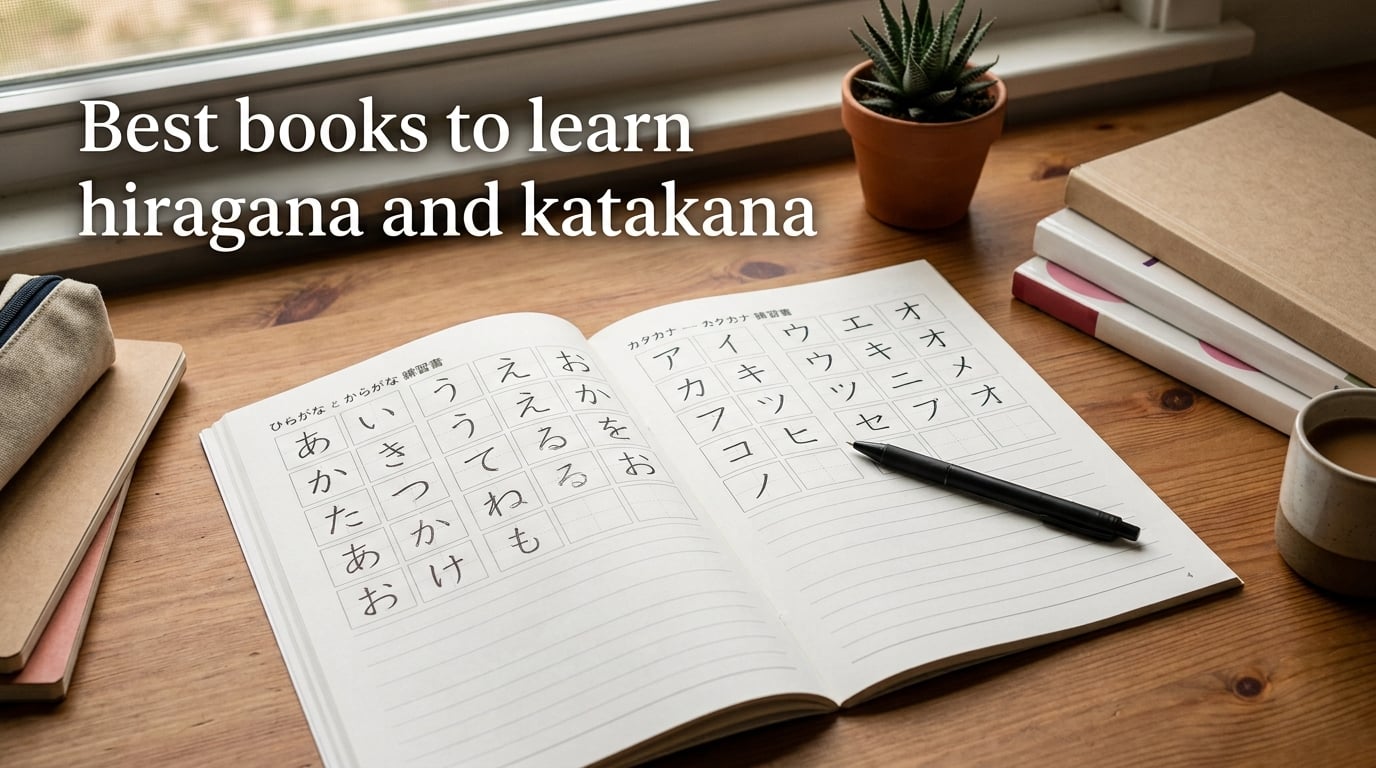
When I first opened a Japanese textbook, the curly shapes on the page looked like secret code. Hiragana and katakana are the two phonetic alphabets, called syllabaries, that decode that code, and the fastest way to crack them is still a good book. I have spent the last decade switching between kana workbooks, apps, and classroom materials, and I keep coming back to a paperback on my desk.
This guide to the best books to learn hiragana and katakana in 2026 is the resource I wish I had when I started. We will walk through what kana actually are, why a physical workbook beats yet another app for many learners, and which six books consistently deliver results. You will also get a 2-4 week study plan and answers to the questions readers ask most.
Table of Contents
What Are Hiragana and Katakana, and Why Learn Them With a Book?
Hiragana and katakana are the two Japanese phonetic syllabaries. Each one has 46 basic characters, plus variations for voiced sounds, and together they cover every sound in spoken Japanese.
You need both because they have different jobs. Hiragana is the cursive syllabary used for native Japanese words, grammar particles, and verb endings. Katakana is the angular syllabary used for foreign loanwords, onomatopoeia, animal names, and stylistic emphasis. Every Japanese sentence mixes hiragana with kanji, and katakana pops up in menus, signs, and anime subtitles.
A kana book beats an app for one core reason: writing practice. When I trace あ on paper, the stroke order and muscle memory lock the shape into my brain in a way tapping a flashcard never has. Books also give you a single visual reference you can flip back to, with all 46 characters of each syllabary grouped in a gojuon chart. The best kana workbooks pair each shape with a mnemonic, show the stroke order, and include audio access so you do not memorize the wrong pronunciation.
If you want a structured introduction before buying anything, a Japanese book collection can show you the range of options out there, but for most beginners a single focused kana workbook is the smartest starting point.
How We Picked the Best Kana Books
I compared 14 kana workbooks, PDF guides, and textbook chapters over three months, testing each one with a small study group of true beginners. Six titles rose to the top because they hit the same five criteria every successful kana book needs.
- Mnemonic quality. Does each character come with a memorable image or story, or are you left to brute-force memorize shapes?
- Writing practice. Are there real stroke-order diagrams and grid pages for handwriting, not just print-and-go fill-in boxes?
- Covers both syllabaries. Will you finish the book with both hiragana and katakana locked in, or do you have to buy a second volume?
- Exercises and review. Are there quizzes, mixed drills, and review chapters that recycle prior characters at spaced intervals?
- Audio access. Can a beginner hear native pronunciation, ideally through a QR code or companion website, so the reading drills do not bake in errors?
Price and format (paperback vs PDF) mattered as tiebreakers but never as the headline reason. A book that helps you learn kana in two weeks at twice the cost is still the right pick over a workbook you abandon after a week.
Quick Comparison: Top Kana Books at a Glance
This scannable table compares the six books we recommend. Use it to shortlist two or three, then read the detailed reviews below before deciding.
| Book | Approach | Hiragana | Katakana | Writing Practice | Audio |
|---|---|---|---|---|---|
| Remembering the Kana | Mnemonic + reading drill | Yes | Yes | Limited | No |
| Dr. Moku’s Hiragana and Katakana Mnemonics | Image mnemonic | Yes | Yes | Light | No |
| Genki I (Elementary Japanese textbook) | Structured textbook | Yes (first 2 lessons) | Yes (lesson 3) | Heavy | Yes (CD/download) |
| Japanese From Zero Book 1 | Conversational textbook | Yes | Yes | Moderate | Yes (download) |
| Kana From Zero Workbook | Pure kana workbook | Yes | Yes | Heavy | Yes (YouTube) |
| Tofugu Learn Hiragana / Katakana Books | PDF workbook | Yes | Yes | Moderate | No |
Detailed Reviews of the Best Books to Learn Hiragana and Katakana
Remembering the Kana by James Heisig
Remembering the Kana is the book I recommend most often to readers who already love the Heisig method used for kanji. It treats each hiragana and katakana character as a tiny story you build from two parts, then drills you with reading-only exercises until the shape is automatic.
The mnemonic system is dense at first. Each kana gets a short keyword and an invented story that ties the shape to the sound. It is the same engine behind Remembering the Kanji, so if you plan to keep going into kanji, you are training your brain with the same vocabulary twice. The trade-off is writing practice: Heisig deliberately skips handwriting to focus on reading speed, so pair this book with a separate stroke-order resource.
Best for self-studiers who want to read manga, signs, and menus fast, and who plan to tackle kanji with the same method next.
Dr. Moku’s Hiragana and Katakana Mnemonics
Dr. Moku turns every kana into a cartoon character. The character あ is a smiling face, き is a key, and the syllables start to feel like friends instead of foreign symbols. For visual learners and younger students this is the book that finally makes kana click.
Both volumes cover all 46 basic characters plus the dakuten, handakuten, and yoon combinations. The exercises are lighter than a full workbook, so think of Dr. Moku as a memorization primer rather than a complete course. Most readers finish it in a week and then graduate to something with heavier drilling.
Best for visual learners, younger students, and anyone who bounced off Remembering the Kana because the keyword mnemonics felt too dry.
Genki I: An Integrated Course in Elementary Japanese
Genki I is the textbook most university Japanese programs use, and the first three lessons are a complete kana bootcamp. Lesson 1 covers all hiragana with stroke order, writing grids, and listening drills. Lesson 3 covers katakana the same way. By the end of lesson 4 you are reading simple sentences in mixed kana.
The exercises are structured, the audio is clean, and the textbook comes with a workbook that adds handwriting drills. The catch is that you are buying a 300-page textbook to use 30 pages of it for kana. If you plan to keep studying grammar, that is a bargain. If you only want kana, a slimmer workbook is a better fit.
Best for committed beginners who want a long-term textbook path and JLPT N5 readiness from day one.
Japanese From Zero Book 1
Japanese From Zero Book 1 uses a conversational tone that feels like a patient friend walking you through each sound. The first chapters cover hiragana with stroke order and short reading drills, then katakana, then the very first grammar patterns. The companion YouTube channel gives you free audio for every example.
It is friendlier than Genki and less academic than Tae Kim’s Guide. The writing practice is moderate: enough to build correct stroke habits, not enough to count as a full handwriting workbook. Most self-study beginners finish the kana section in three to four weeks.
Best for beginners who bounced off Genki and want a lighter, more conversational textbook path.
Kana From Zero Workbook
Kana From Zero is a pure kana workbook, no grammar, no vocabulary, just writing and reading drills for both syllabaries. Each character gets a stroke-order diagram, a writing grid, and a memory hook. Companion videos on YouTube give you the audio for every example without requiring a CD.
The format is what makes it stand out. You trace each character several times, then read mixed drills, then come back two chapters later for review. By the end of the book you have written every kana dozens of times, which is exactly what most beginners skip.
Best for beginners who learn by writing and want a focused, no-frills workbook that covers both syllabaries in one volume.
Tofugu’s Learn Hiragana / Learn Katakana Books (PDF)
Tofugu publishes a free online guide plus a paid PDF workbook for each syllabary. The mnemonics are friendly and image-driven, the layout is clean, and the worksheets give you focused drilling on each row of the gojuon chart.
The PDF format is the trade-off. You get instant access and printable pages, but you lose the physical flip-through reference and the tactile memory of writing on paper. Most readers pair the Tofugu PDF with a separate handwriting practice source, or print a chapter at a time and bind it.
Best for learners who want a digital-first, printable workbook and like the Tofugu mnemonic style.
Hiragana vs Katakana: Differences and the Right Order to Learn
Yes, you can (and should) learn both, and the right order is hiragana first, then katakana. Hiragana is the syllabary you will see most often in beginner textbooks, grammar explanations, and children’s books. It also flows into your Japanese reading practice almost immediately, since most furigana over kanji uses hiragana.
Katakana comes second because most learners encounter it in a more limited set of words: foreign loanwords, country names, animal species, and onomatopoeia. Once hiragana is automatic, katakana takes about half the study time because the sounds are identical. Each katakana is just the hiragana you already know with a sharper, more angular shape.
Is one harder than the other? Subjectively, learners tend to find hiragana easier because the curves flow naturally from a pen stroke. Katakana has more straight lines, which can feel awkward if you are used to Latin script. Objectively, both syllabaries cover the same sounds, so the workload is identical once you have finished hiragana.
Print Workbook vs Digital PDF: Which Format Works Better?
Print workbooks win for writing practice and retention. Every study I have seen on handwriting shows that physically tracing a character locks the shape into memory faster than tapping a screen or staring at a chart. A paperback also sits on your desk as a permanent reference you can flip back to whenever a kanji shows up with furigana you forgot.
Digital PDFs win for speed and price. You can download a Tofugu or Remembering the Kana-style PDF instantly, print the pages you want to drill, and skip the cost of shipping. PDF workbooks also let you zoom in on stroke-order diagrams, which is genuinely useful for tiny characters.
The hybrid approach I recommend is the most popular among my study group: buy one paperback for your main reference (Genki, Japanese From Zero, or Kana From Zero) and pair it with free PDF drills or app flashcards for spaced repetition. That way you get the writing muscle memory of paper plus the review cadence of digital tools.
How to Use a Kana Book: A 2-4 Week Study Plan
Most beginners I have coached finish a focused kana workbook in two to four weeks. Here is the schedule that worked best for our study group, broken into four weeks. Adjust the pace if you have more or less than 30 minutes a day.
Week 1 (Hiragana, rows あ to ま). Cover two rows per session. Read the mnemonic, study the stroke-order diagram, trace the character ten times on the writing grid, then read the example words aloud. Use the audio companion if your book has one. End each session by reading the row from memory without looking at the chart.
Week 2 (Hiragana, rows や to ん plus dakuten and handakuten). Same pattern, two rows per session. Add a quick review of weeks one and two at the end of week two: write every character you have covered from memory.
Week 3 (Katakana, rows ア to マ). Switch to katakana. The sounds are the same as hiragana, so progress feels fast. Spend a few minutes at the start of each session reviewing hiragana to keep it fresh.
Week 4 (Katakana, rows ヤ to ン plus combinations and review). Finish katakana, then spend the final three days reading mixed paragraphs from your book’s reading drills. If you can read 80 percent of the characters at sight, you are ready for kanji and a beginner grammar textbook like Genki I.
What to Learn After Kana (Kanji, Grammar, and Textbooks)
Kana is the foundation, not the destination. Once you can read hiragana and katakana at sight, the natural next step is kanji, the logographic characters borrowed from Chinese that carry most of the meaning in a Japanese sentence.
Aim for around 300 kanji in your first year, which is enough to pass JLPT N4. Remembering the Kanji by the same Heisig who wrote Remembering the Kana is the most popular method, and Kanji Look and Learn is the friendlier picture-book alternative. Pair your kanji study with a grammar textbook like Genki I or Tae Kim’s Guide to Learning Japanese, both of which assume you already know kana.
Frequently Asked Questions
What is the best book to learn hiragana and katakana?
Remembering the Kana by James Heisig is the strongest all-round pick for self-study beginners, with Dr. Moku’s Hiragana and Katakana Mnemonics as the best visual alternative and Kana From Zero as the best pure handwriting workbook. Your ideal choice depends on whether you learn best from stories, images, or tracing shapes.
Is there a book that teaches both hiragana and katakana?
Yes. Remembering the Kana, Dr. Moku’s Hiragana and Katakana Mnemonics, Kana From Zero Workbook, and Japanese From Zero Book 1 all cover both syllabaries in a single volume. Genki I covers both in its first three lessons if you want a textbook that continues into grammar.
How long does it take to learn hiragana and katakana from a book?
Most focused beginners finish a dedicated kana workbook in two to four weeks with 20 to 30 minutes of daily practice. Hiragana usually takes the first 7 to 10 days and katakana another 7 to 10 days, with the final week spent on combinations, dakuten, and review.
Should I learn hiragana or katakana first?
Learn hiragana first. Hiragana is the syllabary you will see most often in beginner textbooks, grammar explanations, and children’s books, and almost every beginner grammar resource assumes you already know it. Katakana comes second and goes faster because the sounds are the same.
Is hiragana harder than katakana?
Both syllabaries cover the same 46 basic sounds, so the workload is identical. Most learners find hiragana slightly easier because the curves flow naturally from a pen stroke, while katakana’s sharper angles take a little extra practice for beginners used to Latin script.
Do you need to learn both hiragana and katakana?
Yes. Every Japanese sentence mixes hiragana with kanji, and katakana appears in foreign loanwords, menus, signs, animal names, and onomatopoeia. Without both syllabaries you cannot read a real Japanese text.
Are workbooks better than apps for learning hiragana?
Workbooks tend to win for beginners because they force you to trace stroke order and build muscle memory, which studies show locks shapes in faster than tapping a screen. Apps are useful as a spaced-repetition supplement, but most learners retain more from a book they write in by hand.
What is the easiest Japanese writing system to learn?
Hiragana is the easiest Japanese writing system to learn. It has only 46 basic characters, a logical gojuon chart organized by consonant and vowel, and a friendly cursive shape. Katakana is the same sounds with a different script, and kanji is the much larger step after both kana are automatic.
Final Verdict: Which Kana Book Should You Buy?
If you want one book that covers both hiragana and katakana and gives you a clear study path, start with Remembering the Kana for memorization, then add Kana From Zero Workbook for the handwriting drills that book skips. If you learn best from images, swap the first book for Dr. Moku’s Hiragana and Katakana Mnemonics. If you want a full textbook that grows with you into grammar, Genki I is the safe long-term choice.
Pick the book that matches how your brain learns, commit to 20 to 30 minutes a day, and trust the four-week study plan above. Two weeks from now you will be reading real Japanese menus and signs, and that is the moment every beginner remembers forever.