
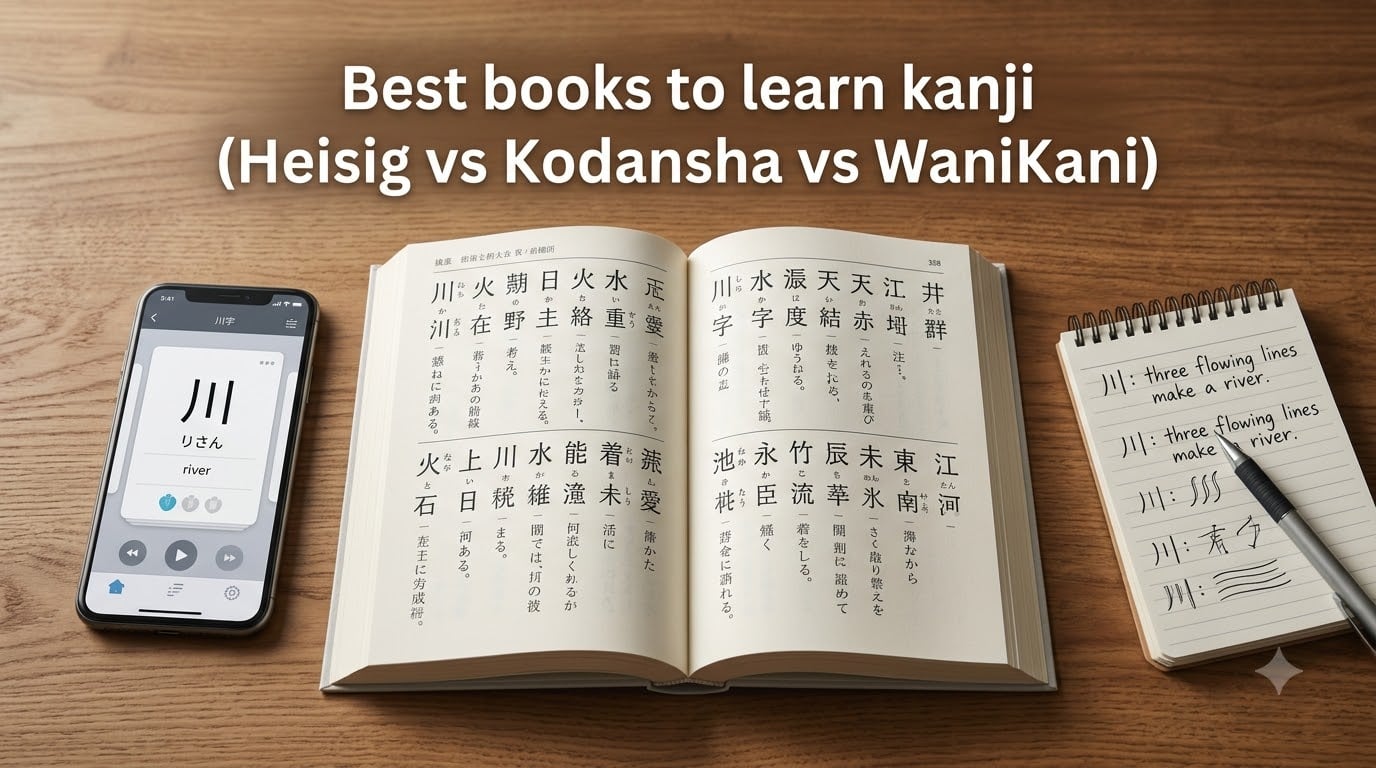
The three most widely recommended systems for self-study kanji in 2026 are James Heisig’s Remembering the Kanji (a 3-volume print series), the Kodansha Kanji Learner’s Course (a single textbook), and WaniKani (a web app by Tofugu). Heisig teaches English keywords via imaginative memory stories; Kodansha KLC adds stroke-order diagrams and contextual sentences with readings included; WaniKani automates mnemonics plus spaced repetition online and pairs each kanji with vocabulary. The right pick depends on whether you want a book, a textbook, or an app, and whether you also need to learn Japanese readings from day one.
Table of Contents
Why Learners Struggle With Kanji (and Why Method Matters)
Kanji are one of the largest barriers to reading Japanese. The Japanese Ministry of Education lists 2,136 joyo kanji as the baseline for general literacy, and reaching comfortable reading in novels or newspapers usually means knowing 3,000 or more. Each character carries at least one on’yomi (Chinese-derived reading) and one kun’yomi (native Japanese reading), often several of each.
Rote memorization does not scale to that volume. Structured methods rely on two engines: a mnemonic system that turns abstract strokes into a memorable story, and a spaced repetition system (SRS) that schedules reviews at the moment you are about to forget. Heisig, Kodansha KLC, and WaniKani all build on this pairing, but they apply it in very different ways.
Before diving in, here are quick definitions you’ll see throughout this guide:
- Kanji: Chinese-derived characters used in Japanese writing.
- Joyo kanji: The 2,136 kanji designated for everyday use.
- On’yomi / kun’yomi: The two reading systems attached to most kanji.
- Primitive: A small recurring building block of a kanji, used in the Heisig method.
- Radical: The traditional indexing component used in dictionaries.
- Mnemonic: A memory aid that ties an abstract symbol to a vivid image.
- SRS: Spaced repetition system, an algorithm that resurfaces items at increasing intervals.
Side-by-Side Comparison Table
| Method | Kanji covered | Readings taught? | Format | Time to finish | One-time or recurring | Best for |
|---|---|---|---|---|---|---|
| Remembering the Kanji (Heisig) | ~2,200 (RTK1) + 3,000+ (RTK2/3) | No (deferred to RTK2 or paired resource) | 3 print volumes | 3-6 months for RTK1 | One-time book purchase | Writing-focused learners who want to front-load meaning |
| Kodansha Kanji Learner’s Course | ~2,300 | Yes (on’yomi and kun’yomi) | 1 textbook + workbook | 9-12 months | One-time book purchase | Self-learners who want readings + structure in one book |
| WaniKani | ~2,000 (+ 6,000 vocabulary) | Yes (built into lessons) | Web app with free tier | 12-18 months (60 levels) | Recurring subscription | App-based learners who want SRS automation |
Remembering the Kanji (Heisig): Method, Coverage, Strengths, Weaknesses
James Heisig’s Remembering the Kanji is the book that started the modern English-language kanji-method conversation. Volume 1 (RTK1) walks through roughly 2,200 kanji using a two-step approach: first you learn an English keyword for each character, then you invent a short story that links the character’s primitives (the recurring building blocks Heisig defines) to that keyword.
Volume 2 (RTK2) teaches the on’yomi and kun’yomi readings and pairs them with vocabulary words. Volume 3 (RTK3) covers compound words and names. Most self-learners stop after RTK1 because the keyword stage alone is heavy lifting, and they pick up readings later through textbooks or an app.
Strengths of the Heisig Method
- Teaches a writing stroke order for every kanji, which is rare among modern methods.
- Front-loads meaning so you can recognize kanji without first mastering readings.
- One-time book purchase; no subscription.
- A massive community of mnemonics exists on Kanji Koohii, so you rarely invent alone.
- Available in 10+ languages with downloadable errata.
Weaknesses of the Heisig Method
- No Japanese readings until you tackle RTK2 or pair the book with another resource.
- The English mnemonics can feel cringeworthy to learners who dislike the imaginative-memory style.
- Writing practice is time-consuming, and many modern learners say they only need recognition for reading manga or websites.
- Finishers often describe the post-RTK1 “cram and forget” feeling if readings are not reinforced immediately.
How Many Kanji Does Remembering the Kanji Cover?
RTK1 covers about 2,200 kanji, slightly more than the full joyo set. Volumes 2 and 3 expand to roughly 3,000+ characters when including names and variant forms. For most learners, finishing RTK1 is the milestone that matters; everything beyond it is enrichment.
Kodansha Kanji Learner’s Course: Method, Coverage, Strengths, Weaknesses
The Kodansha Kanji Learner’s Course (often called KLC) is the answer to a question Heisig leaves open: “What if I want readings and stroke order in a single book?” Authored by Andrew Henshall and the Kodansha editorial team, KLC teaches about 2,300 kanji, including all joyo plus the most common Jinmei (personal-name) kanji.
Each character is introduced with a keyword, stroke-by-stroke diagrams, mnemonic hints, and several contextual sentences that demonstrate on’yomi and kun’yomi in real words. The companion workbook forces you to write each kanji and recall its readings.
Strengths of Kodansha KLC
- Readings (on’yomi and kun’yomi) are taught alongside meaning, so you finish each kanji “complete”.
- Stroke order diagrams are drawn directly into the page, which removes the ambiguity of printed arrows.
- Published by Kodansha, one of Japan’s largest publishers, lending strong editorial credibility.
- One-time purchase with no subscription.
- Excellent companion for the Genki textbook series.
Weaknesses of Kodansha KLC
- Slower than RTK1 or WaniKani because each kanji carries more information (readings, sentences, examples).
- Heavier physically: the textbook and workbook together are over 1,000 pages.
- The contextual-sentence approach feels dense; learners who prefer a lighter daily load may stall.
- Less community-generated mnemonic content than Kanji Koohii.
Does Kodansha KLC Teach Readings?
Yes. KLC is the only one of the three methods that bakes on’yomi and kun’yomi into the primary lesson flow. You learn the keyword and the readings on the same page, then see both in sample sentences. This makes KLC the strongest choice for learners who want a self-contained textbook that does not require a paired app.
WaniKani: Method, Coverage, Strengths, Weaknesses
WaniKani is a web app built by Tofugu, the long-running Japanese-language blog and publisher. It automates the Heisig-style mnemonic + SRS loop and pairs every kanji with curated vocabulary words. You progress through 60 levels, each unlocking a new batch of radicals, kanji, and vocabulary.
The free tier covers the first three levels (about 30 kanji), which is enough to feel the rhythm of the system. Beyond that, WaniKani is a paid subscription with monthly and annual options.
Strengths of WaniKani
- Spaced repetition is fully automated, so you never have to schedule reviews yourself.
- Each kanji is taught alongside vocabulary from the start, which builds reading ability faster than RTK1.
- User-created mnemonics are browsable, so you can borrow a story that already works.
- Active community forums and a steady stream of UI updates since 2012.
- Strong testimonials: multiple users report reaching JLPT N2 in roughly a year and reading manga without subtitles within 12-18 months.
Weaknesses of WaniKani
- Recurring monthly cost adds up over a learner’s lifetime versus a one-time book.
- The level system can feel gated; impatient learners sometimes quit before unlocking the bulk of kanji.
- Kanji are taught in isolation, which critics argue makes long-term retention harder than contextual learning.
- Coverage tops out around 2,000 kanji, which is below the joyo ceiling.
- No writing practice; the app is recognition-only.
How Long Does WaniKani Take to Finish?
At the recommended pace (roughly 1 level every 10-12 days), WaniKani takes about 12-18 months to finish all 60 levels. Slower learners who do fewer reviews per day often stretch this to two years or more. Faster learners who push through apprentice items quickly can shave it to roughly a year.
JLPT Coverage Matrix: Which Method Covers Which Level?
If you are studying for the Japanese Language Proficiency Test, the question is not just “how many kanji” but “which JLPT levels does each method actually reach?” Here is how the three line up as of 2026:
| Method | N5 (~100 kanji) | N4 (~300 kanji) | N3 (~650 kanji) | N2 (~1,000 kanji) | N1 (~2,000+ kanji) |
|---|---|---|---|---|---|
| Remembering the Kanji (RTK1) | Yes (week 1) | Yes (~week 4) | Yes (~month 2) | Yes (~month 3-4) | Yes (~month 4-6, full 2,200) |
| Kodansha KLC | Yes (chapter 1) | Yes (chapter 4-5) | Yes (chapter 12-15) | Yes (chapter 25+) | Partial (reaches ~2,000 around chapter 40) |
| WaniKani | Yes (levels 1-3) | Yes (levels 4-10) | Yes (levels 11-25) | Yes (levels 26-40) | Partial (levels 41-60 reach ~2,000) |
The practical takeaway: all three can carry you to JLPT N2, and all three can get you most of the way to N1 with supplementary study. WaniKani and Heisig reach N1 coverage faster in calendar time; Kodansha KLC reaches it with stronger retention because each kanji arrives with readings already attached.
Who Each Method Is Best For
Choosing between these three comes down to three questions: do you want a book or an app, do you want readings on day one, and do you want to practice writing?
Choose Remembering the Kanji if you:
- Prefer a one-time book purchase over a subscription.
- Want to learn stroke order and writing alongside recognition.
- Are willing to pair RTK1 with a second resource (Genki, Anki, or RTK2) for readings.
- Like the imaginative-memory mnemonic style and want access to a large community mnemonic library on Kanji Koohii.
Choose Kodansha KLC if you:
- Want a self-contained textbook with readings included from chapter one.
- Are pairing your kanji study with Genki or another main textbook.
- Don’t mind a slower pace in exchange for more complete per-character information.
- Prefer print over screen for sustained reading sessions.
Choose WaniKani if you:
- Want a web app that handles SRS scheduling for you.
- Prefer learning on a phone or laptop rather than a heavy textbook.
- Are willing to pay a recurring subscription for ongoing app maintenance.
- Want vocabulary paired with kanji from the start, which speeds up reading practice.
Can You Combine the Three Methods?
Yes, and many experienced learners do. The three systems are not rivals so much as different shapes of the same mnemonic-plus-SRS engine, and they slot together in a few common ways.
Common Combination Strategies
- RTK1 → WaniKani: Finish Heisig’s Volume 1 to front-load meaning and writing, then move to WaniKani to absorb readings and vocabulary in SRS form. Reviewers on r/LearnJapanese describe this as the “meaning first, readings second” path.
- KLC + Anki: Use Kodansha KLC as your primary textbook and reinforce the readings in an Anki deck synced to your KLC progress.
- WaniKani + Genki: Pair WaniKani’s kanji and vocabulary with Genki’s grammar chapters; many Tofugu readers report this as a balanced self-study combo.
- RTK1 + Kanji Koohii: Use Heisig’s book alongside the free Kanji Koohii web app, which adds community mnemonics and SRS scheduling without a WaniKani subscription.
Supplementary Tools Worth Knowing
- Anki: Free (desktop) SRS app. The RTK Anki deck has been downloaded by hundreds of thousands of learners.
- Kanji Koohii: Free web app focused on Heisig’s keyword framework, with user-shared mnemonics.
- Genki: The standard beginner textbook pair; pairs naturally with Kodansha KLC or WaniKani.
- Bunpro: Grammar SRS that complements any of the three kanji methods.
Frequently Asked Questions
Is Remembering the Kanji still good?
Yes. Remembering the Kanji is still the most popular English-language kanji method in 2026, especially for learners who want to front-load meaning and writing. The 6th edition of Volume 1 is current, and errata are available online. The main caveat is that RTK1 teaches English keywords only; you will need a second resource for Japanese readings.
What is the best book to learn kanji?
The best book depends on your goal. For a self-contained textbook with readings included, choose Kodansha Kanji Learner’s Course. For a one-time mnemonic-based foundation that emphasizes writing, choose Remembering the Kanji. If you would rather use an app than a book, WaniKani covers the same ground with SRS automation.
Is WaniKani worth it?
WaniKani is worth it for learners who want SRS automation and vocabulary paired with kanji from day one. It is less worth it for learners who dislike subscriptions, who want writing practice, or who already own a textbook like Kodansha KLC and just need a review schedule.
Heisig or WaniKani, which should I pick?
Pick Heisig if you want a one-time book purchase, enjoy writing practice, and don’t mind adding a second resource for readings. Pick WaniKani if you want readings and vocabulary bundled in, prefer an app, and are comfortable paying a monthly fee for ongoing maintenance.
How long does it take to learn all joyo kanji with WaniKani?
At the recommended pace of about one level every 10-12 days, WaniKani takes 12-18 months to finish all 60 levels, which covers roughly 2,000 kanji. Faster learners can finish in about a year; slower learners often stretch it to two years.
Does Kodansha Kanji Learner’s Course teach readings?
Yes. KLC teaches on’yomi and kun’yomi alongside each kanji’s keyword, with contextual sentences for both. It is the only one of the three methods that bakes readings into the primary lesson flow rather than deferring them to a second volume or app.
Can you learn kanji from books alone?
Yes, you can learn kanji from books alone, especially with Kodansha KLC, which includes readings and contextual sentences. Remembering the Kanji also works from books alone, but most learners pair it with a second resource for readings or with Kanji Koohii for shared mnemonics.
Do you need to learn writing for Japanese reading?
No. Most learners who want to read manga, novels, or websites only need kanji recognition. Writing is required for handwriting letters, filling out forms, or taking the Kanji Kentei exam. If your goal is reading, you can skip stroke-order practice and use WaniKani or Anki for recognition only.
How many kanji does Remembering the Kanji cover?
Volume 1 of Remembering the Kanji covers about 2,200 kanji, slightly more than the full 2,136-kanji joyo set. Volumes 2 and 3 add roughly 800 more characters including names and variant forms, for a total around 3,000 across the series.
Is RTK outdated?
RTK is not outdated, but it is no longer the only serious option. Its core idea, pairing imaginative memory with spaced repetition, now lives in apps like WaniKani and Kanji Koohii. RTK remains the cheapest one-time purchase for learners who want writing and meaning taught together.
Conclusion: Picking the Best Books to Learn Kanji for Your Style
The best books to learn kanji are not a single title but a small set of well-trodden options that fit different learning styles. Remembering the Kanji is the right pick if you want a one-time book purchase, writing practice, and a mnemonic foundation you can layer readings onto later. Kodansha Kanji Learner’s Course is the right pick if you want a self-contained textbook with readings already attached. WaniKani is the right pick if you prefer an app that automates spaced repetition and pairs every kanji with vocabulary.
My short version: start with the format you will actually open every day. A book on your shelf beats an app you uninstall, and an app on your phone beats a textbook you never pick up. Once you have finished your chosen method, return to the comparison table and pick a second tool from the same list to fill the gaps. That pairing, more than any single title, is what carries self-learners to comfortable Japanese reading.