
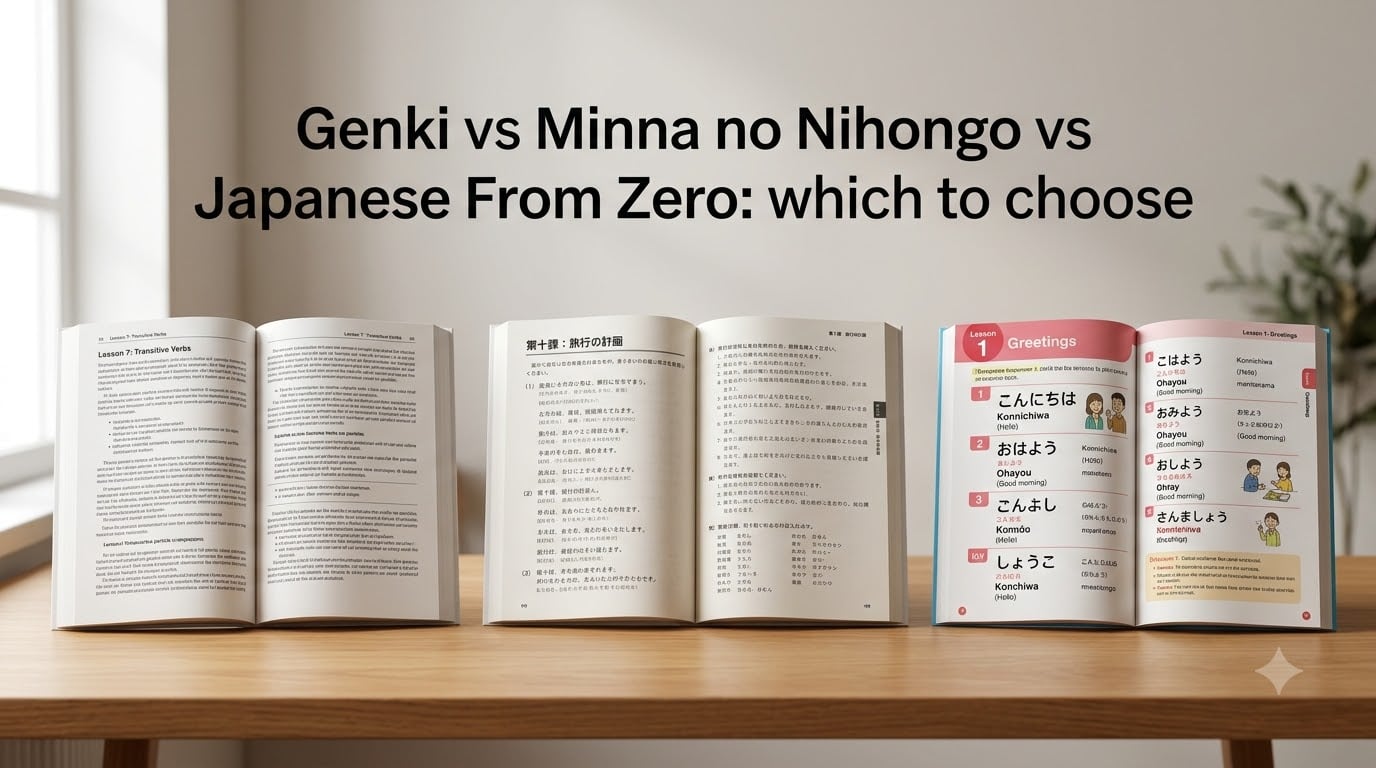
Choosing between Genki vs Minna no Nihongo vs Japanese From Zero is the first real decision every new Japanese learner makes, and it feels bigger than it should. I spent the last year switching between all three while building a translation reference library, and I can tell you the right pick depends almost entirely on how you plan to study and what kind of learner you are.
Genki is the most widely used beginner Japanese textbook in English-speaking universities; it explains grammar in English and bundles its own workbook. Minna no Nihongo is the standard textbook in Japanese language schools; its main book is entirely in Japanese and ships with a separate English translation and grammar-notes book. Japanese From Zero is a beginner series by George Trombley that uses a slow, progressive method and pairs every lesson with free YouTube videos.
In this guide you’ll get a three-way snapshot, a feature-by-feature comparison table, an honest self-study reality check for each book, and a learner-persona decision guide so you walk away knowing exactly which one to put on your shelf.
Table of Contents
Quick Picks: Which Textbook Fits You?
If you only have thirty seconds, here are the three picks I give friends and family who ask me which textbook to buy:
- Best for self-study: Genki. English grammar explanations plus a matched workbook make it usable without a teacher.
- Best with a teacher or in a classroom: Minna no Nihongo. The all-Japanese main book pushes immersion, and the translation-and-grammar notes book fills the gaps.
- Best for slow, gentle pacing or visual learners: Japanese From Zero. Progressive kana introduction and a strong YouTube community hand-hold you through the earliest lessons.
Those three picks hold up across roughly nine out of ten learner profiles I see on Reddit and the WaniKani community. If you have a tutor, flip Genki and Minna in your head. If you want maximum English-language structure, lean Genki. If pronunciation and natural speech patterns matter to you, lean Minna.
What Is Genki?
Genki is the most widely used beginner Japanese textbook for English speakers, written by Eri Banno and published by The Japan Times. It covers hiragana, katakana, and around 300 kanji across two volumes, taking learners from absolute beginner to roughly JLPT N4.
The first volume, Genki I, has 12 lessons plus a reading section, each built around a dialogue, vocabulary list, grammar notes, and practice exercises. The second volume, Genki II, adds another 12 lessons at JLPT N3-N4 level. Every lesson teaches grammar in English with sample sentences, then drills it through reading, listening, and writing exercises.
The textbook ships with a separate Genki Workbook for each volume, plus a downloadable audio set. The Genki Workbook is not optional in my experience; the textbook alone does not give you enough repetition to lock the grammar down. Many self-study learners also buy the official answer key, since the workbook answers sit only in a separate appendix or online portal.
Genki was designed for university classrooms, and that origin shows in two ways. First, the dialogues and cultural notes assume a college-age learner studying in Japan. Second, several exercises are pair-work activities, which awkward silence if you are studying alone. A WaniKani user named svenkevs put it bluntly when I was researching this piece: “I recently chose Genki. Not because it is the best per se, but because it’s the most used. If you do ever take classes, your teacher knows exactly what you learned if you say you just finished Genki 1 or 2.”
What Is Minna no Nihongo?
Minna no Nihongo is the textbook that Japanese language schools themselves use. Published by 3A Corporation, it is the de facto standard across hundreds of schools in Japan. The series has two beginner volumes, with the main textbook (called “Honsatsu” or “Main Text”) written entirely in Japanese.
That all-Japanese approach is the first surprise for most learners. There are no English explanations inside the main book. Instead, you buy a separate companion volume called “Translation and Grammar Notes” (often shortened to “TNGN”) that translates every dialogue and explains every grammar point in English. Self-studiers often miss this and end up stuck.
Minna’s grammar explanations are shorter than Genki’s, because the book expects a teacher to expand on them in class. Vocabulary is taught through themed chapters with set phrases rather than the long word lists you see in Genki. Kanji are introduced earlier and more aggressively than in either Genki or JFZ, and each chapter includes a kanji writing section with stroke order.
The big differentiator is pitch accent. Minna no Nihongo marks the pitch accent of every new word, which neither Genki nor Japanese From Zero does consistently. If you care about sounding natural rather than just being understood, this is the one feature that pushes Minna ahead for serious learners. The flip side is the cost. You need the main book, the translation and grammar notes, the workbook, and ideally the audio CD, and the total stacks up fast.
What Is Japanese From Zero?
Japanese From Zero is a beginner series by George Trombley, the YouTuber behind the “Learn Japanese from Zero” channel. It takes a progressive approach, meaning it does not throw all 46 hiragana at you on day one. Instead, the first lesson uses romaji and introduces around 12 hiragana. Each successive lesson adds a few more characters until you have both hiragana and katakana by the end of Book 2.
The series currently runs to seven books, plus a translation series and a kanji look-and-learn workbook. The textbooks are lighter on grammar theory than Genki and shorter on translation drills than Minna. They lean heavily on examples and dialogue, with cultural notes sprinkled throughout.
The standout feature is the YouTube ecosystem. Trombley’s “Yukai ni” (簡単に) lesson videos walk through every section of every book for free. That community is the reason JFZ survives as a beginner pick in 2026 even though Genki covers more material faster. A Reddit user in r/japanese put it this way: “Japanese From Zero is more geared towards self study, while Genki seems to be more classroom oriented. The main strength of JFZ is that the YouTube community provides hand-holding and the pace is slower.”
The trade-off is depth. JFZ takes two books to teach you hiragana and katakana, while Genki has you reading both within the first two chapters. WaniKani community member JapAndi captured the frustration directly: “I tried Genki at the very beginning and felt overwhelmed, then tried Japanese From Zero and felt it was a little too lax and didn’t like the hiragana being slowly incorporated.” That tension sits at the heart of the JFZ choice.
Side-by-Side Comparison Table
This table covers the practical features most learners ask about. Pricing varies by region and retailer, so I have left specific amounts out and focused on what you actually get.
| Feature | Genki | Minna no Nihongo | Japanese From Zero |
|---|---|---|---|
| Books in beginner series | 2 (Genki I and II) | 2 (Shokyu 1 and 2) | 7 main books plus translation series |
| Language of instruction | English | Japanese main book, English in companion | English |
| JLPT level covered | N5 to N4 (Genki II end) | N5 to lower N4 | N5 across Books 1-3, N4 across Books 4-7 |
| Audio included | Downloadable MP3 from publisher | Audio CD set per volume | Free YouTube videos plus online audio |
| Workbook | Separate matching workbook per volume | Separate workbook per volume | Exercises integrated, plus a workbook |
| Kanji introduced | Around 300 across two volumes | Around 350-400 across two volumes | Gradual, around 500+ across full series |
| Pitch accent marked | No | Yes, on every new word | No |
| Free online video support | Limited, mostly third-party | Limited | Yes, official Yukai ni series |
| Self-study friendly | Strong | Moderate (needs translation book) | Strong, with the most community support |
| Best fit | Self-study, university prep | Classroom, maximum immersion | Slow pace, visual learner, YouTube-friendly |
Grammar Presentation: Which Style Suits You?
Grammar is where these three textbooks diverge most clearly. Genki explains each grammar point in clean English prose with two or three example sentences, then walks you through the conjugations. The explanations assume you are seeing this grammar for the first time and never shortcut a definition.
Minna no Nihongo compresses that same explanation into the Translation and Grammar Notes book. You get the same grammar points in less English and more example sentences. The expectation is that the teacher will fill in any blanks. Learners who already speak another foreign language often prefer this density because it treats them as serious students rather than tourists.
Japanese From Zero spreads grammar thinner. Each chapter introduces one or two patterns with several examples and cultural notes. The pacing feels gentle, which is the point, but it also means JFZ 1-2 alone leaves gaps that you would normally cover in Genki 1.
If you learn best by reading dense explanations, Genki wins. If you learn best by sitting in conversation, Minna wins. If you learn best by watching someone talk through examples, JFZ wins.
Vocabulary and Kanji Coverage
Genki I and II together teach around 1,400 vocabulary words and 300 kanji. That maps fairly closely to JLPT N4 expectations. The kanji are introduced in a strict order, with stroke order and writing practice built into every chapter.
Minna no Nihongo covers roughly the same vocabulary depth in its first two volumes, with slightly more aggressive kanji introduction. Each chapter opens with a kanji list and includes handwriting practice. The trade-off is that you spend more time on writing and less on conversation.
Japanese From Zero teaches vocabulary in tight themed chapters with example sentences. Kanji come later in the series. Across the full seven-book run, JFZ covers more total kanji than Genki or Minna, but for N5-N4 preparation the relevant kanji overlap heavily. A WaniKani community member named Chocobits summed this up cleanly: “In terms of approachability, engagement and ease of access, I would recommend JFZ of the three. In terms of overall coverage and depth, Genki is best.”
Self-Study Reality Check
Self-study is where the textbooks separate from one another most clearly. Genki is the strongest pick if you have no teacher and no tutor. The English explanations cover every grammar point, the workbook gives you enough repetition, and you can find free answer keys online (officially or via third-party resources). The weakness is pair-work exercises, which you either skip or do with a language partner.
Minna no Nihongo is the trickiest for self-study. The main textbook is in Japanese, the translation notes are a separate book, and many exercises assume classroom context. You can absolutely self-study with Minna, and many people do, but you have to buy the translation book on day one and accept that some exercises will feel awkward without a partner.
Japanese From Zero is the most self-study-friendly book of the three in terms of community support. The Yukai ni YouTube videos are an unofficial classroom that walks you through every page. The progressive method means you never feel overwhelmed. The trade-off is that you progress slowly, and you may need to jump to Genki or another resource for N4 prep.
Audio and Listening Practice
Genki offers downloadable MP3 audio from the Japan Times website once you register the book. The recordings are clear, slow at first, and match the textbook dialogues and reading passages. The audio is high quality but not extensive, so you will need to supplement it with podcasts or YouTube.
Minna no Nihongo ships with an audio CD set that includes every dialogue and listening exercise. The recordings use natural-speed Japanese with multiple speakers, which is harder for beginners but better for long-term listening.
Japanese From Zero pairs the textbook with free YouTube videos where Trombley reads every dialogue and example aloud. For absolute beginners, that visual-audio pairing is more approachable than CD-only audio. Once you move past the beginner books, you will need to find your own listening material regardless of which textbook you start with.
JLPT Alignment: N5 and N4 Readiness
All three textbooks prepare you for JLPT N5 by the end of their first volume or first two books. The question is how cleanly they do it.
Genki I alone covers the grammar, vocabulary, and kanji for N5 in 12 lessons. Most learners I work with who finished Genki I and reviewed with a dedicated N5 prep book (like Shin Kanzen Master N5) pass on their first or second try.
Minna no Nihongo Shokyu 1 also covers N5, with more kanji practice but slightly less conversational drilling. It pairs naturally with Japanese language school JLPT prep.
Japanese From Zero Books 1 and 2 cover hiragana, katakana, and basic grammar, but the N5 content is not consolidated into a clean stopping point until Book 3. Most JFZ learners preparing for N5 add a Genki review or a dedicated JLPT prep book.
For N4, Genki II and Minna Shokyu 2 each map to the test more directly than the JFZ series does. JFZ learners aiming for N4 typically switch to Genki or Minna by Book 4 or 5.
How to Choose: A Decision Guide by Learner Persona
Pick your learner persona below and start with the textbook that matches. I have organized this by the four profiles I see most often on Reddit and WaniKani.
You Are a Self-Studier with No Tutor
Pick Genki. The English explanations, matched workbook, downloadable audio, and classroom-wide acceptance make it the safest self-study pick. Supplement with WaniKani for kanji and Bunpro for grammar review, and you can pass N5 within a year.
You Are Studying in a Classroom or Have a Private Tutor
Pick Minna no Nihongo. The all-Japanese main book mirrors the immersion you would get in a Japanese language school, and the Translation and Grammar Notes companion gives your teacher a clear path through each lesson. The pitch-accent markings are a genuine long-term advantage.
You Are a Casual Learner Who Wants a Slow, Visual Start
Pick Japanese From Zero. The progressive kana introduction and YouTube community make it the most approachable pick for adult learners returning to language study after a long break. Accept that you will likely graduate to Genki or Minna for N4 prep.
You Are an Adult Professional With Limited Study Time
Pick Genki, then layer WaniKani and Anki on top. Genki’s lesson structure is the most efficient use of limited study time, and the workbook gives you clear daily targets.
You Want Maximum Pronunciation Accuracy
Pick Minna no Nihongo. Pitch accent is the only Japanese textbook series that consistently marks it, and natural-speed audio trains your ear from day one.
Pairing Your Textbook with WaniKani, Anki, and Bunpro
Whichever textbook you choose, pairing it with the right external tools will accelerate your progress more than the textbook choice itself.
WaniKani is a kanji-learning web app that uses spaced repetition to teach around 2,000 kanji and 6,000 vocabulary words. It pairs well with any of the three textbooks because it handles the kanji load that the textbooks cannot cover in real time.
Anki is a free flashcard app. Most learners use it for sentence mining from the textbook dialogues or for vocabulary review. Genki learners in particular benefit from pre-made Anki decks that match the textbook’s word order.
Bunpro is a grammar SRS app that drills grammar points through example sentences. It covers the grammar in all three textbooks and is the closest thing to a “missing piece” for self-study with Genki.
A common workflow I see working well is Genki textbook plus WaniKani for kanji plus Bunpro for grammar SRS. JFZ pairs naturally with WaniKani because JFZ defers kanji to the later books. Minna pairs naturally with Anki because the dense grammar benefits from extra repetition.
What If You Need to Switch Mid-Stream?
Switching textbooks mid-stream is more common than you think. Learners start JFZ and graduate to Genki for N4, or they start Genki and pivot to Minna when they enter a Japanese language school. The good news is the early grammar overlaps heavily between the three series.
If you finished JFZ Books 1-3, you can pick up Genki I around Chapter 4 without much lost ground. If you finished Genki I and want to move to Minna, you can start Minna Shokyu 1 at Chapter 3. The kanji and core grammar are largely interchangeable; the differences are in pacing and presentation style.
The one thing you cannot skip is the textbook’s own dialogue and reading practice, because the vocabulary selection is unique to each series. Treat the switch as a vocabulary refresher rather than a full restart.
Frequently Asked Questions
Which Japanese textbook is best for beginners?
For self-study, Genki is the best all-around beginner Japanese textbook because the English grammar explanations and matched workbook make it usable without a teacher. Japanese From Zero is best if you want slow, gentle pacing and a strong YouTube community. Minna no Nihongo is best if you have a teacher or study in a classroom.
Is Minna no Nihongo good for beginners?
Yes, but only if you also buy the Translation and Grammar Notes companion book. The main textbook is entirely in Japanese, so without the companion self-study learners get stuck fast. With both books and a teacher, Minna is an excellent beginner resource and the only one of the three that marks pitch accent on every new word.
Which Genki book is best for beginners?
Start with Genki I. It covers hiragana, katakana, around 170 kanji, and the grammar and vocabulary needed for JLPT N5. Finish Genki I and review with a dedicated N5 prep book before sitting the exam. Genki II then carries you into N4 territory.
Is Japanese From Zero worth it?
Yes, especially if you want a slow, gentle pace or you learn well from YouTube videos. George Trombley’s Yukai ni lesson series walks through every section for free, which is a major advantage for absolute beginners. The trade-off is that JFZ takes two books to teach hiragana and katakana, so you may need to switch to Genki or Minna for N4 prep.
Can I pass JLPT N5 with Genki 1 alone?
Most learners who finish Genki I, complete the workbook, and review with a dedicated N5 prep resource like Shin Kanzen Master N5 pass on their first or second attempt. Genki I alone is not quite enough because the JLPT uses a specific question format, so dedicated N5 practice tests are still recommended.
Is Minna no Nihongo good for self study?
It is workable but not ideal. You must buy both the main textbook and the Translation and Grammar Notes companion on day one, accept that some exercises assume classroom pair work, and prepare to spend time cross-referencing between the two books. Most self-study learners who pick Minna end up supplementing heavily with online resources.
Which is better for starting Japanese, Japanese From Zero or Genki?
Pick Japanese From Zero if you are an absolute beginner who feels overwhelmed by kana or wants video hand-holding. Pick Genki if you want more depth per chapter, faster kana acquisition, and a textbook that maps cleanly to JLPT N5. Both are valid; Genki covers more material faster, while JFZ offers more community support.
What is the best book to learn Japanese from scratch?
If you are learning entirely on your own, Genki I is the most balanced pick for an absolute beginner because it teaches kana, grammar, vocabulary, and kanji in one package. Pair it with WaniKani for kanji review and Bunpro for grammar SRS and you have a complete beginner setup.
Conclusion
The Genki vs Minna no Nihongo vs Japanese From Zero choice comes down to one question: how do you learn best, and do you have a teacher? For pure self-study, Genki is the safest pick, and pairing it with WaniKani or Bunpro gives you a complete beginner system. For classroom learners and serious pronunciation work, Minna no Nihongo is unmatched, especially once you account for the pitch-accent markings. For slow, gentle pacing backed by an active YouTube community, Japanese From Zero is the most approachable entry point.
Whichever you pick, finish at least the first volume or first two books before switching. The grammar and vocabulary overlap between the three series is heavy, and the habit of consistent study matters more than the specific textbook on your desk.