
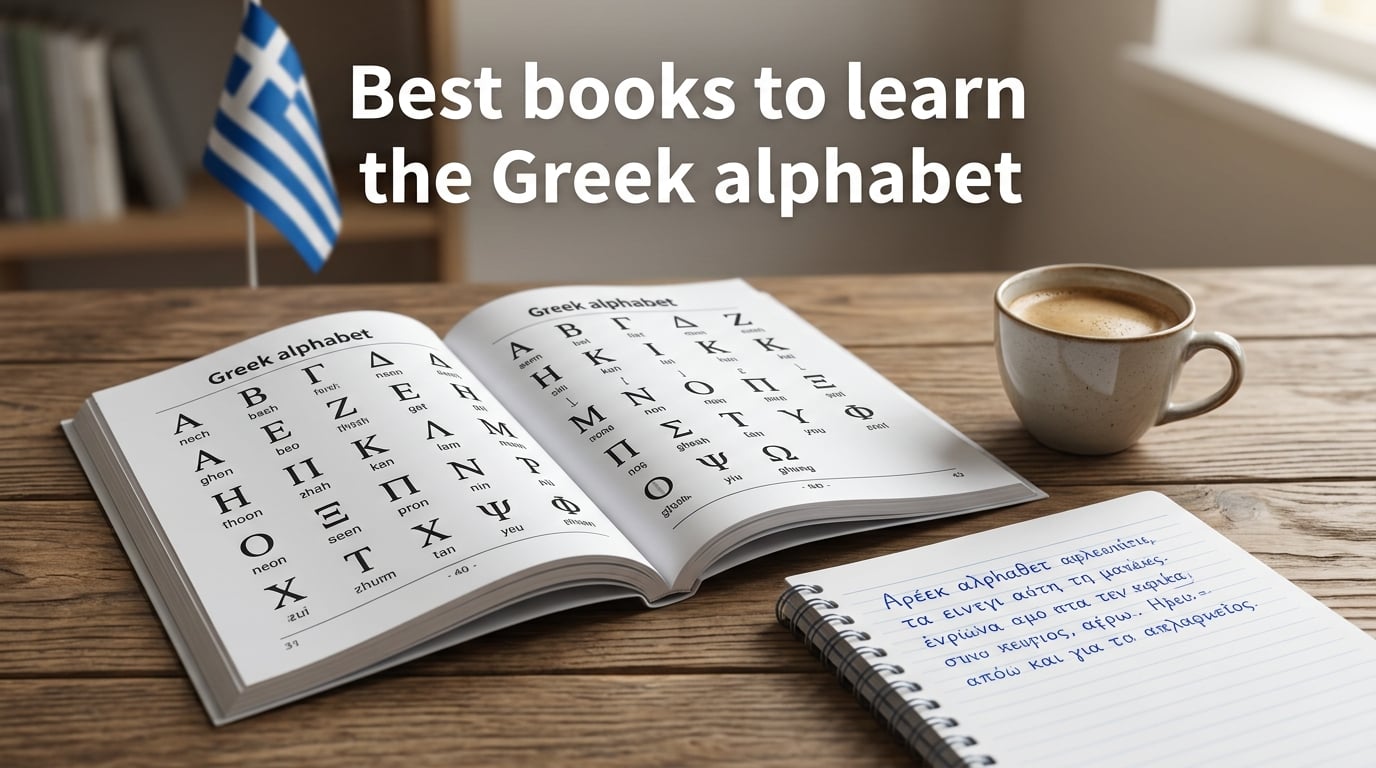
When I opened my first Greek textbook years ago, I stared at what looked like English letters gone rogue. The letter P was not “p” – it was “r.” The letter H was not “h” – it was a long “e” vowel. Within ten minutes I had mispronounced three “obvious” words. That single confusing hour taught me the lesson every Greek learner eventually learns: the Greek alphabet is small (only 24 letters), but its false-friend letters will trip you up if you walk in unprepared.
This guide is the resource I wish I had back then. We’ve compared the best books to learn the Greek alphabet across workbooks, dedicated alphabet primers, and full-scale textbooks, drawing on Reddit recommendations from r/GREEK and r/AncientGreek, expert-tested methodologies, and time-tested pedagogy. By the end, you’ll know which book to grab for your goal, how to use it, and how to avoid the five false-friend letter traps that derail most beginners.
Table of Contents
Our Top Picks to Learn the Greek Alphabet (Quick Picks)
If you only have 60 seconds, here are the seven books our team ranks highest for alphabet mastery in 2026, matched to the learner profile they serve best:
- Best Overall Workbook: Alpha Beta Learn Greek Alphabet Letters – handwriting-focused, ideal for true beginners of any age.
- Best Dedicated Alphabet Primer: Master the Greek Alphabet – laser-focused drills on letter recognition, pronunciation, and writing.
- Best for Speed Learners: Learn to Read Greek in 5 Days – a crash-course format for travelers and curious learners.
- Best Modern Greek Script Book: Greek Script Hacking by Judith Meyer – mnemonics and writing tricks for adults.
- Best for Ancient Greek: From Alpha to Omega by Ann Groton – rigorous foundation in the Classical alphabet.
- Best Short Reader/Workbook: Biblical Greek for Children by R.A. Sheats – digest-sized lessons paired with simple readings.
- Best Intensive One-Week Primer: The Greek Alphabet: 24 Letters in 24 Hours – structured drills for self-paced completion in a week or two.
Each of these titles is unpacked in detail further down. Before you pick a book, though, you need to know which Greek you’re learning and what those 24 letters actually include.
Understanding the Greek Alphabet: What You’re Actually Learning
The Greek alphabet consists of 24 letters: 17 consonants and 7 vowels. Each letter carries one consistent sound, which makes Greek far more phonetic than English – once you know the alphabet, you can pronounce almost any word on the page.
The 24 letters are: Α α, Β β, Γ γ, Δ δ, Ε ε, Ζ ζ, Η η, Θ θ, Ι ι, Κ κ, Λ λ, Μ μ, Ν ν, Ξ ξ, Ο ο, Π π, Ρ ρ, Σ σ/ς, Τ τ, Υ υ, Φ φ, Χ χ, Ψ ψ, Ω ω. Every one has both an uppercase and a lowercase form, and most lowercase letters connect to a handwritten stroke pattern you’ll only learn by writing them out.
The 24 Letters at a Glance
Beginners often worry that 24 letters will take months. In practice, the Greek alphabet takes most adult learners 10 to 20 hours of focused study to recognize and pronounce confidently, with handwriting requiring an additional 5 to 10 hours of muscle-memory practice. A motivated adult can decode simple Greek words within a single week.
Digraphs and Accent Marks (Tonoi)
Modern Greek uses several two-letter combinations called digraphs that represent one sound each: ου (ou, as in “soup”), ει and οι and αι (all “ee”), μπ (b), ντ (d), γκ (g), τσ (ts), and τζ (dz/j). Any quality alphabet book will drill these in order, because seeing “ου” and reading it as two separate vowels is a common beginner mistake.
Modern Greek also uses tonoi – accent marks over vowels that show where the stress falls in a word (e.g., α vs ά). The tonos is your friend, not decoration: it tells you how to pronounce a word when you’re still new to the alphabet. Every good primer devotes a page or two to tonoi early on.
Modern Greek Alphabet vs Ancient Greek Alphabet: Which Do You Need?
This is the single biggest mistake beginner book-buyers make. Picking the wrong version of the alphabet is the most common reason people abandon Greek study after a few weeks, according to multiple Reddit threads in r/GREEK and r/AncientGreek.
The Modern Greek alphabet has 24 letters and is used in Greece today. The Ancient (Classical) Greek alphabet also had 24 letters in its standard Attic form, but it included additional symbols, breathings (rough and smooth), and a three-accent system (acute, grave, circumflex). Several Ancient Greek letters – digamma, san, koppa – dropped out of use early.
| Feature | Modern Greek | Ancient (Classical) Greek |
|---|---|---|
| Letters in use | 24 | 24 (Attic standard), with extra archaic variants |
| Accent marks | One accent (tonos) | Three (acute, grave, circumflex) |
| Breathing marks | None | Rough (̔) and smooth on initial vowels |
| Vowel length distinction | No (η and ου are separate sounds) | Yes (η vs ε, ω vs ο) |
| Use case | Travel, Modern Greek fluency, Greek heritage | Classics, philosophy, biblical studies, ancient history |
| Best book types | Workbooks with audio, phrasebooks, Teach Yourself | Athenaze, From Alpha to Omega, Reading Greek |
Our recommendation: Decide before you buy. If your goal is conversation, travel, or Modern Greek fluency, buy a Modern Greek-focused book. If your goal is reading Plato, the New Testament, or Homer, buy an Ancient Greek textbook. The alphabets overlap heavily, but the books are not interchangeable – Modern Greek primers skip the breathing marks entirely, while Ancient primers spend their first lesson on them.
The False-Friend Letters Every Beginner Must Know (P, H, X, B, Y)
This is the highest-impact section in this guide. Five letters look almost exactly like English letters but represent completely different sounds. If you skip this callout, you will mispronounce almost every Greek word you read in your first week.
The five false-friend letters:
- P (Ρ ρ) is “R,” not “P.” When you see “Πελοπόννησος,” the first letter is “P” (rho) but the word’s actual sound is “Peloponnisos.” This trips every single English speaker.
- H (Η η) is “EE,” not “H.” Greek has no “h” sound at all. The letter eta sounds like the “ee” in “see.”
- X (Χ χ) is “CH” (as in “loch”), not “X.” The Greek chi is a hard, breathy “ch.”
- B (Β β) is “V,” not “B.” Greek beta sounds like “v.” The Modern Greek letter for “b” is actually μπ (the digraph).
- Y (Υ υ) is “EE” (in Modern Greek), not “Y.” Upsilon made a “u” sound in Ancient Greek; in Modern Greek it sounds like the French “u” or German “ü” in some dialects, but in standard Modern Greek it’s typically “ee.”
Write these five letters on a sticky note and put it on your book. Every alphabet book we recommend drills these explicitly – if the book you’re using doesn’t call them out, switch books.
The Best Books to Learn the Greek Alphabet, Reviewed
Now that you know what you’re learning and what to watch out for, let’s walk through each book our team recommends. Each pick has been matched to a learner profile based on Reddit recommendations, pedagogical depth, and the specific way it treats the alphabet itself.
1. Alpha Beta Learn Greek Alphabet Letters – Best Overall Workbook
This handwriting-practice workbook is the one we hand to absolute beginners most often. It treats the alphabet as a writing system, not a memorization list: every letter gets a dedicated tracing page, an example word, and a short pronunciation guide.
Key benefits: Letter-by-letter stroke order (not just typed font), printable traceable letters, audiobook companion for pronunciation, suitable for kids and adults. The book leads with vowels, groups similar-looking consonants together, and ends with short reading drills using words you’ve already written.
Best for: Anyone who wants to learn both to recognize and to handwrite Greek. Especially strong for visual learners and tactile learners who struggle with typing their way through a language.
2. Master the Greek Alphabet – Best Dedicated Alphabet Primer
If you want a book whose entire purpose is the alphabet, this is the one. Where most Greek textbooks treat the alphabet as a 6-page appendix, this book dedicates 80+ pages to it.
Key benefits: Pronunciation symbols with audio download, uppercase and lowercase practice pages, digraph coverage, accent mark drills, end-of-chapter reviews. Reviewers consistently call out the methodical pacing – one letter, one page, one drill, one review.
Best for: Learners who want alphabet mastery before they ever open a chapter on grammar or vocabulary. A natural pairing with any beginner Greek course.
3. Learn to Read Greek in 5 Days – Best for Speed Learners
If your goal is “I land in Athens in two weeks and need to read a menu,” this is the book. It is built entirely around rapid alphabet recognition and basic reading comprehension.
Key benefits: Five-day lesson plan, mnemonics for every letter, short reading passages built from words you’ve learned, audio downloads for pronunciation. The book makes a promise – read Greek in five days – and its method is unusually disciplined about delivering it.
Best for: Travelers, casual learners, and anyone who wants quick alphabet recognition without committing to a full course.
4. Greek Script Hacking by Judith Meyer – Best Modern Greek Script Book
Judith Meyer’s Script Hacking series treats the Modern Greek script the way a fluent polyglot would teach it: with mnemonics, shape associations, and adult-learner pacing. The book uses spaced-repetition techniques and visual memory tricks designed for people who have learned other alphabets before.
Key benefits: Letter-mnemonic pairings, handwriting tricks, side-by-side comparison with Latin and Cyrillic to highlight visual confusions, audio companion. Multiple Reddit users in r/languagelearning praise the Script Hacking series for its adult-friendly tone.
Best for: Adults who already speak another non-Latin-script language (Russian, Arabic, Hebrew, Japanese) and want a fast, technique-driven approach.
5. From Alpha to Omega by Ann Groton – Best for Ancient Greek
If you’re learning Ancient Greek for classics, philosophy, or biblical studies, this is the gold standard. Recommended repeatedly on r/AncientGreek, r/classics, and r/AcademicPhilosophy, the book pairs alphabet mastery with a careful first-year reading program.
Key benefits: Coverage of breathings and polytonic accents from day one, vocabulary drawn from Classical texts, gentle grammar ramp-up, integrated workbook. Reviewers describe it as “rigorous but not punishing,” which is rare for Ancient Greek primers.
Best for: Adult students and serious self-learners of Ancient Greek. The book assumes you’re reading Plato or Homer eventually – so the alphabet drills point you toward real Classical text from page one.
6. Biblical Greek for Children by R.A. Sheats – Best Short Reader/Workbook
This compact book punches above its weight. Despite the title, it works equally well for adults who want a digestible first reader. The book’s format pairs each alphabet letter with short, readable Greek sentences – so you practice recognition and reading simultaneously.
Key benefits: Built-in reading material from lesson one, manageable length (typically under 200 pages), clear pronunciation key, end-of-book review. Many r/AncientGreek users recommend this as a “weekend primer” before tackling Athenaze.
Best for: Beginners who want alphabet + reading in one shot, parents teaching kids, anyone intimidated by 400-page textbooks.
7. The Greek Alphabet: 24 Letters in 24 Hours – Best Intensive Primer
The title is a promise, and the book keeps it. The 24 hours are organized into roughly hour-long lessons, each focused on three letters plus a review drill.
Key benefits: Hour-by-hour structured plan, focused drills, suitable for classroom or self-study, includes review sessions every five letters. Not a full Greek textbook – the book’s job ends where the alphabet ends.
Best for: Self-disciplined learners who want a clear, measurable timeline. Pairs well with a longer textbook once you’ve finished the 24 hours.
Greek Letters in English: Where You Already Use the Alphabet
Even if you never plan to speak a word of Greek, you already use Greek letters every day. This section is the one no other competitor covers, and it’s worth knowing.
Greek letters show up in branding and pop culture (Alpha, Beta, and Omega as product names; Sigma as a camera brand; Theta as a network), in fraternities and sororities (most U.S. Greek-letter organizations use a sequence of Greek letters as their official name), and heavily in science and math – pi (π), sigma (σ) for summation, delta (Δ) for change, theta (θ) for angles, alpha and beta for probability in finance, lambda (λ) for wavelength, and omega (Ω) for electrical resistance.
You already encounter Greek letters in biology (DNA sequences use alpha, beta, gamma for protein chains), astronomy (constellations use Greek letters for star designation – Alpha Centauri, Beta Pictoris), and academic numbering (Tau as a mathematical constant). Recognizing these letters pays off even if your Greek language study stays casual.
How to Use Alphabet Books Effectively: A 4-Week Plan
A great book used badly teaches you nothing. Here’s the four-week plan our team built based on how successful self-learners in r/GREEK structure their study:
Week 1: Vowels and Familiar Letters
Spend 30 to 45 minutes per day on the seven vowels (Α, Ε, Η, Ι, Ο, Υ, Ω) and the consonants that look familiar but mislead (P, H, X, B, Y). Read each aloud. Write each by hand five times each. Cross-reference the audio companion in your book if it has one. Goal by day 7: recognize and pronounce all seven vowels and the five false-friend letters without hesitation.
Week 2: Consonants and Digraphs
Tackle the remaining 12 consonants in two groups: the “easy” ones (Δ, Ζ, Λ, Μ, Ν, Τ sound similar to their Latin cousins) and the “new” ones (Γ, Θ, Κ, Ξ, Π, Φ, Ψ, Σ). After the consonants, drill the digraphs (ου, ει, οι, αι, μπ, ντ, γκ, τσ, τζ) and the tonos accent. Goal by day 14: read any Greek word letter by letter with at least 80 percent accuracy.
Week 3: Handwriting Practice
Stop reading. Start writing. Most beginners skip handwriting entirely because keyboard input is faster, but handwriting is what cements letter shapes into memory. Use your book’s practice pages. If your book lacks them, print free Greek alphabet tracing worksheets from sites like greekalphabet.net. Goal by day 21: handwrite every letter confidently, both uppercase and lowercase.
Week 4: Reading Real Words
Pick up graded readers, simple Greek news headlines, or children’s books in Greek. Use what you’ve learned to decode real text. When you hit a letter you don’t recognize, go back to your primer. Goal by day 28: read a short Greek paragraph without help.
If you practice 30 minutes a day, you can realistically be functionally alphabet-literate within a month. The 80-hour FSI estimate for conversational Greek covers far more than the alphabet – the alphabet itself is just the first 30 to 40 of those hours.
Mnemonic Techniques to Memorize the Greek Alphabet Fast
Mnemonics are the single fastest way to lock the alphabet into memory. Here are five techniques used by learners in r/languagelearning and r/GREEK:
- Acrostic for the vowels: “A E I O U” in Greek becomes “Α, Ε, Η, Ι, Ο, Υ, Ω” – a 7-letter acrostic song you sing out loud while writing each letter.
- Shape rhymes: The letter Γ looks like an English “L” tilted; the letter Π looks like a fence; the letter Σ looks like a curvy “E” turned sideways. Say these shape comparisons out loud.
- English word links: “Alpha” begins with A. “Beta” begins with B. Most Greek letter names sound like their English equivalent – use that to anchor them.
- Pair drilling: Don’t learn letters one at a time; learn them in confusing pairs. Drill Β (v) vs English B, Ρ (r) vs English P, Χ (ch) vs English X as triplets until the difference is automatic.
- Spaced-repetition apps: Pair your book with Anki flashcard decks for the Greek alphabet. Review 10 cards per day for two weeks and you’ll have the alphabet permanently memorized.
Common Pitfalls and How to Avoid Them
The five pitfalls our team sees most often in beginning Greek learners:
- Buying the wrong alphabet version. Modern Greek learners who accidentally buy Ancient Greek primers (or vice versa) usually give up within a week. Verify before you buy.
- Skipping the false-friend letters. Treating the alphabet as a memorization list rather than a pronunciation guide leads to silent misreadings. Always study the false friends first.
- Choosing a book without audio. Without audio, you cannot verify your pronunciation. Pick a book with downloadable audio or pair it with a free pronunciation app.
- Ignoring handwriting. Recognition is not the same as reading. Handwriting builds muscle memory, which is what enables real fluency.
- Trying to learn all 24 letters at once. Beginners who try to memorize all 24 letters in one sitting forget half by the next morning. Stick to the week-by-week plan.
Choosing the Right Book for Your Goal: Kids, Adults, Travelers, Students
Match the book to the reader profile. For adults learning Modern Greek, start with Master the Greek Alphabet or Greek Script Hacking. For kids, Alpha Beta Learn Greek Alphabet Letters or Biblical Greek for Children offer the right mix of traceable writing and simple examples. For travelers with two weeks to prepare, Learn to Read Greek in 5 Days is the most efficient path. For Ancient Greek students, pair From Alpha to Omega with Athenaze or Reading Greek for a full first-year curriculum.
Frequently Asked Questions
What is the best book to learn the Greek alphabet?
The single best book for most beginners is Master the Greek Alphabet for its focused alphabet drills, but Alpha Beta Learn Greek Alphabet Letters is the strongest choice if handwriting practice matters to you, and Learn to Read Greek in 5 Days wins for travelers who need quick recognition. Choose based on your learner profile, not on which book is most popular online.
How long does it take to learn the Greek alphabet?
Most adult learners can recognize and pronounce all 24 Greek letters within 10 to 20 hours of focused study. Handwriting adds another 5 to 10 hours of practice. Practicing 30 minutes a day, you can be functionally alphabet-literate in about four weeks.
Can I teach myself the Greek alphabet?
Yes. The Greek alphabet is one of the easiest alphabets to self-teach because it is fully phonetic – every letter corresponds to one consistent sound. Pair a good alphabet workbook (like Master the Greek Alphabet) with audio downloads and free YouTube pronunciation guides, and you can teach yourself entirely without a classroom.
What is the fastest way to memorize the Greek alphabet?
Use spaced-repetition flashcards (Anki has ready-made Greek alphabet decks), learn the five false-friend letters (P, H, X, B, Y) first to avoid bad habits, and pair every letter with a mnemonic or English word link. Most learners who use spaced repetition can recognize all 24 letters within one week.
Is the Greek alphabet hard to learn?
The Greek alphabet itself is not hard – it has only 24 letters and is far more phonetic than English. The challenge is that several letters look like English letters but represent different sounds (false friends like P, H, X, B, Y). Once you lock in those five exceptions, the rest of the alphabet is straightforward.
Should I learn Ancient Greek or Modern Greek?
Learn Modern Greek if your goal is travel, conversation, Greek heritage, or reading modern Greek texts. Learn Ancient Greek if your goal is classics, philosophy, biblical studies, or ancient history. The alphabets overlap heavily, but the primers are not interchangeable – Modern primers skip breathings, while Ancient primers make them central.
How many letters are in the Greek alphabet?
The Greek alphabet has 24 letters: 17 consonants and 7 vowels. The Modern Greek alphabet uses all 24, while Ancient Greek used the same 24 in its Attic standard plus some archaic variants that later dropped out of use.
Final Thoughts on Choosing Your Greek Alphabet Book
After reviewing dozens of primers, workbooks, and full-length textbooks, our team’s clear takeaway is this: the best books to learn the Greek alphabet are the ones that drill the false-friend letters, pair every letter with audio, and treat handwriting as a first-class skill. For most learners in 2026, Master the Greek Alphabet and Alpha Beta Learn Greek Alphabet Letters lead the pack, with the right pick depending on whether you need a dedicated primer or a full handwriting workbook.
Pick the book that matches your goal, follow the four-week plan above, and your foundation will be set before most learners even finish their first chapter. Once you can read Greek, the rest of the language – grammar, vocabulary, conversation – opens up in ways that are genuinely fun to explore.