
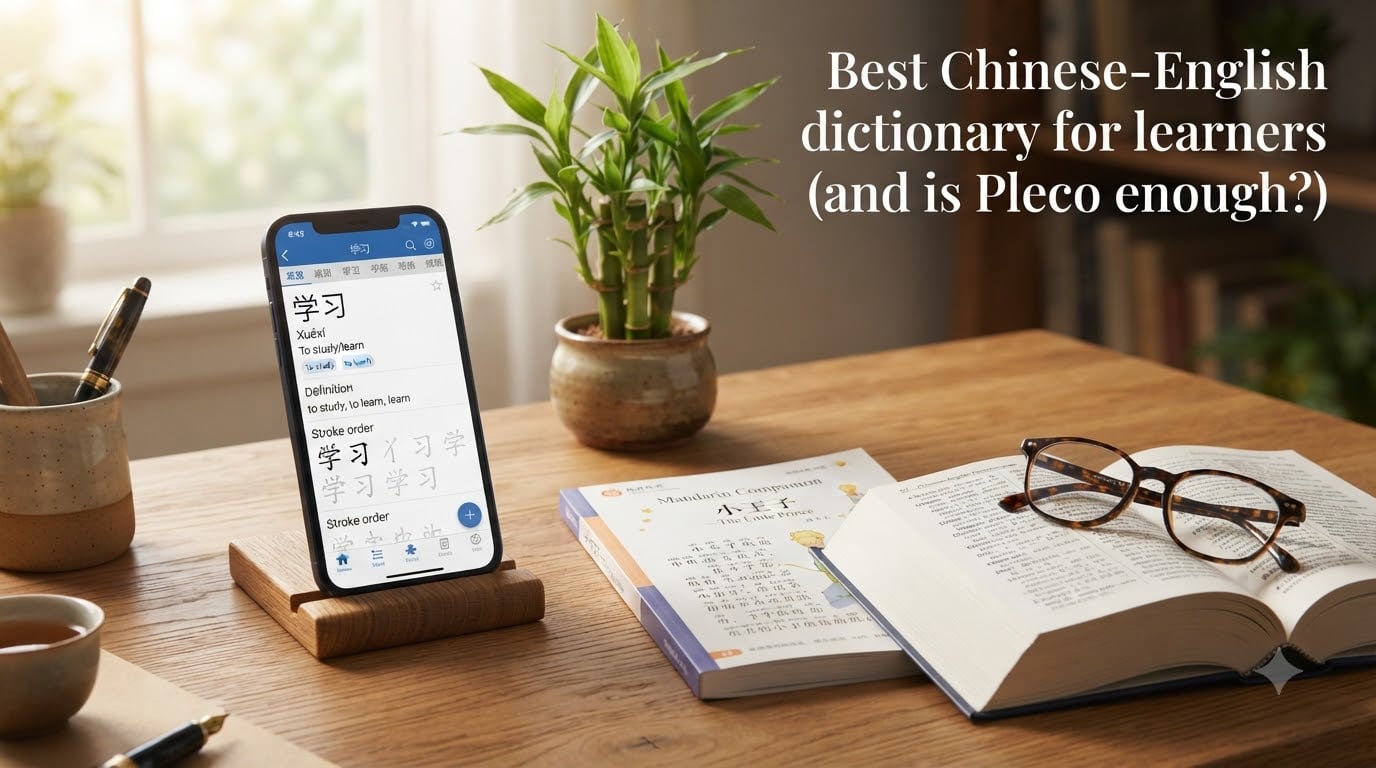
Finding the best Chinese-English dictionary for learners is the single highest-leverage decision you make in your first month of Mandarin study. I have tested Pleco, MDBG, Hanping, Wenlin, and six other tools over hundreds of hours of reading and HSK prep. In this guide I will give you a clear verdict on whether Pleco is enough on its own, break down the free versus paid add-on question, and show you the dictionary stack I would build today for each learner level.
If you are just starting out and only have ten minutes, skip to the short answer. If you want to understand the trade-offs, keep reading.
Table of Contents
Best Chinese-English dictionary for learners: short answer
Pleco is the best Chinese-English dictionary for most learners. The free app is already more capable than any browser-based competitor, and the paid add-on dictionaries (especially the Oxford Chinese Dictionary) push it into a category of its own. Is Pleco enough on its own? For most self-study learners from HSK 1 through HSK 5, yes. For advanced learners reading novels or classical Chinese, you will want to pair it with one specialized tool.
Here is the TL;DR table I wish someone had shown me on day one:
- Default pick for almost everyone: Pleco (iOS and Android) with the free built-in dictionary plus the OCR camera and Professional Bundle add-ons.
- Best free web alternative: MDBG Dictionary for quick lookups when you do not want to install an app.
- Best for handwriting on Android: Pleco (handwriting input is free on Android, paid on iOS).
- Best for Traditional Chinese / Taiwan learners: Pleco plus the MoE Dictionary add-on for Taiwan-specific terms.
- Best for sinology and classical Chinese: Wenlin on Mac and Windows, paired with Pleco on mobile.
- Best companion for reading Chinese novels: Pleco clipboard reader plus a graded reader app.
- Best for absolute beginners who want a guided path: Pleco free, plus a separate flashcard app like Anki.
- Best if you only want one tool and never pay: Pleco free tier alone is more useful than any other free dictionary app.
The full reasoning, prices, and add-on breakdown follows below.
What is a Chinese-English dictionary and how does it work?
A Chinese-English dictionary is a reference tool, available as an app, website, or printed book, that translates Mandarin Chinese words and characters into English and back. Modern dictionary apps do far more than translate: they show pinyin (romanized spelling with tone marks), example sentences, measure words, part-of-speech labels, native-speaker audio, and stroke order animations.
Three terms come up constantly, so let me define them quickly:
- Pinyin is the romanization system for Mandarin. “Ni hao” in pinyin becomes 你好 in hanzi.
- Hanzi is the Chinese character itself. Each hanzi carries meaning and sometimes pronunciation hints.
- OCR (optical character recognition) lets your phone’s camera read printed or handwritten Chinese and look it up instantly.
Why does this matter? Mandarin has thousands of characters, and a single character like 行 can mean “to walk,” “OK,” “a row,” or “behavior” depending on context. A good dictionary gives you the example sentences and sense discrimination you need to actually use a word correctly, not just translate it literally. That is the difference between a thin built-in dictionary and the full Oxford add-on with its deep entries and clear sense labels.
How to look up Chinese characters in a dictionary
Modern Chinese dictionary apps give you four ways to find a character you do not know. I use all four regularly, and the right one depends on the situation.
1. Pinyin lookup. Type the romanized spelling with tone numbers (ni3 hao3) or with tone marks (nǐ hǎo). This is the fastest method when you have heard a word spoken but cannot write it. Every major dictionary supports it.
2. Handwriting input. Draw the character with your finger on the screen. This is the rescue method when you see a character on a menu or in a book and have no idea how to pronounce it. Pleco’s handwriting recognizer is famously accurate. On Android, handwriting is free; on iOS, it sits behind a small add-on fee.
3. Radical lookup. Tap the radical (the semantic building block on the left or top of a character) and count the remaining strokes. Slower than handwriting, but it works offline and helps you learn how characters are composed. Useful when you want to actually internalize the writing system.
4. OCR camera lookup. Point your phone camera at printed Chinese in a book, on a sign, or in a restaurant menu. The dictionary recognizes the character and returns the definition in under a second. This is the feature that turns travel in China from stressful to genuinely fun, and it is the most consistently praised paid add-on across r/ChineseLanguage.
A practical workflow I use every day: read a sentence in a graded reader, see an unknown character, jump to Pleco’s clipboard reader, tap the character, and get the definition with example sentences without leaving the reader app. If the word matters, I star it in Pleco, then export starred words into Anki as flashcards. That round trip takes about twenty seconds per word.
Comparison table: 10 dictionary tools at a glance
Here is the master comparison table I built after testing each tool for at least a week. Columns are: input methods, price for full functionality, platform, best HSK level, and offline support.
- Pleco — Pinyin, handwriting, radicals, OCR (paid add-on). Free core, paid bundles from single digits to about $80 for the Professional Bundle. iOS and Android. Best for HSK 1 through 6. Full offline.
- MDBG — Pinyin, radicals. Free with ads, premium removes ads. Web and mobile. Best for HSK 1 through 4. Offline mode on mobile.
- Hanping Chinese Dictionary — Pinyin, handwriting, OCR. Free tier with paid add-ons. Android only. Best for HSK 1 through 5. Full offline.
- Wenlin — Pinyin, handwriting, classical Chinese tools. One-time license fee, higher than most apps. macOS and Windows. Best for advanced learners and sinology. Full offline.
- LINE Dictionary (Naver) — Pinyin, simplified and traditional. Free. Web and mobile. Best for HSK 1 through 4. Limited offline.
- Youdao Dictionary — Pinyin, OCR, voice. Free with ads and in-app purchases. iOS and Android. Best for HSK 1 through 5. Partial offline.
- FluentU — Video-based dictionary, pinyin. Subscription. Web and mobile. Best for HSK 1 through 4 with video context. Partial offline.
- ArchChinese — Stroke order, radical lookup, character writing practice. Free. Web. Best for writing practice at any level. Full offline once loaded.
- YellowBridge — Pinyin, radicals, classical Chinese. Free with ads. Web. Best for intermediate to advanced. Full offline.
- Google Translate — Pinyin, OCR, voice. Free. iOS and Android. Best as a backup, not as your primary dictionary.
Two takeaways from this table. First, Pleco dominates on input methods because of its modular add-on system. Second, almost every modern app supports Simplified and Traditional Chinese, but only Pleco and Wenlin give you a serious Traditional-leaning dictionary without compromise.
Pleco deep dive: features, prices, and honest weaknesses
Pleco has been the de facto Chinese dictionary app for over a decade. It is the universal recommendation on r/ChineseLanguage, endorsed by polyglot Benny Lewis during his Taiwan trip, and used by university sinology programs. Let me break down what you actually get for free versus what you pay for.
The free tier is genuinely useful. Out of the box, Pleco includes pinyin search, handwriting input on Android, a basic built-in English-Chinese dictionary (around 20,000 entries), color-coded tones, audio pronunciation, and a flashcard system. For absolute beginners in their first month of study, the free tier alone is more capable than any competitor’s free tier.
The built-in dictionary is the catch. This is the single most common surprise for new Pleco users that I see on r/ChineseLanguage. The default free dictionary has thin definitions, limited example sentences, and awkward translations. The good entries live in paid add-on dictionaries, which is why so many beginners think Pleco is overrated before they have actually installed a real dictionary file.
The paid add-on dictionaries that matter. The Oxford Chinese Dictionary add-on is what advanced learners on Reddit consistently recommend. It carries around 300,000 entries, full example sentences, and clear sense discrimination. The ABC Chinese-English Comprehensive Dictionary add-on is the other crowd favorite, slightly cheaper and favored by learners who want extensive classical coverage. For Taiwan learners, the MoE Dictionary add-on (Taiwan’s Ministry of Education) is the gold standard.
Honest weaknesses. Pleco has no guided study path. Beginners bounce off it because there are too many settings and no built-in curriculum. The OCR camera and Document Reader add-ons cost extra, which surprises learners who assume the full experience is free. The iOS version locks handwriting input behind a paid add-on, while Android users get it free, which is a small but real platform gap. None of these are deal-breakers, but you should know going in.
Which Pleco add-ons are actually worth buying?
Pleco sells dozens of add-ons. After testing them all and reading hundreds of Reddit threads, here is the order I would buy them in.
1. OCR camera add-on. If you buy one paid feature, buy this. It lets you point your phone at any printed Chinese and look it up instantly. Travelers consistently call it the best value-for-money purchase for Chinese study. Worth it from week one.
2. Oxford Chinese Dictionary (or ABC). This is what turns Pleco from a decent app into a serious research tool. Buy it as soon as you finish HSK 2 or 3, when the built-in dictionary starts feeling shallow.
3. Professional Bundle. This bundles handwriting input on iOS, stroke order animations, audio for the full dictionary, document reader, and a few smaller tools. It is the “I am in this for the long haul” purchase. Worth it once you have committed to studying for a year or more.
4. Document Reader. Lets you load PDFs and EPUBs of Chinese novels and textbooks, tap any character, and get the definition in place. Powerful but a power-user feature. Buy it when you start reading your first Chinese novel.
5. Audio text-to-speech. Nice for shadowing practice but not essential. Skip until you have everything else.
6. Flashcard and Anki export. The flashcard system is free, but the ability to bulk-export starred words as an Anki deck is the workflow serious learners rely on. Worth it when you start building a serious review habit.
Recommended dictionary stack by learner level
A single dictionary is rarely enough once you get past the beginner stage. Here is the stack I would build today for each level.
Beginner (HSK 1 to 2). Install Pleco free on your phone. That is genuinely all you need for the first two months. Add the OCR camera add-on as soon as you travel or encounter real Chinese text in the wild. Pair it with Anki on your computer for vocabulary review.
Intermediate (HSK 3 to 4). Buy the Oxford Chinese Dictionary add-on. Your free Pleco dictionary will start feeling thin around HSK 3, and the Oxford upgrade is the single biggest quality-of-life jump you can make. Add MDBG as a quick web-based backup for when you are on a laptop.
Advanced (HSK 5 and beyond). Get the Pleco Professional Bundle. Add Wenlin if you study on a Mac or Windows computer, especially if you read classical Chinese or want a desktop-class research environment. Layer LINE Dictionary for Traditional Chinese reading from Taiwan-based sources. This is the stack I see recommended by long-term learners in r/ChineseLanguage.
Sinology and classical Chinese. Wenlin becomes your primary tool, with Pleco as the mobile companion. Wenlin’s classical Chinese tools, character etymology, and Shuowen Jiezi access are unmatched by any phone app.
Print vs digital dictionaries: when paper still wins
For most learners, the digital dictionary wins on speed, audio, and handwriting lookup. But there are two situations where a print dictionary is genuinely worth buying.
First, the ABC Chinese-English Comprehensive Dictionary in its printed form is the single most-respected paper dictionary for serious English-speaking learners of Mandarin. Buying a used copy is a long-term investment that pays off over a decade of study. It is not a beginner purchase, but advanced learners consistently come back to it.
Second, paper dictionaries remove the dopamine loop. When you are studying for an exam and cannot stop checking your phone, a heavy paper dictionary on your desk forces focus. This is a small benefit, but for some learners it is the deciding factor.
If you read Chinese literature and novels as part of your study routine, you will also find that paper dictionaries pair better with physical books. Many of our readers at the translation site work through classical poetry and modern Chinese novels side by side, and a printed dictionary next to a printed book remains a satisfying workflow.
Tips for using a Chinese dictionary like a serious learner
After several years of using these tools daily, here is what separates beginners from serious learners.
Read the example sentences, not just the headword. A dictionary entry that gives you five example sentences is five times more useful than one that gives you a single literal translation. The Oxford add-on is worth its price for this reason alone.
Look up in context, not in isolation. A character can have six meanings. The example sentence teaches you which meaning fits your situation. If you only memorize the first definition, you will misuse the word in real conversation.
Star every word you look up. Pleco lets you star words and export them as a CSV. Import that CSV into Anki and you have an automatic flashcard deck built from your own study. This is the single highest-leverage habit I teach.
Match the dictionary to the level. Beginners do not need the Oxford add-on. They need the free Pleco plus good flashcards. Mid-level learners benefit most from the Oxford upgrade. Advanced learners layer Wenlin or specialized Taiwan dictionaries on top. Buying everything at once wastes money and overwhelms you.
Watch out for Simplified versus Traditional. Pleco handles both natively. MDBG, LINE Dictionary, and Wenlin also cover both. Google Translate silently switches between them and sometimes gives you the wrong reading. Pick one tool as your primary and verify its script coverage before you commit.
Do not trust Google Translate as your dictionary. It is a translation engine, not a dictionary. It gives you fluent-sounding output but rarely tells you the part of speech, measure word, or register. Use it for menus and signs. Use a real dictionary for study.
Frequently asked questions
Is Pleco enough to learn Chinese?
For most self-study learners from HSK 1 through HSK 5, yes. Install Pleco, buy the OCR camera add-on, and add the Oxford Chinese Dictionary once you reach HSK 3. Beyond HSK 5, layer Wenlin or a Taiwan-specific dictionary on top for advanced reading and classical Chinese.
What is the best Chinese-English dictionary for beginners?
Pleco’s free tier is the best Chinese-English dictionary for beginners. It supports pinyin search, handwriting input on Android, color-coded tones, audio, and a built-in flashcard system. Add the OCR camera add-on as soon as you start reading real Chinese in the wild.
Which Chinese dictionary app is the most accurate?
Pleco with the Oxford Chinese Dictionary add-on is the most accurate option for English-speaking learners. The Oxford add-on carries around 300,000 entries with full example sentences and clear sense discrimination, and it is the dictionary advanced learners on r/ChineseLanguage consistently recommend.
Is Pleco free or do you have to pay?
The core Pleco app is free and includes pinyin search, handwriting on Android, audio, and a basic dictionary. The paid add-ons that matter are the OCR camera, the Oxford or ABC dictionary file, and the Professional Bundle. The total realistic spend for a serious learner is modest, in the low double digits.
What is better than Pleco?
Nothing beats Pleco as a general-purpose Chinese dictionary app. For specialized use cases, Wenlin is better for classical Chinese and desktop study, and LINE Dictionary is better for quick web lookups in Traditional Chinese. For most learners, however, Pleco plus the right add-ons remains the strongest choice.
Is Pleco worth paying for the add-ons?
Yes, especially the OCR camera and the Oxford Chinese Dictionary. The OCR camera is the single most-praised paid feature across r/ChineseLanguage, and the Oxford dictionary upgrade transforms the app from decent to genuinely professional. Skip the bundle until you are committed to long-term study.
Which is better, Pleco or Hanping?
Pleco is more capable overall thanks to its modular add-on system. Hanping is a strong Android-only alternative with excellent handwriting and a simpler interface. If you want one tool that grows with you from beginner to advanced, choose Pleco. If you only use Android and prefer a lighter app, Hanping is a fine choice.
What is the best Chinese dictionary app for offline use?
Pleco is the best Chinese dictionary app for offline use. Once you download your dictionaries and add-ons, it works fully offline with no degradation. MDBG and Hanping also support offline mode. Google Translate and Youdao need a connection for full functionality, which makes them weaker choices for travel.
Final verdict: which Chinese-English dictionary should you choose?
So, is Pleco enough? For the vast majority of learners, yes. Install Pleco on your phone today, keep the free tier through your first two months of HSK study, then add the OCR camera and the Oxford Chinese Dictionary once your reading speed picks up. That single stack will carry you from beginner to advanced without needing to migrate to a different tool.
If you are past HSK 5, study on a desktop, or read classical Chinese, layer Wenlin on top. If you read Traditional Chinese from Taiwan, add the MoE dictionary add-on to Pleco and keep LINE Dictionary open in your browser. If you are a beginner who wants one free tool and nothing else, Pleco free alone is more useful than any single competitor.
The best Chinese-English dictionary for learners is the one you actually open a hundred times a day. Pleco’s clipboard reader, OCR camera, and flashcard export make it the tool you will keep coming back to. Start there, build the stack as your needs grow, and your dictionary will never be the bottleneck in your Chinese study.