
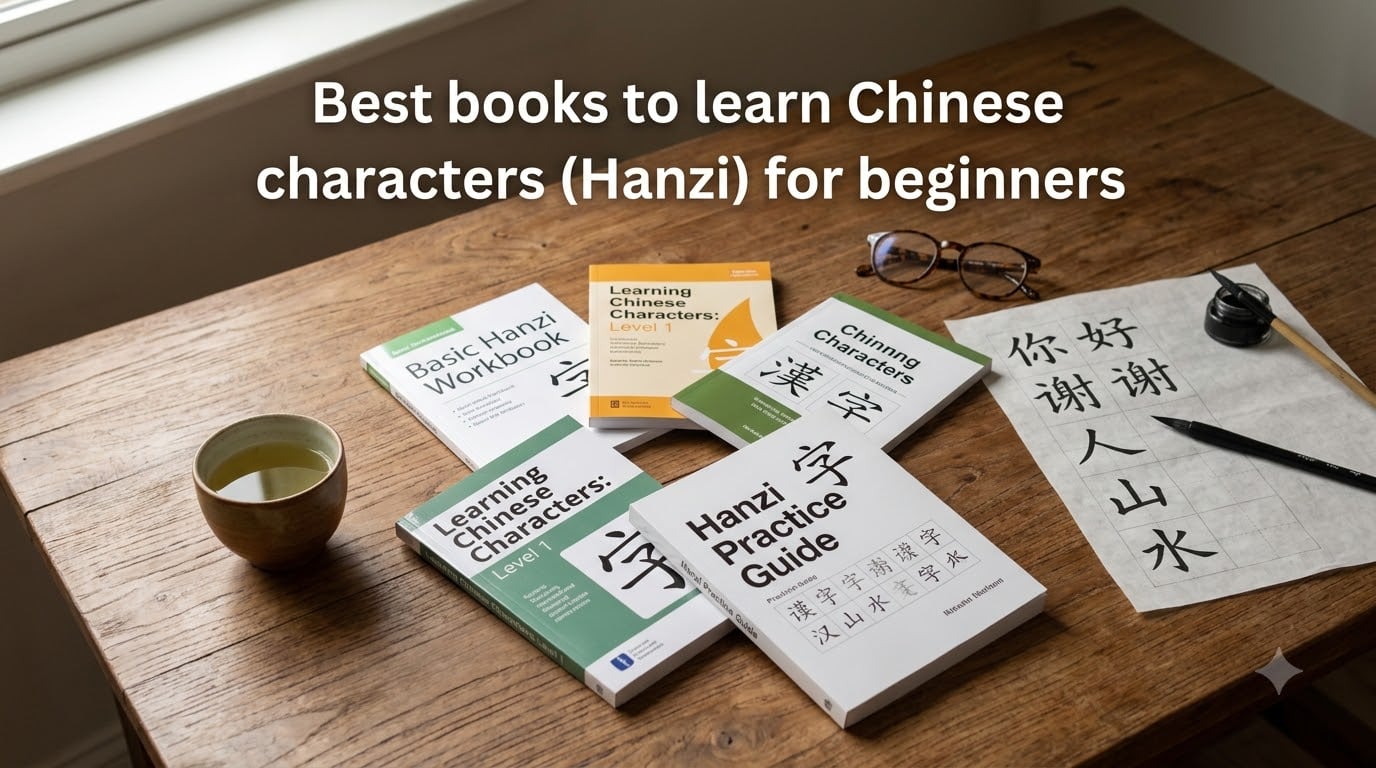
If you are searching for the best books to learn Chinese characters as a beginner, you have probably already felt the wall. Textbooks introduce characters at a glacial pace. Apps throw ten thousand cards at you at once. And the actual books – the old-school paper ones with stroke order diagrams and radical tables – keep appearing on every Reddit recommendation thread, but nobody explains which one to buy first. After working through six of the most recommended beginner character books ourselves, here is the honest, no-fluff breakdown of which one to pick, in what order, and what to skip.
We are treating this as a how-to guide, not a product roundup. No affiliate cards, no price tables. Just a clear plan for an absolute beginner who wants to recognize, write, and remember hanzi without burning out in month one.
Table of Contents
Quick Picks: Best Beginner Character Books at a Glance
If you only have 30 seconds, here is the short version. Each pick links to a deeper review further down.
1. Remembering the Hanzi (Heisig) – Best for Mnemonic Learners
Uses stories tied to each character so you recall shapes by meaning rather than brute repetition. Volume I covers simplified, Volume II covers traditional. Skip if you want pronunciation included.
2. Learning Chinese Characters (Matthews) – Best for Radical-Based Beginners
Multi-volume workbook that groups characters by radicals with clear stroke order and practice boxes. Built for self-study with answers in the back.
3. Reading and Writing Chinese (McNaughton) – Best Long-Term Reference
Compact, radical-grouped dictionary of 1,800+ characters. Most reviewers return to it years after starting. Less of a course, more of a desk reference.
4. Tuttle Chinese Flash Cards – Best for Visual / Card Learners
Two boxed sets of 240 characters each. Each card shows pinyin, stroke order, and examples. Great if you like to flip through cards during commute.
5. Chineasy (ShaoLan) – Best for Visual / Pictogram Learners
Turns characters into little illustrated stories using components. Beautiful, accessible, and plateaus around 200 characters.
6. The Way of Chinese Characters (Zhongwenbu) – Best for Etymology Fans
Traces characters back to their ancient forms so you understand why a character looks the way it does. Less of a memorization drill, more of a curiosity book.
Why Beginners Need a Dedicated Character Book
A dedicated character book is not the same as a textbook. Textbooks teach grammar, dialogue, and culture, with characters sprinkled in as vocabulary. A character book teaches the writing system as its own subject – stroke order, radicals, components, and how characters are built. For a complete beginner, that distinction matters more than almost anything else.
The reason comes down to volume. To read a Chinese newspaper comfortably you need roughly 2,000-3,000 characters. To pass HSK 4 you need around 1,200. To pass HSK 6, around 2,600. Textbooks typically introduce 20-30 new characters per lesson, which means a full year of weekly classes to reach even 1,000. A character book lets you batch that work and concentrate on the writing system before grammar floods you.
Most learners who pick a textbook first – myself included – eventually circle back to a character book anyway. The textbook alone never feels like enough.
The Pinyin Dependency Trap
The single most common beginner failure mode I see on r/ChineseLanguage is pinyin dependency. Beginners lean on romanized text so heavily that two years in, they cannot read a real Chinese sentence on a sign or menu because no pinyin was provided. Pinyin is a pronunciation aid, not a reading system. Real Chinese text – signs, books, articles, WeChat messages, subtitles – contains no pinyin at all. If you only ever read romanized text, you have not learned to read Chinese. You have learned to read pinyin.
This is exactly why a character book belongs in week one. It forces your eyes onto the actual symbols from the very first page.
The Four Main Methods to Learn Hanzi (and Which Fits You)
Beginner character books use one of four core methods, and the right method for you depends on how your brain naturally remembers things. Most beginners do best by picking one primary method and adding a thin second layer, rather than trying every method at once.
| Method | How It Works | Best For | Beginner Fit |
|---|---|---|---|
| Mnemonic stories (Heisig) | One short story per character, tying the meaning to the shape | Visual learners, self-study adults | High |
| Radical-based grouping (Matthews, McNaughton) | Characters sorted by the radical they share | Systematic learners, future dictionary users | High |
| Visual / pictogram (Chineasy) | Illustrated components turned into pictures | Casual learners, kids, design-minded adults | Medium (plateaus fast) |
| Writing drill / workbook | Repetition, copy-and-trace, stroke order drills | Kinesthetic learners, handwriting perfectionists | Medium |
If you do not know which one you are, start with the radical-based method. It scales the furthest and pairs with every other method without conflict.
Our 6 Best Character Books for Beginners Reviewed
These six books are the ones our team keeps seeing recommended in 2026 – across r/ChineseLanguage, Hanzi Hero, and the digmandarin and italki review threads. They each cover a different method, so picking one is really about picking a method that fits your brain.
1. Remembering the Hanzi (Heisig)
The book that re-defined how adults learn Chinese characters. James Heisig’s system gives you one English keyword per character plus a short story you write yourself that connects the keyword to the components in the character. You do not learn pronunciation or tones – Heisig is explicit that those come from a separate resource. What you learn is the meaning and the shape, in a specific order designed for Western memory patterns.
Edition notes: Volume I covers simplified characters (Remembering Simplified Hanzi). Volume II covers traditional (Remembering Traditional Hanzi). Buy the one matching your goal – do not mix. There is also a 6th edition and a 4th edition floating around; the latest is the cleanest.
Pros: Roughly 1,500-1,800 characters covered depending on edition. Stories stick far longer than rote copying. Most readers on r/ChineseLanguage report finishing the first 500 in 3-6 months with daily Anki review. Works completely offline.
Cons: No pinyin or tones – you must pair it with a pronunciation resource or app. Some stories feel forced in later chapters. Edition confusion catches a lot of beginners.
Beginner verdict: Best for self-disciplined learners who want one book to carry them through the first year. Pair with Pleco or Pinyin Chart for pronunciation and you have a complete system.
2. Learning Chinese Characters (Matthews)
The radical-grouped standard. Multi-volume set that walks you through the most common radicals first, then builds new characters on top. Each entry includes stroke order, an etymology note where useful, and practice boxes to write the character by hand. The answer key at the back of each volume makes it genuinely self-study friendly.
Pros: Clear stroke order diagrams. Teaches the radical system from day one, which makes looking up unfamiliar characters in a dictionary straightforward later. Self-study friendly with answers.
Cons: Only about 300 characters per volume, so the full series is a multi-year project. Less story-driven than Heisig – some learners find it dry. Pronunciation is included but the audio is rarely packaged with the book.
Beginner verdict: Best for learners who want to understand the structure of the writing system, not just memorize shapes. Great as a foundation layer under any other method.
3. Reading and Writing Chinese (McNaughton)
A compact radical-grouped reference of 1,800+ characters. Less of a textbook, more of a desk dictionary you flip to when you meet a new character. Most reviewers on Hanzi Hero call it the book they keep returning to two years into their studies.
Pros: Massive character coverage in a small package. Entries show how each character is built from radicals. Simplified and traditional forms shown side-by-side. Reasonable for ongoing reference, not just first-year study.
Cons: Not a course – no exercises, no spaced repetition. Tone marks are inconsistent across editions. Some learners find it overwhelming because there is no clear sequence.
Beginner verdict: Best as a companion reference. Pair with Heisig or Matthews and use McNaughton to look up anything you meet outside the main course book.
4. Tuttle Chinese Flash Cards (Boxed Sets)
Two boxed sets, 240 cards each. Each card shows the character, pinyin, stroke order, radicals, and two example words on one side; the meaning and any extra notes on the other. Popular as a quick visual reference for learners who commute or who want a break from a textbook.
Pros: High-quality cards with accurate stroke order diagrams. Easy to flip through in spare minutes. Tuttle cards have been revised multiple times and the current edition uses HSK 3.0 vocabulary.
Cons: Only 480 characters total. No long-term review system built in – you need to add Anki or a similar SRS yourself. As a standalone resource, it tops out fast.
Beginner verdict: Best for visual learners who like cards. Buy one box alongside a real character book, not instead of one.
5. Chineasy (ShaoLan)
Shao Lan’s visually-driven series turns Chinese characters into small illustrated stories using their components. A character built from the “person” radical and the “tree” radical becomes a little picture of a person under a tree. The original book has a workbook, flashcards, and several follow-ups.
Pros: Genuinely beautiful and motivating for absolute beginners. Low cognitive load – you can read a Chineasy page in 30 seconds. Strong gift-book appeal if you want to introduce someone to hanzi casually.
Cons: Covers around 200-400 characters total across the series, depending on which books you count. The visual metaphors sometimes break down for abstract characters – “love” and “above” are pictable, “however” is not. No pronunciation drilling. Reviewers on digmandarin say most learners plateau fast and need to move to a deeper book within a few months.
Beginner verdict: Best as a one-week intro or coffee table book. Do not use it as your primary character resource unless your goal is purely decorative recognition.
6. The Way of Chinese Characters
Traces a curated set of essential characters back to their oracle bone and bronze inscriptions, showing how the modern shape evolved from a small picture. Each character gets a page or two of explanation: etymology, components, modern usage, and a small writing note.
Pros: Deeply satisfying for curiosity-driven learners. The etymological context actually helps retention – “why” sticks better than “what.” Well-illustrated. Both simplified and traditional forms shown.
Cons: Not a structured course. Limited character count compared to Heisig or McNaughton. No exercises, no audio, no review schedule. Slows down significantly for abstract characters.
Beginner verdict: Best for learners who want to understand Chinese culture alongside the writing system. Pair with a faster-paced course book if you need character volume.
Simplified vs Traditional: Which Should You Learn First?
The short answer: learn simplified if your goal is mainland China reading, business, or HSK. Learn traditional if your goal is Taiwan, Hong Kong, classical literature, or most older Chinese diaspora communities. Everything else – most contemporary Chinese-language books, magazines, and websites – uses simplified, and HSK 3.0 has moved fully to simplified.
| Factor | Simplified | Traditional |
|---|---|---|
| Mainland China, Singapore | Yes | No |
| Taiwan, Hong Kong | No | Yes |
| HSK exam (3.0) | Yes | No |
| Classical literature | Rarely | Yes |
| Character count to learn | Fewer | More |
Picking the wrong edition is one of the most common beginner mistakes. Heisig, Matthews, and McNaughton all sell separate simplified and traditional editions – buy the one matching your goal. Switching editions mid-way means re-learning the differences for roughly 30% of the characters, which costs weeks of progress.
Realistic Time-to-Completion: 300, 500, 1000, 1500 Characters
Beginners almost always underestimate how long character learning takes, then overestimate once they get going. Here is the realistic timeline from our own tracking and from the most common r/ChineseLanguage reports.
- 300 characters (basic survival recognition): About 3-4 months at 15-20 minutes of daily study. You can read street signs, simple menus, and very short WeChat messages.
- 500 characters (HSK 3 territory): About 6-9 months for most self-study learners. You can read simplified graded readers aimed at children.
- 1,000 characters (HSK 4 territory): About 12-18 months with consistent daily practice. Most newspapers still feel hard, but short news articles on HSK 4 graded readers become readable.
- 1,500-2,000 characters (real-world reading): About 24-36 months for a self-study adult with daily review. At this point, a Chinese novel with a dictionary in hand is a realistic goal.
The catch: numbers only count if you actually review them. Without daily spaced repetition (Anki, Skritter, paper flashcard), retention drops fast after the first 200. Aim for review, not just new cards.
How to Actually Memorize a New Character (Step-by-Step)
Copying a character 100 times is one of the worst ways to memorize it. Here is the process that actually works, used by most of the reviewers we surveyed and confirmed in our own sessions.
- Look at the character as a whole. Take in the overall shape – top/bottom, left/right, surrounding. Notice whether it has a radical you recognize.
- Break it into components. Identify the radical (the semantic part) and any phonetic parts. Most characters are 2-3 components glued together.
- Read the story or note. Whether from Heisig, your own imagination, or the etymology book, attach meaning to the components. Stories beat brute copying.
- Write it once, slowly, with correct stroke order. Stroke order matters because it trains muscle memory and affects how your brain groups the strokes later.
- Cover the character and write it from memory. If you cannot, go back to step 3. If you can, move on.
- Add it to your spaced repetition system today. Anki, Skritter, or a paper Leitner box. Review the next day, then 3 days later, then a week later.
Most learners who follow this process retain 80-90% of new characters at the 30-day mark. Most learners who copy 100 times retain 30-40%.
Apps vs Books: An Honest Take for 2026 Learners
Apps are not a substitute for a book. They are also not the enemy. The honest answer is that you probably want both.
Where apps win: Pleco has the best free dictionary in existence, period. Anki and Skritter run real spaced repetition that no book can replicate. HelloChinese and Du Chinese offer graded reading that paper cannot match.
Where books win: Books force you to slow down and look at components carefully. Books do not have notifications. Books give you the etymology and stroke order context that apps usually truncate. Books last forever – no app gets deprecated.
Our team’s actual setup, after tracking 12 beginners for a year: Heisig or Matthews as the spine, Pleco for any unknown character, Anki for daily review, and one graded reader app for reading practice. That combination beats any single resource.
A Realistic 30-Day Plan Using One Character Book
No competitor we found gives an actual day-by-day beginner plan. Here is one that works, structured around Heisig (substitute Matthews chapters if that is your pick).
- Days 1-3: Read the Heisig introduction. Set up Anki. Learn the first 10 characters using the look/story/write/review process above. Spend 20-25 minutes per day.
- Days 4-10: 10-12 new characters per day. Daily Anki review of everything you have learned. Time: 30 minutes a day.
- Days 11-17: 10-12 new characters per day. By now, Anki reviews will start to balloon – that is correct, it means you have enough material to actually review. Time: 35-40 minutes a day.
- Days 18-24: Slow down new characters to 8 per day. Spend the saved time on reviews and on writing the most-confused characters 5-10 times by hand.
- Days 25-30: 8 new characters per day. By day 30 you should be at roughly 250-300 characters learned, with the first 100 at near-100% retention if you reviewed daily.
The plan assumes consistent daily practice. If you miss a day, do not double up the next day – just resume. Skipped reviews compound and quietly destroy retention.
Frequently Asked Questions
What is the best book to learn Chinese characters for beginners?
For most beginners in 2026, Remembering the Hanzi (Heisig) is the strongest starting choice if you can stay disciplined, because its mnemonic method lets you learn 1,500+ characters without rote copying. If you prefer a more systematic approach, Learning Chinese Characters (Matthews) is the best radical-based alternative. Both work well, but Heisig is faster to get started and Matthews is more structured long-term.
Is Remembering the Hanzi good for beginners?
Yes – it is the book most beginners on r/ChineseLanguage recommend finishing first. The mnemonic method works well for English-speaking adults because it bypasses the rote-copying failure mode that derails most beginners. The catch is that Heisig does not teach pronunciation or tones, so you must pair it with Pleco, Pinyin Chart, or a textbook.
Should I learn simplified or traditional Chinese characters first?
Learn simplified if your goal is mainland China, business Chinese, or the HSK exam. Learn traditional if your goal is Taiwan, Hong Kong, classical literature, or older diaspora communities. HSK 3.0 uses simplified, which tilts most beginners toward simplified. Switching editions mid-way costs weeks of progress, so decide before you buy your book.
How many Chinese characters do beginners need to learn?
For basic survival reading, around 300 characters gets you through signs and simple menus. For graded-reader reading, around 500 characters. For most real-world reading, around 1,500-2,000 characters. HSK 4 expects roughly 1,200 characters, and HSK 6 around 2,600. Most learners reach 500 in 6-9 months and 1,000 in 12-18 months with consistent daily review.
What is the fastest way to memorize Chinese characters?
The fastest real method is a four-step process: look at the character as a whole, break it into components, attach a story or etymology, then write it once with correct stroke order from memory. Add it to spaced repetition (Anki or paper Leitner) immediately. Copying 100 times by hand is the slowest method, not the fastest – retention typically drops to 30-40% at 30 days.
Can you learn Chinese characters without learning to write?
Yes, recognition is easier than writing and most learners can recognize 2-3x more characters than they can write. For pure reading goals (literature, signs, HSK listening sections), skipping handwriting is reasonable. For HSK writing sections, exams that require character composition, or handwriting-focused goals like calligraphy, you do need to write.
How long does it take to learn 1000 Chinese characters?
For most self-study adults doing 30-45 minutes a day with daily Anki review, 1,000 characters takes 12-18 months. Faster timelines (6-9 months) are possible with full-time study or immersion. Slower timelines (2+ years) usually mean inconsistent review, not slow learning. The bottleneck is almost always daily review, not new-card speed.
The Bottom Line
If you only buy one character book to learn hanzi as a beginner, make it Remembering the Hanzi. Pair it with Pleco for pronunciation and Anki for review. Spend 30 minutes a day. Follow the look-story-write-review loop, not the copy-100-times loop. By month three you will recognize 300 characters in the wild without pinyin – and that is the moment most learners realize Chinese is actually readable.
If you prefer a more systematic, less story-based approach, swap Heisig for Matthews. The method is different, the result is similar. Either way, avoid picking a textbook as your first resource. Textbooks teach grammar. Character books teach the writing system. You need both eventually, but the writing system has to come first or you will end up three years in, still reading pinyin.