
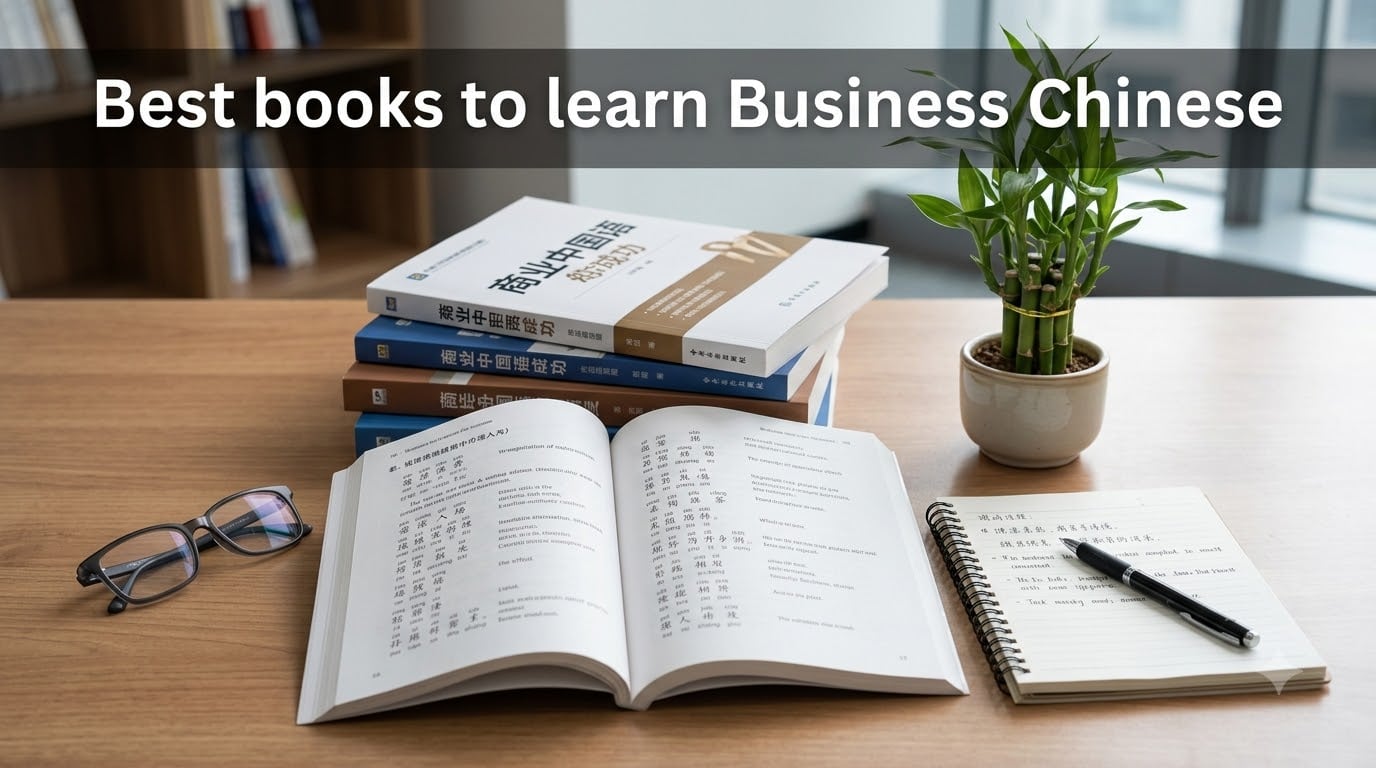
Business Chinese is a specialized form of Mandarin used in professional settings, covering workplace vocabulary, formal meeting language, contract terminology, and cross-cultural communication norms. If you want the best books to learn business Chinese, you need resources that go beyond general Mandarin textbooks and teach you the language of offices, negotiations, and trade. After spending months comparing what works and what doesn’t, our team has narrowed down the top recommendations organized by proficiency level.
This guide covers what we found to be the strongest options available in 2026, including the specific strengths of each book, who it suits best, and how to match the right resource to your current Chinese level. Whether you are an expat relocating for work, a business student preparing for a career in China, or a professional handling Chinese-speaking clients, we have organized the picks to help you choose quickly.
Table of Contents
Quick Picks: Best Business Chinese Books at a Glance
If you need a fast recommendation, here are the three books our team considers the strongest starting points based on quality of content, audio resources, and workplace relevance.
- Best for Beginners: Business Chinese Book 1 (600 Workplace Chinese Sentences) — short sentences with MP3 audio, ideal if you have HSK 2-3 level.
- Best for Intermediate Learners: 经贸汉语阅读 (Business Chinese Reading) — authentic articles from trade publications that build vocabulary in context.
- Best for Advanced Learners: 商务汉语教程 (Business Chinese Course) by Peking University Press — full textbook used in university business Chinese programs.
Read on for full details, our comparison table, and a buying guide that helps you match a book to your goals.
Why You Need Business Chinese Books
General Mandarin textbooks teach you how to order food, ask for directions, and discuss hobbies. Business Chinese books teach you how to introduce yourself in a meeting, negotiate a contract clause, and write a professional email to a Chinese client. The vocabulary, sentence structures, and cultural assumptions are completely different.
Our team has seen learners spend years studying general Mandarin, only to feel lost the moment they step into a Chinese-speaking office. The gap is real. Business Chinese textbooks fill it by focusing on what professionals actually say and hear: meeting openers, price negotiation phrases, project status updates, formal email closings, and industry-specific terms.
Reddit users on r/ChineseLanguage frequently mention this gap, with one learner noting that they could chat about weekend plans but froze when asked to introduce their company in Mandarin. The right book addresses this directly.
Beyond vocabulary, business Chinese books also teach cultural context: how to address counterparts politely, how meetings are typically structured in China, and which phrases signal respect versus over-familiarity. That context is hard to absorb from a language app alone.
Types of Business Chinese Books
Not all business Chinese resources look the same. Knowing the main categories helps you pick the book that fits how you actually plan to study.
- Conversation and Scenario Books: Built around dialogues in settings like meetings, trade fairs, and client dinners. Best for speaking practice and listening comprehension.
- Vocabulary-Focused Textbooks: Organized by topic (finance, marketing, trade, HR) with terminology lists, example sentences, and exercises. Best for building a strong foundation of workplace words.
- Reading Comprehension Books: Feature authentic or adapted articles from Chinese business publications. Best for learners who want to read industry reports and news.
- BCT Preparation Books: Designed around the official Business Chinese Test. Best if you have a specific certification goal.
- Email and Writing Books: Focus on formal written communication, including contracts, business letters, and proposals.
Most learners benefit from combining two types: a conversation book for speaking practice and a vocabulary or reading book for deeper study.
Best Business Chinese Books for Beginners
Beginner-level business Chinese books assume you know basic Mandarin characters and pinyin, typically equivalent to HSK 2-3 or CEFR A1-A2. They introduce workplace vocabulary gradually and avoid complex sentence structures. Here are our top recommendations for this level.
Business Chinese Book 1 – 600 Workplace Chinese Sentences (with MP3)
This book delivers exactly what the title promises: 600 short workplace sentences with bilingual translations and accompanying MP3 audio. Each sentence covers a specific professional scenario, from greeting a client to discussing a project timeline. The sentences are short enough that beginners can memorize them in batches.
What makes this book stand out is the audio quality. Every sentence is recorded by native speakers, which is exactly what beginners need for pronunciation. Many learners on Chinese-Forums recommend starting here because the short sentences build confidence quickly without overwhelming the reader.
The drawback is that the book does not go deep into grammar or cultural context. It is a sentence bank, not a full course. Pair it with a grammar textbook or app for the best results.
体验商务汉语 (Experiencing Business Chinese) – Beginner Level
This textbook series by Peking University Press is widely used in introductory business Chinese courses at universities. The beginner volume uses simplified characters, pinyin, and English translations, with each chapter built around a theme like company visits, product presentations, and office communication.
It includes dialogues, vocabulary lists, role-play exercises, and cultural notes. The cultural notes are particularly useful for beginners who do not yet know how Chinese business meetings differ from Western ones.
The main limitation is that beginners who have not studied general Mandarin first may find the pace challenging. We recommend completing at least HSK 2 before starting this book.
Best Business Chinese Books for Intermediate Learners
Intermediate learners typically have HSK 4-5 or CEFR B1-B2 level and can handle longer passages and more complex grammar. Books at this level introduce professional terminology in context and expect the reader to do more independent work. Here are our top picks.
经贸汉语阅读 (Business Chinese Reading)
This reading-focused book compiles articles from Chinese trade and business publications, adapted for language learners. It covers topics like China’s WTO entry, e-commerce growth, manufacturing trends, and trade policy. Each article includes vocabulary notes, comprehension questions, and discussion prompts.
Reddit users frequently recommend this book because it bridges the gap between textbook Chinese and real Chinese business content. The articles teach you how business topics are actually discussed in Mandarin, which is useful reading for anyone who needs to follow Chinese industry news.
The downside is that it focuses on reading rather than speaking. If your goal is conversation, pair it with a dialogue-based book.
商务汉语教程 (Business Chinese Course) – Intermediate Level
This Peking University Press textbook is a staple of intermediate business Chinese programs. Each chapter covers a business function: marketing, finance, human resources, supply chain, and international trade. The content includes dialogues, case studies, vocabulary lists, and exercises.
What makes it especially useful is the case study approach. Rather than just memorizing vocabulary, you analyze business situations and respond in Chinese. This builds practical thinking skills in the language.
Some learners find the content dense and recommend working through one chapter per week rather than rushing.
Best Business Chinese Books for Advanced Learners
Advanced learners have HSK 6+ or CEFR C1-C2 level and can handle specialized vocabulary, formal writing, and complex sentence structures. Books at this level prepare you for high-stakes professional communication. Here are our top recommendations.
高级商务汉语 (Advanced Business Chinese)
This advanced textbook covers topics like mergers and acquisitions, international contracts, financial reporting, and corporate strategy. Content is presented through case studies of real Chinese companies, including Lenovo, Huawei, and Alibaba.
The book assumes strong general Chinese proficiency and introduces specialized terminology in finance, law, and management. It is the kind of resource that prepares you for executive-level communication rather than day-to-day office chat.
Most learners use this book alongside a tutor or in a university course, because the case studies benefit from discussion.
BCT Official Exam Preparation Books
If you are preparing for the Business Chinese Test (BCT), the official preparation books are essential. They follow the test format precisely and include listening, reading, and writing practice. The BCT is recognized by employers and universities as proof of business Chinese proficiency.
There are two BCT levels: BCT (A) for intermediate learners and BCT (B) for advanced learners. Pick the level that matches your current proficiency rather than your goal, since the test is scored against your level.
These books are also useful even if you do not plan to take the test, because they expose you to a wide range of business topics and vocabulary.
Business Chinese Books Comparison Table
Here is a side-by-side comparison of the books mentioned above to help you compare at a glance.
- Business Chinese Book 1 (600 Sentences) — Beginner — Sentence bank with audio — MP3 included — Short sentences for speaking practice
- 体验商务汉语 Beginner — Beginner (HSK 2+) — Full textbook — Audio varies by edition — University-style business intro
- 经贸汉语阅读 — Intermediate — Reading textbook — No audio — Authentic business articles
- 商务汉语教程 Intermediate — Intermediate — Full textbook — Some audio in newer editions — Case studies across business functions
- 高级商务汉语 — Advanced — Full textbook — Limited audio — Case studies of major Chinese companies
- BCT Prep Books — Intermediate to Advanced — Exam prep — Yes — Test format practice
How to Choose the Right Business Chinese Book
With many solid options available, the right choice depends on your current level, learning style, and goals. Here are the criteria our team uses when recommending a book.
Assess Your Current Chinese Level First
Start with an honest assessment of your Mandarin proficiency. If you have not completed at least HSK 2 or equivalent, you are not ready for most business Chinese books. Build general Mandarin foundation first, then specialize.
Our team has watched learners skip this step and end up frustrated by books that assume vocabulary they have not yet learned. Two months spent on general Mandarin saves six months of confusion later.
Match Book Format to Your Learning Style
Different books suit different learners. If you learn best by listening and repeating, prioritize books with strong MP3 or audio components. If you learn by reading and analyzing, choose a reading-heavy textbook. If you learn through discussion, pick a case study book and work through it with a tutor.
Most successful learners combine two formats. A typical combination is a conversation book for daily speaking practice plus a reading textbook for deeper vocabulary building.
Check for Audio and MP3 Resources
Audio is non-negotiable for most learners. Pronunciation matters in Chinese, and reading pinyin alone does not train your ear or your mouth. Our team found that learners who use audio resources make roughly twice the speaking progress compared to those who skip audio.
When choosing a book, verify that audio is included or available as a download. Some older editions ship without MP3s even when listed, so check the edition details carefully.
Decide If You Need BCT Preparation
If you have a specific certification goal, choose BCT prep books first and use general business Chinese books as supplementary material. If your goal is conversational fluency without certification, skip BCT prep and focus on conversation and vocabulary books.
The BCT is worth taking for anyone planning a long-term career involving Chinese, because it gives employers a clear benchmark of your ability. Plan for roughly three to six months of focused study per BCT level.
Self-Study Versus Teacher-Guided Learning
Business Chinese is well-suited to self-study at beginner and intermediate levels, especially if the book includes audio and exercises. At advanced levels, our team found that learners benefit significantly from working with a tutor or joining a class, because the case studies and cultural nuances are easier to discuss with a teacher.
If you self-study, build in accountability: a study partner, a weekly tutor session, or a structured online course that forces you to complete exercises.
Books vs. Apps and Online Courses: What Works Best?
Books are not the only way to learn business Chinese, and they work best when combined with other resources. Apps like Pleco are excellent for character lookup and flashcard review. Platforms like iTalki connect you with native-speaking tutors for conversation practice. Structured courses at universities or language centers add accountability.
Our team’s recommendation is to anchor your study in a book, use apps as daily supplements (15-30 minutes of flashcard review), and add a weekly tutor session for speaking practice. This combination produces faster progress than any single resource alone.
Apps alone rarely get you to business fluency. They are useful for vocabulary retention and quick practice, but they do not teach the depth of workplace context that a good business Chinese book provides.
For learners on a tight budget, books plus Pleco plus a free podcast like Chinese Business Daily can form a complete study system without the cost of a formal course.
Frequently Asked Questions
What is the best Chinese language to learn for business?
Mandarin Chinese is the best Chinese language to learn for business, since it is the official language of mainland China, Taiwan, and Singapore and the dominant language of commerce across the Chinese-speaking world. Cantonese matters in Hong Kong and parts of Guangdong, but Mandarin opens the most doors for business professionals.
What is the best book for a beginner learning Chinese?
For complete beginners, we recommend starting with a general Mandarin textbook like the HSK Standard Course series to build foundational vocabulary and grammar. Once you reach HSK 2-3 level, transition to a business-focused book like Business Chinese Book 1 (600 Workplace Chinese Sentences) to begin learning workplace vocabulary.
How long does it take to become proficient in business Chinese?
Most learners reach working business proficiency (BCT A level) within one to two years of focused study, assuming they start with solid general Mandarin skills. Advanced business proficiency (BCT B level) typically takes three to five years of consistent study combined with workplace immersion or tutoring.
Is HSK enough for business Chinese?
HSK covers general Mandarin proficiency and is a useful foundation, but it does not test business-specific vocabulary, formal email writing, or workplace cultural norms. Most employers and professional contexts expect both HSK level certification and demonstrated business Chinese ability through the BCT or equivalent practical assessment.
Can I learn business Chinese on my own?
Yes, you can learn business Chinese on your own, especially at beginner and intermediate levels, using textbooks with audio, apps like Pleco for character practice, and online resources. At advanced levels, working with a tutor or joining a class significantly accelerates progress because case studies and cultural nuances benefit from discussion.
Final Thoughts on Learning Business Chinese
The best books to learn business Chinese are the ones that match your current level and include the audio resources you need to actually speak and listen, not just read. For most beginners, Business Chinese Book 1 (600 Workplace Chinese Sentences) is the fastest way to start using workplace language. For intermediate learners, 经贸汉语阅读 and the 商务汉语教程 series build the vocabulary and case study skills you need for real meetings and negotiations. For advanced learners preparing for high-level work or BCT certification, 高级商务汉语 and the official BCT prep books are worth the investment.
Start where you are, not where you wish you were. Build general Mandarin skills first if you have not already, then pick one book from the level that matches you and work through it chapter by chapter. Pair it with daily app practice and weekly speaking sessions, and you will see steady progress through 2026 and beyond.