
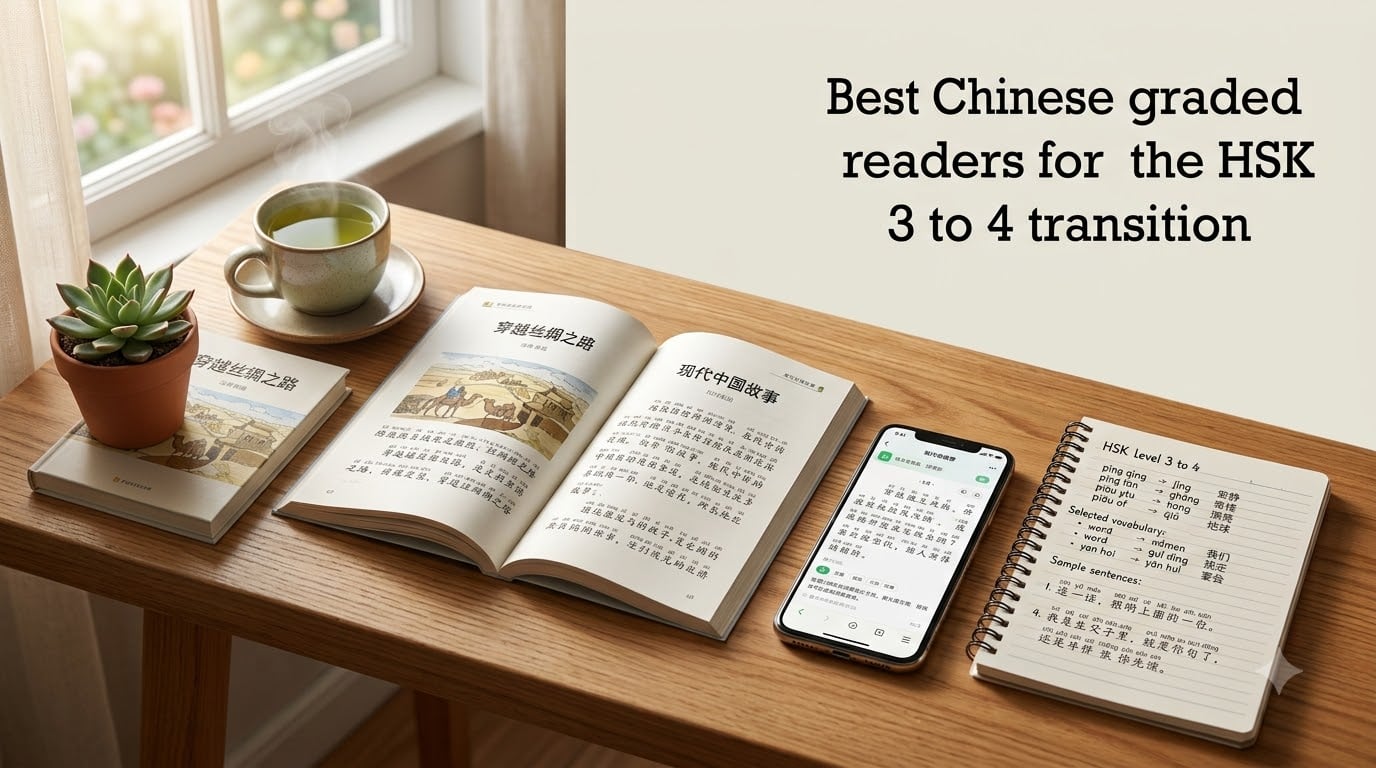
Finishing HSK 3 feels like a milestone – until you open the HSK 4 textbook and discover you cannot finish a single page without looking up half the words. That gap is real, and it is exactly where the best Chinese graded readers for the HSK 3 to 4 transition earn their keep.
Our team has spent months working through eight major graded reader series and comparing what each one offers at the intermediate band. This guide maps the vocabulary jump, breaks down the strongest reader series for HSK 3-4 learners, and gives you a concrete 6-week plan to cross the gap without burning out.
Table of Contents
What Is a Chinese Graded Reader?
A Chinese graded reader is a book, story, or app article written or adapted for a defined learner range, limiting unfamiliar vocabulary to a target HSK band and repeating high-frequency words in context so the reader can follow a complete text without a dictionary.
How does this work in practice? The publisher fixes a vocabulary pool – for example, 500 words for an HSK 3 target, or 1000-1200 words for an HSK 4 target – then rewrites or adapts a story using mostly that pool. Anything outside the pool gets a footnote with pinyin and English. You read the story whole, and the high-frequency words repeat so often that they stick without flashcard drills.
The principle comes from extensive reading research: you learn vocabulary best when you meet a word 15-20 times in meaningful context. Graded readers engineer that repetition. At HSK 3-4, where you are trying to internalize roughly 1000 new words, that engineered repetition is what separates steady progress from textbook burnout.
Why the HSK 3 to 4 Jump Demands Graded Readers
The HSK 3 to HSK 4 transition is widely considered the hardest jump in the entire HSK ladder. Under the new HSK 3.0 syllabus, the cumulative vocabulary roughly doubles – from about 1000 entries at HSK 3 to about 2000 entries at HSK 4. Under the older HSK 2.0 system, the jump was smaller (about 1200 to 1500), but still meaningful.
Vocabulary count alone is not the whole story. HSK 4 also introduces more abstract sentence patterns, longer clauses, and connectors that textbooks introduce but rarely repeat. A learner who grinds through HSK 3 vocabulary lists often still cannot sustain a 30-page book at HSK 4 difficulty.
Graded readers solve this by giving you 10-15 short stories calibrated to the band. You meet each new word in multiple sentences, in multiple stories, before you ever see it on an exam. That is the bridge the textbook cannot build.
The vocabulary jump in numbers
HSK 3 (HSK 2.0) carries roughly 1200 cumulative words; HSK 4 (HSK 2.0) carries about 1500. Under HSK 3.0, the equivalent bands are HSK 3 at about 1000 normalized distinct written forms and HSK 4 at about 2000. That larger jump under the new syllabus is one reason graded reader choice matters more than ever for learners testing in 2026.
Best Chinese Graded Readers for the HSK 3 to 4 Transition
Eight series cover the HSK 3-4 band well. They split into three groups: physical story-driven readers, app-based readers with synchronized audio, and publisher series that target HSK 3 or HSK 4 specifically. Below is what each one brings to the table.
Mandarin Companion Level 2
Mandarin Companion Level 2 stories use roughly 450 unique characters and sit squarely in the HSK 3-4 sweet spot. The plots are adaptations of classics (The Secret Garden, Emma, Journey to the West) rewritten with natural Chinese and English glosses on every non-target word.
What we liked: adult-appropriate storylines, clear HSK labeling, and a transparent word count on every cover. The physical books run 80-120 pages each, which is long enough to build reading stamina.
What could improve: limited audio support – you get the text and the English, but no synchronized audio recording on the page. If you need to train your ear alongside your reading, pair it with an app.
Chinese Breeze Level 2 and Level 3
Chinese Breeze runs from 300 words at Level 1 up to 1100 words at the higher levels. Level 2 (around 500 words) targets HSK 3, and Level 3 (around 750 words) targets HSK 4. Each book is a standalone story with pinyin footnotes and a free audio download.
What we liked: very transparent vocabulary count printed on the back of every book, a large backlist so you do not run out of titles, and audio that is included free with purchase. Forum users consistently call out Level 2-3 as the natural HSK 3-4 band.
What could improve: the plotlines can feel juvenile at the lower levels. If you are an adult learner who finds school-style stories off-putting, skip Level 1 and start at Level 2.
Du Chinese
Du Chinese is a subscription app with hundreds of articles tagged by HSK level. The lower levels are HSK 1-3 and feel natural for an HSK 3 reader; the intermediate level jumps to HSK 4-5 vocabulary quickly, which some learners find too steep.
What we liked: synchronized audio with word-by-word highlighting, one-tap dictionary lookups for any word, and a clean mobile reading experience. New articles land regularly, so you do not exhaust the library.
What could improve: the intermediate band can feel uneven – one article sits at HSK 4 vocabulary and the next pulls in HSK 5 words without warning. Filtering by exact HSK level helps.
The Chairman’s Bao
The Chairman’s Bao publishes a fresh graded news article every day, tagged by HSK level from 1 to 6. The HSK 3-4 articles use real-world news topics rewritten in controlled vocabulary, which makes them feel less repetitive than story-based readers.
What we liked: real news content, daily new material, and a difficulty filter that lets you lock to HSK 3 or HSK 4. A free trial lets you test a handful of stories before subscribing.
What could improve: news topics do not build a long narrative, so you miss out on the plot-following stamina that story readers build. Best used alongside a physical series, not as your only reader.
Pleco Graded Readers
Pleco ships a free dictionary with optional graded reader add-ons you can buy a la carte. The add-on packs cover HSK 1 through HSK 6, with synchronized text and audio in the same reader you already use for lookups.
What we liked: tight integration with the Pleco dictionary, sentence-level audio, and a one-time purchase model instead of a subscription. Forum users who already own Pleco often find this the lowest-friction option.
What could improve: the catalog is smaller than Du Chinese or The Chairman’s Bao, and the storylines are not as memorable. Think of it as a workout tool, not a reading habit builder.
Imagin8 Press
Imagin8 Press publishes original short novels in controlled vocabulary, with several titles explicitly tagged for HSK 3 and HSK 4. The plots are adult-themed (mystery, romance, workplace drama) and the books come in both simplified and traditional Chinese.
What we liked: adult storylines, both scripts available, and clear HSK labels. A solid pick if the children’s-book feel of Chinese Breeze turns you off.
What could improve: smaller backlist than Chinese Breeze or Mandarin Companion, so you will need to mix series once you finish the HSK 3-4 titles.
Friends BLCU Graded Readers
The Friends series comes from Beijing Language and Culture University Press and is widely used in Chinese classrooms. Levels 3 and 4 line up with HSK 3 and HSK 4 vocabulary, and the books include pinyin annotations on every page.
What we liked: structured classroom alignment, full pinyin on every page, and a transparent level system. A reliable choice if you want to know exactly what HSK band you are reading.
What could improve: the dialogues feel classroom-scripted and the storylines are not memorable for adult self-study. Better as a study supplement than a pleasure read.
Rainbow Bridge (Sinolingua)
Sinolingua’s Rainbow Bridge series adapts well-known stories (Aliens in Shanghai is a popular HSK 3 title) into controlled vocabulary. The physical books include pinyin, English notes, and a CD of audio recordings.
What we liked: recognized publisher with reliable print quality, both simplified and traditional editions for many titles, and the Rainbow Bridge shelf is one of the most heavily stocked on Amazon shopping results.
What could improve: the level labeling can be inconsistent across titles, so check the word count and sample pages before buying rather than trusting the HSK band on the cover alone.
At-a-Glance Comparison
The table below compares the eight series on the dimensions that matter at HSK 3-4: format, target word count, HSK band, pinyin, audio, and script availability.
| Series | Format | Target word count | HSK band | Pinyin | Audio | Script |
|---|---|---|---|---|---|---|
| Mandarin Companion Level 2 | Physical | ~450 unique characters | HSK 3-4 | Footnotes | Not included | Simplified |
| Chinese Breeze Level 2-3 | Physical | 500-750 words | HSK 3-4 | Footnotes | Free download | Simplified, some Traditional |
| Du Chinese | App | Tagged by HSK level | HSK 1-6 | Toggle on/off | Synchronized | Both |
| The Chairman’s Bao | App | Tagged by HSK level | HSK 1-6 | Toggle on/off | Synchronized | Simplified, some Traditional |
| Pleco add-ons | App add-on | Tagged by HSK level | HSK 1-6 | Optional | Synchronized | Simplified |
| Imagin8 Press | Physical | Tagged per title | HSK 3-4 | Footnotes | Some titles | Both |
| Friends BLCU | Physical | Tagged per level | HSK 3-4 | Full pinyin | CD in some editions | Simplified |
| Rainbow Bridge (Sinolingua) | Physical | Tagged per title | HSK 3-4 | Footnotes | CD in some editions | Both |
Digital vs Physical: Which Format Works Best at HSK 3-4?
Both formats work, and the strongest results come from pairing one physical series with one app. Here is why that combination tends to win.
Physical readers build stamina and a sense of progress – you turn pages, you finish a book, you remember the plot a month later. That story memory is what carries vocabulary into long-term recall. Apps deliver audio and dictionary lookup speed, which is how you train your ear and clear friction on unknown words.
For the HSK 3-4 jump specifically, our team recommends pairing Mandarin Companion or Chinese Breeze (physical) with Du Chinese or The Chairman’s Bao (app). Use the physical book for daily reading sessions of 20-30 minutes, and the app for short audio-heavy sessions when you cannot sit down with a book.
Subscription fatigue is a real pain point – several forum users have explicitly asked for physical readers because they did not want another monthly charge. If that is you, lean on Mandarin Companion plus Pleco’s one-time add-ons and skip the subscription apps entirely.
When digital wins
If you commute, travel, or read in short 5-10 minute bursts, the apps deliver more words per minute than a physical book. The synchronized audio also matters: hearing the words as you read them reinforces tone and pronunciation in a way that silent reading cannot.
When physical wins
If you need to build reading stamina for the HSK 4 exam, nothing replaces finishing an 80-page book. Apps make it too easy to bail out after two articles.
Common Mistakes When Picking a Graded Reader at HSK 3-4
These are the traps we see most often, and avoiding them will save you months of frustration.
Trusting the HSK label without checking the word count. Different publishers define HSK 3 differently, especially under the new HSK 3.0 syllabus. Always cross-check the word count on the back cover or sample pages.
Picking readers that are too easy. If you understand 100% of the words, you are not learning. Aim for 95-98% comprehensibility – the 2-5% unknown words are the ones you will actually acquire.
Dropping pinyin too early. At HSK 3, you still need pinyin support. Plan to phase it out gradually around HSK 4, not at the start of HSK 4.
Ignoring audio. Reading without listening trains your eyes but not your ears. If your goal is conversational fluency or exam listening sections, audio is non-negotiable.
Choosing only one format. A single physical series runs out of titles fast at HSK 3-4. Mix formats to keep the variety high.
Reading only children’s stories. If the plot feels juvenile, switch to Imagin8 Press or Mandarin Companion, which target adult readers.
A 6-Week Reading Schedule to Bridge HSK 3 to 4
This schedule mixes one physical reader with daily app articles. Assume 25-30 minutes per session, five days a week.
Week 1-2: Stabilize at HSK 3. Read one Chinese Breeze Level 2 book (or Mandarin Companion Level 2 title). Read a few pages per day, marking unknown words. Supplement with one Du Chinese HSK 3 article per day for audio practice.
Week 3-4: Push into HSK 4 vocabulary. Switch to a Chinese Breeze Level 3 book (or Imagin8 Press HSK 4 title). Keep the daily Du Chinese article but switch the filter to HSK 4.
Week 5: Mixed reading. Finish your current physical book. Add one The Chairman’s Bao HSK 4 article per day for variety and real-world vocabulary.
Week 6: Consolidation. Re-read the physical books you finished earlier. Notice how much smoother they feel. If they feel easy, you are ready for HSK 4.
Adjust the pace to your schedule. The key is consistency – 20 minutes a day beats 2 hours on a weekend.
HSK 3.0 vs HSK 2.0: What Has Changed for Graded Readers
The Chinese Test International (CTI) launched the new HSK 3.0 exam on December 13, 2026. Under the new syllabus, the vocabulary counts at every band shifted. Old HSK 4 (about 1500 cumulative words) lines up more closely with new HSK 4 at about 2000 normalized distinct written forms, but the band you target depends on which exam you are sitting.
For learners testing in 2026 and beyond, this matters because many publisher labels still reference the old HSK 2.0 system. A book labeled “HSK 4” might use 1500 words under the old system or 2000 under the new one. HelloChinese’s graded stories are one of the few series explicitly aligned to the HSK 3.0 syllabus.
If you are studying for the new exam, look for publishers that print the HSK 3.0 word count on the cover. If the cover only says “HSK 4,” check the sample pages and count the unique characters against the HSK 3.0 vocabulary list.
Frequently Asked Questions
What is a Chinese graded reader?
A Chinese graded reader is a book, story, or app article written or adapted for a defined learner range, limiting unfamiliar vocabulary to a target HSK band and repeating high-frequency words in context so you can follow a complete text without a dictionary.
What are the best Chinese graded readers for the HSK 3 to 4 transition?
For the HSK 3 to 4 transition, our top picks are Mandarin Companion Level 2, Chinese Breeze Level 2 and 3, Du Chinese, The Chairman’s Bao, Imagin8 Press, Friends BLCU, Pleco graded reader add-ons, and Rainbow Bridge (Sinolingua). Pair one physical series with one app for the best results.
Is HSK 3 a good level?
HSK 3 is a solid intermediate foundation. You can handle short articles and basic conversations. However, native Chinese content and HSK 4-level textbooks still feel dense, which is why graded readers are the most efficient bridge between HSK 3 and HSK 4.
How do I move from HSK 3 to HSK 4?
Read 10 to 15 graded readers at the HSK 3-4 band over 6 to 12 weeks, supplementing with daily app articles for audio practice. Aim for 95 to 98 percent comprehensibility, phase out pinyin gradually, and track your progress with timed re-reads of books you finished earlier.
What is the difference between HSK 3 and HSK 4 vocabulary?
Under HSK 2.0, HSK 3 has about 1200 cumulative words and HSK 4 has about 1500. Under HSK 3.0, HSK 3 has about 1000 normalized distinct written forms and HSK 4 has about 2000, which is a much larger jump. HSK 4 also introduces more abstract sentence structures and longer clauses.
Are graded readers good for learning Chinese?
Yes. Graded readers are one of the most effective tools for building reading stamina and internalizing vocabulary in context. The key is picking readers at the right difficulty level and reading enough of them – 10 to 15 books is the typical bridge between HSK levels.
The Best Way Forward
The HSK 3 to 4 transition does not have to feel like a wall. Pick one physical series – Mandarin Companion Level 2 or Chinese Breeze Level 2-3 is the safest bet – and one app for audio. Read for 25 minutes a day, finish 10-15 books, and re-read your favorites at the end.
That is the best Chinese graded readers plan for the HSK 3 to 4 transition, and it is what worked for our team and for the forum users who finally cracked HSK 4 after months of textbook frustration.