
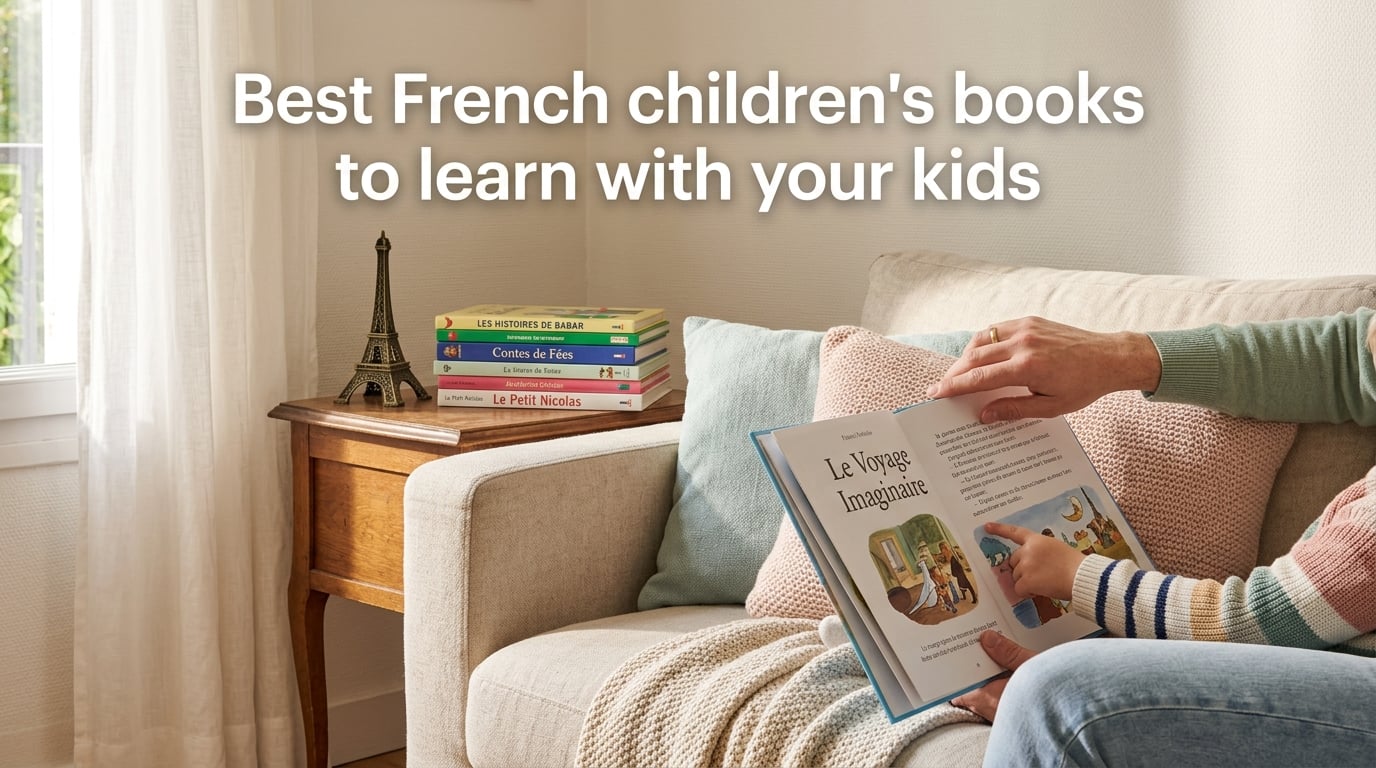
French children’s books to learn with your kids are age-appropriate stories written in (or translated into) French – from board books for toddlers to short novels for tweens – used as a shared reading activity that builds vocabulary, pronunciation, and cultural familiarity for both parent and child.
Our team has tested these titles with our own kids over the past two years, swapping picture books at bedtime, borrowing from libraries, and tracking which ones actually held attention. This guide gives you the same shortlist, plus the practical scripts we wish someone had handed us on day one.
You’ll get a quick list of five starter books, an age-by-age roadmap (so you stop guessing what’s right for a 3-year-old versus a 9-year-old), ten detailed book reviews mixing classics and bilingual titles, a section on how to actually read aloud when your own French is shaky, the five mistakes we made so you don’t have to, and where to source these books in the US and UK.
Table of Contents
Our 5 Favorite French Children’s Books to Start With
Pick one from this list tonight and start reading. These are the five we recommend first because they work at multiple ages, pair well with audio, and stay interesting on the fifteenth reread.
- T’choupi (toddlers, 2-4) – short, repetitive sentences with bright illustrations that carry the meaning even when words don’t.
- Le Petit Prince (ages 6+, parent and child) – the universal first French book; gentle vocabulary, poetic rhythm.
- First Thousand Words in French (ages 4-9) – Usborne picture dictionary, perfect for pointing and naming together.
- Un Deux Trois: Dual Language French/English (ages 4-8) – parallel text on facing pages, so you never get stuck on a word.
- Le Petit Nicolas (ages 6-10) – short schoolyard chapters, full of humor, ideal for early independent reading.
An Age-by-Age Roadmap for French Reading
Match the book to the child, not the other way around. The right French book for a 3-year-old looks nothing like the right one for a 10-year-old, and forcing the wrong level is the fastest way to lose interest.
| Age | Recommended Books | Why It Works |
|---|---|---|
| 0-3 (board books) | T’choupi, Petit Ours Brun | One or two words per page, repetition, sturdy for small hands |
| 3-5 (picture books) | Babar, Martine, Bonjour! Let’s Learn French | Storylines carry meaning when vocabulary fails; illustrations do the heavy lifting |
| 6-8 (early readers) | Le Petit Nicolas, Un Deux Trois (bilingual) | Short chapters, familiar humor, manageable sentence length |
| 9-12 (short novels) | Le Petit Prince, Astérix, Harry Potter à l’école des sorciers | Plot-driven, encourages independent reading, builds stamina |
If your child is between stages, drop down a level. A 7-year-old will happily listen to T’choupi at bedtime and read Le Petit Nicolas solo during the day.
10 Best French Children’s Books to Learn With Your Kids
These are the ten titles we recommend most often. Each works as a shared read-aloud even when the parent’s French is beginner-level, and each rewards rereading – which is exactly how vocabulary sticks.
1. Le Petit Prince by Antoine de Saint-Exupéry
Le Petit Prince (The Little Prince) is the first French book most adults recommend, and for good reason. The sentences are simple, the pace is unhurried, and the story rewards any age. Reading it with your child means you’ll both build vocabulary together – and you’ll have a ready-made answer to every question about why grown-ups act so strange.
Best for ages 6 and up. Look for the French edition with the original Saint-Exupéry illustrations; the bilingual French-English versions are also widely available if you want a safety net.
2. Le Petit Nicolas by René Goscinny and Jean-Jacques Sempé
Le Petit Nicolas (Little Nicholas) is a series of short schoolyard stories, told from a child’s point of view, that read like a French Diary of a Wimpy Kid. The humor lands without footnotes, the chapters are bite-sized, and the vocabulary is conversational rather than literary.
Best for ages 6-10. Start with Le Petit Nicolas et les copains; if your child reads it twice and laughs, you have a lifelong French reader on your hands.
3. Histoire de Babar by Jean de Brunhoff
Histoire de Babar (The Story of Babar) is the classic French picture book about the little elephant who becomes king. The sentences are simple, the illustrations are charming, and the cadence is built for reading aloud.
Best for ages 3-7. Pair it with the original Jean de Brunhoff edition if you can find it; later Babar books are more complex and less suited to beginner French.
4. T’choupi by Thierry Courtin
T’choupi is a toddler picture book series starring a small penguin navigating everyday situations – bedtime, the doctor, getting dressed. The vocabulary is functional French you actually use (“dors bien,” “au revoir”), and the short sentences on each page are perfect for a parent who is itself still learning.
Best for ages 2-4. This is the one parents on r/multilingualparenting recommend more than any other.
5. Petit Ours Brun by Danièle Bour
Petit Ours Brun (Little Brown Bear) is the French equivalent of Spot the Dog: predictable, gentle, repetitive, and beloved by toddlers. The same scenes appear across the series, which is exactly the point – repetition is how vocabulary sticks.
Best for ages 2-4. Buy two or three titles in the series so your toddler can choose, but don’t worry about variety; familiarity is the goal.
6. Martine by Gilbert Delahaye and Marcel Marlier
Martine is a long-running Belgian picture book series about a little girl and her daily adventures – going to the farm, the circus, the seaside. The illustrations are detailed and the vocabulary is rich without being hard.
Best for ages 4-8. The series is so popular in French-speaking countries that you’ll find dozens of titles at any French bookstore online.
7. Astérix by René Goscinny and Albert Uderzo
Astérix is the famous French bande dessinée (comic strip) set in ancient Gaul. The visual storytelling carries a huge amount of meaning, the jokes work on kids and adults, and the vocabulary mixes everyday French with playful invented words.
Best for ages 8-12. Start with Astérix le Gaulois; if your child gets hooked, there are 40+ volumes to work through.
8. Les Contes de Perrault by Charles Perrault
Les Contes de Perrault (Perrault’s Fairy Tales) collects the original French versions of Cinderella, Sleeping Beauty, Little Red Riding Hood, and more. The 17th-century language is a step harder than modern French, but the stories are familiar enough that kids follow along anyway.
Best for ages 7-12. Read aloud with a modern French-English edition side by side until your child is ready for the original.
9. Harry Potter à l’école des sorciers by J.K. Rowling (French translation)
Harry Potter à l’école des sorciers is the French translation of Harry Potter and the Sorcerer’s Stone. The reason it works so well for French learners is simple: kids already know the story. When you know what happens, you can decode unfamiliar French words from context instead of stopping every sentence.
Best for ages 9-12 who are already hooked on the English series. The French translation by Jean-François Ménard is widely available.
10. Charlie et la chocolaterie by Roald Dahl (French translation)
Charlie et la chocolaterie (Charlie and the Chocolate Factory) is the same logic as Harry Potter – a beloved English story, now in French, with familiar characters kids can follow. The vocabulary is kid-friendly and the chapters are short enough to read one per bedtime.
Best for ages 7-11. Pair it with a quick recap of the plot in English before you start, and watch your child’s confidence grow chapter by chapter.
Modern and Bilingual French Books Worth Knowing
If you’ve already worked through the classics, or if your family wants to see modern Francophone voices reflected in what you read together, these picks broaden the shelf.
Bilingual French-English Books
Bilingual editions put French and English text on facing pages, which is the single biggest confidence boost for a non-French-speaking parent. Un Deux Trois: Dual Language French/English is the cleanest example; First Thousand Words in French (Usborne) is the most useful for vocabulary; and French-English Fairy Tales pairs classic Perrault stories side by side.
Modern Diverse Authors
Coucou French Classes singles out Laura Nsafou’s Comme un million de papillons noirs and Isabelle Simler’s Ciels rouges as standout modern picks. Both are by contemporary Francophone authors, both bring fresh illustration styles, and both are still in print at French bookstores.
Audio Companion Books
Books with free online audio – like the Storyplay’r versions of many French picture books – solve the parent-pronunciation problem. Read the page, hit play, hear a native speaker say it, repeat. Multilingual parenting forum users consistently rank this pairing above books alone.
How to Read French Books With Your Kid (Even If You Don’t Speak French)
Reading French aloud when your own French is shaky feels intimidating. Here’s the script we use with our own kids when we’re reading a book for the first time.
Start with a “comment dit-on” routine. When you hit a word you don’t know, say it out loud in your best attempt: “Comment dit-on…?” (How do you say…?). Look it up together, repeat it three times, then move on. Your child learns that not knowing a word is the beginning of learning it, not a failure.
Read the same book three nights in a row. Repetition is how kids (and adults) absorb vocabulary. The first night is for sound and pictures. The second night is for meaning. The third night is when your child starts “reading” along.
Use a bilingual book for the first month. Until your ear adjusts, parallel French-English text removes the friction. After a few weeks, switch to French-only and watch how much more you understand.
Pair with audio for five minutes. Before bed, play the French audio version (YouTube, Storyplay’r, or a podcast) while you flip the pages. Hearing a native speaker once is worth ten minutes of your own pronunciation.
Skip what doesn’t matter. You don’t have to translate every word. If the story still makes sense, keep going. The goal is enjoyment first, vocabulary second.
5 Mistakes Parents Make With French Children’s Books (and How to Fix Them)
These are the mistakes we made in year one. None of them are fatal; all of them are fixable.
Mistake 1: Translating every word. Parents default to “what does that mean in English?” every other sentence. That turns reading time into vocabulary test time. Fix: translate only the words your child asks about, and otherwise let the pictures and story do the work.
Mistake 2: Forcing it. If your kid pushes back on French at bedtime, don’t double down. Fix: switch to English for that night and try French again the next morning, when energy is higher. Language learning sticks when it’s voluntary.
Mistake 3: Choosing books above the level. Le Petit Prince is famous, but it’s not a beginner book for a 5-year-old. Fix: drop down a level. A 7-year-old can absolutely enjoy T’choupi; nobody is too old for a good picture book.
Mistake 4: Skipping audio support. Books alone are half the tool. Fix: add five minutes of French audio (a cartoon, a podcast, Storyplay’r) every day and the books start making sense faster.
Mistake 5: Rotating too many books. Parents often feel they should expose kids to variety, so they swap books nightly. Fix: reread the same book for a week. Repetition is how vocabulary locks in; novelty is for after your child knows ten of the words.
Where to Find These French Children’s Books
Sourcing French books outside France used to be hard. In 2026, it’s straightforward if you know where to look.
US bookstores. Barnes & Noble and Bookshop.org carry the major titles (Le Petit Prince, Le Petit Nicolas, Babar) in French and bilingual editions. Target’s online store is hit-or-miss on French imports but good on Usborne dictionaries.
UK bookstores. Bookshop.org’s UK site is the best-curated list, with strong picks from DK, Collins, and Usborne’s learning range. The French Bookshop online and The European Bookshop ship French originals internationally.
Libraries. Many US public libraries stock a French children’s section, and interlibrary loan through WorldCat can pull in titles from university libraries. The New York Public Library and Chicago Public Library have especially strong French juvenile collections.
Free PDFs and online libraries. The French Experiment, Storyplay’r, and Bibliothèque Numérique offer free picture books and audio. Le Petit Prince is in the public domain in France and free on Wikisource. For older readers, Bibliothèque Sans Frontières provides free access to French chapter books.
Subscription services. If your child reads independently, Epic! and Reading Eggs both have French children’s book libraries. Lingopie and Storyplay’r add French TV and audio for fuller immersion.
Frequently Asked Questions
What are the best books for children to learn French?
The best books for children to learn French are short, repetitive, and full of pictures: T’choupi and Petit Ours Brun for toddlers, Babar and Martine for ages 3 to 7, Le Petit Nicolas and Un Deux Trois for ages 6 to 10, and Le Petit Prince, Astérix, and Harry Potter à l’école des sorciers for ages 8 and up. Bilingual French-English editions help non-French-speaking parents keep up. Pair the books with French audio (Storyplay’r, French podcasts) for the fastest progress.
What are the top 10 French children’s books?
The top 10 French children’s books most recommended by parents and teachers are Le Petit Prince by Antoine de Saint-Exupéry, Le Petit Nicolas by René Goscinny, Histoire de Babar by Jean de Brunhoff, T’choupi by Thierry Courtin, Petit Ours Brun by Danièle Bour, Martine by Gilbert Delahaye and Marcel Marlier, Astérix by Goscinny and Uderzo, Les Contes de Perrault by Charles Perrault, Harry Potter à l’école des sorciers (French translation), and Charlie et la chocolaterie (French translation). Together they cover ages 2 to 12 and a mix of classics, picture books, and bilingual editions.
What are some good French language books for kids?
Good French language books for kids include picture dictionaries like Usborne’s First Thousand Words in French, parallel-text titles like Un Deux Trois and French-English Fairy Tales, audio companion books available on Storyplay’r, and modern Francophone authors like Laura Nsafou and Isabelle Simler. For older kids, French translations of familiar English stories (Harry Potter, Charlie et la chocolaterie) are the easiest entry point because kids already know the plot and can decode unfamiliar words from context.
What is the best way for kids to learn French?
The best way for kids to learn French is a daily mix of picture books read aloud, age-appropriate French audio or cartoons, and short conversations. Reading French children’s books together for 15 minutes a day builds vocabulary and pronunciation faster than any workbook; combining the reading with 10 minutes of French audio (a podcast, Storyplay’r, or a French cartoon) reinforces pronunciation. Heritage families get the best results by adding one French-only activity per day – a meal, a show, or a bedtime story – so the language becomes normal rather than special.
Start With One Book, Read It Three Times
You don’t need a shelf of French children’s books to start learning with your kids. Pick one book from this list tonight – T’choupi if your child is under 5, Le Petit Nicolas if they’re 6 to 10, Le Petit Prince if they’re older – and read it three nights in a row. Add five minutes of French audio if you can. That single habit, repeated a few times a week, builds more vocabulary than any app.
Come back to this guide when you’re ready for book two. By then, your child will probably already be telling you which one to read next.