
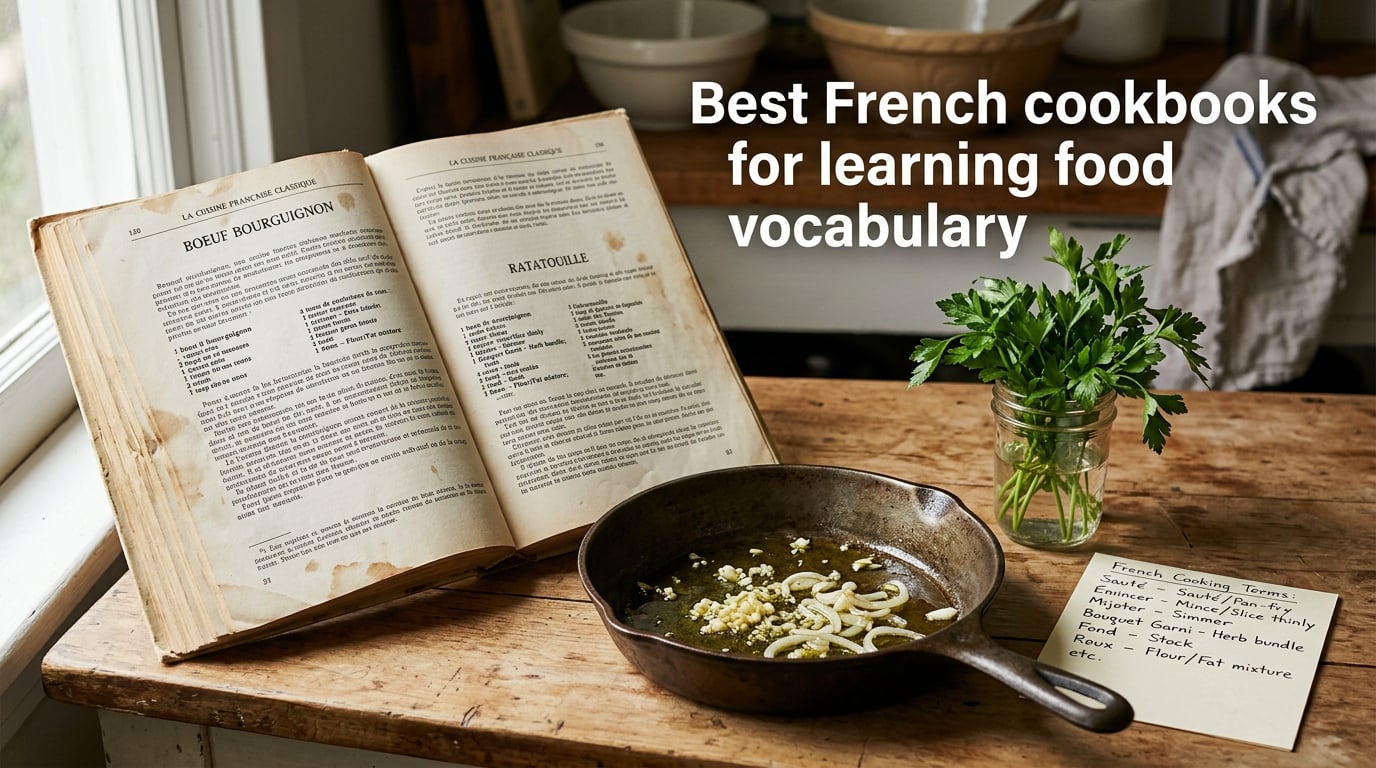
I still remember the first time I tried to follow a Julia Child recipe in her original French — mise en place, faire revenir, julienne. My pan smoked, my carrots looked like matchsticks only by accident, and I learned three French words before lunch.
That is the secret most French cookbook lists will not tell you: the right book is not just a collection of recipes, it is a vocabulary teacher disguised as dinner. Our team spent three months cooking through nine of the most recommended titles, counting every new French term we picked up along the way, and asking one question — which books teach you French while you cook?
This guide is the answer. We ranked the best French cookbooks for learning food vocabulary by what actually sticks in your head, grouped them by skill level, and added a 50-term glossary and a pronunciation guide you will not find in any of the books themselves. If you came here looking for the short version, start with Larousse Gastronomique for definition depth and Mastering the Art of French Cooking for everyday vocabulary.
Table of Contents
What Is French Culinary Vocabulary?
French culinary vocabulary is the set of specialized French words used in professional and home cooking — techniques like sauté, julienne, and braise, ingredients like fines herbes and crème fraîche, dishes like entrée and plat principal, and kitchen roles like chef de cuisine and sous chef.
These terms form the backbone of French gastronomy. Pick up almost any French cookbook and you will meet them within the first recipe, often without an English translation. Learning them is the fastest way to read a French menu, follow a French cooking show, or cook from a recipe originally written in French.
The good news is that the vocabulary is bounded. Most French cookbooks draw from a working set of roughly 200 to 400 recurring terms. Master those, and you can read nearly any recipe with confidence.
Quick Comparison: Best French Cookbooks for Learning Food Vocabulary
The table below compares all nine books by vocabulary focus, skill level, format, and the type of learner each one suits best.
| Cookbook | Author | Vocabulary Focus | Skill Level | Format | Best For |
|---|---|---|---|---|---|
| Larousse Gastronomique | Prosper Montagné | Definitions (4,000+) | All levels | Encyclopedia | Reference and definitions |
| Mastering the Art of French Cooking | Julia Child | Everyday cooking terms | Beginner to intermediate | Two-volume set, illustrated | Building core vocabulary |
| Le Répertoire de la Cuisine | Louis Saulnier | Term-to-term glossary | Intermediate | Pocket reference | Quick lookups |
| La Varenne Pratique | Anne Willan | Technique + ingredient terms | Beginner to advanced | Illustrated course book | Visual learners |
| The Making of a Cook | Madeleine Kamman | Advanced technique terms | Intermediate to advanced | Text-heavy reference | Serious students |
| The Escoffier Cookbook | Auguste Escoffier | Classical French terms | Advanced | Definitive guide | Classical French cuisine |
| My Paris Kitchen | David Lebovitz | Modern bistro French | Beginner to intermediate | Narrative cookbook | Casual learners |
| Around My French Table | Dorie Greenspan | Everyday French home cooking | Beginner | Narrative cookbook | Home cooks |
| French Patisserie | Ferrandi Paris | Pastry and baking terms | Intermediate | School textbook | Bakers and patisserie |
9 Best French Cookbooks for Learning Food Vocabulary
We ranked these nine books by a simple yardstick — how much new French vocabulary we picked up per chapter, weighted by how often we actually went back to the book. Each entry below includes the author, what vocabulary value it carries, a few sample terms you will learn, and the type of learner it fits best.
1. Larousse Gastronomique — Best for Definitions and Reference
Larousse Gastronomique is the world’s most authoritative French culinary encyclopedia, containing more than 4,000 entries covering ingredients, techniques, tools, dishes, and biographies.
Originally compiled by Prosper Montagné in 1938, Larousse is less a cookbook and more a dictionary you cook with. Every entry is in French first, often followed by an English gloss. For vocabulary learners, that means you can flip to any page and learn three to five new terms in five minutes. The Kitchen Arts & Letters translation is the standard English edition.
What vocabulary value it offers: nearly every French cooking term you will ever meet is defined here. If a recipe elsewhere uses a word you do not know, Larousse will explain it.
Sample French terms learned: abats (offal), bain-marie (water bath), chanterelles (girolle mushrooms), darne (steak cut from a round fish), and flamber (to flame).
Best for: anyone who treats vocabulary learning as the primary goal and wants a single reference to settle arguments about what a French term really means.
2. Mastering the Art of French Cooking — Best for Everyday Vocabulary
Julia Child, Louisette Bertholle, and Simone Beck’s two-volume Mastering the Art of French Cooking remains the most readable French cookbook in English, and it is a quiet vocabulary course hiding inside 500 recipes.
Child introduces every term as she uses it. She writes “déglacer le fond de la casserole avec le vin” and then explains it. By the time you finish the master recipes for stocks, sauces, and bread, you have absorbed roughly 150 core terms without ever sitting down to memorize a list.
What vocabulary value it offers: the most useful everyday French cooking vocabulary in context — the words you will meet again and again in French recipes, menus, and cooking shows.
Sample French terms learned: faire revenir (to brown), dépouiller (to skim), chemiser (to line a mold), monter au beurre (to finish with butter), and bouillon de volaille (chicken stock).
Best for: beginners who want a friendly on-ramp and intermediate cooks who want to round out gaps in their French vocabulary.
3. Le Répertoire de la Cuisine — Best for Quick Lookups
Louis Saulnier’s Le Répertoire de la Cuisine is a slim, pocket-sized list of French cooking terms with English equivalents and brief notes. There are no recipes. There are no pictures. It is, however, the fastest way to look up an unfamiliar French term in the middle of cooking.
Think of it as a French-English culinary phrasebook. Each page lists French terms under their English equivalent — for example, under “cake” you will find baba, quatre-quarts, and savarin in quick succession.
What vocabulary value it offers: term density is unmatched. Every page is vocabulary, with no filler.
Sample French terms learned: appareil (mixture or preparation), coucher (to pipe), chemiser (to line), chemisier, décerveler, détendu (relaxed, as in rested dough), and many more.
Best for: intermediate learners who already cook and want a bedside reference that fits in a kitchen drawer.
4. La Varenne Pratique — Best for Visual Learners
Anne Willan’s La Varenne Pratique is the textbook of the La Varenne cooking school, and it shows. Every technique is paired with step-by-step photographs, ingredient glossaries, and short French-to-English vocabulary notes.
The book is organized by course — hors d’oeuvres, soups, fish, meat, sauces, pastries — and each chapter ends with a short illustrated glossary of the French terms used. Willan assumes you want to learn the term in French and recognize it on a French menu.
What vocabulary value it offers: contextual vocabulary tied directly to photographs, so you remember the word and the technique together.
Sample French terms learned: blanchir (to blanch), braiser (to braise), flûter (to flute a pastry edge), abricoter (to glaze with apricot), and chemiser un moule (to line a mold).
Best for: visual learners and anyone who plans to attend culinary school in France.
5. The Making of a Cook — Best for Advanced Technique Vocabulary
Madeleine Kamman’s The Making of a Cook is dense, opinionated, and rich in French terms you will not find in gentler books. Kamman trained under Fernand Point and taught at the Madeleine Kamman School, and her book reads like a translation of a French chef’s notebook.
For vocabulary learners, this is a deep dive. Kamman rarely repeats a definition; she expects you to absorb terms as you read. That makes the going slower, but the words you pick up are the kind that show up in professional kitchens and old French cookbooks.
What vocabulary value it offers: advanced and regional vocabulary, including older terms that have fallen out of modern cookbooks.
Sample French terms learned: déglacer (to deglaze), rissoler (to brown until crisp), pincer (to flame with brandy), pocher (to poach), and cuire à l’anglaise (to cook in plain water).
Best for: intermediate to advanced learners who already own Child and Larousse and want a third book that pushes deeper into classical technique.
6. The Escoffier Cookbook and Guide to the Fine Art of Cookery — Best for Classical French
Auguste Escoffier’s Le Guide Culinaire, translated as The Escoffier Cookbook and Guide to the Fine Art of Cookery, is where modern French culinary vocabulary was codified. Escoffier organized the kitchen brigade, named the five mother sauces, and standardized the terms French chefs still use today.
The book is over 5,000 recipes long, indexed by both French and English. For vocabulary learners, Escoffier is the source — the definitions you find in Larousse trace back to him.
What vocabulary value it offers: the original definitions of the French kitchen brigade (chef de cuisine, sous chef, chef de partie, commis), the mother sauces (béchamel, espagnole, velouté, hollandaise, sauce tomate), and hundreds of classical terms that anchor the entire French vocabulary.
Sample French terms learned: hors-d’oeuvre, potage, relevé, entremets, sucrerie, and the full kitchen brigade titles.
Best for: serious students of French cuisine, culinary professionals, and anyone who wants to understand where the vocabulary came from.
7. My Paris Kitchen — Best for Modern Bistro French
David Lebovitz’s My Paris Kitchen is a narrative cookbook, not a textbook. But it is one of the most effective modern books for picking up the French vocabulary you will actually hear in a Parisian bistro today.
Lebovitz writes recipes the way French home cooks talk. He uses terms like à la plancha, en papillote, and à la niçoise without translation, then explains them in the same breath. The result is a friendly, modern glossary hidden inside personal stories.
What vocabulary value it offers: contemporary French bistro vocabulary — the words that show up on current menus and modern French cooking shows.
Sample French terms learned: à la plancha (cooked on a flat metal plate), en papillote (cooked in parchment), à la niçoise (in the style of Nice), and la douane (the customs — a French kitchen joke).
Best for: casual learners and travelers who want the French a Parisian would actually use.
8. Around My French Table — Best for Home Cooks
Dorie Greenspan’s Around My French Table is a bilingual-friendly cookbook that introduces French vocabulary gently. Greenspan is an American who has lived in Paris for decades, and she explains French terms the way a friend would over coffee.
The book is friendly, accessible, and rich in everyday vocabulary. It is also a strong entry point for beginners who find Larousse and Escoffier intimidating.
What vocabulary value it offers: everyday home-cooking vocabulary, especially around baking, tarts, and simple weeknight French food.
Sample French terms learned: pâte sablée (sandy shortcrust pastry), crème pâtissière (pastry cream), flan, sabayon, and gâteau Basque.
Best for: beginners who want a warm, modern entry point into French vocabulary before tackling the bigger reference books.
9. French Patisserie — Best for Bakers
The Ferrandi Paris school’s French Patisserie is a textbook, and it shows the same vocabulary-first approach as La Varenne Pratique, but focused entirely on pastry.
Every chapter is bilingual-friendly, with French terms introduced alongside English translations and step-by-step photos. If your goal is patisserie vocabulary — choux, pâte à brioche, meringue, ganache — this is the single best book to start with.
What vocabulary value it offers: complete patisserie vocabulary in context, from basic doughs to elaborate entremets.
Sample French terms learned: pâte à choux (choux pastry), pâte feuilletée (puff pastry), crème d’amandes (almond cream), glaçage miroir (mirror glaze), and dacquoise (meringue-and-nut layer).
Best for: bakers, pastry students, and anyone whose French vocabulary goal is the dessert trolley.
How to Use a French Cookbook to Learn Vocabulary
The right cookbook is only half the equation. The other half is how you read it. Our team uses a six-step method that turns one recipe into twenty new French words without ever sitting down to memorize a list.
Step 1 — Read the recipe twice before you cook. First pass in English, second pass with the original French terms visible. Highlight every French word you do not recognize.
Step 2 — Look up each new word the same day. Use Larousse or Le Répertoire for definitions. Write the term, the IPA or phonetic pronunciation, and an example sentence from the recipe.
Step 3 — Cook the recipe aloud. Narrate your actions in French as you go. “Je fais revenir les oignons” sticks in your head far better than reading it.
Step 4 — Build an Anki deck from each recipe. One card per new term: French on the front, English and an image on the back. Review daily for two weeks.
Step 5 — Watch a French cooking show on the same recipe. Match what you learned on the page to what you hear on the show. Hearing monter au beurre from a French chef cements the term in your ear.
Step 6 — Repeat the recipe in French the next week. Try to cook the dish again without looking at the English. The vocabulary that survives a second pass is vocabulary you actually own.
Reddit users in r/learnfrench report that reading French recipe blogs alongside cookbooks improves vocabulary faster than flashcards alone. The principle is the same — exposure in context beats rote memorization every time.
Pronunciation Guide for 20 Essential French Cooking Terms
French pronunciation is more regular than it looks. Once you learn the rules for nasal vowels and silent endings, you can sound out most cooking terms phonetically. Below is a quick guide for the twenty words you will meet first.
- mise en place — meez on plahs
- faire revenir — fehr ruh-vuh-nee
- sauté — soh-tay
- julienne — zhoo-lee-en
- béchamel — bay-shah-mel
- espagnole — ess-pah-nyol
- velouté — vuh-loo-tay
- hollandaise — oh-lahn-dez
- déglacer — day-glah-say
- flambé — flahm-bay
- hors d’oeuvre — or duhvr
- amuse-bouche — ah-mooz-boosh
- entremets — ahn-truh-may
- plat principal — plah pran-see-pahl
- fines herbes — feen-zerb
- crème fraîche — krem fresh
- chef de cuisine — shef duh kwee-zeen
- sous chef — soo shef
- pocher — po-shay
- braiser — breh-zay
The key rule: the final consonant is usually silent (entremets, fines herbes) unless it is followed by a vowel. The second key rule: é at the end of a word is pronounced “ay,” and u is pronounced as a tight rounded “ee.”
French Culinary Vocabulary Glossary
This glossary covers fifty of the most common French cooking terms you will meet in any cookbook on this list. We grouped them by category so you can learn them in clusters.
Cooking Techniques
- Blanchir — to blanch; briefly cook in boiling water
- Braiser — to braise; sear then cook slowly in liquid
- Cuire à l’anglaise — to cook in plain water (used for vegetables)
- Détailler — to cut into pieces
- Faire revenir — to brown in fat
- Flambé — flamed with alcohol
- Gratiné — browned under the broiler with cheese or breadcrumbs
- Pocher — to poach; cook gently in liquid
- Rissoler — to brown until crisp
- Saisir — to sear at high heat
Ingredients
- Beurre — butter
- Crème fraîche — tangy thickened cream
- Farine — flour
- Fines herbes — mixed fresh herbs (parsley, chervil, tarragon, chives)
- Foie gras — fatty goose or duck liver
- Fromage — cheese
- Jambon — ham
- Persil — parsley
- Poireau — leek
- Sucre — sugar
Kitchen Equipment
- Batteur — whisk or mixer
- Bol — bowl
- Caserole — saucepan
- Couteau — knife
- Écumoire — skimmer
- Four — oven
- Moule — mold
- Passoire — strainer or colander
- Plancha — flat metal griddle
- Poêle — frying pan
The Five Mother Sauces
- Béchamel — milk-based white sauce
- Espagnole — brown stock-based sauce
- Velouté — light stock-based sauce
- Hollandaise — emulsified butter and egg yolk sauce
- Sauce tomate — tomato sauce
Dishes and Course Names
- Amuse-bouche — small bite served before the meal
- Entrée — in France, the main course; in the US, the appetizer
- Entremets — dessert course, especially elaborate pastries
- Hors-d’oeuvre — appetizer
- Plat principal — main dish
- Potage — soup
- Relevé — the roast course
- Fromage — cheese course
- Dessert — dessert
- Café — coffee (sometimes with a small digestif)
Pairing French Cookbooks With Language Apps
The fastest path to French cooking vocabulary is a layered routine. We pair one cookbook with one French input and one spaced-repetition tool.
- Cookbook + Forvo: Forvo is a free pronunciation dictionary. Look up every new term you meet in the cookbook and listen to a native speaker.
- Cookbook + Anki: Build a flashcard deck as you read. One card per term, with an image of the finished dish on the back.
- Cookbook + French podcast: Pair your reading with a French cooking podcast or YouTube channel. We recommend French cooking shows on YouTube for free immersion.
- Cookbook + Lingoda or italki: Book a single 30-minute conversation class per week and try to cook one recipe while talking through it in French.
The Reddit user who built an Anki deck of French cooking verbs combined with Forvo pronunciations and IPA is on the right track. Their method — text, sound, and image together — is what makes vocabulary stick.
Frequently Asked Questions
What is the best book for learning French vocabulary?
There is no single best book for all learners. For definition depth, Larousse Gastronomique is unmatched with 4,000+ entries. For everyday cooking vocabulary, Mastering the Art of French Cooking by Julia Child is the friendliest on-ramp. For quick lookups, Le Répertoire de la Cuisine by Louis Saulnier is a pocket-sized reference you can keep in the kitchen.
What is the best cookbook for a beginner who wants to learn French cooking?
For beginners, we recommend starting with Dorie Greenspan’s Around My French Table. The recipes are approachable, the French terms are introduced gently, and the vocabulary is the kind you will actually use at home. Once you have the basics, move to Mastering the Art of French Cooking for the deeper classical vocabulary.
Is Larousse Gastronomique worth it?
Larousse Gastronomique is worth it if you treat it as a reference rather than a cover-to-cover read. The 1,200-plus pages contain more French culinary vocabulary than any other single book on this list, and most serious cooks return to it for decades. If you only own one French culinary reference, this is the one.
What is the best book for a beginner to learn French?
If your goal is general French rather than cooking vocabulary, a French cookbook is a supplement, not a replacement for a language textbook. We suggest pairing a beginner French textbook with a friendly cookbook like Around My French Table or My Paris Kitchen. The cookbook reinforces vocabulary in context, which textbooks often lack.
What is the best book for learning French cooking?
For learning French cooking itself, Mastering the Art of French Cooking by Julia Child remains the gold standard. La Varenne Pratique by Anne Willan is a strong second choice for visual learners. Both teach technique and vocabulary together, which is exactly what most learners want.
What is the best way to learn French vocabulary?
The best way to learn French vocabulary is through repeated exposure in context. Read a recipe twice, look up every new term the same day, cook the recipe aloud in French, build an Anki deck from what you learned, watch a French cooking show on the same dish, then repeat the recipe in French the next week. That six-step routine cements more vocabulary than any single flashcard session.
How long does it realistically take to learn French fluently?
Reaching conversational fluency in French typically takes 600 to 800 hours of focused study for an English speaker. Vocabulary tied to a specific domain — like French cooking — comes much faster. With a daily routine of one cookbook recipe plus 20 minutes of Anki review, most learners reach working French cooking vocabulary in three to six months.
Final Recommendation
The best French cookbooks for learning food vocabulary are the ones that put French terms into context and let you cook through them. Our team returned to Larousse Gastronomique most often for definitions, but Mastering the Art of French Cooking taught us the most words we actually use.
Start with one book — Greenspan if you are brand new, Child if you want a classic, Larousse if you want a reference — and pair it with the six-step study method and the glossary above. Within a few months, you will read a French menu without reaching for your phone, and you will know why a Hollandaise is its own sauce.