
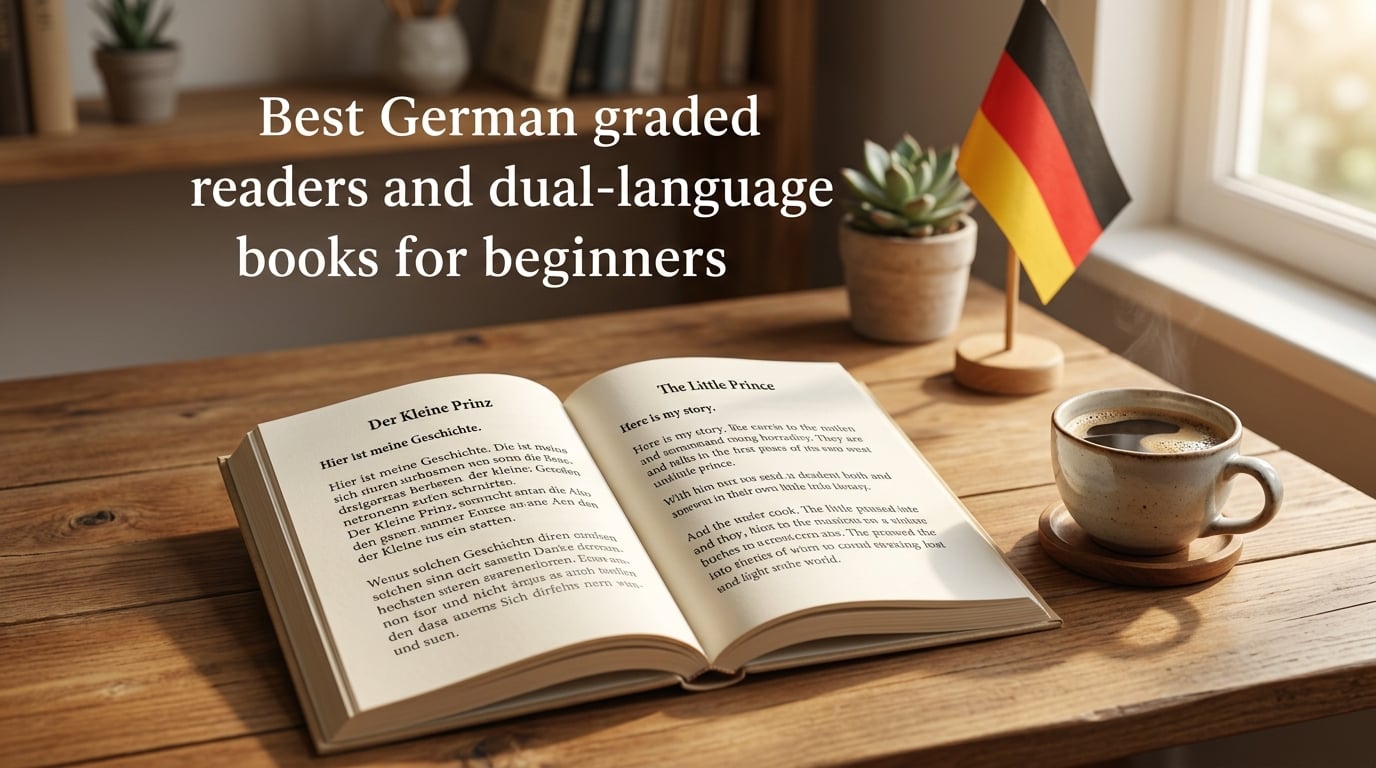
When I picked up my first German graded reader, I expected the usual grind of flashcards and grammar tables. Instead I got a short story I could actually finish in one sitting, with a translation on the opposite page when I got stuck. That single book did more for my reading confidence than three months of textbook drills. This guide is the resource I wish I’d had back then: a curated map of the best German graded readers and dual-language books for beginners, organized by CEFR level, with honest notes on what each one is actually good for.
If you’ve ever stared at a German paragraph, felt your eyes glaze over at every third noun, and quietly closed the book, you already know why a beginner needs graded input. The right book meets you where your vocabulary actually is, lets you build momentum, and quietly teaches you grammar through context. Below is everything I recommend after testing dozens of titles, plus the strategy that turns reading time into real progress.
Table of Contents
What Is a German Graded Reader (and Why Beginners Need One)
A German graded reader is a book written or adapted specifically for language learners, with vocabulary and grammar restricted to a target CEFR level (usually A1-B1) and built-in supports like glossaries, comprehension questions, and audio. The vocabulary is controlled, the sentences stay short, and the plot moves forward without relying on cultural references you have not learned yet.
Dual-language books and parallel-text editions work differently. They pair the original German with an English translation, usually on facing pages or in alternating sections, so you can read continuously without breaking flow. Think of them as a built-in translator that fades into the background once you stop needing it.
Both formats solve the same problem: native German novels overwhelm beginners. A typical page of contemporary German fiction might use 600 different words, while a graded reader at A1 might use only 300 of the most common ones, repeated with care. You still see cases, separable verbs, and German compound nouns, but in proportions you can handle.
I think of these books as scaffolding. You climb with them, and once your level rises, you put them down. The goal is never to collect a shelf of graded readers; the goal is to use them until you no longer need them.
Why Graded Readers and Dual-Language Books Work for Beginners
Graded readers and dual-language books work because they deliver comprehensible input – reading you can mostly understand, with just enough new material to keep your brain working. Linguist Stephen Krashen’s input hypothesis argues that you acquire language fastest when you understand roughly 95 percent of what you read or hear. Below that threshold, learners give up. Above it, almost nothing new sticks.
Beginner-friendly German books engineer that 95 percent on the page. They keep sentence length manageable, repeat the high-frequency words you actually need, and introduce grammar gradually instead of dumping cases and subordinate clauses on you in chapter one.
Graded Readers vs Literary Novels vs Children’s Books
A literary novel assumes full adult fluency and cultural knowledge. Children’s books look easier, but they often use playful language, regional dialect, or unusual compound nouns that trip beginners up. Graded readers sit in between: written for adult learners, with controlled vocabulary and explicit learner supports.
That is why I usually steer self-learners toward graded readers first, then parallel-text editions of familiar stories (fairy tales, The Little Prince, Kafka), then short newspaper articles in Deutsch perfekt magazine. Each step builds on the last.
The Comprehension Threshold You Should Aim For
Before you buy, do the page test. Open a sample page on your phone. If you understand roughly 18 out of 20 words, you have found your level. If you are under 14 out of 20, the book is too hard. If you understand everything, you have probably outgrown it.
Quick Comparison: Top Picks at a Glance
Before I walk through each recommendation in detail, here is the comparison table I built when I was choosing books for my own study plan. It is the easiest way to scan levels and formats side by side.
| Title | Author | CEFR Level | Format | Audio? |
|---|---|---|---|---|
| Café in Berlin | André Klein | A1-A2 | Print, Kindle | Audible companion |
| Short Stories in German for Beginners | Olly Richards | A1-A2 | Print, Kindle, Audiobook | Audiobook edition |
| Short Stories in German (Penguin Parallel Text) | Various | A2-B1 | No | |
| Grimm’s Fairy Tales (Dover Dual-Language) | Brothers Grimm | A2-B1 | No | |
| Ferien in Frankfurt | André Klein | A2 | Print, Kindle | Audible companion |
| Mord Am Morgen | André Klein | B1-B2 | Print, Kindle | Audible companion |
| Die Verwandlung (CIDEB Lesen und Üben) | Kafka, ed. CIDEB | B1 | Print with audio CD | Audio CD included |
| Heidi (bilingual edition) | Johanna Spyri | A2 | Librivox free audio |
Best German Graded Readers for A1 Beginners
At A1 you have maybe 300 words of vocabulary and a shaky grip on the case system. The right graded reader gives you short chapters, lots of repetition, and a story light enough that you can finish it in a week. Here are the four I keep recommending.
1. Café in Berlin by André Klein (A1-A2)
Café in Berlin is the first book in the Dino Lernt Deutsch series, and it is the title that comes up most often in r/German threads when beginners ask for a starting point. The plot is simple: a young traveler arrives in Berlin, makes friends, fumbles through small talk, and explores the city one café at a time. Sentences stay short, vocabulary stays in the 400 most common German words, and every chapter ends with a short summary in English so you can check yourself.
What I like most is the pacing. Each chapter is genuinely short, which makes it easy to set a goal of one chapter per day. The Kindle edition works beautifully because the built-in German-English dictionary fires on tap, so you never lose your place flipping pages. There is also an Audible companion if you want to train your ear at the same time.
2. Erste Stufe: Graded German Reader by Harry Bosch (A1-A2)
If you want a reader that feels like a textbook but reads like a story, Erste Stufe is a solid pick. It moves through a series of short episodes with explicit grammar notes and a glossary at the back. The vocabulary is restricted, the grammar is introduced gently, and the exercises at the end of each chapter double as comprehension checks.
It is a quieter, more methodical book than Café in Berlin, and that is the point. Some learners want humor and travel writing; others want a structured path through the basics. This one fits the second group.
3. Einfach Deutsch lesen by Angelika Bohn (A1)
Angelika Bohn’s Einfach Deutsch lesen series is what a lot of German teachers quietly hand to their absolute beginners. The vocabulary is heavily restricted, the chapters are short, and the plot is built around everyday situations: grocery shopping, doctor visits, phone calls. It is not glamorous, but it is exactly the kind of language you need on day one in Germany.
I recommend this one to learners who want to sound natural in real-life situations before they worry about literature. Pair it with a phrasebook and you have a practical survival kit.
4. Die Bremer Stadtmusikanten (graded edition) (A1)
The Bremen Town Musicians is one of the Grimm fairy tales almost everyone already knows. A graded edition pairs the familiar story with simplified language and a chapter glossary, which means your brain spends its energy on grammar and vocabulary instead of plot comprehension. Knowing how the story ends removes a huge cognitive load, and that is the trick.
If fairy tales feel too childish, swap in a graded Little Prince edition; the same logic applies, and Saint-Exupéry’s German is gentle enough for A2 readers to handle with light support.
Best Dual-Language and Parallel-Text Books for Beginners
Dual-language books are the second pillar of beginner reading. The German stays on the left, the English on the right, and you can switch eyes whenever a sentence refuses to give up its meaning. These four parallel-text editions are the ones I see beginners stick with longest.
1. Short Stories in German for Beginners by Olly Richards (A1-A2)
Olly Richards’ Short Stories series is one of the most beginner-friendly parallel-text editions on the market. Each story uses a controlled set of high-frequency words, the English translation sits on the facing page, and a short summary plus comprehension questions follow every chapter.
What separates this book from raw parallel text is the support scaffolding: a glossary at the back, plot recaps, and a reading strategy section at the start. If you have ever opened a parallel-text edition and felt paralyzed by where to begin, this book answers that question for you. The audiobook edition is excellent too.
2. Short Stories in German: Penguin Parallel Text (A2-B1)
The Penguin Parallel Text edition is the cleanest facing-page translation I have seen. Eight classic German short stories sit next to their English translations, with no clutter, no footnotes, no gimmicks. The stories include work by canonical German authors, lightly abridged for the parallel-text format.
It is best for learners who already have A2 confidence and want a taste of real German prose with a safety net. The vocabulary is not restricted, but the facing-page translation lets you stay in flow.
3. Grimm’s Fairy Tales: Dover Dual-Language (A2-B1)
The Dover Dual-Language edition of Grimm’s Fairy Tales is the parallel-text book I recommend most often to absolute beginners, and the reason is sneaky: you already know the plots. Rotkäppchen is Little Red Riding Hood. Aschenputtel is Cinderella. Your brain does not have to follow a brand-new story in a foreign language, so all its attention goes to grammar and vocabulary.
Some of the older Grimm language is a little stiff for modern learners, but the parallel-text format handles that gracefully. There is no audio edition, so pair it with a free Librivox recording if you want listening practice.
4. Heidi (Bilingual Edition) (A2)
Spyri’s Heidi is a childhood favorite for many learners, and a good bilingual edition is a confidence-builder at A2. The vocabulary leans toward nature, family, and Swiss-German rural life, which is more accessible than urban slang or bureaucratic German.
I like to recommend this book to adult learners who feel silly reading fairy tales. Heidi reads as warmly at 35 as it does at 9, and the parallel translation keeps the language approachable.
Best German Books for A2 Elementary Learners
Once you have around 800 words of vocabulary and a working grasp of present tense plus the most common cases, you can leave A1 readers behind. These A2 picks keep the supports but raise the language level a notch.
1. Ferien in Frankfurt by André Klein (A2)
Ferien in Frankfurt is the second Dino Lernt Deutsch book, and it picks up right where Café in Berlin leaves off. Dino heads south, navigates train stations, deals with hotel mix-ups, and bumbles through Frankfurt’s bureaucracy. The vocabulary climbs slightly, more past-tense verbs appear, and the chapters introduce new grammar in small doses.
By the end of the series you have a real feel for how German changes when you travel, and the plot stays engaging enough that you forget you are studying.
2. Hueber Lese-Novela Series (A2)
Hueber’s Lese-Novela line is one of my favorite publisher picks for A2. Each book is a slim novella written in controlled vocabulary, with a glossary at the back and comprehension questions. The plots are adult – workplace drama, travel mishaps, family stories – so you do not feel like you are reading a children’s book.
The Hueber brand has decades of classroom credibility, and the production quality is high. If you want a publisher you can trust to get the level right, Hueber is a safe starting point.
3. ELI Lektüren Reihe (A2)
ELI’s graded reader series covers a surprising range of genres: crime, romance, historical fiction, adventure. The German is a touch tighter than Hueber’s, and the books often include a small audio CD or online audio download, which makes them ideal if you want reading plus listening in one package.
I recommend these to learners who like variety. Reading the same author for six months gets stale; ELI lets you hop between genres while staying at your level.
4. Lernkrimi: German Crime Readers (A2)
Cornelsen’s Lernkrimi series turns short crime stories into graded readers, with vocabulary lists, comprehension questions, and audio support. The premise is simple: solve a German mystery while you learn the language. The format is genuinely addictive.
If you read murder mysteries in English for fun, these will hook you fast. The cases stay light, the language stays controlled, and the audio lets you follow the investigation with your ears.
Best Books to Bridge to B1 Intermediate
B1 is the awkward middle. You have outgrown A2 readers, but native German novels still feel like wading through mud. The right B1 book holds your hand a little less and starts to feel like a real novel.
1. Mord Am Morgen by André Klein (B1-B2)
Mord Am Morgen is the crime-novel entry in the Dino Lernt Deutsch series, and it is my top recommendation for learners crossing into B1. The plot is a murder mystery set in a small town, the vocabulary pushes into the 1500-2000 most common German words, and the chapters begin to assume you can follow longer paragraphs without translation support.
It is also the most fun book in the Klein catalog. By the time you finish it, you should be ready to try your first unadapted German novel.
2. Short Stories in German (Penguin Parallel Text) – revisited (B1)
The Penguin Parallel Text edition earns a second mention here because at B1 it works as a bridge book. You read the German stories on their own first, then check the English when you need to. By the time you reach the end, you should be checking less often.
This is the gentle exit ramp from parallel text into unadapted German. Use it deliberately as a graduation exercise.
3. Die Verwandlung (CIDEB Lesen und Üben) (B1)
Kafka’s Die Verwandlung – the original German short story, lightly edited for learners – is a perfect B1 reader. The vocabulary is challenging but not crushing, the sentence structure forces you to think about cases and word order, and the audio CD lets you hear Kafka read aloud.
It is slim, manageable, and culturally significant. If you want to read something that feels like real German literature without drowning in dialect, this is my pick.
When to Graduate from Graded Readers
The general rule I follow: when you finish a graded reader and feel bored instead of challenged, it is time to move up. B1 readers should feel like work, not struggle. If you can read a B1 book with only occasional dictionary lookups, try a YA novel like Krabat or a contemporary bestseller like Der Trafikant next. The graded readers have done their job.
Free Bilingual German-English Resources You Can Start Today
You do not need to spend much to read in German. Several excellent platforms publish parallel-text editions and public-domain books for free, and they are perfect for learners who want to test the waters before committing to a purchase.
1. Bilinguis.com
Bilinguis.com hosts a library of short German-English bilingual stories with sentence-aligned translation. You can read on any device, the layout is clean, and the content is genuinely free. It is the closest thing to a Duolingo for reading practice.
2. Doppeltext
Doppeltext publishes parallel-text editions of classic German texts, from fairy tales to Kafka to modern short stories. The platform also publishes its own graded stories with audio, and the production quality is excellent.
3. Librivox Free Audiobooks
Librivox is a volunteer-recorded library of public-domain audiobooks in dozens of languages, including German. Pair any parallel-text edition with the matching Librivox recording and you have a free reading-plus-listening practice system. Heidi, Die Verwandlung, and most of Kafka’s short stories are all there.
4. Project Gutenberg German Section
Project Gutenberg’s German-language section hosts thousands of public-domain German books. Most are not bilingual, but you can read alongside a free online translation tool. Best for B1+ learners who want to dive into unadapted German literature.
5. Deutsch perfekt Magazine
Deutsch perfekt is a graded reading magazine published for German learners. Each issue contains short articles at varying CEFR levels, with glossaries and audio. There is a print subscription, but many articles are available free online.
6. Lingolibros and Linguabooster
Both publishers specialize in free or low-cost bilingual children’s books and graded readers. The illustrations help context, the language stays accessible, and they are excellent supplements to heavier graded readers.
Print vs Kindle vs Audiobook: Which Format Works Best for Learning German?
No single format is best for every learner, but each has clear strengths. The format that fits your study style will accelerate your progress; the wrong one will quietly slow it down.
Print Books
Print books give you tactile focus. There is no notification, no dictionary pop-up, and no temptation to switch apps. I recommend print for your evening reading time, when you want to disconnect and read slowly.
The downside is the dictionary. Without one built in, you either flip to a glossary in the back or keep a separate notebook. Both slow you down.
Kindle Editions
Kindle is the format I recommend most for active reading practice. The built-in German-English dictionary fires instantly when you tap a word, which means you stay in flow. Highlight new vocabulary, export to Anki, and your reading session doubles as a vocabulary-building session.
The downside is screen fatigue, and Kindle’s dictionary is sometimes clunky with compound nouns. For longer reading sessions, switch to print.
Audiobooks
Audiobooks train your ear, teach you pronunciation, and let you read while you commute or exercise. The Olly Richards audiobook editions and Librivox free recordings are my go-to recommendations. Pair audio with the matching print or Kindle book and you get reading plus listening in one pass.
The downside is comprehension speed. Native German speakers read audio at conversational pace, which can feel fast for beginners. Use the 0.75x speed setting until you feel comfortable.
My Recommended Combo
Kindle for active reading sessions, audiobook for commute and exercise, print for slow evenings. Rotate formats to keep your brain engaged, and you will not get bored of any single one.
How to Use Graded Readers Effectively: A Step-by-Step Method
Buying the right book is only half the battle. The strategy you use while reading determines how much German you actually retain. Here is the six-step method I recommend after testing it on my own study routine.
Step 1: Pick the Right CEFR Level
Use the page test. Open a sample page and aim for roughly 95 percent comprehension. Below that, choose a lower level. Above it, choose a higher one. This single decision is the difference between a book you finish and a book you abandon in chapter three.
Step 2: Read the Chapter Twice Without a Dictionary
First pass: read straight through without stopping. Guess at unfamiliar words from context. Second pass: read again, now circling the words you still cannot guess. You will end up with maybe five to ten circled words per chapter, not fifty.
Step 3: Look Up Only the Circled Words
Use the Kindle dictionary, the chapter glossary, or a separate notebook – but only for the words you circled. Looking up every unknown word destroys flow and demotivates beginners fast.
Step 4: Listen to the Audio Version
After finishing the chapter, listen to the matching audio while you follow along in the book. This trains your ear, teaches you pronunciation, and helps you catch sentence-level patterns your eyes missed.
Step 5: Build a Vocabulary Notebook
Add the circled words to a notebook or Anki deck with the sentence you found them in. Vocabulary learned in context sticks far longer than vocabulary learned from word lists.
Step 6: Re-read Favorite Chapters
Once a month, re-read the chapters you enjoyed most. Repetition is how vocabulary becomes automatic, and re-reading is the easiest, lowest-stress way to repeat.
Common Mistakes Beginners Make with German Graded Readers
Almost every beginner I have talked to has fallen into at least one of these traps. Knowing them in advance will save you months of slow progress.
Picking a Book That Is Too Hard
The most common mistake. Beginners reach for a B1 book because they want to be challenged, then abandon it in frustration. Start where you are, not where you wish you were.
Stopping for Every Word
The second most common mistake. Looking up every unknown word breaks reading flow and exhausts you. Read in passes and look up only the words that block comprehension.
Ignoring the Audio
Reading without listening trains your eyes but leaves your ear behind. Pair the book with its audiobook whenever one is available.
Reading Once and Moving On
Single-pass reading is fine for entertainment, but it is poor for learning. Re-read the chapters you liked. The second time through, you will understand more than you thought possible.
Confusing Children’s Books with Easy German
Children’s books often use playful, irregular, or dialect-heavy German that is genuinely harder than a graded reader. Do not assume a thin picture book is easier than a graded A1 chapter book – it usually is not.
Skipping the Glossary
If your graded reader has a chapter glossary at the back, use it. It exists to keep you reading. Skipping it because you think you should figure everything out from context is the same mistake as stopping for every word.
Frequently Asked Questions
What are some good German reading books for beginners?
The most beginner-friendly German reading books are graded readers at A1 level like Café in Berlin by André Klein, Erste Stufe, Einfach Deutsch lesen by Angelika Bohn, and bilingual editions like Olly Richards’ Short Stories in German for Beginners. These books use controlled vocabulary, short chapters, and built-in glossaries so you can read without stopping for every word.
What is a graded reader for German?
A German graded reader is a book written or adapted for language learners, with vocabulary and grammar controlled to a CEFR level (typically A1-B1). It includes learner supports like glossaries, comprehension questions, and sometimes audio. The goal is to give you comprehensible input – around 95 percent of words understood – so you can build reading fluency without the frustration of native-level texts.
What are some good bilingual German-English books?
Good bilingual German-English books for beginners include Olly Richards’ Short Stories in German for Beginners, Penguin Parallel Text Short Stories in German, Dover Dual-Language Grimm’s Fairy Tales, and bilingual editions of Heidi. Each pairs the original German with an English translation on facing pages so you can stay in flow while checking comprehension.
Are children’s books good for learning German?
Children’s books look easier but often use playful, archaic, or dialect-heavy German that is actually harder than a graded reader written for adults. They can still help at A2 or B1 once you have the basics, but they are not a substitute for a proper beginner graded reader.
Should I read German books with a dictionary?
You should look up only the words you cannot guess from context, not every unknown word. Reading with constant dictionary use destroys flow and demotivates beginners fast. Read a chapter twice first, circle the words you still cannot guess, then check only those – ideally using a Kindle edition with a built-in dictionary for speed.
What is the best German learning book for beginners?
The best German learning book for beginners depends on your level and learning style. For self-study, Café in Berlin by André Klein is the most beginner-friendly starting point, with controlled A1 vocabulary and short chapters. For learners who prefer parallel text, Olly Richards’ Short Stories in German for Beginners is the strongest pick, with facing-page translations and built-in glossaries.
The Best Path Forward With German Graded Readers
The best German graded readers and dual-language books for beginners are the ones that match your current level, hold your attention, and come with the format that fits how you actually study. For most self-learners, that means starting with Café in Berlin or Olly Richards’ Short Stories in German for Beginners, reading one chapter a day, and pairing the print edition with the audiobook when one is available.
Pick one book today, read the first chapter twice, and see how it feels. If it is too easy, move up. If it is too hard, drop down. Within a few weeks of daily reading, you will start to recognize German sentence patterns without translating, and that is when real fluency begins. The graded readers are scaffolding; the German is the building.