
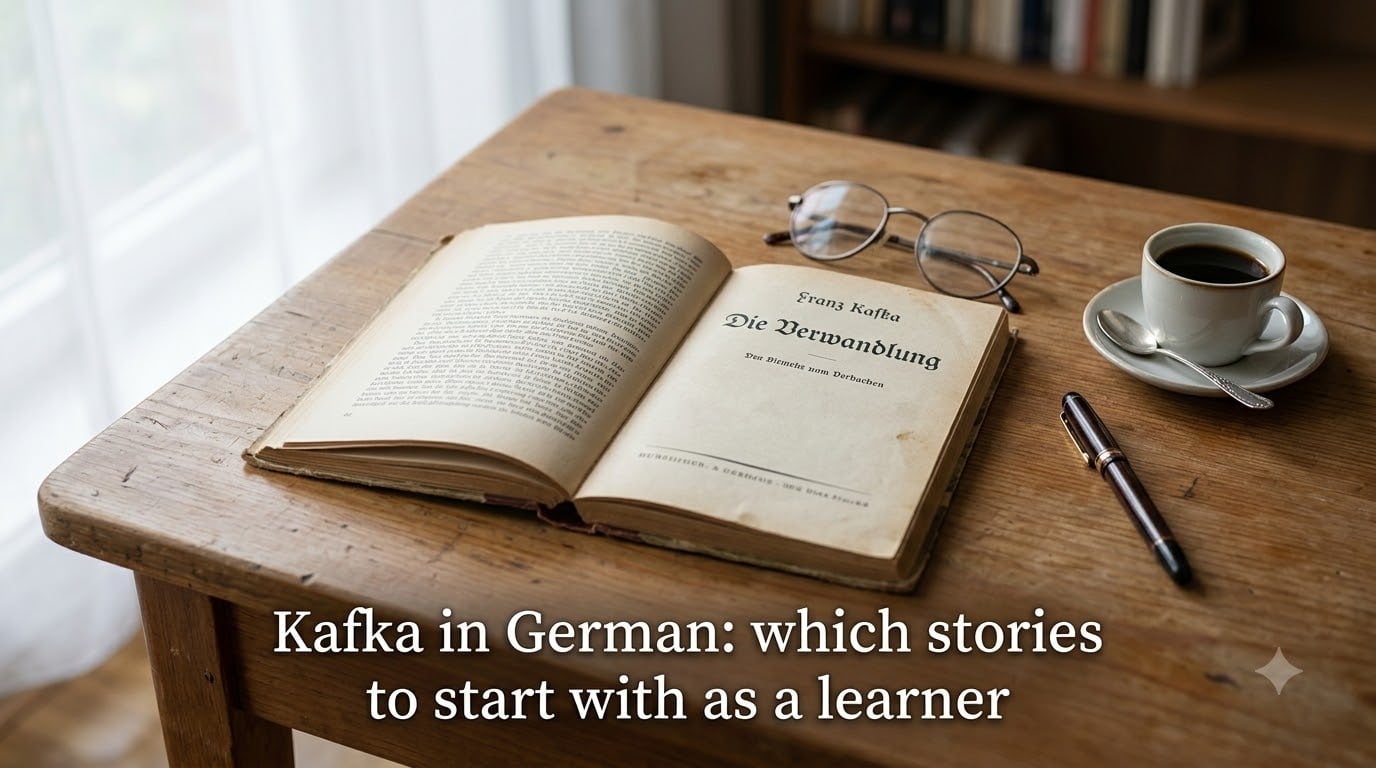
Reading Franz Kafka in the original German is one of those goals many German learners carry quietly for years, then quietly abandon when they finally crack open Der Prozess and meet a 90-word sentence on page one. I had the same experience, and so did most people on the r/German thread titled will I ever be able to read Kafka in german?. The good news: a few of Kafka’s short stories really are accessible around B1 to B2, and you do not need to start with a novel.
This guide answers a specific learner question: which stories should you start with when reading Kafka in German? I have ranked the four best starter stories by difficulty, mapped them to the Common European Framework (CEFR), and laid out a practical reading plan that takes you from a graded reader to solo Kafka without burning out on long novels before you are ready.
Table of Contents
Quick Answer: the 4 best Kafka stories to start with in German
If you only have 30 seconds, start with these four in this order. Each one is short enough to finish in one sitting and gives you a different angle on Kafka’s prose.
- Ein Hungerkünstler (A Hunger Artist, 1922) — four short parables, B1-accessible, perfect first Kafka text.
- Vor dem Gesetz (Before the Law, 1915) — a single 4-page parable, dense but bounded; great for a focused close-read.
- Die Verwandlung (The Metamorphosis, 1915) — Kafka’s most famous novella, the safe community choice for German learners.
- Das Urteil (The Judgment, 1912) — psychological depth and faster dialogue, a natural step up from Die Verwandlung.
Save Der Prozess, Das Schloss, and Amerika for later. They reward B2+ reading and benefit from a familiarity with Kafka’s shorter work first.
Why Kafka feels harder than his reputation suggests
Kafka’s German is not Modern Standard German. It is early 20th-century Prague German with a strong preference for Präteritum (the simple past tense) over the Perfekt most learners meet first. His sentences stack subordinate clauses, nest relative clauses inside participial phrases, and pack three or four adjectives in a row. Read aloud, they feel musical. Read slowly without help, they feel impossible.
Here is the opening sentence of Die Verwandlung, translated literally:
Als Gregor Samsa eines Morgens aus unruhigen Träumen erwachte, fand er sich in seinem Bett zu einem ungeheuren Ungeziefer verwandelt.
Translated: When Gregor Samsa woke one morning from uneasy dreams, he found himself transformed in his bed into a gigantic vermin. Notice three things that catch German learners off guard:
- Präteritum in erwachte and Präteritum passive in fand er sich … verwandelt. Both feel bookish, but they are the tense Kafka defaults to.
- Stacked adjectives — unruhigen + Träumen, then seinem Bett, then ungeheuren Ungeziefer. Four descriptive units before the verb.
- The infamous Ungeziefer — translated everywhere as vermin, insect, or cockroach, but Kafka deliberately chose a word that refuses to commit. You will see this word discussed in every English edition; in German, you have to sit with the ambiguity yourself.
None of this is C1 grammar. The Präteritum is taught around A2-B1 in most textbooks. The adjective agreement and case endings are B1 territory. What makes Kafka feel hard is the density: he uses all of those tools at once, in long sentences, in service of strange plots. That is why a few short stories are a much friendlier on-ramp than a full novel.
Story 1: Die Verwandlung (The Metamorphosis) — the safe starting point
Length: roughly 30,000 words (about 70 pages). CEFR sweet spot: B1 to B2.
If you ask any German teacher or any r/German thread, the first answer is almost always the same: start with Die Verwandlung. There are good reasons. The plot is simple enough that even a B1 reader can follow it — Gregor Samsa wakes up as a vermin, hides from his family, gradually dies — so you spend your mental energy on the German rather than on figuring out what is happening. The sentences are long but rhythmic, and you start hearing Kafka’s signature within a page or two.
What I like about this choice for learners is that Die Verwandlung has been translated more than almost any other German text, which means you can find parallel-text editions, facing-page translations, and a mountain of vocabulary lists. On r/Kafka, a learner described reading it as a delightful challenge, like catching up with an old friend. That balance is exactly what you want for a first Kafka.
Two practical tips from my own reading sessions:
- Read Part I in one sitting (about 20 pages). Stop when Gregor locks himself in his room. You will understand the entire premise, and you will have already met most of the vocabulary that recurs.
- Keep a running list of the family’s names — Grete, die Mutter, der Vater. Kafka’s long sentences get confusing when you cannot remember who is speaking or acting.
Story 2: Ein Hungerkünstler (A Hunger Artist) — short, aphoristic, B1-accessible
Length: roughly 10,000 words (four short parables, each 3 to 8 pages). CEFR sweet spot: B1.
Ein Hungerkünstler is, in my view, the single best first Kafka text for a German learner. It is short, written later in Kafka’s career when his prose was leaner, and split into four stand-alone parables. You can read one parable in 20 minutes, finish it, and feel the satisfaction of having actually read Kafka in German from start to end.
The vocabulary is closer to everyday German than Die Verwandlung. The title parable is about a hunger artist who fasts publicly for 40 days at a time — a real sideshow practice in the early 1900s — and Kafka treats the absurdity with a kind of dry tenderness that is easier to follow than the family dynamics of Verwandlung.
The other three short pieces in the collection — often published with Ein Hungerkünstler — are Erstes Leid (First Sorrow), Eine kleine Frau (A Little Woman), and Der Aufbruch (The Departure). Each is just a few pages long, and each is a miniature Kafka parable. If Die Verwandlung is the novel-length choice, Ein Hungerkünstler is the short-story choice, and arguably the smarter place to begin.
Story 3: Vor dem Gesetz (Before the Law) — the 4-page parable
Length: roughly 700 words (4 pages). CEFR sweet spot: B1 to B2 (dense, but bounded).
Vor dem Gesetz is the parable that opens Der Prozess, but Kafka published it on its own first, and it works completely on its own. It is a single scene: a man from the country arrives at the gate of the Law and spends his whole life waiting to be let in, only to learn as he dies that the gate was meant for him alone.
For a German learner, this is an extraordinarily useful text. It is short enough to read in 15 minutes. It is dense enough that you can re-read it many times. And because it is so short, you can realistically read the original German, an English translation, and a word-by-word gloss within a single study session. There is no shame in looking up every noun the first time. By the second reading, the vocabulary will have stuck.
Forum readers on LingQ describe Vor dem Gesetz as the cleanest entry to Kafka. I agree. If your reading goal is to understand what Kafkaesque actually feels like at the level of a single sentence, this is the text where you can experience it without drowning.
Story 4: Das Urteil (The Judgment) — psychological depth at moderate length
Length: roughly 7,000 words (about 25 pages). CEFR sweet spot: B2.
Das Urteil is a single long short story, written in one white-heat night in September 1912, and Kafka himself considered it a breakthrough. The plot: a young businessman named Georg Bendemann writes a letter to a friend in Russia, then confides in his father, who delivers a devastating judgment about his son. It is psychologically dense, fast-moving once it gets going, and rewards close reading.
This is the right story to pick up after you have finished Die Verwandlung. The dialogue is faster and uses more colloquial registers, which is a useful contrast to Verwandlung‘s descriptive narration. The famous ending, where Georg runs out of his house and throws himself off a bridge, is a manageable 200-word climax — readable in one go, but layered enough that you will want to re-read it.
What makes Das Urteil a strong fourth choice is the experience of finishing it. You finish Verwandlung feeling like you have read a long novella. You finish Das Urteil feeling like you have read a story, and that shift in reader identity is the step that prepares you for the longer novels.
Difficulty comparison: the four starter stories ranked
No top competitor gives a clean difficulty comparison between these four stories. Here is one, based on sentence length, vocabulary age, and what learners on r/German and LingQ report.
| Story | Year | Word count | CEFR sweet spot | Difficulty |
|---|---|---|---|---|
| Ein Hungerkünstler | 1922 | ~10,000 | B1 | Easiest |
| Vor dem Gesetz | 1915 | ~700 | B1-B2 | Easy-medium (dense) |
| Die Verwandlung | 1915 | ~30,000 | B1-B2 | Medium |
| Das Urteil | 1912 | ~7,000 | B2 | Medium-hard |
The reason Ein Hungerkünstler ranks easiest is mostly vocabulary: it was written later, after Kafka simplified his prose, and it deals with public-life settings rather than family interiors. Die Verwandlung ranks medium because length multiplies fatigue even when individual sentences are not harder. Das Urteil ranks hardest of the four because the dialogue moves fast and the father’s monologue builds to a dense climax.
A practical reading plan for Kafka in German
This is the plan I wish I had when I first tried to read Kafka. It assumes you are roughly at B1 or above; if you are at A2, start with Step 1 and stay there for two or three months before moving on.
Step 1: Build your reading engine with easier prose
Spend two to three months with short stories or graded readers before opening Kafka. Aim for 15 minutes of German reading per day — even five pages a day adds up. The goal at this stage is to make German sentences feel automatic, so that when Kafka’s long sentences arrive, the syntax itself is not new. The LingQ forum and r/German both echo this advice: don’t read Kafka as your first German novel.
Step 2: Do a parallel-text Kafka pass
Pick Vor dem Gesetz or the title parable from Ein Hungerkünstler. Find a German-English parallel-text edition — either a printed Penguin Parallel Text, a Kindle bilingual edition, or a freely available side-by-side PDF. Read the German sentence, then the English translation, then the German sentence again. Do this for one parable a week.
The value of parallel text is not the translation — it is the way the translation exposes the German structure. You start to see why Kafka placed aus unruhigen Träumen before erwachte, and what the difference between Ungeziefer and Insekt actually feels like in the original.
Step 3: Read your first solo short story
Pick Die Verwandlung or Das Urteil and read it solo, in German, with a dictionary within reach but closed unless you need it. Set a goal: one Part per session (Part I, Part II, Part III of Verwandlung). Track how many words you actually looked up. By the end of the novella, you should have looked up roughly the same number of words per page — that is the signal that your vocabulary is keeping pace with Kafka’s prose.
Step 4: Move to a novel only when ready
Wait until you can read two pages of Die Verwandlung in 15 minutes without consulting a dictionary. At that point, your reading stamina matches the average page density of Der Prozess. Only then crack open Der Prozess. If you can read Verwandlung in a week, you can read Prozess in three to four weeks, comfortably.
What NOT to start with: the longer novels
There is an honest answer here that most guides skip. You should not start with Der Prozess, Das Schloss, or Amerika. Here is why, by novel:
- Der Prozess (The Trial) — 60,000+ words, B2 to C1. Famous first chapter is famously difficult, and the novel assumes you have read some Kafka already to follow its callbacks.
- Das Schloss (The Castle) — 70,000+ words, C1. Kafka left it unfinished, and the prose keeps circling the same bureaucratic abstractions. A first Kafka novel should not also be an unfinished one.
- Amerika — 50,000+ words, B2. Easier than the other two novels but its plot is fragmented and the ending is famously abrupt.
None of these are bad choices in themselves. They are bad first choices. The forum consensus on r/Kafka and LingQ is consistent: read short stories first, novels later. A C2 reader on r/Kafka admitted I have difficulties with reading Kafka, which is a useful reminder that even very advanced German learners find Kafka challenging. Save the novels for when the short stories feel comfortable.
Where to find free German Kafka texts
All four of my recommended starter stories are available for free online in the original German:
- Project Gutenberg DE (projekt-gutenberg.org) — hosts Die Verwandlung, Ein Hungerkünstler, and most of Kafka’s shorter works. Public domain, free, clean HTML.
- Zeno.org — a German literary portal that hosts Vor dem Gesetz in its original 1915 form.
- Wikisource — has Das Urteil with a faithful transcription of the first edition.
For audio, librivox.org has volunteer-read audiobook versions of the major works, including Die Verwandlung. The reader voices are not professional, but they let you hear Kafka’s sentence rhythm, which is genuinely useful for parsing his long constructions.
Audio + print: a dual-modality approach
One method that worked surprisingly well for me: read Die Verwandlung in print while listening to the audiobook at half speed. The print keeps your eyes on the syntax; the audio keeps your ears on the rhythm. When you encounter the famous opening sentence, you can hear where Kafka places his pauses, and the long sentence stops feeling like a wall.
This approach is also more forgiving when you hit a Präteritum form you don’t recognize. You hear the verb first, you catch its context from the audio, and then you read the printed form. Forum readers on LingQ recommend this dual-modality approach specifically for Kafka because his prose is so much about cadence, not just vocabulary.
Frequently Asked Questions
What Franz Kafka books are recommended for beginners?
The four best Kafka books for beginners reading in German are Ein Hungerkünstler (A Hunger Artist), Vor dem Gesetz (Before the Law), Die Verwandlung (The Metamorphosis), and Das Urteil (The Judgment). Start with Ein Hungerkünstler at around B1, then move to Vor dem Gesetz, then Die Verwandlung, then Das Urteil. All four are short enough to finish in a few sittings and are available for free on Project Gutenberg DE.
Where to start when reading Kafka?
Start with Ein Hungerkünstler or Vor dem Gesetz. Both are short parables by Kafka that are accessible around B1 German, give you a feel for his prose style, and finish in a single sitting. After those, move to Die Verwandlung, then Das Urteil. Avoid the longer novels (Der Prozess, Das Schloss, Amerika) until the short stories feel comfortable.
What are some easy German stories for beginners?
For easy German stories that build toward Kafka, try Ein Hungerkünstler first – it is the most accessible Kafka text for B1 learners, with lean prose and four short stand-alone parables. Vor dem Gesetz is even shorter (4 pages) but denser, and works well as a focused close-read once you are comfortable with Präteritum. Both are available free in German on Project Gutenberg.
What is the best German book for a beginner?
Die Verwandlung is the most-recommended first German book for learners, and the most commonly suggested first Kafka text. It is the right first Kafka novel because the plot is simple (Gregor Samsa wakes as a vermin), the language is repetitive in helpful ways, and there are more parallel-text editions and vocabulary resources for it than for any other German novella.
Can I read Kafka with B1 German?
Yes, but with the right stories. Ein Hungerkünstler and Vor dem Gesetz are realistic at B1, especially with a parallel-text edition or a small dictionary. Die Verwandlung is also doable at B1 if you give yourself more time and read in multiple sittings. Das Urteil and the longer novels (Der Prozess, Das Schloss) really need B2 or above.
Conclusion: which Kafka stories to start with as a German learner
The shortest honest answer to which Kafka stories you should start with as a German learner: Ein Hungerkünstler, then Vor dem Gesetz, then Die Verwandlung, then Das Urteil. Those four cover you from B1 to low B2, are all free on Project Gutenberg DE, and together give you a complete picture of Kafka’s prose range before you commit to a novel.
The longer answer is the reading plan: build your reading engine first, then do a parallel-text pass, then read your first solo short story, then save the novels for when the short stories feel easy. The forum consensus — and the experience of most learners who have tried — is that reading Kafka in German is not a question of if but when, and when is much sooner than most learners think, provided they pick the right first story.
Pick one of the four stories above, open Project Gutenberg, and start reading. You will probably re-read the first sentence three times. That is normal. By the third page, you will be reading Kafka in German.