
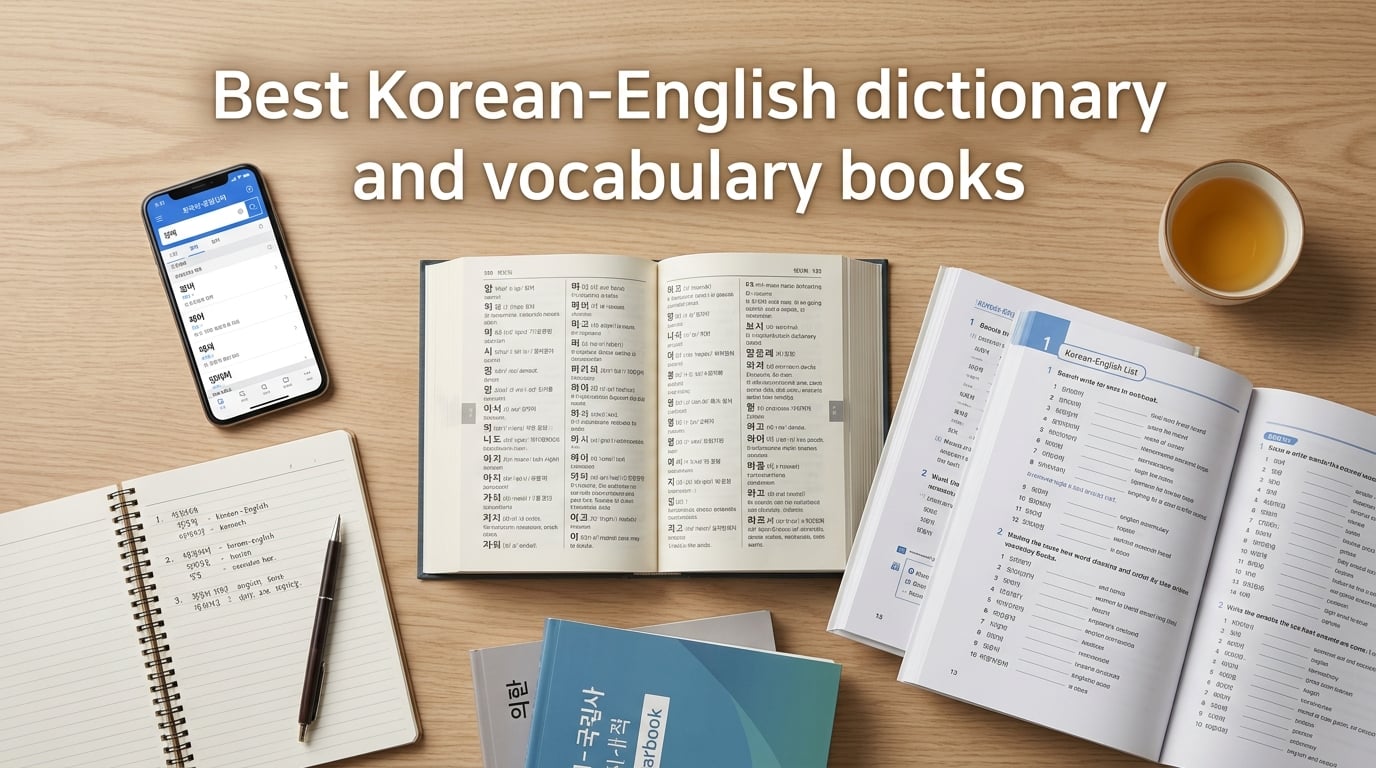
If you are searching for the best Korean-English dictionary and vocabulary books, start with the Tuttle Learner’s Korean-English Dictionary for everyday study, pair it with the free Naver Dictionary app for fast lookups, and add a TTMIK vocabulary workbook for structured practice. Together, those three cover roughly 90 percent of what self-taught learners actually need.
Korean dictionaries are reference tools that translate between Korean (Hangeul) and English, and they exist in print, online, and mobile app formats. Vocabulary books and workbooks sit alongside them to help you actually retain the words you look up. I have spent years comparing these resources for learners at every level, and this guide breaks down the strongest options available in 2026, how to match them to your study stage, and how to use them well.
Table of Contents
What Is a Korean-English Dictionary and Who Needs One?
A Korean-English dictionary is a reference book, website, or app that translates Korean words into English and English words into Korean. The best entries include definitions, parts of speech, Romanization, audio pronunciation, example sentences, and Hanja (Chinese-character equivalents) for Sino-Korean vocabulary.
Anyone learning Korean can benefit from one, from absolute beginners working through Hangeul to advanced students preparing for the TOPIK exam, reading Korean literature, or working with Korean text in a professional setting.
Dictionary vs Translator: What’s the Difference?
A dictionary is designed for looking up individual words, showing you multiple meanings, grammatical forms, and example sentences. A translator is built for entire phrases and sentences, using machine translation to render a full string of text. For accurate word study, use a dictionary; for understanding a quick sentence on a sign or in a chat, use a translator.
Naver Dictionary is the best place to look up individual Korean or English words. It shows meanings, pronunciation audio, word types, and example sentences. For translating a complete sentence, Papago does a better job because dictionaries work best for individual words.
Key Terms Every Learner Should Know
Hangeul is the Korean alphabet, invented in the 15th century and made up of 14 basic consonants and 10 basic vowels. Hanja refers to Chinese characters used in Korean, especially for Sino-Korean words. Romanization is the Latin-letter spelling of Korean (most commonly Revised Romanization), useful for beginners who have not yet memorized Hangeul. A headword is the main entry for a word in a dictionary, and TOPIK is the Test of Proficiency in Korean, the standard exam for non-native learners.
Best Print Korean-English Dictionaries
Print Korean-English dictionaries remain the most thorough reference tools for serious learners. They are distraction-free, battery-free, and typically include deeper grammatical information than apps. Below are the strongest print options for 2026, ordered by who each one suits best.
Tuttle Learner’s Korean-English Dictionary
Tuttle’s Learner’s Korean-English Dictionary is the most widely recommended beginner-to-intermediate option. It contains roughly 5,600 main entries selected for daily use, includes audio downloads via QR code, uses Revised Romanization throughout, and adds grammatical information suited to learners. It is the right starting point for anyone at level 1-3 on a Korean proficiency scale.
Minjung’s Essence Korean-English Dictionary
Minjung’s Essence is the heavyweight of Korean reference works, with over 150,000 entries covering modern vocabulary, Sino-Korean words, and specialized terminology. It is bulky and dense, which makes it better suited as a desk reference for serious students, translators, and university programs than as a portable carry-around.
Periplus Essential Korean Dictionary
Periplus publishes a compact Essential Korean Dictionary that strikes a middle ground between Tuttle and Minjung. It has around 6,000 entries, fits in a backpack, and is commonly used in travel and short-course contexts.
Hollym Korean-English Dictionary
Hollym’s Korean-English Dictionary has been a standard reference for decades and is frequently cited in academic Korean programs. Its layout and entry selection lean toward intermediate and advanced learners, with thorough coverage of Sino-Korean vocabulary.
Yonsei Korean Dictionary
The Yonsei Korean Dictionary is published by Yonsei University Press and is a fixture in Korean university classrooms. It carries strong Hanja support and detailed example sentences, which makes it a strong choice for advanced learners and TOPIK preparation.
| Dictionary | Headwords | Level | Hanja | Examples | Audio |
|---|---|---|---|---|---|
| Tuttle Learner’s | ~5,600 | Beginner-Intermediate | Limited | Yes | Yes (QR) |
| Minjung’s Essence | 150,000+ | Advanced | Extensive | Yes | No |
| Periplus Essential | ~6,000 | Beginner-Intermediate | Some | Yes | No |
| Hollym | ~50,000 | Intermediate-Advanced | Yes | Yes | No |
| Yonsei | ~60,000 | Intermediate-Advanced | Yes | Yes | No |
Best Online Korean Dictionaries and Apps
Online Korean dictionaries and apps complement print by offering instant search, free audio, and offline access on phones. They are especially helpful when you encounter a new word in a K-drama subtitle, on a restaurant menu, or in a chat message.
Naver Dictionary
Naver Dictionary (dict.naver.com) is the strongest free online Korean-English dictionary. It includes definitions, audio pronunciation by native speakers, example sentences, Hanja, and even grammar notes. A mobile app version is available for iOS and Android. Most learners I have worked with start their lookups here and only switch to print for deeper study.
Daum Dictionary
Daum Dictionary (dic.daum.net) is Naver’s main competitor and is sometimes preferred for its cleaner interface and slightly different example sentence selection. It covers both Korean-to-English and English-to-Korean lookups with audio.
Papago and Google Translate for Full Sentences
When you need a full sentence translated quickly, Naver’s Papago and Google Translate are the leading options. Papago is especially strong on Korean-to-Korean simplification, while Google Translate has wider language coverage. Use them for understanding, then confirm important words in a real dictionary.
Best Korean Vocabulary Books and Workbooks
A dictionary tells you what a word means, but a vocabulary workbook helps you remember it. Vocabulary books are structured by topic, level, or frequency, and most combine word lists with example sentences and audio. For 2026, these are the categories I recommend most.
Talk To Me In Korean (TTMIK) Vocabulary Books
TTMIK publishes a vocabulary book series that pairs well with their podcast lessons. Each book groups words by theme (food, emotions, daily life), includes example sentences in both Korean and English, and ships with audio downloads. Learners consistently rate TTMIK workbooks as the easiest to stick with because the words are selected for real conversation, not academic reading.
Korean Frequency Dictionaries (Most Common 5,000 Words)
Frequency dictionaries list the most common Korean words in order, usually with IPA or Romanization, example sentences, and part of speech tags. The 5,000-word version covers roughly 95 percent of everyday Korean reading. These are popular with self-study learners who want a measurable target.
Topic-Based Vocabulary Books (Food, K-Drama, Travel)
Topic-based books pull vocabulary for specific situations, such as ordering food, surviving a trip to Seoul, or following K-drama dialogue. They are great supplements once you have a base dictionary and want to expand into a specific interest area.
TOPIK-Specific Vocabulary Books
Few competitors cover this gap, but TOPIK-specific vocabulary books exist and are worth their weight if you are sitting the exam. They group words by the level (TOPIK I or II) and by topic clusters that have appeared on past papers. Pair one with a Yonsei or Minjung print dictionary for the strongest prep combo.
How to Choose the Right Korean Dictionary for Your Level
Matching a dictionary to your current level matters more than picking the one with the most entries. A 150,000-word Minjung overwhelms a beginner, and a 5,600-word Tuttle frustrates an advanced reader who needs obscure vocabulary.
Beginner Learners
Choose Tuttle Learner’s or Periplus Essential. Both use Romanization, include example sentences, and keep entries manageable. Add Naver Dictionary for free audio and quick lookups.
Intermediate Learners
Move to Hollym or a TTMIK vocabulary workbook. At this level, look for Hanja support and longer example sentences so you start seeing how words combine in real Korean.
Advanced Learners and TOPIK Prep
Use Minjung’s Essence, Yonsei, or a TOPIK-specific vocabulary book. At advanced level you want depth, Hanja lookup, and exam-aligned word lists.
Free vs Paid Options
Naver Dictionary, Daum Dictionary, Papago, and Google Translate are all free and strong enough for most lookups. Paid dictionaries earn their price through depth (more entries, Hanja, paper quality) and the focused reading experience that a screen cannot replicate.
How to Use a Korean Dictionary Effectively
Owning a great dictionary does not help unless you know how to use it. Here is the process I walk learners through.
Step 1: Look Up the Headword in Hangeul First
Even if you rely on Romanization, the dictionary is alphabetized by Hangeul. Type or paste the Hangeul form whenever possible; Romanization search returns inconsistent results.
Step 2: Read All Sub-Entries
Korean words frequently have multiple meanings depending on context. Read every sub-entry and the example sentences before choosing a translation.
Step 3: Note the Part of Speech and Grammatical Form
Verbs and adjectives conjugate, so the dictionary form (the one listed as the headword) is rarely what you will see in a sentence. Look for the conjugation pattern listed in parentheses.
Step 4: Use Audio and Romanization Side by Side
Pair the printed Romanization with the audio file. Reading the Romanization while listening trains both your eye and your ear at the same time.
Step 5: Log New Words in a Spaced Repetition System
Once you have looked a word up, add it to an SRS app such as Anki. Looking up is the first half; reviewing over spaced intervals is what moves words into long-term memory.
Frequently Asked Questions
What is the best Korean-English dictionary book for beginners?
The Tuttle Learner’s Korean-English Dictionary is the strongest pick for beginners. It uses Revised Romanization, includes roughly 5,600 carefully selected headwords, and ships with downloadable audio. Pair it with the free Naver Dictionary app for fast lookups and you have a complete beginner setup.
Which Korean dictionary has the most words?
Minjung’s Essence Korean-English Dictionary is the heavyweight, with over 150,000 entries. It is dense and best used as a desk reference by advanced learners, translators, and university students rather than as a portable carry-around.
Is Tuttle Korean dictionary good?
Yes. The Tuttle Learner’s Korean-English Dictionary is widely used in Korean programs and is one of the most consistent beginner-to-intermediate options on the market. Reviewers appreciate its clear layout, audio companion, and word selection focused on daily use.
Are Naver Dictionary and Papago better than printed dictionaries?
They are better for speed, audio, and free access, but not for depth. Use Naver Dictionary for quick word lookups and Papago for full-sentence translation, then reach for a print dictionary like Tuttle or Minjung when you need thorough grammar notes or rare vocabulary.
What is the best Korean vocabulary book for TOPIK?
A TOPIK-specific vocabulary book that groups words by level (TOPIK I or II) and past-paper topic clusters is the best fit. Combine it with the Yonsei Korean Dictionary for entry-level depth and a frequency dictionary for the 5,000 most common Korean words.
Do I need a physical Korean dictionary if I use apps?
Not strictly, but a print dictionary offers distraction-free reading, deeper grammatical notes, and reliable Hanja lookup that apps often skip. Most serious learners use both: an app for fast daily lookups and a print reference for deep study.
Final Verdict: Picking Your Korean Dictionary and Vocabulary Books
For most learners in 2026, the cleanest setup is a three-layer stack. Start with the Tuttle Learner’s Korean-English Dictionary as your print backbone, add Naver Dictionary for free daily lookups, and pair both with a TTMIK vocabulary workbook to retain what you find. Intermediate learners should graduate toward Hollym or Yonsei, while advanced learners preparing for TOPIK should add Minjung’s Essence and a TOPIK-specific vocabulary book.
Pick the stack that matches your level today, commit to reviewing new words in a spaced repetition system, and revisit your dictionary choices every six months as your vocabulary grows.