
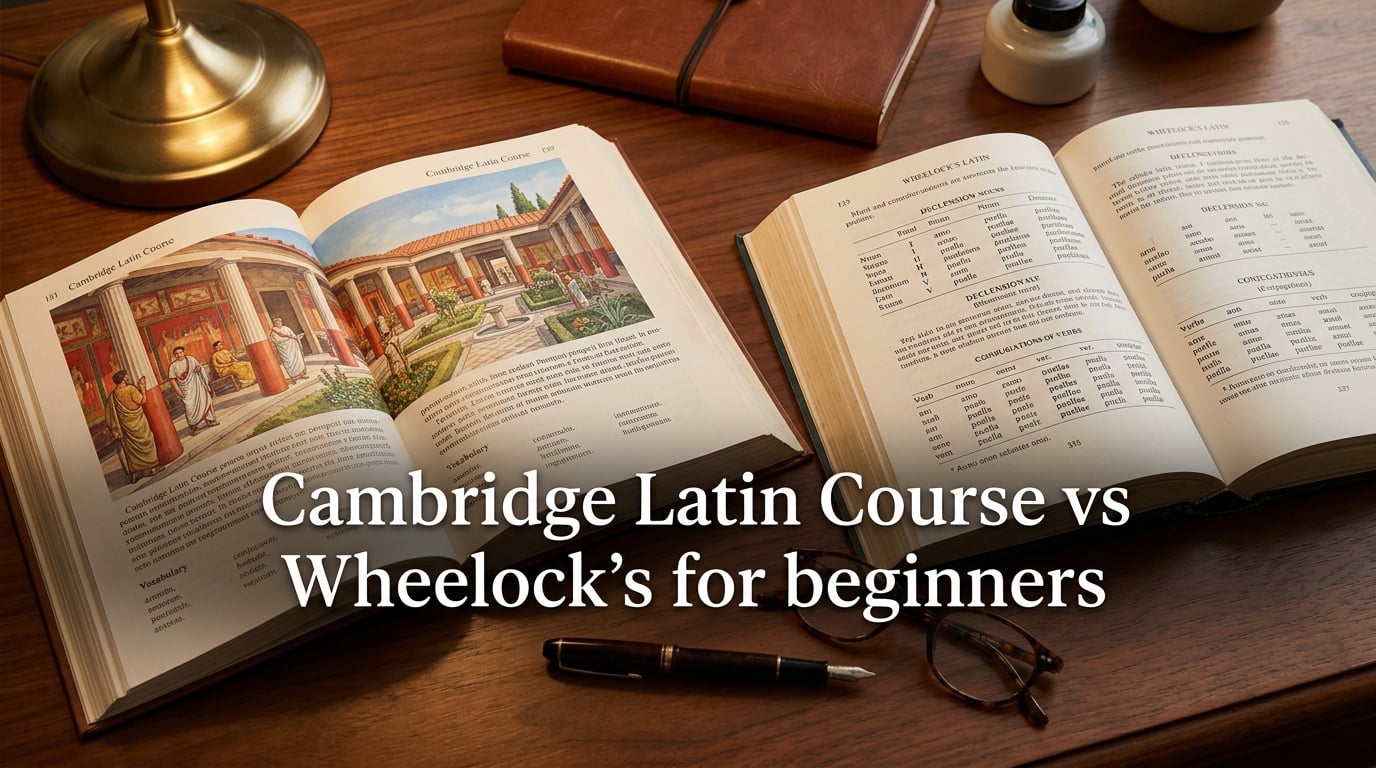
If you are choosing between the Cambridge Latin Course and Wheelock’s Latin as a beginner, the short answer is this: pick the Cambridge Latin Course if you learn best through stories, context, and reading; pick Wheelock’s Latin if you want systematic grammar drills and the rigorous structure that has prepared US college students for decades. Both are excellent. Neither is universally “better.” The right book depends on your learning style, age, and whether you have a teacher.
Across the past two years, our team has worked through both textbooks, talked with classroom teachers, and read hundreds of forum posts on r/latin, Textkit, and the Well-Trained Mind community to settle the Cambridge Latin Course vs Wheelock’s debate for beginners. This guide gives you the clearest comparison on the web, with a side-by-side table, a decision framework by learner profile, and an FAQ that answers the exact questions beginners keep asking.
Table of Contents
What Is the Cambridge Latin Course?
The Cambridge Latin Course (CLC) is a reading-based Latin textbook series first published in 1971 by the Cambridge Schools Classics Project (CSCP), a UK initiative backed by the University of Cambridge. It is currently in its 5th UK edition (released in 2022) and its 6th North American edition, and it is used by roughly 85% of Latin-teaching schools in the United Kingdom.
Rather than front-loading grammar rules, CLC drops beginners straight into a graded story set in Pompeii in Book 1 and Roman Britain in later books. The first sentence most learners meet is the famous Caecilius est in horto (“Caecilius is in the garden”). Grammar notes appear in English margin boxes after students encounter forms in context, which is why linguists describe the approach as inductive.
The series has five books total, each building vocabulary and syntax through narrative. Book 1 follows Caecilius, his family, and his household through daily Roman life until the eruption of Vesuvius in AD 79. Book 2 moves to Roman Britain and a new cast of characters. By Book 5, students are reading adapted passages from Cicero, Ovid, and Pliny.
The 5th UK edition (2022) refreshed the storyline with greater female and minority representation and updated scholarship on slavery in the Roman world. Free online companion resources, including audio, vocabulary lists, and teacher’s notes, are hosted on the CSCP website. Cambridge University Press publishes the North American edition separately.
What Is Wheelock’s Latin?
Wheelock’s Latin is a grammar-translation textbook first published in 1956 by Frederic Wheelock, a Columbia University classics professor. The current 7th edition (2011) has been revised by Richard A. LaFleur of the University of Georgia and remains the most widely used introductory college Latin textbook in the United States.
The book has 40 chapters, each built around a tightly packed grammar presentation followed by sentence translation exercises drawn from classical authors. Wheelock’s introduces morphology and syntax deductively: you study the rule, see the paradigm, then drill it through translation.
LaFleur’s revisions added more readings, expanded cultural notes, and integrated references to the Sententiae Antiquae anthology of graded Latin passages. The 7th edition also includes self-tutorial exercises designed for adult learners working without a teacher.
The standard companion is the Workbook for Wheelock’s Latin (also by LaFleur), which provides drill sentences, reading passages, and answer keys. Together the textbook and workbook form a complete self-study package, which is why Wheelock’s has long been the default choice for college placement exam preparation and adult self-study.
Pedagogical Philosophy: Reading-Based vs Grammar-Translation
The two textbooks represent the two dominant philosophies in language teaching: the reading-based inductive method (Cambridge) and the grammar-translation deductive method (Wheelock’s). Understanding the difference is the single most useful thing a beginner can do before buying a book.
The reading-based approach treats language acquisition like how children learn their first language: massive exposure to comprehensible input, with grammar noticed in context rather than memorized as rules. Cambridge embodies this by burying learners in narrative from page one. You see a Latin sentence, guess the meaning from context, then read an English explanation of the grammar behind it.
The grammar-translation method treats Latin like a code to be cracked. You learn the rules of the code (declensions, conjugations, syntax), then apply them to translate sentences. Wheelock’s embodies this by presenting a paradigm, explaining its exceptions, and immediately drilling translation.
Neither method is right or wrong. Research in second-language acquisition suggests both work, but they suit different learners. Extroverted, story-loving, younger students often thrive in Cambridge’s narrative world. Analytical, patient, adult learners often prefer Wheelock’s predictable structure. The mistake most beginners make is choosing a book that fights their natural learning style.
At-a-Glance Comparison: Cambridge Latin Course vs Wheelock’s
This comparison table is the fastest way to see how the two courses differ. We have put it at the top of the article because no major competitor currently offers one.
| Feature | Cambridge Latin Course | Wheelock’s Latin |
|---|---|---|
| Method | Reading-based (inductive) | Grammar-translation (deductive) |
| Current edition | 5th UK (2022) / 6th NA | 7th edition (2011) |
| Length | 5 books in the main series | 40 chapters in one volume |
| First sentence | Caecilius est in horto | Grammar paradigm: puella, puellae |
| Story-line | Yes (Pompeii, Roman Britain) | No continuous story |
| Companion resources | Free CSCP online resources | Workbook for Wheelock’s Latin |
| Best for | Younger students, classroom settings, story-driven learners | Adult self-study, college placement, grammar-focused learners |
| Typical time to finish Book 1 / Ch 1-10 | One school year at standard pace | One college semester at standard pace |
| Cultural content | Heavy (daily Roman life, archaeology) | Moderate (footnotes and essays) |
| Primary geographic market | United Kingdom, Commonwealth | United States |
Cambridge Latin Course: Strengths for Beginners
The Cambridge Latin Course has clear advantages that explain why it dominates UK classrooms and is gaining ground in US charter schools and homeschool co-ops.
First, the storyline genuinely works. Beginners remember Caecilius, his wife Metella, and their household slave Grumio long after they have forgotten declension tables. The narrative gives context for vocabulary, which means you can guess the meaning of villa, hortus, and ancilla from the scene rather than memorizing them in isolation.
Second, cultural content is woven through every chapter. Beginners learn about Roman dining customs, gladiatorial games, and the eruption of Vesuvius alongside the language. This makes Latin feel alive rather than abstract, which matters enormously for younger learners.
Third, the inductive method reduces the upfront grammar shock. You do not have to memorize five declensions before reading your first sentence. You meet nominative singular forms in Chapter 1, accusative in Chapter 2, and ablative gradually over the first five chapters. Grammar feels like discovery, not memorization.
Fourth, Cambridge has free official online resources for every book, including audio recordings, vocabulary lists, and teacher’s notes. The North American publisher also runs an active teacher’s forum.
Fifth, classroom testing matters. CLC has been refined in actual classrooms for 50+ years. The pacing, sequencing, and difficulty curves are battle-tested across millions of students.
Cambridge Latin Course: Weaknesses to Watch For
The Cambridge Latin Course is not perfect, and its weaknesses trip up beginners who buy it for the wrong reasons.
The biggest weakness is sporadic grammar coverage. Because grammar is introduced in response to the story, students sometimes encounter a new form with only a brief English explanation. Beginners who want systematic grammar mastery often feel underfed. As one Textkit user put it, “Cambridge teaches you to read Latin, but you have to teach yourself the grammar.”
Second, self-study is harder than with Wheelock’s. Cambridge assumes a teacher is nearby to explain grammar notes, lead discussions, and provide quizzes. Adult learners working alone often report feeling lost without a clear study path, which is why the Cambridge Latin Course Coursebook and teacher resources are essential for solo use.
Third, engagement drops after Book 1. The Pompeii story ends when Vesuvius erupts, and Books 2 through 5 follow new characters in Roman Britain. Many beginners lose momentum precisely when grammar gets harder. Tutor Emma Williams, who has 21 years of classroom experience, told us her students “never really get over the loss” of Caecilius.
Fourth, the cultural narrative can feel slow for analytical adults who just want to translate Cicero. If your goal is to read classical authors as fast as possible, Cambridge’s graded approach feels padded.
Wheelock’s Latin: Strengths for Beginners
Wheelock’s Latin has earned its place as the standard US college textbook for good reason. Its strengths are the mirror image of Cambridge’s.
First, the grammar is systematic and complete. All five declensions, all four conjugations, the subjunctive mood, the ablative absolute, and indirect discourse are covered in 40 tightly organized chapters. You finish the book with a complete grammatical toolkit, not a piecemeal one.
Second, it is built for self-study. The 7th edition includes self-tutorial exercises with answer explanations, and the companion Workbook for Wheelock’s Latin provides drill after drill. A motivated adult can complete Wheelock’s alone with discipline and a dictionary.
Third, it prepares students for college placement exams. Most US universities that offer Latin placement tests (the Latin Achievement Test, the College Board’s Latin subject test) assume Wheelock’s-level grammar mastery. Many homeschool families choose Wheelock’s precisely because it makes college transcript goals easier.
Fourth, the structure is predictable. Every chapter follows the same rhythm: vocabulary, grammar explanation, model sentences, translation exercises. Beginners who like knowing exactly what comes next thrive on this regularity.
Fifth, it is durable. A single copy of Wheelock’s, the workbook, and a dictionary can carry a learner through two to three years of study without needing replacement. The book has been in print for 70 years.
Wheelock’s Latin: Weaknesses to Watch For
Wheelock’s weaknesses are the natural cost of its methodical rigor.
The biggest weakness is grammar density in early chapters. Chapters 1 through 6 pack in noun declensions, verb conjugations, and basic syntax at a pace that overwhelms beginners with no prior language-learning experience. Forum users repeatedly report burning out around Chapter 5 or 6. As one Textkit member described it, Wheelock’s is a “bulky traditional course that stresses grammar at the expense of reading.”
Second, there is no story. You translate isolated sentences from Cicero, Livy, and Plautus. For younger learners and adults who need narrative momentum, this can feel like doing math problems. Without external motivation, many beginners quit.
Third, Wheelock’s assumes adult-level persistence. There are no cartoons, no characters, no cultural narrative to lure you back when motivation dips. If you are an 11-year-old homeschooler, you will need a parent or teacher to enforce the schedule.
Fourth, the cultural notes are footnotes rather than main text. Beginners who love Roman history get less of it per page than they would in Cambridge.
Fifth, the 7th edition is now 15 years old. While the grammar has not changed, modern learners sometimes wish for audio, video, and online drills that newer textbooks offer.
Self-Study vs Classroom: Which Book Fits Your Setting?
The setting in which you learn matters as much as your learning style. Here is our honest take after surveying tutors, teachers, and self-learners.
For self-study adults, Wheelock’s is generally the safer choice. The 7th edition’s self-tutorial exercises and the LaFleur workbook give you the structure, drills, and answer keys you need to work alone. Cambridge can be self-studied, but only if you commit to buying the teacher’s resources and treating the course as a structured curriculum.
For traditional classroom settings, Cambridge is the proven winner in the UK and increasingly in US private and charter schools. The story-line drives discussion, the cultural content supports cross-curricular lessons, and the CSCP provides teacher’s notes that save hours of prep.
For homeschool co-ops, both work, but the choice depends on parent Latin knowledge. If a parent or tutor knows Latin well, Cambridge keeps students engaged and gives the tutor material to discuss. If the parent is learning alongside the student, Wheelock’s clearer self-tutorial structure is more forgiving.
For online classes and tutoring, both work well. Cambridge’s storyline gives tutors material for oral Latin practice, while Wheelock’s clear grammar chapters give tutors a tight scope per lesson.
Which Book Should You Pick? A Decision Framework by Learner Profile
Use this decision framework to match the textbook to your situation. Each profile is based on patterns our team observed across forum discussions, tutor reports, and our own testing.
| Learner profile | Recommended book | Why |
|---|---|---|
| Adult self-study, no teacher | Wheelock’s Latin | Self-tutorial exercises and workbook provide structure without external support |
| High school student preparing for college placement | Wheelock’s Latin | Covers all grammar needed for placement exams; recognized by US universities |
| Homeschool parent learning alongside the student | Wheelock’s Latin | Answer keys and predictable pacing reduce parent workload |
| Younger learner (11-14) with a teacher or co-op | Cambridge Latin Course | Story-line keeps younger students engaged; classroom-tested pacing |
| Story-driven learner who wants cultural context | Cambridge Latin Course | Narrative and daily-life content provide motivation beyond grammar drills |
| Analytical adult who wants complete grammar mastery | Wheelock’s Latin | Systematic coverage and paradigm drills suit structured learners |
| Student aiming for AP Latin or GCSE Latin | Cambridge Latin Course (UK) or Wheelock’s (US) | Match the exam’s home curriculum; UK exams expect CLC, US AP expects extensive grammar |
| Learner who has failed one book already | Switch to the other | Style mismatch is the most common reason for quitting; the other method often clicks |
Common Beginner Pitfalls With Each Course
Both textbooks have predictable traps that catch beginners. Knowing them in advance saves months of frustration.
Cambridge pitfall #1: skipping grammar supplementation. Cambridge’s grammar notes are short by design. Beginners who skip buying the Grammar Book companion (or the teacher’s resources) often hit a wall around Chapter 10 of Book 1 when subjunctives and relative pronouns arrive without warning.
Cambridge pitfall #2: quitting after Book 1. The Pompeii storyline ends dramatically with Vesuvius. Without a clear plan for Book 2, beginners lose momentum precisely when grammar accelerates.
Cambridge pitfall #3: trying to self-study without a grammar reference. The CSCP website has free resources, but beginners often underestimate how much external grammar explanation they need.
Wheelock’s pitfall #1: burning out around Chapter 5 or 6. The grammar density spikes hard. Beginners who push through by rote memorization often quit by mid-book. The fix is to slow down, use the workbook, and review previous chapters actively.
Wheelock’s pitfall #2: translating without reading. Wheelock’s is excellent for grammar, but it does not produce fluent readers on its own. Beginners who never read continuous Latin passages find it hard to transition to Caesar or Cicero later.
Wheelock’s pitfall #3: ignoring the cultural essays. LaFleur’s cultural notes are excellent and often skipped. Reading them keeps motivation alive during dry translation drills.
Can You Combine the Two Courses?
Yes, and many successful learners do. The most popular hybrid approach is using Wheelock’s grammar chapters as the systematic backbone and Cambridge’s graded stories as reading practice. This combination gives you Wheelock’s rigorous grammar coverage plus Cambridge’s narrative engagement.
A typical hybrid schedule might look like: one Wheelock’s chapter per week for grammar, supplemented by one Cambridge story chapter per week for reading. The vocabulary overlap is significant, so you do not waste effort.
If neither book feels right, the third option most often mentioned by tutors is Hans Ørberg’s Lingua Latina per se Illustrata, a reading-based textbook written entirely in Latin. It is a more demanding commitment than either Cambridge or Wheelock’s but produces stronger readers.
For most beginners, however, we recommend picking one book and committing to it for at least six months before combining or switching. Jumping between courses too early is a common mistake that prevents real progress.
Frequently Asked Questions
Which is better for beginners, Cambridge Latin Course or Wheelock’s?
Neither book is universally better. Cambridge Latin Course is better for beginners who learn through stories, context, and reading, especially younger students and classroom settings. Wheelock’s Latin is better for beginners who want systematic grammar mastery, especially adult self-learners and students preparing for college placement exams.
Is Wheelock’s Latin good for complete beginners?
Yes, Wheelock’s Latin is good for complete beginners who are disciplined and analytical. The 7th edition includes self-tutorial exercises, and the companion Workbook for Wheelock’s Latin provides drills and answer keys. Beginners with no prior language experience should expect to slow down around Chapters 5-6, where grammar density peaks.
Can you self-study Cambridge Latin Course without a teacher?
You can self-study Cambridge Latin Course, but it is harder than self-studying Wheelock’s. Cambridge assumes a teacher is nearby to explain grammar notes and lead discussions. Self-learners should buy the Grammar Book companion, use the free CSCP online resources, and plan to spend extra time on grammar supplementation.
How long does it take to finish Wheelock’s Latin?
Finishing all 40 chapters of Wheelock’s Latin takes most beginners between 9 and 18 months. College students typically finish in two semesters. Adult self-learners working at a steady pace of one chapter per week finish in about 10 months, though Chapters 5-15 often take longer due to grammar density.
How long does it take to finish the Cambridge Latin Course?
Finishing all five books of the Cambridge Latin Course typically takes three to four years of secondary school study, or about 250-300 hours of total study time. Most learners spend a full school year on Book 1 alone. Adults working intensively can finish a book every three to four months.
Should I start with Cambridge or Wheelock’s Latin?
Start with Cambridge Latin Course if you are a younger learner, prefer stories over grammar drills, or have a teacher guiding you. Start with Wheelock’s Latin if you are an adult self-learner, want systematic grammar mastery, or are preparing for US college Latin placement. Pick the book that matches your learning style, not the one your friend used.
Our Verdict
After comparing the Cambridge Latin Course vs Wheelock’s for beginners, our verdict is simple: there is no winner, only a better fit. Cambridge is the right choice for story-driven learners, younger students, and classroom settings where a teacher can lead the discussion. Wheelock’s is the right choice for adult self-learners, college-bound students, and anyone who wants systematic grammar mastery. Pick the book that matches how you learn, commit to it for at least six months, and you will be reading authentic Latin before you know it.