
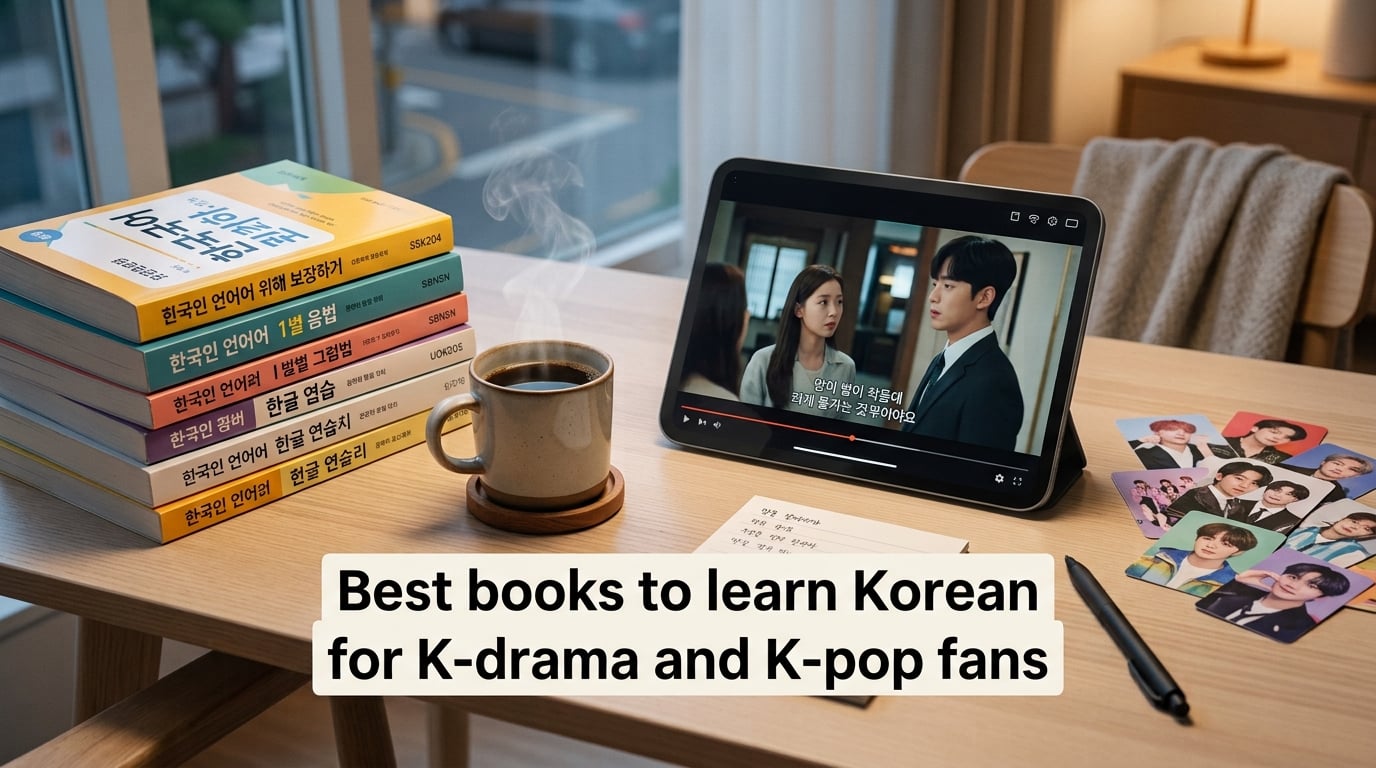
After watching Crash Landing on You for the third time and crying at BTS lyrics I couldn’t pronounce, I finally picked up a textbook. The single book I’d hand any K-drama or K-pop fan today is Talk To Me In Korean (TTMIK) Level 1, paired with Korean for K-Pop and K-Drama Fans by Soohee Kim (Tuttle) as a cultural phrasebook.
This guide covers the best books to learn Korean for K-drama and K-pop fans, written for someone who already has Netflix queued up and a Spotify playlist on repeat. I’ll walk through the textbook series worth buying, the K-pop and K-drama-specific phrasebooks most learners skip, and the exact way to pair a book with your favorite show so the grammar actually sticks.
By the end you’ll know which book fits your level, how to use it alongside K-dramas and K-pop songs, and where to grab free PDFs if you want to try before you spend anything.
Table of Contents
Best Korean Textbook Series at a Glance
If you want the short answer before the long one, this is the comparison I wish I’d had. Every series below teaches real Korean (Hangul, grammar, listening) rather than just phrasebook content, and each row tells you who it actually fits.
| Series | Level | Best for | Self-study? | Cost |
|---|---|---|---|---|
| Talk To Me In Korean (TTMIK) | Beginner to upper-intermediate | K-pop and K-drama fans starting from zero | Excellent | Mid (bundle for Levels 1-9) |
| Go! Billy Korean (Korean Made Simple) | Beginner to intermediate | Budget self-learners who want one clear path | Excellent | Low (book is free as PDF, print is cheap) |
| Integrated Korean / KLEAR | Beginner to advanced | Learners who want a college-grade foundation | Good (with answer key) | Mid (full beginner set) |
| Yonsei Korean | Beginner to intermediate | Speaking-focused learners, classroom users | Fair (tutor-friendly) | Mid-High |
| Korean Grammar in Use (Darakwon) | Beginner, intermediate, advanced editions | Anyone past Level 2 of any series | Excellent | Low-Mid (per volume) |
| Korean for K-Pop and K-Drama Fans (Tuttle) | All levels (phrasebook) | K-pop lyric decoding and drama dialogue | Excellent | Low |
| The Kpop Dictionary | All levels (slang reference) | Idol fans who want slang + idol lore | Excellent | Low |
| King Sejong Institute textbooks | Beginner to intermediate | Trying before buying | Excellent | Free PDF |
What a K-drama or K-pop fan actually needs from a Korean book
Most “Korean for K-pop” books fail at the same job: they teach you 사랑해요 (saranghaeyo) and call it a day. You walk away with twenty phrases but no grammar, so when the drama switches to “~ㄹ 거예요” you can’t follow it.
A good Korean book for our use case has to do four things at once. First, it has to teach Hangul in the first chapter so you’re not stuck reading romanization. Second, it needs real grammar explanations, not just “Korean verbs end in -da.” Third, it needs audio files you can actually download and replay, because K-drama listening practice is what makes your ear adjust. Fourth, it has to work for self-study, which means workbook answer keys, structured review, and explanations written for someone without a Korean teacher.
The textbook series below all clear that bar. The K-pop and K-drama-specific phrasebooks sit on top of them as flavor, not as a foundation.
Hangul first: a 3-day crash course for K-pop fans starting from zero
Before you open any textbook, spend three days on the Hangul alphabet. It is the single highest-ROI activity you can do, and most competitors skip it entirely.
Hangul is the Korean writing system, designed in the 15th century to be learnable. There are 14 basic consonants and 10 basic vowels. You can read simple syllables by day two and full words by day three. The reason this matters is romanization. Romanization is the English spelling of Korean sounds (e.g., “annyeonghaseyo”). It looks helpful, but it hides real pronunciation, makes tone mistakes permanent, and locks you out of any book, lyric, or sign that isn’t transliterated.
Here is the 3-day plan I wish someone had given me:
- Day 1: Learn the 10 basic vowels (ㅏ ㅑ ㅓ ㅕ ㅗ ㅛ ㅜ ㅠ ㅡ ㅣ) and 14 consonants (ㄱ ㄴ ㄷ ㄹ ㅁ ㅂ ㅅ ㅇ ㅈ ㅊ ㅋ ㅌ ㅍ ㅎ). Write each one by hand twenty times. The TTMIK Hangul handout and Go! Billy Korean’s free Hangul crash course both work.
- Day 2: Learn how syllables combine (consonant + vowel on top/bottom) and start reading simple syllables like 가, 나, 다. Watch one episode of any K-drama with Korean subtitles only.
- Day 3: Read your first full words (사랑, 행복, 한국). Drop romanization entirely from your notes and only use Hangul from this point forward.
After day three, every textbook in this guide becomes easier. The same move takes apps like Duolingo and LingoDeer months to deliver, because they don’t gate romanization off.
Best Korean Textbooks for Beginners (and the ones to skip)
Here’s the core textbook rundown. If you only buy one, buy the first one. If you want a college-grade foundation, buy the third. The others are tier two.
Talk To Me In Korean (TTMIK) — my top pick for K-drama and K-pop fans
TTMIK is a nine-level series built around short, friendly lessons with audio, a workbook, and a massive YouTube channel. It is the consensus recommendation on r/Korean for anyone starting from zero with K-pop or K-drama as the motivation.
The grammar explanations are in plain English, the dialogues model the conversational Korean you’ll hear in actual dramas, and Levels 1-2 get you to a place where you can pick out words in song lyrics by mid-series. Levels 1-9 total a low bundle price, which makes it the cheapest end of a real textbook series.
What it isn’t: TTMIK doesn’t drill hanja, classical grammar, or TOPIK exam technique. If your goal is the TOPIK exam, switch to Integrated Korean around Level 6.
Go! Billy Korean — Korean Made Simple
Billy Go’s Korean Made Simple series is the single best free option on this list. The PDF of book 1 is legally free on his site, and the print version is cheap. The grammar explanations are clean, the order is logical, and the cultural notes are written for K-pop fans.
Billy also has a YouTube channel where he walks through every chapter. For a self-studier on a budget, this is the path I’d take before any paid book.
Integrated Korean / KLEAR — the college standard
If you searched “best Korean textbook” on Reddit, Integrated Korean from KLEAR is the answer you’ll see most often. Developed for Korean university programs, it is the most-used series in the U.S. and a few other countries, and the grammar coverage is the deepest in this list.
The catch: it’s written assuming a teacher. The dialogues are fast, the cultural notes assume classroom discussion, and you’ll want the answer key workbook. The full beginner set (textbook + workbook + answer key) is the most expensive option here. For self-learners, TTMIK or Go! Billy is the friendlier on-ramp before this one.
Yonsei Korean — speaking-focused
Yonsei Korean leans heavily on conversation drills and pair-work exercises. It’s the standard at Yonsei University’s language institute and the audio quality is excellent. If your goal is speaking Korean with friends (or K-pop idols at a fan meeting), this is the series to consider.
For pure self-study, though, it falls short. The exercises assume a partner. Pair it with a tutor or a language exchange buddy.
Korean Grammar in Use (Darakwon) — the forever reference
Past the beginner stage, every Korean learner on r/Korean eventually buys Korean Grammar in Use from Darakwon. It exists in three editions (Beginning, Intermediate, Advanced), with grammar points ordered by frequency and a clean example sentence for each one.
This is not a textbook. It’s a reference. Buy Beginning around TTMIK Level 3 or Go! Billy book 2, and Intermediate around TTMIK Level 6. You’ll use the Advanced edition eventually, just not for a year or two.
Books written specifically for K-drama and K-pop fans
Most learners skip this category entirely, which is a mistake. These three books do something textbooks can’t: they teach the exact words, phrases, and cultural references that show up in the content you’re already watching.
Korean for K-Pop and K-Drama Fans by Soohee Kim (Tuttle)
This is the only major book whose target audience matches yours exactly. Tuttle’s Korean for K-Pop and K-Drama Fans is a full-color phrasebook organized by situations you’ll actually hit: fan meetings, concert small talk, ordering food in Korea, texting an idol, plus key phrases pulled from real dramas.
It doesn’t teach grammar, so don’t use it as your primary book. Use it as the supplement that makes your textbook feel relevant. The price is low and the format is quick to flip through.
The Kpop Dictionary
If you want to know what daebak, all-kill, saesang fan, visual, main dancer or comeback actually mean, The Kpop Dictionary is the reference. It’s small enough to keep next to your phone and light enough to read in one sitting.
It is also the most-recommended K-pop supplemental book on the entire web. Reddit, Goodreads, and even Soul of Seoul all call it out by name.
Korean Slang: As Much As A Rat’s Tail
For older learners or anyone who wants Korean slang beyond the K-pop flavor, Korean Slang: As Much As A Rat’s Tail is the deeper cut. It’s written by a Korean linguist and pairs each slang term with its etymology, which matters when you want to know why a word feels rude or affectionate.
How to Use These Books with K-Dramas: an active-listening workflow
Reading alone won’t get you to drama-comprehension. Watching alone won’t get you grammar. Pair them, and the gap closes fast. Here is the workflow r/Korean users consistently settle on after a few months.
- Pick one episode you’ve never seen. Watch it with English subtitles first, just for plot. No note-taking yet.
- Replay it with Korean subtitles only. Pause on every line where the Korean audio and the Korean subtitle don’t quite line up. That gap is where real spoken Korean lives.
- Pull 10 words per episode. Write them in Hangul (no romanization) with their plain English meaning. Put them in an Anki or Quizlet deck.
- Replay the same episode once more, no subtitles. See how many of the 10 words you catch by ear.
- Open your textbook the next day and find the grammar point that explains one of the lines you caught.
Run this loop for one episode a day and you’ll notice a real shift in your comprehension in three to four weeks. The textbook gives you the grammar, the drama gives you the input, and the flashcards give you the long-term retention.
K-pop song-lyric study method (with a real song example)
Lyric study is the most underrated study method for K-pop fans, because you already know the melody and the singer’s voice. The trick is to slow down enough to actually look up words.
The method in four steps:
- Pick one song you love and look up its official Korean lyrics on a site like Genius or Melon. Good starter picks: IU’s “Through the Night” (밤편지) for a slower tempo, or BTS’s “Spring Day” (봄날) for the kind of metaphor you’ll want to understand.
- Highlight every word you don’t recognize. For each one, write the Hangul, the romanization (for pronunciation only), and the meaning.
- Sing along with the official lyric video, three times in a row. Singing locks pronunciation and rhythm in a way that reading never does.
- Translate one full verse into English in your own words. This forces you to understand grammar, not just vocabulary.
One song a week for three months is a 12-song corpus. By the end, you’ll be able to read newer lyrics on your own, and you’ll feel the shift in your listening skills too.
Free Korean textbooks you can start with today
Before you spend any money, three free resources deserve a real look.
The King Sejong Institute publishes free PDF textbooks in English, organized by level, with audio. They are the official teaching materials from the Korean government’s language institute. They are not as glossy as TTMIK, but they are complete and free.
Go! Billy Korean’s blog and YouTube channel effectively give you book 1 of Korean Made Simple for free, plus video walk-throughs of every chapter. This is the easiest free path to follow.
My Korean 1 and 2 are free university-published PDFs aimed at heritage learners but useful for anyone. They are less polished but cover the same grammar spine.
How to choose the right book for your level and goal
With this many options, picking the wrong one is the real cost. Here is how I’d match books to four common reader types.
True beginner, K-drama motivation, self-study: Go! Billy Korean book 1 (free PDF) for the first month. Once you finish it, switch to TTMIK Level 1. Add Korean for K-Pop and K-Drama Fans as your cultural supplement from day one.
True beginner, K-pop motivation, lyrics focus: TTMIK Level 1 plus The Kpop Dictionary. After Level 3, pick one K-pop song a week using the lyric-study method above.
Intermediate learner wanting TOPIK prep: Integrated Korean / KLEAR (full beginner-to-intermediate set) plus Korean Grammar in Use Intermediate. Budget for the full KLEAR set plus one Grammar in Use volume.
Classroom learner who wants textbook structure: Yonsei Korean plus a tutor. Skip if you have no tutor.
If you only pick one path, take the first one. It is the most efficient route from zero to “I followed an entire episode without English subtitles,” and that is the moment the K-drama habit turns into real Korean.
Frequently Asked Questions
What is the best book to learn Korean for beginners?
Talk To Me In Korean (TTMIK) Level 1 is the most beginner-friendly option for K-drama and K-pop fans. For budget learners, Go! Billy Korean’s Korean Made Simple book 1 is free as a PDF and has a clear self-study path. Both teach Hangul in the first chapter and include audio files for listening practice.
What is the best book to learn Korean for K-drama fans?
Pair a core textbook (TTMIK Level 1 or Go! Billy Korean) with Tuttle’s Korean for K-Pop and K-Drama Fans by Soohee Kim as a phrasebook. The textbook gives you grammar, the Tuttle book gives you the actual drama dialogue patterns and K-pop cultural phrases you’ll hear on screen.
How can I learn Korean through watching K-dramas?
Use the active-listening workflow: watch an episode with English subtitles first for plot, replay it with Korean subtitles only and note 10 unknown words, replay once more with no subtitles to test your ear, then open your textbook the next day to find the grammar point behind one of those lines. One episode a day for three to four weeks produces a real comprehension shift.
How long does it realistically take to learn Korean?
Most self-learners reach comfortable K-drama comprehension (no subtitles on common shows) in about 12 to 18 months of daily 30-to-60-minute study. TOPIK level 4 (upper-intermediate on the official exam) typically takes two to three years of consistent study. Apps alone without a textbook or input rarely get past survival level.
Do I need a tutor to learn Korean from a book?
No, but it helps past beginner level. TTMIK, Go! Billy Korean, and Integrated Korean all include answer keys and self-check material that work for solo learners. A tutor becomes useful around TTMIK Level 4 or Integrated Korean 2 for speaking practice and grammar questions that books can’t answer in real time.
Is TTMIK good for beginners?
Yes. TTMIK is widely recommended on r/Korean as the friendliest starting textbook for English speakers with no Korean background. Its short lessons, plain-English grammar explanations, large YouTube channel, and audio files make it one of the strongest self-study options. It is less suited for TOPIK exam prep, where Integrated Korean is stronger.
Are free Korean textbook PDFs any good?
Yes, for the first one to three months. King Sejong Institute’s official free PDFs and Go! Billy Korean’s free Korean Made Simple book 1 both teach real grammar with audio. They are not as glossy as paid textbooks and don’t carry you past intermediate, but they are a legitimate way to test whether Korean study is for you before spending any money.
What is TOPIK and which books prepare for it?
TOPIK is the official Test of Proficiency in Korean, used for university admission, employment, and immigration in Korea. Integrated Korean / KLEAR is the standard TOPIK-prep textbook series, used in most Korean university language programs. Pair it with Korean Grammar in Use Intermediate and a dedicated TOPIK past-papers book closer to your exam date.
Final thoughts: pair one book, one drama, one song
The single biggest mistake I see new learners make is treating the textbook as the whole plan. The textbook is half. The other half is the content you already love.
For the best books to learn Korean for K-drama and K-pop fans, my honest recommendation is this: start with Go! Billy Korean’s Korean Made Simple book 1 (free PDF) for the first month, switch to TTMIK Level 1, and from week one pair every chapter with one K-drama episode using the active-listening workflow and one K-pop song using the lyric-study method. Add Korean for K-Pop and K-Drama Fans by Soohee Kim on your phone for cultural flavor, and you’re set for the first six months.
One book, one drama, one song. That is the loop that actually works.