
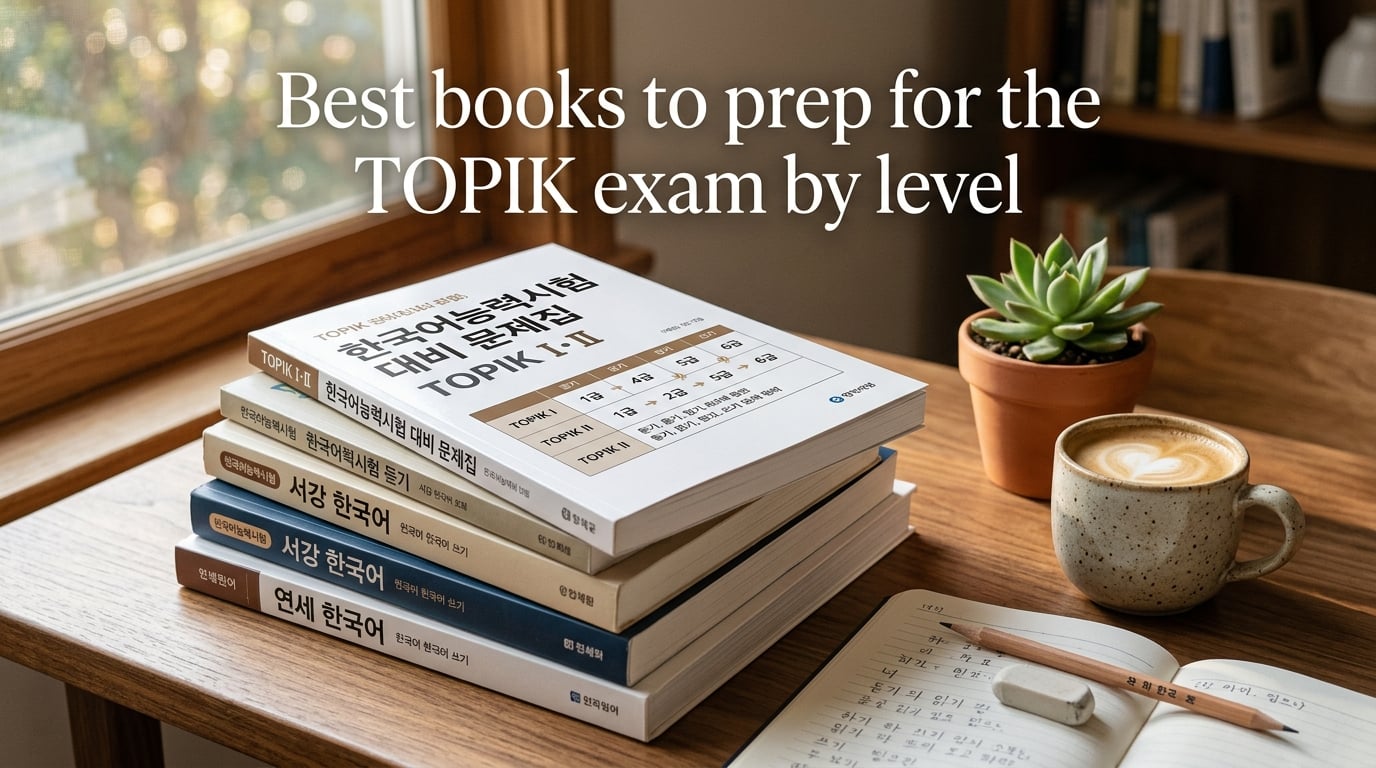
The Test of Proficiency in Korean (TOPIK) is the official Korean language exam administered by South Korea’s National Institute for International Education (NIIED), and the best books to prepare for the TOPIK exam by level depend entirely on which of the two tracks you are sitting.
TOPIK I covers levels 1 to 2 (beginner, listening and reading only), while TOPIK II covers levels 3 to 6 (intermediate to advanced, with writing). After comparing dozens of titles used by self-study learners, the books we recommend most often for 2026 are Complete Guide to the TOPIK for the official-format baseline, Korean Grammar in Use for grammar foundations, and TOPIK II Pass Recipe for advanced writing.
Each level also has a flagship pick, plus 1 or 2 backup books for learners who want to stack a grammar reference, a vocabulary builder, or a writing-specific guide on top of the main textbook. Below is the level-by-level breakdown.
Table of Contents
Quick Picks: Best TOPIK Prep Book by Level
| Level | Top Book Pick | Publisher | Skills Covered | Pages | Best For |
|---|---|---|---|---|---|
| TOPIK I – Level 1 | Complete Guide to the TOPIK I (3rd ed.) | Darakwon | Listening, Reading | 304 | Absolute beginners who want exam-format practice |
| TOPIK I – Level 2 | Talk To Me In Korean Level 2 | TTMIK | Grammar, Listening, Reading | ~290 | Learners past Hangul, ready for high-beginner grammar |
| TOPIK II – Level 3 | Korean Grammar in Use – Intermediate | Darakwon | Grammar, Reading | 368 | First jump into intermediate, builds grammar bridge |
| TOPIK II – Level 4 | Complete Guide to the TOPIK II (3rd ed.) | Darakwon | Listening, Reading, Writing | 488 | Intermediate learners who want official-format drill |
| TOPIK II – Level 5 | TOPIK II Pass Recipe | Darakwon | Reading, Writing (Q 51-54) | ~360 | Long-essay writing + 4000-word vocab target |
| TOPIK II – Level 6 | Korean Grammar in Use – Advanced | Darakwon | Grammar, Reading, Writing | 432 | Advanced learners targeting academic-grade prose |
Best Book for TOPIK I Level 1 (Absolute Beginners)
For TOPIK I Level 1, the most widely recommended book is Complete Guide to the TOPIK I (3rd edition, Darakwon), and it is the right starting point for learners who know Hangul and roughly 800 words of vocabulary.
The book mirrors the actual NIIED test format with two full listening sections, two reading sections, and a vocabulary and grammar handbook in the back. The 3rd edition was updated to match the current test structure, including the QR code audio tracks that learners scan with a phone. Reddit beginners in r/Korean consistently call out this title as the safest first TOPIK purchase because every question type matches the real exam.
Two strong companions at this level are Instant Pass TOPIK I Comprehensive Guide (Dongyang Books, 304 pages) for a second source of mock tests, and Korean Grammar in Use – Beginning for the grammar gap most beginners hit around question 15 to 25. Learners who score below 80 on the first mock test should add the grammar book before retaking.
Best Book for TOPIK I Level 2 (High Beginner)
For TOPIK I Level 2, the best book to graduate to is Talk To Me In Korean Level 2, paired with continued use of the Complete Guide to the TOPIK I for mock tests.
Level 2 requires roughly 1,500 to 2,000 words of vocabulary and a working command of basic verb conjugations. The TTMIK Level 2 textbook and workbook cover exactly this range in a friendly, dialogue-driven format that complements the more exam-focused Complete Guide. Reviewers on r/Korean who reached Level 2 in 6 to 9 months usually credit TTMIK for the listening jump and Complete Guide for the reading score.
For learners who prefer a Korean-only resource, FunPik TOPIK PASS Reading Level 1 is a budget-friendly way to drill reading comprehension without grammar explanations in English. The book is shorter (~180 pages) and works well as a daily 20-minute reading warmup between full mock tests.
Best Book for TOPIK II Level 3 (Low Intermediate)
For TOPIK II Level 3, the flagship book is Korean Grammar in Use – Intermediate by Darakwon, and it is the bridge between beginner textbooks and full TOPIK II exam prep.
Level 3 demands roughly 3,000 words of vocabulary and the ability to read 300 to 500 character passages on social topics. Korean Grammar in Use – Intermediate covers the grammar points (relative clauses, causal connectors, indirect speech) that show up repeatedly in the TOPIK II reading section. Most learners stack this book with the Complete Guide to the TOPIK II mock tests, using grammar chapters on Monday and Wednesday and full mock tests on Saturday.
Lindie Botes, who scored TOPIK II Level 5 on her first attempt, used a single comprehensive book instead. Her pick was 한국어뱅크 TOPIK II – OK with one book, which bundles grammar, vocab, listening, reading, writing and past papers into one volume. Learners who feel overwhelmed by multiple books should consider this anti-overwhelm approach before adding more.
Best Book for TOPIK II Level 4 (Intermediate)
For TOPIK II Level 4, the best book is Complete Guide to the TOPIK II (3rd edition, Darakwon), and this is where most intermediate learners should sit down with a full exam-format textbook.
Level 4 requires 150 points total and includes the first exposure to writing (questions 51 to 53, three short essays of 100 to 150 characters each). Complete Guide to the TOPIK II devotes an entire chapter to those short-essay formats with model answers and grading rubrics. The 488-page book also includes 5 full mock tests with audio files accessible by QR code, which most learners finish in about 8 to 10 weeks of part-time study.
For vocabulary, TOPIK Vocabulary in 30 Days pairs well with this level. Learners report forgetting half of new words after a week, so pair the vocab book with an Anki deck for spaced repetition. For writing drill, New TOPIK II – Writing (Levels 3-6) by Dongyang Books has 200+ model essays that mirror the new question 51 to 53 format.
Best Book for TOPIK II Level 5 (High Intermediate)
For TOPIK II Level 5, the best book is TOPIK II Pass Recipe by Darakwon, which was the No. 1 bestselling TOPIK textbook on Yes24 in early 2025.
Level 5 requires 190 points and a working command of the long essay in question 54 (600 to 700 characters on an abstract topic). Pass Recipe is the only widely available book that breaks down the question 54 scoring rubric paragraph by paragraph and shows model answers at each band. The Korea JoongAng Daily profiled the author in 2025 and highlighted how the book came out of 8 years of teaching TOPIK writing at a Korean university language center.
For grammar, Korean Grammar in Use – Advanced covers the connective endings and academic-style sentence patterns that score highest in question 54. For reading speed, learners at this level should add timed drills with the Intensive Exam Preparation TOPIK II – Reading workbook, which forces 4-minute pacing per passage.
Best Book for TOPIK II Level 6 (Advanced)
For TOPIK II Level 6, the flagship book is Korean Grammar in Use – Advanced, paired with TOPIK II Pass Recipe for writing and Quick Topik II – Eduwill for timed mock tests.
Level 6 requires 230 points and roughly 8,000 words of vocabulary – close to the working vocabulary of an educated native speaker. Korean Grammar in Use – Advanced is the only mainstream grammar book that covers the academic register (passive constructions, formal connectives, news-style vocabulary) that shows up at this level. Eduwill’s Quick Topik II is the best timed-mock resource because it includes 4 full-length tests under realistic time pressure.
Learners targeting Level 6 for university admission or GKS scholarship usually pair these books with weekly essay feedback from an italki tutor. Books alone cannot grade essays at this level – the writing band requires a human reader. We recommend at least 4 italki sessions before the test date for any learner chasing Level 5 or higher.
Skills-Specific Companions: Vocabulary, Grammar, Listening, Writing
The right companion book depends on which skill is pulling your mock-test score down, and most learners stack one skills book on top of a main textbook.
For vocabulary, TOPIK Vocabulary in 30 Days (Darakwon) and TOPIK Vocabulary in 50 Days (Sida Edu) are the two main picks. The 30-day version targets Level 3 to 4, while the 50-day version covers Level 5 to 6 vocabulary including Sino-Korean and Hanja roots. Pair either with an Anki deck for daily 10-minute reviews, since spaced repetition is the only way to retain 1,500+ new words in a single prep cycle.
For grammar, the Korean Grammar in Use series (Beginning, Intermediate, Advanced) is the standard stack – one book per TOPIK tier. For listening, Fast Pass TOPIK I and Fast Pass TOPIK II (Listening) are the most recommended audio-drill books. For writing, New TOPIK II – Writing (Levels 3-6) and TOPIK II Pass Recipe together cover short essays (Q 51-53) and the long essay (Q 54).
One-Book Series vs Split-Skills Series: Which Should You Buy?
If you feel overwhelmed by buying 4 or 5 books, a one-book series bundles grammar, vocab, listening, reading and writing into a single volume; a split-skills series sells each skill as its own book.
Lindie Botes passed TOPIK II Level 5 with one book (한국어뱅크 TOPIK II – OK with one book), proving the focused approach works. The upside of one-book is lower cost, less decision fatigue, and one consistent formatting. The downside is shallow coverage of any single skill – the writing section in particular tends to be only 20 to 30 pages long.
Split-skills series like the Cool TOPIK and Intensive Exam Preparation lines let you drill the exact weak skill. The downside is buying 3 to 5 books at once, which is the most common Reddit complaint in r/Korean. Our recommendation: start with one flagship book that matches your target level, identify your weakest skill after the first full mock test, then add one split-skills book for that section only.
How to Choose the Right TOPIK Book (Buying Guide)
Before you buy a TOPIK prep book, check the edition year, the publisher, the format, and where you can actually order it internationally.
First, check the edition year. NIIED updates the test format periodically, and the largest recent change was the 2024+ writing section revision (questions 51-54 with stricter character counts). Books older than 2024 may not match the current writing format. The 3rd edition of Complete Guide to the TOPIK I and II and the 2025 Instant Pass editions are safe picks. Avoid any book that does not list an edition number on the cover.
Second, prefer flagship publishers. Darakwon, Dongyang Books, Sida Edu, Hollym and Talk To Me In Korean all publish with editorial teams that track NIIED format changes. Smaller or self-published books sometimes skip the audio quality control that real listening practice requires.
Third, choose your format. Paperback is the default and works internationally. PDF is cheaper but most official Korean publishers do not sell licensed PDFs – free PDFs floating around are usually pirated scans. e-book works on Kindle for some TTMIK titles but not for image-heavy mock-test books with audio QR codes.
Fourth, know where to buy internationally. Yes24 Global and Kyobo English deliver worldwide with English-language checkout. Darakwon delivers direct from Korea to most countries. Amazon US and Amazon Japan carry most flagship titles, often with Prime delivery. Avoid third-party Amazon sellers with low ratings – counterfeit TOPIK books do exist.
Fifth, verify the ISBN. Every legitimate TOPIK prep book has a 13-digit ISBN printed on the back cover. Search that ISBN on the publisher’s site before you buy. If no results show up, you are looking at a misprint or a pirated edition.
8-Week Self-Study Plan Using One Book + Past Papers + An App
The fastest self-study path combines one main textbook, one app, and NIIED past papers, run over 8 weeks at 1 to 2 hours per day.
Weeks 1 to 2: Read the first 4 chapters of your main textbook, then take a full diagnostic mock test from the back. Score yourself honestly and write down which section (listening, reading, writing, vocab, grammar) is weakest. The Reddit user New-Dragonfruit-1835 reached TOPIK 4 from zero in one year by following exactly this diagnostic-first approach.
Weeks 3 to 4: Spend 30 minutes daily on grammar (Korean Grammar in Use for your level) and 30 minutes daily on the LingoDeer or TTMIK app. Add a vocabulary Anki deck of 1,500 words for your target level.
Weeks 5 to 6: Switch to one full past-paper test every Saturday under timed conditions. Use the rest of the week to drill the weakest section using a split-skills book (listening, reading, or writing).
Weeks 7 to 8: Run 2 to 3 full mock tests at real exam timing. For TOPIK II, write 4 practice long essays (question 54) and grade them against the model answers in TOPIK II Pass Recipe or your main textbook. For TOPIK I, focus the last week entirely on listening drills since listening is the section beginners most often fail.
Lindie Botes used a slightly longer plan (about 4 months) but reached Level 5; most learners targeting Level 3 to 4 can finish in 8 to 12 weeks at 1 to 2 hours per day.
Frequently Asked Questions
Which TOPIK book is best?
There is no single best book for every learner, but the two most widely recommended titles for 2026 are Complete Guide to the TOPIK (Darakwon) for official exam-format practice and Korean Grammar in Use for grammar foundations. Choose Complete Guide to the TOPIK I for levels 1 to 2, and Complete Guide to the TOPIK II or TOPIK II Pass Recipe for levels 3 to 6.
What is the best book to prepare for the TOPIK exam?
For the official exam format, Complete Guide to the TOPIK I (3rd edition) and Complete Guide to the TOPIK II (3rd edition) by Darakwon are the safest picks. Pair the TOPIK II book with TOPIK II Pass Recipe for writing practice at levels 5 and 6.
What is the best book for preparing for the TOPIK 1 exam?
For TOPIK I (levels 1 to 2), the best book is Complete Guide to the TOPIK I (3rd edition, Darakwon). It contains two full listening sections, two reading sections, a vocabulary and grammar handbook, and a QR code for the audio files. Add Instant Pass TOPIK I Comprehensive Guide (Dongyang Books) if you want a second source of mock tests.
What level of TOPIK is considered fluent?
Level 5 or 6 on TOPIK II is generally considered fluent. Most Korean universities require level 3 to 4 for undergraduate admission, level 5 for graduate programs, and level 6 for professional roles at Korean companies and certain scholarship applications like the GKS.
How long does it take to pass TOPIK?
Most self-study learners reach TOPIK I Level 2 in 6 to 12 months at 1 to 2 hours per day. TOPIK II Level 4 typically takes 12 to 24 months from zero. Lindie Botes reached Level 5 in about 4 months of focused study after years of prior Korean practice, which is faster than the average learner should expect.
Can you pass TOPIK with self-study?
Yes. Most TOPIK passers at levels 1 to 4 are self-taught using a main textbook, an app like LingoDeer or TTMIK, and NIIED past papers. Levels 5 and 6 are harder to pass with self-study alone because the writing section requires human feedback, which is why most level 5+ learners add an italki tutor.
Are TOPIK prep books actually necessary, or can I just use apps?
Apps alone are usually not enough past absolute beginner level. Apps are best for daily vocab and grammar drills, while a TOPIK prep book is needed for full-length timed mock tests, official question formats, and writing model answers. Our recommended minimum stack is one book plus one app plus NIIED past papers.
How do I choose the right edition of a TOPIK book?
Always pick the latest edition that matches the current NIIED test format. The most recent change was the 2024+ writing section revision (questions 51 to 54), so avoid any book published before 2024 if you are sitting TOPIK II. Check the back cover for a 13-digit ISBN and verify it on the publisher’s website before you buy.
Final Verdict: Building Your TOPIK Book Stack
The best books to prepare for the TOPIK exam by level for 2026 are Complete Guide to the TOPIK I for absolute beginners, Talk To Me In Korean Level 2 for high beginners, Korean Grammar in Use – Intermediate for level 3, Complete Guide to the TOPIK II for level 4, and TOPIK II Pass Recipe for levels 5 and 6.
Pick one main textbook that matches your target level, add one skills-specific companion for your weakest section, and finish the cycle with NIIED past papers under timed conditions. That three-piece stack is what most successful TOPIK self-study learners actually use, and it is the shortest path from where you are now to the level printed on your score report.