
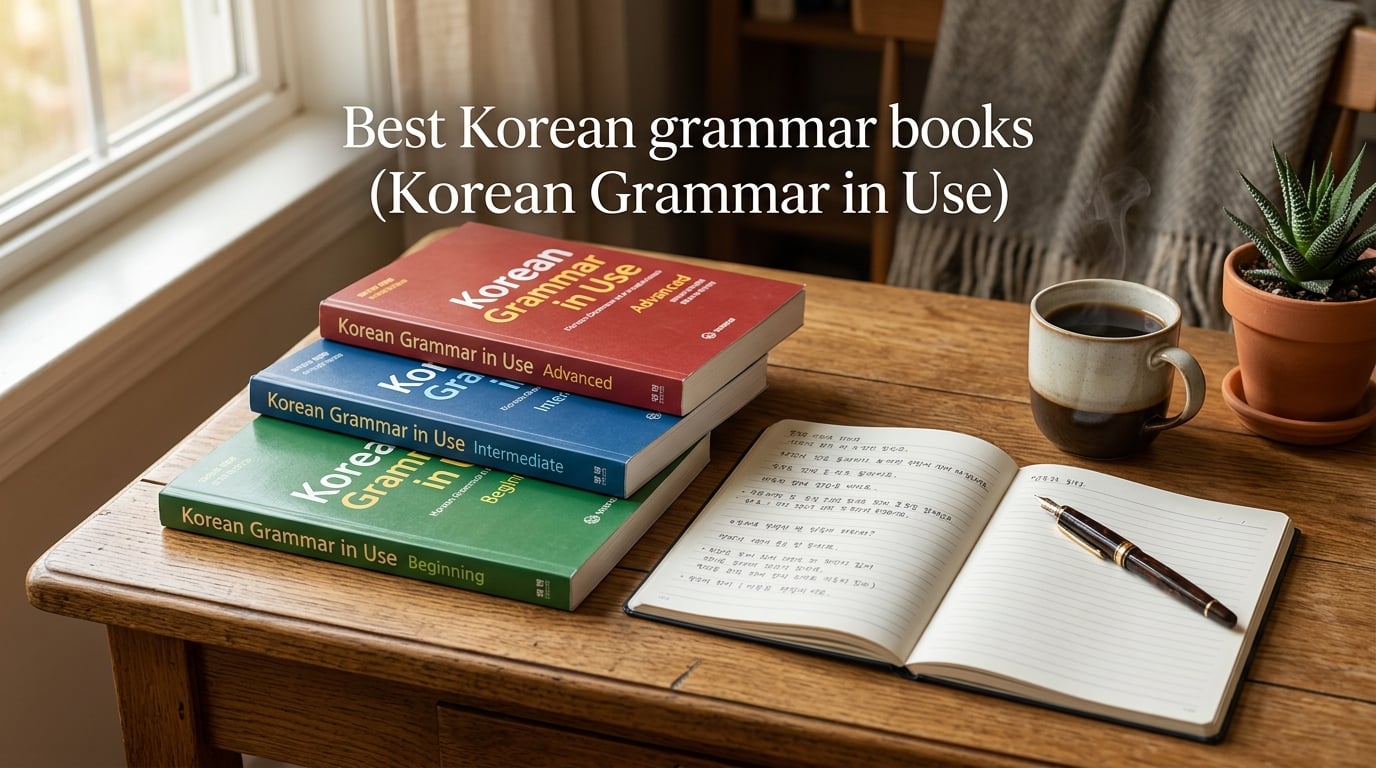
Looking for the best Korean grammar books to study on your own? After comparing the most recommended titles, our team landed on one series as the clear anchor: Korean Grammar in Use (KGIU) by Darakwon. This guide breaks down every KGIU volume, shows how it compares to TTMIK, Integrated Korean, and Korean Made Simple, and helps you pick the right book for your level.
Korean grammar can feel stacked: speech levels, honorifics, particles, and verb conjugations all show up before you finish your first textbook. A well-organized reference book turns that wall into a ladder. KGIU does this better than almost anything else on the market, which is why Korean language teachers, self-study learners, and TOPIK candidates keep coming back to it.
Table of Contents
What Is Korean Grammar in Use?
Korean Grammar in Use (KGIU) is a three-volume grammar reference series published by Darakwon, covering Korean grammar points from beginner (CEFR A1-A2) through advanced (C1-C2). It is aligned with the TOPIK exam and the Standard Korean Language Learning System.
Each volume presents grammar points with example sentences drawn from real conversation contexts, then follows up with a concise Grammar Focus explanation and short practice exercises. The series is widely used by self-study learners, university Korean programs, and TOPIK prep students.
- Publisher: Darakwon (also publishes Korean Made Simple)
- Volumes: Beginning, Intermediate, Advanced
- CEFR coverage: A1 through C2
- TOPIK alignment: Volumes map to TOPIK I (1-2) and TOPIK II (3-6)
- Editions: English, Spanish, German, Japanese, and Chinese
The English edition is the most common pick for North American and European learners, and it is the version I will focus on throughout this guide.
Quick Picks: Best Korean Grammar Books at a Glance
If you only have a minute, here are the best Korean grammar books our team recommends for 2026, organized by level.
- Korean Grammar in Use: Beginning — Best for absolute beginners who already know Hangul. CEFR A1-A2.
- Korean Grammar in Use: Intermediate — Best for learners preparing for TOPIK I or building toward intermediate fluency. CEFR B1-B2.
- Korean Grammar in Use: Advanced — Best for upper-intermediate and advanced learners tackling TOPIK II. CEFR C1-C2.
- Talk To Me In Korean (TTMIK) Level 1-9 — Best for learners who prefer lesson-style content over grammar references.
- Integrated Korean (Klear Textbooks) — Best for university classroom learners who need a full textbook.
- Korean Made Simple — Best for self-study learners who want one streamlined book from zero to conversation.
- 500 Basic Korean Verbs — Best companion for verb conjugation drilling.
- Korean Sentence Patterns — Best for learners who want to expand beyond grammar points into natural phrasing.
Each pick below is unpacked in detail, with strengths, weaknesses, and the level it actually fits.
Korean Grammar in Use: Beginning – Full Review
Korean Grammar in Use: Beginning is the best Korean grammar book for true beginners who already know Hangul. It opens with foundational grammar points like particles (은/는, 이/가, 을/를), present tense conjugations, and basic sentence structures, then layers in speech levels and honorifics gradually.
The book is structured so each grammar point gets a two-page spread: example sentences on the left, Grammar Focus on the right. This makes it easy to skim, review, or drill without reading cover to cover. Each unit wraps with short practice exercises and an answer key in the back.
What it does well:
- Logical progression from basic particles through complex sentence endings
- Clear contrast of similar grammar patterns (for example, 아/어요 vs 습니다)
- Audio files available through a QR code for pronunciation support
- Compact enough to carry to a café or commute
Where it falls short:
- Paper quality smudges easily if you write or highlight directly on the page
- Exercises are limited — it is a reference, not a full course
- Assumes Hangul fluency, so total beginners should learn the alphabet first
Best for: Absolute beginners with Hangul under their belt, classroom supplements, and TOPIK I candidates building a foundation. Most learners finish the volume in 8 to 12 weeks at a steady pace.
Korean Grammar in Use: Intermediate – Full Review
Korean Grammar in Use: Intermediate is the workhorse of the series and the most commonly recommended book for TOPIK I prep. It picks up where Beginning leaves off, covering indirect speech, complex conjunctions, advanced particles, and a wide range of sentence endings.
Compared to the Beginning volume, Intermediate goes deeper into nuance. You will see grammar points broken down by meaning, formality, and the social contexts where each pattern applies. That makes it especially useful once you start consuming K-dramas and K-pop lyrics and want to understand why a particular ending was used.
What it does well:
- The widest coverage of any single Korean grammar reference book in print
- Excellent for TOPIK I (levels 1-2) and a strong base for TOPIK II (levels 3-4)
- Examples are practical and feel closer to real conversation than textbook drills
- Works well for both classroom and self-study learners
Where it falls short:
- Exercises are still modest compared to dedicated workbooks
- Some grammar points assume prior exposure to Intermediate-level vocabulary
- Paper quality matches the Beginning volume, which means highlighters are risky
Best for: Intermediate learners, TOPIK I candidates, and anyone who finished Beginning and wants to keep moving forward. Plan on 3 to 5 months if you cover one grammar point per day.
Korean Grammar in Use: Advanced – Full Review
Korean Grammar in Use: Advanced is the right call once you are reading native material and pushing for TOPIK II levels 5 and 6. It focuses on literary forms, complex sentence structures, and the grammar patterns you will encounter in news articles, academic writing, and professional settings.
This volume is denser than the first two, both visually and conceptually. Grammar points assume you already have a solid handle on speech levels and honorifics, and the examples often pull from written Korean rather than dialogue.
What it does well:
- Covers C1 and C2 grammar in one volume — most competing books stop at B2
- Strong alignment with TOPIK II (levels 5-6)
- Useful for academic and professional Korean preparation
- Examples show how patterns shift in writing versus speech
Where it falls short:
- Less approachable for self-study learners who have not yet read native material
- Limited practice exercises, just like the other volumes
- Examples can feel dense if your vocabulary is not yet advanced
Best for: Upper-intermediate and advanced learners, TOPIK II candidates, and professional Korean learners. Most readers spend 4 to 6 months working through this volume.
How Korean Grammar in Use Compares to Alternatives
Korean Grammar in Use is the most balanced grammar reference for self-study, but it is not the only strong option. Here is how it stacks up against the three most common alternatives.
KGIU vs Talk To Me In Korean (TTMIK)
TTMIK is a lesson-based series with podcasts, workbooks, and YouTube content. It teaches grammar through themed lessons and conversational context. KGIU teaches grammar as a reference, organized by grammar point with example sentences.
Choose TTMIK if you want a guided curriculum with audio. Choose KGIU if you want a grammar reference you can return to over and over. Many learners use both: TTMIK for progression and KGIU for grammar clarification.
KGIU vs Integrated Korean (Klear Textbooks)
Integrated Korean is a full university textbook series published by Klear. It integrates reading, writing, listening, and grammar in a structured curriculum. KGIU isolates grammar from those skills.
Choose Integrated Korean if you are in a formal classroom or want one all-in-one path. Choose KGIU if you already have a main textbook or curriculum and want a grammar-focused supplement.
KGIU vs Korean Made Simple
Korean Made Simple is also published by Darakwon, the same publisher behind KGIU. It is a streamlined single-author textbook aimed at self-study from zero. KGIU is broader and more reference-friendly.
Choose Korean Made Simple if you want one book from Hangul through conversation. Choose KGIU if you want grammar depth at a specific CEFR level.
Reddit r/Korean learners often describe KGIU as “extremely well regarded” but note that it works best alongside a main textbook. Our team agrees: KGIU is a supplement that becomes indispensable, not a standalone course.
How to Choose the Right Korean Grammar Book for Your Level
Pick a Korean grammar book by matching it to your CEFR level, your study style, and your target outcome. Here are the factors our team uses when advising learners.
- Match your CEFR level. A1-A2: KGIU Beginning or Korean Made Simple. B1-B2: KGIU Intermediate or TTMIK Level 5-7. C1-C2: KGIU Advanced or a specialized reference.
- Decide reference vs curriculum. Reference books (KGIU, Handbook of Korean Grammar) are great for review. Curricula (TTMIK, Integrated Korean) walk you through progression.
- Check audio support. KGIU and TTMIK both include audio. Integrated Korean relies on classroom audio. Self-study learners should pick a book with built-in audio.
- Look at practice exercises. KGIU has limited exercises. If you want heavy drilling, add a workbook (Gooseapple, Vitamin Korean, or the KGIU Workbook).
- Consider TOPIK alignment. For TOPIK I (levels 1-2), KGIU Beginning and Intermediate cover the grammar. For TOPIK II (levels 3-6), add KGIU Advanced plus dedicated past-paper practice.
- Choose an edition that fits. Print is easier on the eyes but heavier. PDF is searchable but harder to annotate. Most learners end up buying print for daily use.
CEFR mapping for the KGIU series is straightforward: Beginning covers A1-A2, Intermediate covers B1-B2, and Advanced covers C1-C2. This makes KGIU one of the few series with full A1-C2 coverage in print.
When to Move from KGIU Beginning to Intermediate
Move from KGIU Beginning to Intermediate when you can read example sentences without constantly looking up particles or basic verb endings. Reddit r/Korean learners ask this question constantly, and the answer comes down to a few practical signs.
- You finish the Beginning exercises with fewer than 5 grammar questions per page.
- You can read short K-drama subtitles without pausing every other sentence.
- You understand the difference between 습니다 and 아/어요 without re-reading the explanation.
- You are comfortable with all major particles and basic conjunctions.
- You have started learning Intermediate-level vocabulary through TTMIK, Anki, or a similar deck.
If you can check at least four of these five boxes, it is time to graduate to KGIU Intermediate. If you cannot, stay with Beginning and pair it with a workbook for extra practice. Jumping too early is one of the most common reasons learners stall out.
Tips for Studying Korean Grammar Books Effectively
The fastest way to make Korean grammar stick is to use one main reference and one workbook, and study them in 30-minute focused blocks. Trying to juggle three or four grammar books at once is a fast track to burnout — a problem the Reddit r/Korean community flags repeatedly.
Here is what works for our team and for the learners we have coached:
- Set a daily grammar point. One KGIU grammar point per day, five days a week, gives you 260 points in a year — more than any single volume.
- Speak the example sentences out loud. KGIU’s audio is helpful, but reading aloud builds muscle memory faster than silent review.
- Keep a grammar notebook. Write each grammar point in your own words and add two of your own example sentences. Review it weekly.
- Pair KGIU with a workbook. Gooseapple and Vitamin Korean workbooks are community favorites and plug the gap that KGIU exercises leave open.
- Use spaced repetition. Anki decks built from KGIU example sentences lock patterns into long-term memory.
- Track your hours, not your page count. Some grammar points take 20 minutes, others take two hours. Log time, not progress.
For most adult learners, one year of focused study brings them to the end of KGIU Beginning or partway through KGIU Intermediate. Fluency in one year is possible only if you layer speaking practice on top of grammar reading — books alone will not get you there.
Honest Criticisms of Korean Grammar in Use
Korean Grammar in Use is excellent as a reference but is not a complete course. Reviewers and Reddit learners consistently raise the same points.
- Limited exercises. KGIU includes practice problems but not enough to fully internalize each grammar point on its own.
- Paper quality. The pages smudge easily when you write or highlight. Most readers use sticky notes or a separate notebook instead.
- Not beginner-friendly without Hangul. The series assumes you can already read Korean. Total beginners need a Hangul primer first.
- Reference style. Some learners want a guided curriculum. KGIU reads more like a dictionary than a textbook.
None of these criticisms disqualify KGIU. They simply mean you should plan to pair it with a main textbook, a workbook, or a lesson series like TTMIK.
Frequently Asked Questions
Is Korean Grammar in Use good for beginners?
Yes, Korean Grammar in Use: Beginning is one of the best Korean grammar books for beginners, but only if you already know Hangul. It assumes you can read Korean script and focuses entirely on grammar points from particles and basic verb endings up through speech levels. Total beginners should learn Hangul first, then start with the Beginning volume.
Is Korean Grammar in Use enough to pass TOPIK?
Korean Grammar in Use covers the grammar points you need for both TOPIK I (levels 1-2) and TOPIK II (levels 3-6), but the series alone will not get you a passing score. You still need vocabulary practice, listening drills, writing practice, and past-paper tests. Most successful TOPIK candidates pair KGIU with a workbook, a TTMIK curriculum, and dedicated past-paper practice.
KGIU vs TTMIK: which is better?
Korean Grammar in Use is a grammar reference organized by grammar point, while Talk To Me In Korean is a lesson-based curriculum with audio and themed lessons. KGIU is better for looking up and reviewing specific grammar patterns; TTMIK is better for guided progression from beginner to advanced. Many learners use both at the same time.
Which Korean grammar book should I buy?
If you want one book to anchor your self-study, start with Korean Grammar in Use: Beginning (A1-A2) and move to Intermediate (B1-B2) once you finish. If you prefer a guided curriculum, start with Talk To Me In Korean Level 1. If you are in a university classroom, Integrated Korean by Klear is the standard. Choose by your level and your learning style rather than by brand.
How long does it take to finish Korean Grammar in Use?
Most learners finish KGIU Beginning in 8 to 12 weeks, KGIU Intermediate in 3 to 5 months, and KGIU Advanced in 4 to 6 months when studying one grammar point per day, five days a week. Total time across the series is roughly 12 to 18 months for an adult self-study learner.
Can I learn Korean with Korean Grammar in Use alone?
You can build a strong grammar foundation with KGIU alone, but you will not reach fluency without speaking, listening, and writing practice. Pair KGIU with a workbook for extra exercises, a TTMIK curriculum for guided progression, and a speaking partner or tutor for conversation. Books teach grammar; fluency comes from using grammar in real contexts.
What is the difference between KGIU and Integrated Korean?
Korean Grammar in Use is a grammar reference series published by Darakwon, covering grammar points from beginner to advanced. Integrated Korean is a full university textbook series published by Klear that integrates reading, writing, listening, speaking, and grammar. Choose KGIU for grammar depth and review; choose Integrated Korean for a complete classroom curriculum.
Final Recommendation
The best Korean grammar books for 2026 are the Korean Grammar in Use series by Darakwon. Beginning, Intermediate, and Advanced together cover A1 through C2, align with TOPIK, and stay in print across multiple editions and languages.
Start with KGIU Beginning if you know Hangul, pair it with a workbook for exercises, and graduate to Intermediate and Advanced as your level rises. Add TTMIK or Integrated Korean if you want a guided curriculum alongside your grammar reference.