
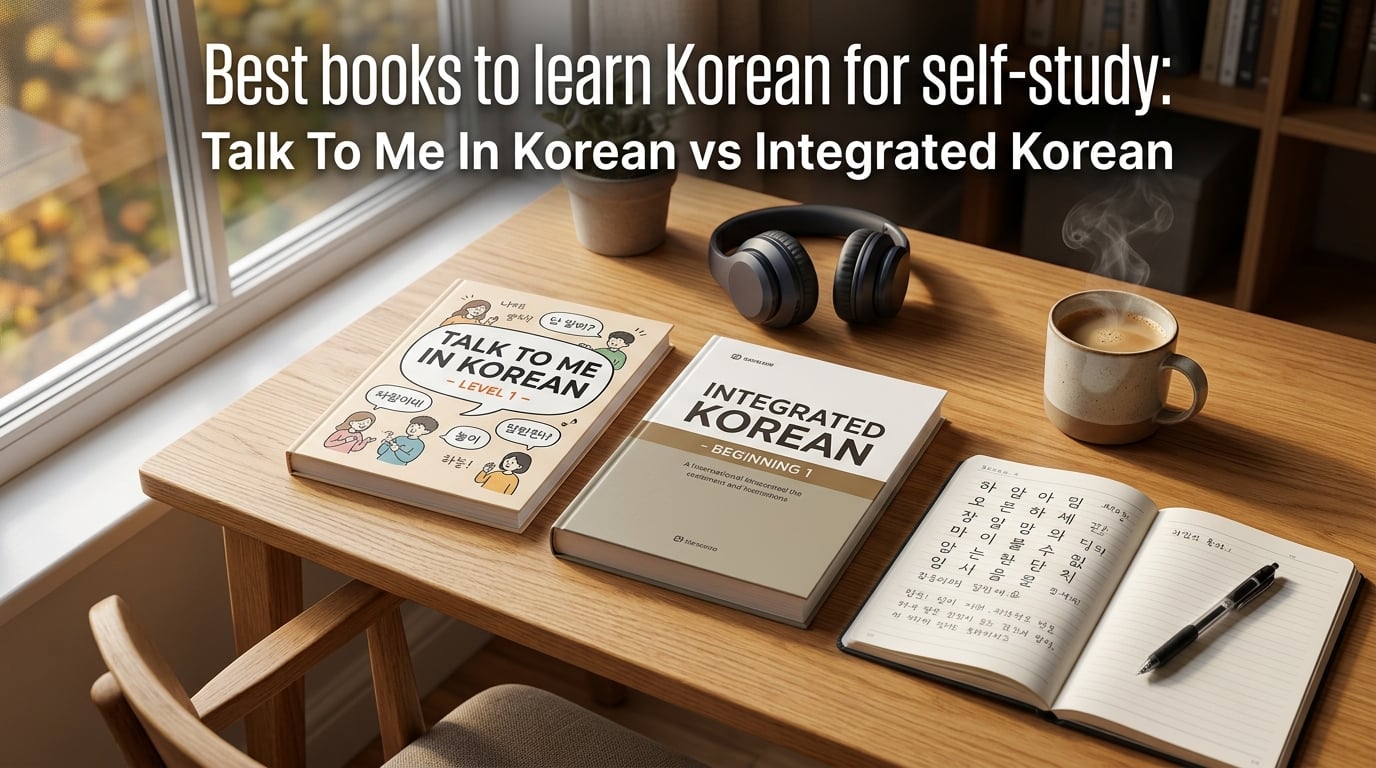
If you are choosing between Talk To Me In Korean and Integrated Korean for self-study, the honest answer is that neither book is universally better. The two series are built for different goals, and the right choice depends on whether you want to start speaking Korean fast or build a deep, university-grade foundation.
I have worked through both series myself, and the same conclusion keeps showing up on Reddit threads and in DMs from readers: the “best book to learn Korean” question almost always comes down to Talk To Me In Korean vs Integrated Korean. In this guide I will walk you through what each series actually is, how they differ on teaching style, audio, cost, and depth, and when it makes sense to use both books together as a hybrid setup.
By the end you will have a clear answer for your situation, plus a realistic estimate of how long each series takes to finish and what to add when you plateau.
Table of Contents
Talk To Me In Korean vs Integrated Korean at a Glance
The fastest way to feel the difference between these two series is to see them side by side. This table summarizes what we cover in detail later in the guide.
| Attribute | Talk To Me In Korean (TTMIK) | Integrated Korean (KLEAR) |
|---|---|---|
| Publisher | TalkToMeInKorean (independent, founded 2009) | University of Hawai’i Press (KLEAR project) |
| Levels | 10 levels (Level 1 to Level 10) | 12 books (Beginning 1 through High Advanced 2) |
| Teaching philosophy | Conversational, speaking-first, pattern-based | Performance-based, task-based, four-skill integrated |
| Audio | Free podcasts (Iyagi, TTMIK Lessons) plus book audio | Free MP3 downloads via kleartextbook.com |
| Workbook | Built into each level | Separate workbook for every textbook |
| Best for | Casual self-study, speaking quickly, K-drama/K-pop fans | TOPIK prep, university-bound learners, grammar depth |
| Time to finish beginner set | 3 to 9 months (Levels 1 to 4) | 6 to 12 months (Beginning 1 and 2) |
Use this table as your shortcut. If you want the deeper reasoning behind each row, the rest of the guide breaks it down.
What Is Talk To Me In Korean?
Talk To Me In Korean (TTMIK) is a Korean language learning platform founded in 2009 that publishes textbooks, audio lessons, and a long-running podcast and YouTube channel focused on conversational Korean.
The textbook series runs from Level 1 through Level 10, and each level is essentially a printed companion to the free audio lessons that TTMIK has been releasing since the late 2000s. Lessons are short, dialogue-driven, and pattern-based. Instead of long grammar explanations, you get a recurring conversation, a handful of grammar points broken into “key sentences,” a short vocabulary list, and a “Try It” speaking prompt.
What makes TTMIK special for self-study is the surrounding ecosystem. YouTube has thousands of free lessons organized by grammar point, and the Iyagi (이야기) intermediate podcast has been running for over a decade. The community forum, Discord, and study groups give beginners a place to ask questions without paying for a tutor.
TTMIK is best understood as a speaking-first system. Grammar is taught through repeated exposure to sentence patterns, not through dense linguistic explanation. The trade-off is that you can hold a basic conversation within a few months, but you may eventually feel gaps in your grammar once you reach Level 4 or 5.
What Is Integrated Korean?
Integrated Korean is a university-grade textbook series developed by the Korean Language Education and Research (KLEAR) project at the University of Hawai’i and published by the University of Hawai’i Press.
The series has 12 books in total: Beginning 1, Beginning 2, Intermediate 1, Intermediate 2, Advanced 1, Advanced 2, and so on through High Advanced 2. Each textbook pairs with a separate workbook and a free audio companion downloadable from kleartextbook.com.
The teaching approach is described in the preface as performance-based and task-based, organized around contextualized dialogues followed by grammar notes, vocabulary, culture sections, and four-skill activities that integrate reading, writing, listening, and speaking. Lessons are longer and denser than TTMIK, with bilingual examples, formal speech drills, and a stronger focus on Hangul reading skills, Hanja, and written grammar.
Integrated Korean is the dominant textbook at most US university Korean programs, which is why it is often called the “gold standard” for serious Korean study. It is also the series most TOPIK candidates use because the progression maps cleanly to the test format.
The trade-off is the workload. Each lesson assumes roughly 1.5 to 2 hours of study, and the workbook is required if you want the practice that turns input into output.
Talk To Me In Korean vs Integrated Korean: Side-by-Side Comparison
This is the core head-to-head. I will walk through the dimensions that actually matter when you study alone, not the ones that only matter in a classroom.
Teaching Style and Lesson Structure
TTMIK lessons average 8 to 15 pages and follow a predictable pattern: a short dialogue, three or four grammar points introduced as patterns, a vocabulary list, and a speaking prompt. You can finish a lesson in 30 to 45 minutes.
Integrated Korean lessons run 20 to 35 pages and move through a longer dialogue, a grammar section with bilingual examples, vocabulary and Hanja notes, culture notes, and integrated skills activities. A single lesson takes 1.5 to 2.5 hours to complete well.
If you have a short daily window (under an hour), TTMIK fits. If you can sit for a long focused study block, Integrated Korean rewards you with more depth per page.
Grammar Depth and Explanation
TTMIK teaches grammar through repetition and pattern recognition. You learn “~고 싶어요” before you ever see the formal name of the grammar pattern. This works for speaking, but once you hit Level 4 or 5 you may want a structural reference like Korean Grammar in Use to fill in the gaps.
Integrated Korean explains each grammar point with bilingual examples, contrastive notes (for example, polite vs formal endings), and explicit drills. The result is that you understand the why behind each sentence, not just the how.
If grammar depth matters to you, Integrated Korean wins on this dimension. If you would rather absorb grammar through dialogue, TTMIK is more accessible.
Audio Resources and Listening Practice
Both series include free audio, but the experience is different.
TTMIK audio is split across the textbook tracks, the free Iyagi intermediate podcast (which has run since 2009), and the active TTMIK podcast feed. Listening practice is woven into the speaking-first philosophy, and the audio is conversational in tone.
Integrated Korean audio is organized per textbook at kleartextbook.com. Tracks follow the textbook dialogues and reading passages exactly, so the audio is a direct mirror of what you read. There is no separate podcast, but the consistency between audio and text makes review easier.
For listening-heavy learners, TTMIK gives you more variety. For learners who want one reliable audio track per lesson, Integrated Korean is cleaner.
Cost and Total Series Investment
Costs change constantly, so I am deliberately not putting dollar figures in this guide. What I will say is the structural difference: TTMIK Levels 1 through 9 are sold individually, and most self-study learners buy one or two levels at a time rather than the full set. Integrated Korean requires a textbook plus a separate workbook per level, so each “level” is actually two books.
On a per-month basis, TTMIK is cheaper to start because you can begin with Level 1 and the free podcasts and add more later. Integrated Korean is more expensive up front per level, but the workbook is built into the TTMIK equivalent by design.
Levels and Progression
TTMIK Levels 1 through 4 cover roughly the same ground as Integrated Korean Beginning 1 and 2. Levels 5 through 9 cover the equivalent of Intermediate, and Levels 9 through 10 push into Advanced territory. After Level 10, TTMIK recommends Korean Grammar in Use and supplemental media.
Integrated Korean has clearer official levels and a smoother runway to true advanced. Beginning 1 and 2 map to beginner, Intermediate 1 and 2 to mid-range, Advanced 1 and 2 to upper intermediate, and beyond that High Advanced 1 and 2 for learners approaching native-level reading and writing.
If you want a clearly mapped path from zero to advanced, Integrated Korean has the cleaner structure. If you want to stop at conversational fluency and pivot to media immersion, TTMIK gets you there faster.
Edition Differences and Common Confusion
One thing that trips up beginners: Integrated Korean has gone through editions, and the 2nd edition Beginning 1 and Beginning 2 books have a noticeably different look from the 1st edition. Make sure the audio companion you download matches the edition you bought. The kleartextbook.com download page lists both editions.
TTMIK has refreshed some Level covers over the years, but the lesson content has stayed mostly stable since 2015. Older copies from 2014 to 2016 are still usable today.
Who Is Talk To Me In Korean Best For?
TTMIK is the right call if you fall into one of these buckets.
You want to start speaking quickly. The pattern-based lessons and short dialogues get you forming sentences in Korean within the first two weeks. If your goal is a trip to Seoul in six months, TTMIK is the more direct route.
You study in short bursts. A single 30-minute daily session is enough to finish one TTMIK lesson per week. Integrated Korean rarely fits into a session that short.
You learn better from audio than from textbooks. The TTMIK podcast library is large and free, and the YouTube channel has over a thousand lessons you can replay on your phone.
You are a casual learner or hobbyist. If you want to enjoy K-dramas and K-pop without committing to a multi-year academic path, TTMIK is friendlier.
You need encouragement to keep going. The TTMIK community is active and welcoming, and short wins feel easier to celebrate when each lesson is short.
Who Is Integrated Korean Best For?
Integrated Korean is the right call if you fall into one of these buckets.
You plan to take TOPIK. The progression maps cleanly to TOPIK levels, and the formal grammar drills prepare you for the writing sections.
You want university-level rigor. If you are aiming for a Korean studies program, an exchange semester, or a job that requires reading professional Korean, Integrated Korean is the academic standard.
You crave grammar depth. Bilingual explanations, contrastive notes, and the cultural sidebars give Integrated Korean a depth that TTMIK deliberately skips.
You have long study blocks. A 1.5 to 2 hour session is the natural unit for Integrated Korean. If that fits your schedule, the books reward you.
You prefer a textbook you write in. The separate Integrated Korean workbook has more drill exercises per lesson than TTMIK’s built-in practice.
Can You Use Both Books Together? The Hybrid Approach
Yes, and this is the setup that experienced self-study learners recommend most often. Reddit’s r/Korean threads on TTMIK vs Integrated Korean consistently land on the same conclusion: use TTMIK for speaking and listening, and use Integrated Korean for grammar depth and reading.
Here is how a hybrid plan works in practice.
Weekday mornings (30 minutes): One TTMIK Level lesson. Listen to the audio first, read the dialogue, drill the patterns, do the Try It speaking prompt out loud.
Weekday evenings (45 to 60 minutes): One Integrated Korean lesson from the same general level. Read the dialogue, study the grammar section, complete the matching workbook pages.
Weekends: Review both, watch one TTMIK YouTube video on a grammar point you found hard, and listen to one Iyagi episode.
The hybrid approach works because each book fills the other’s gap. TTMIK keeps you motivated with quick wins and a friendly speaking routine. Integrated Korean fills in the grammar backbone that TTMIK skips. After 6 to 9 months of consistent hybrid study, most learners report reaching a comfortable intermediate plateau.
If you only have time for one book, pick the one that matches your goal. If you have time for both, the hybrid is genuinely the best of both worlds.
Self-Study Tips for Each Series
A few practical tips that have worked for me and for the readers who have written in over the years.
Tips for Self-Studying with TTMIK
Always listen to the audio before reading the lesson. The first pass primes your ear, and the second pass with the book sticks better because you already know how the sentence sounds.
Use the “Try It” prompts out loud. Saying the sentences in your own voice is what moves them from recognition into recall. Reading them silently is not enough.
Plan to add Korean Grammar in Use around Level 4 or 5. TTMIK deliberately keeps grammar light to keep you talking, so a structural reference book helps once you start asking why sentences work the way they do.
Subscribe to one TTMIK podcast or YouTube channel and treat it as background listening. Even 15 minutes of passive listening a day accelerates your ear.
Tips for Self-Studying with Integrated Korean
Buy the workbook. The textbook alone is not enough for self-study, because the practice that turns input into output lives in the workbook.
Do every audio track twice: once while reading the Korean, once with the book closed. The second pass forces active listening.
Keep a vocabulary notebook by lesson. Integrated Korean introduces around 25 to 40 new vocabulary items per lesson, and reviewing them on a 3-day, 7-day, and 30-day cycle is the most reliable way to retain them.
Pair each Integrated Korean lesson with 15 minutes of TTMIK YouTube on the same grammar point. The two voices reinforce each other and the lesson becomes far less abstract.
Final Verdict: Which One Should You Buy?
There is no universal winner. The right book depends on what you want from Korean over the next year. This decision matrix is the shortcut.
| If you are… | Start with | Why |
|---|---|---|
| An absolute beginner who wants to speak quickly | TTMIK Level 1 | Short lessons, friendly tone, fast wins |
| A TOPIK candidate | Integrated Korean Beginning 1 | Maps cleanly to TOPIK levels, formal grammar drills |
| A university-bound learner | Integrated Korean Beginning 1 | Academic standard, expected at most US Korean programs |
| A K-drama or K-pop fan who wants listening fluency | TTMIK Level 1 | Audio-heavy ecosystem, speaking-first habits |
| A serious self-studier with 1.5 hours a day | Both, in a hybrid plan | TTMIK for speaking, Integrated Korean for depth |
| A casual hobbyist with 30 minutes a day | TTMIK Level 1 | Fits a short daily window without burning out |
| A learner who wants grammar depth first | Integrated Korean Beginning 1 | Bilingual grammar notes, contrastive explanations |
My personal take: if you are new to Korean and unsure which direction you want, start with TTMIK Level 1. The cost of switching later is low, and the early momentum matters more than picking the perfect book on day one.
If you already know you want a serious, multi-year path and you have the study time, start with Integrated Korean Beginning 1 and add TTMIK on the side once you reach Lesson 5.
Frequently Asked Questions
What is the best textbook for learning Korean?
For self-study, Talk To Me In Korean is the most beginner-friendly choice because of its short, dialogue-driven lessons and free podcast library. Integrated Korean is the best choice if you want university-level rigor, grammar depth, or TOPIK preparation. The best textbook is the one you actually finish, so pick the style that matches your study time and goals.
What is the best way to self-study Korean?
Pick one textbook (TTMIK or Integrated Korean), study it daily in 30 to 90 minute sessions, listen to the matching audio every day, review vocabulary on a 3-7-30 day cycle, and add Korean media (K-dramas, Iyagi podcast, K-pop) once you finish Level 1 or Beginning 1. Consistency matters more than the book you choose.
Is Integrated Korean good for self-study?
Yes, Integrated Korean works for self-study if you commit to the workbook and the audio companion. The textbook itself is dense, and the workbook provides the practice that turns reading into production. Most self-study learners finish Beginning 1 in 3 to 6 months at 1 hour a day, then move to Beginning 2.
Is Integrated Korean a better textbook than TTMIK?
Integrated Korean is more comprehensive and academically rigorous, while TTMIK is more accessible and speaking-focused. Neither is objectively better; Integrated Korean wins on depth and TOPIK alignment, and TTMIK wins on engagement and ease of self-study. The right answer depends on your learning style and goals.
What Korean textbook is best for beginners?
TTMIK Level 1 is the most popular beginner Korean textbook because it teaches Hangul, basic particles, and core sentence patterns in under 50 pages with free audio. Integrated Korean Beginning 1 is the best beginner textbook if you want a more formal, grammar-rich foundation that maps to university-level study.
Can I learn Korean with just one textbook?
Yes, you can reach an upper-intermediate level with one textbook if you finish the whole series and supplement with native media. TTMIK Levels 1 through 9 or Integrated Korean Beginning through Advanced will get you there on their own. The textbook is the spine; podcasts, dramas, and conversation partners are the muscle.
Is TTMIK enough to learn Korean?
TTMIK is enough to reach comfortable conversational fluency and a solid intermediate base, but most long-term learners add Korean Grammar in Use around Level 4 or 5 to fill grammar gaps, and they pair the books with native media for listening practice. TTMIK is a complete beginner and intermediate system on its own.
Which is better for self-study, TTMIK or Integrated Korean?
TTMIK is better for self-study if you have 30 to 45 minutes a day and want speaking-first lessons with built-in audio. Integrated Korean is better for self-study if you have 1.5 to 2 hours a day, want grammar depth, and are willing to buy the workbook. Many serious self-study learners use both in a hybrid plan.
How long does it take to finish Integrated Korean Beginning 1?
Most self-study learners finish Integrated Korean Beginning 1 in 3 to 6 months at roughly 1 hour per day, including workbook exercises and audio review. Faster learners who already know Hangul can finish in 2 to 3 months; slower learners who are new to the language often take 6 to 9 months.
Are TTMIK books good for beginners?
Yes, TTMIK is one of the most beginner-friendly Korean textbook series available. Level 1 starts with Hangul and the most basic particles, and each lesson adds one or two new grammar patterns in a conversational context. The free audio and YouTube lessons make it easy to review, even with no Korean background.
Final Thoughts on Choosing the Best Books to Learn Korean for Self-Study
The Talk To Me In Korean vs Integrated Korean question does not have a single right answer, and that is exactly why both series have thrived for over a decade. TTMIK is the friendly on-ramp that gets you speaking fast and keeps you motivated through short daily lessons. Integrated Korean is the academic depth that carries you through TOPIK, university Korean, and years of serious study.
Pick the book that fits your study time and goals this week. Finish Level 1 or Beginning 1 before you second-guess the choice, because consistency with any one book beats bouncing between two. If you plateau, the hybrid approach is always there as your next step.
Whichever path you take, I hope this guide makes the choice a little clearer. Stick with it, finish the first book, and the rest of Korean opens up from there.