
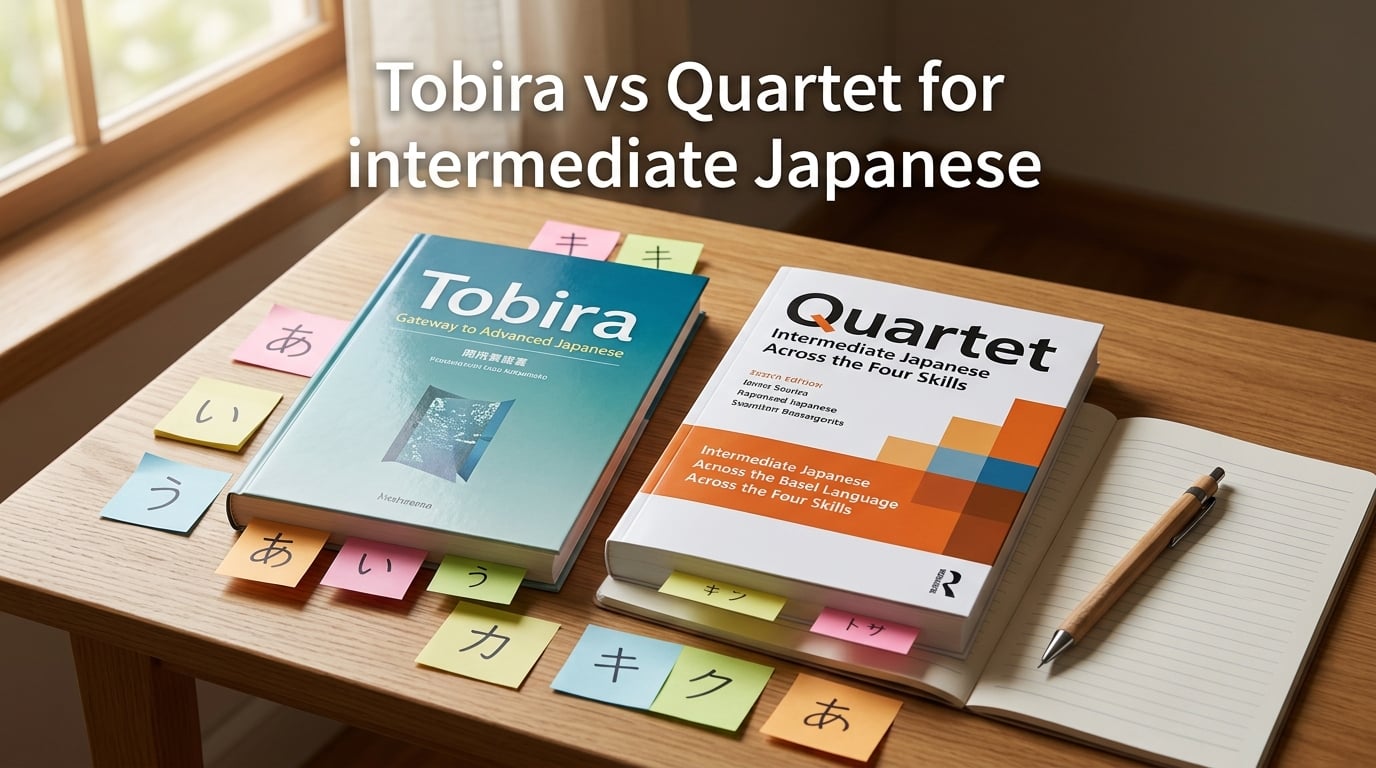
Choosing between Tobira and Quartet is one of the most common dilemmas for learners moving past the beginner stage of Japanese. Both textbooks target the same JLPT band, both are widely used in classrooms, and both claim to bridge you from Genki-level Japanese into real-world reading and listening. After comparing them across structure, grammar approach, JLPT coverage, and self-study suitability, here is the short answer: Tobira is the safer pick for solo learners who want English grammar explanations and a clear path to JLPT N2, while Quartet is the better choice for classroom learners, tutor-supported study, and people who want a more modern, all-Japanese reading experience.
In this guide, our team walks through both textbooks in detail, compares them side by side, and helps you pick the right one for your situation.
Table of Contents
Tobira vs Quartet at a Glance
Here is the quick comparison our team built after reviewing both textbooks cover to cover.
| Feature | Tobira: Gateway to Advanced Japanese | Quartet (1, 2, etc.) |
|---|---|---|
| Publisher | Kuroshio Publishers | 3A Corporation (Bonjinsha imprint) |
| Target JLPT level | N3 to N2 | N3 to N2 |
| Volumes | Single main textbook (15 chapters) + workbook | Multiple volumes (Quartet 1, 2, …) |
| Grammar explanations | English (first edition), lighter English (second edition) | Mostly Japanese with English translation notes |
| Best for | Self-study, university intermediate, JLPT N2 prep | Classroom use, tutor-supported study, modern reading practice |
| Kanji introduced | Around 300+ new kanji across the main book | Around 300+ new kanji per volume |
| Audio companion | Audio CD / download included with new editions | Audio companion available |
| Companion workbook | Yes (Tobira Workbook) | Yes (per-volume workbook) |
| Difficulty jump from Genki | Significant (assumes Genki 2 completion) | Moderate to significant (assumes beginner foundation) |
What Is Tobira: Gateway to Advanced Japanese?
Tobira: Gateway to Advanced Japanese (sometimes called Tobira: Learning Japanese Beyond Middle Level) is the long-standing standard intermediate textbook used in university Japanese programs across the English-speaking world. It is published by Kuroshio Publishers, a respected academic press that has produced several Japanese-language teaching materials.
The book assumes you have already worked through a beginner series like Genki 1 and 2, which means you should know hiragana, katakana, around 600 kanji, and the core grammar patterns covered in those books. Once you are at that stage, Tobira becomes the next step. It introduces around 300 additional kanji and roughly 50 to 80 grammar points across 15 themed chapters plus review material.
The first edition of Tobira explained grammar in clear English, which is why it became the default recommendation for self-study learners. The second edition, released in recent years, keeps English support but moves the book closer to an immersive format. Both editions are still in active use today.
What Is Inside Tobira?
Each chapter of Tobira follows a consistent structure that makes it easy to build a study routine. You get a themed dialogue or reading passage, new grammar explanations with example sentences, a kanji introduction section, vocabulary lists, and exercises that test comprehension, grammar production, and translation.
Themed chapters cover topics like Japanese geography, education, pop culture, the workplace, technology, traditional arts, and social issues. This is one of the reasons learners who finish Tobira feel ready to handle native material: the book deliberately covers the kind of vocabulary and cultural references you will encounter in newspapers, podcasts, and novels.
Tobira Strengths and Weaknesses
Learners on r/LearnJapanese regularly point to a few clear strengths of Tobira: the grammar explanations are thorough, the chapter structure is predictable, and the workbook provides real drilling practice. The downsides most often mentioned are the difficulty jump from Genki and the fact that copies of certain editions have been intermittently out of print.
What Is Quartet?
Quartet is a newer intermediate textbook series published by 3A Corporation under the Bonjinsha imprint. The series includes Quartet 1, Quartet 2, and additional volumes, each covering themed chapters designed to push learners toward JLPT N3 and N2 while building real reading and listening stamina.
Quartet is sometimes described as the more modern alternative to Tobira. The themed chapters reflect current Japanese life and culture, the dialogues feel closer to natural spoken Japanese, and the visual design is fresh. Where Tobira leans on English grammar notes, Quartet is written primarily in Japanese with English translation support at key points.
What Is Inside Quartet?
Each Quartet volume contains around 12 themed chapters covering topics like daily life, relationships, work, travel, social media, food, and contemporary Japanese culture. Each chapter includes a reading passage or dialogue in natural Japanese, vocabulary lists, grammar focus sections, and exercises that move from comprehension to production.
The kanji introduction order in Quartet is structured, and cultural notes are woven throughout the chapters. Because the explanations are written in Japanese first, learners get early exposure to reading dense native-style content.
Quartet Strengths and Weaknesses
The strengths reviewers and classroom teachers often mention for Quartet include the modern cultural content, the natural-sounding dialogues, and the way it pushes learners toward Japanese-only explanations. The most common weakness cited by self-study learners on Reddit is that without a teacher or tutor, the lack of full English grammar notes can slow progress in harder chapters.
JLPT Level Coverage of Tobira vs Quartet
Both textbooks target the JLPT N3 to N2 band, which is the standard intermediate plateau that most learners spend one to two years working through. The difference is in how each book handles that band.
Tobira’s 15 chapters are designed to take a learner from solid Genki 2 completion all the way through JLPT N3 material and into N2 grammar territory. By the time you finish the book, you have seen most of the grammar and vocabulary tested at JLPT N2.
Quartet covers JLPT N3 to N2 across multiple volumes. Quartet 1 is roughly equivalent to early-to-mid intermediate, while subsequent volumes push deeper into N2 material. This multi-volume structure lets you progress in clearly defined stages rather than rushing through one large book.
Structure, Chapters, and Pacing
The pacing difference between the two textbooks is significant if you are planning your study schedule.
Tobira Chapter Count and Pacing
Tobira has 15 main chapters plus review sections. Most self-study learners report finishing it in 6 to 12 months when studying around 1 to 1.5 hours per day, though it is common to spend more time on later chapters because the grammar density rises. Our team estimates 250 to 400 total study hours to complete the main textbook and workbook.
Quartet Chapter Count and Pacing
Quartet has around 12 chapters per volume, with multiple volumes making up the full series. A single Quartet volume typically takes 3 to 6 months at a self-study pace, depending on how much time you spend on the reading passages and exercises.
Grammar Approach: English vs Immersion
The biggest pedagogical difference between Tobira and Quartet is how grammar is presented.
Tobira, especially in the first edition, explains each new grammar pattern in English first, then provides Japanese example sentences. This makes it easier for solo learners who do not have a teacher to translate difficult grammar on the fly.
Quartet presents grammar explanations primarily in Japanese, with English translation notes at key points. This pushes you to think about grammar in Japanese from the start, which builds stronger reading stamina but can feel harder without a tutor nearby to clarify subtle points.
Reading Passages, Kanji, and Vocabulary
Both textbooks treat reading passages as a core learning tool, not just a side feature.
Tobira’s reading passages are longer and denser, which is why finishing the book feels like a real accomplishment. Each chapter introduces themed vocabulary and around 20 new kanji, with the kanji order carefully sequenced so that you build on previously learned characters.
Quartet’s reading passages are slightly shorter per chapter but cover more contemporary topics. The kanji introduction follows a similar structured order, and the vocabulary lists emphasize words you will hear in modern Japanese media.
Workbook, Audio, and Companion Materials
Both textbooks come with companion workbooks and audio, though availability can vary by edition and region.
Tobira’s companion workbook, often called the Tobira Workbook, contains drills and exercises for each chapter. Answer keys are sold separately and can sometimes be hard to source depending on your region. The audio CD or downloadable audio companion is typically included with new copies.
Quartet has its own per-volume workbooks with exercises covering grammar, vocabulary, kanji, and reading comprehension. Audio companions are available, and answer keys are included or sold with the workbook.
Self-Study Suitability: Which Is Easier Alone?
If you are studying without a tutor or classroom, the English grammar support in Tobira makes it the more forgiving option. Learners on r/LearnJapanese consistently report being able to push through Tobira alone as long as they have worked through Genki 2 and are willing to look up the occasional grammar point online.
Quartet is doable as a self-study textbook, but it rewards having a tutor, study partner, or active Japanese-language community to clarify grammar points. Without that support, learners sometimes stall on later chapters where the grammar explanations become denser.
If your study situation includes a tutor, classroom, or weekly conversation partner, Quartet becomes a much more attractive option because the immersive grammar approach accelerates your transition to native material.
Difficulty Jump From Genki to Tobira or Quartet
Almost every learner who has finished Genki 1 and 2 will tell you that the first few chapters of intermediate textbooks feel harder than the last chapters of Genki. That difficulty jump is real and intentional: it is meant to prepare you for reading real Japanese, not just textbook Japanese.
Tobira assumes you have completed Genki 2 and have a working knowledge of around 600 kanji. If you are missing any of that foundation, the first two or three chapters of Tobira will feel punishing.
Quartet also assumes a beginner foundation, though the immersive format makes the difficulty jump feel slightly different. You may not struggle with grammar explanations as much, but you will need to push through reading passages that move fast.
Availability and Where to Buy Tobira and Quartet
Tobira has had periods where the first edition was hard to source, and new copies of either edition have occasionally been out of print. Used copies and PDF versions are widely available, but if you want a physical new copy, it can take some hunting depending on your region.
Quartet is generally more available through Japanese bookstores and major online retailers. International shipping is usually straightforward, and the publisher has been steadily producing new volumes in the series.
How to Choose Between Tobira and Quartet
Our team’s decision framework boils down to a few learner profiles.
Pick Tobira if you:
- Finished Genki 1 and 2 and want a clear next step
- Study alone without a tutor
- Prefer English grammar explanations while you read
- Plan to take JLPT N2 within one to two years
- Want a single, well-known textbook that university programs use
Pick Quartet if you:
- Have access to a tutor or Japanese-language classroom
- Want modern cultural content and natural-sounding dialogues
- Prefer learning grammar through Japanese-first explanations
- Plan to work through multiple volumes in sequence
- Want stronger reading and listening stamina by the end of each volume
For most self-study learners coming out of Genki, our team recommends starting with Tobira. You can always add Quartet as a reading-practice supplement once you finish Tobira’s main text. Many learners use both side by side: Tobira for grammar, Quartet for reading.
Frequently Asked Questions
Is Tobira good for intermediate Japanese?
Yes. Tobira is one of the most widely used intermediate Japanese textbooks, especially in university programs and self-study. It covers JLPT N3 to N2 material across 15 chapters with English grammar explanations, structured kanji introduction, and themed reading passages. Most learners who finish Tobira feel ready to start tackling native material like news articles and graded readers.
Is Quartet a good textbook for Japanese?
Yes, Quartet is well-regarded as a modern intermediate textbook, particularly for classroom and tutor-supported learners. It covers JLPT N3 to N2 across multiple volumes with mostly-Japanese explanations, contemporary cultural themes, and natural-sounding dialogues. Learners who use Quartet often praise the modern content but note that solo study is harder without English grammar support.
Is Quartet harder than Tobira?
Difficulty is roughly similar, but the challenge feels different. Quartet’s mostly-Japanese grammar explanations can be harder for solo learners, while Tobira’s English grammar notes make self-study easier. Quartet’s reading passages may feel more approachable because of modern themes, but the lack of English support at grammar points can slow you down without a teacher.
What JLPT level is Tobira?
Tobira covers JLPT N3 to early N2 material. By the time you finish all 15 chapters and the companion workbook, you will have worked through most of the grammar and vocabulary tested at JLPT N2. Many learners use Tobira as their primary N2 prep textbook.
What JLPT level is Quartet?
Quartet targets JLPT N3 to N2 across its volumes. Quartet 1 covers the earlier half of that range, while subsequent volumes push deeper into N2 territory. Each volume also includes vocabulary and grammar consistent with what appears on the JLPT.
How long does it take to finish Tobira?
Most self-study learners finish Tobira’s main textbook in 6 to 12 months at a pace of about 1 to 1.5 hours per day. Adding the workbook and review chapters usually takes another 1 to 3 months. Our team estimates 250 to 400 total study hours for the main textbook and workbook combined.
Can I self-study Tobira?
Yes. Tobira is widely recommended for self-study because its grammar explanations are written in English (especially in the first edition), and the chapter structure is predictable. You will need patience during the difficulty jump from Genki 2, but most solo learners can work through Tobira without a tutor if they supplement with online resources.
Does Quartet have English translations?
Quartet is written primarily in Japanese. English translation notes appear at key grammar points and in the vocabulary lists, but full English grammar explanations are not provided. This is the most common pain point raised by self-study learners on forums, and it is one reason Quartet works best with a tutor or in a classroom setting.
Final Verdict on Tobira vs Quartet
Both Tobira and Quartet are excellent intermediate Japanese textbooks, and the choice comes down to your study setup. If you are self-studying after Genki and want the most forgiving path to JLPT N2, Tobira is the textbook our team recommends first. If you have tutor support and want a more modern, immersive reading experience, Quartet will push your Japanese further, faster.
Whichever textbook you choose for your intermediate Japanese study, commit to the full chapter sequence, pair it with consistent listening and kanji practice, and you will arrive at JLPT N2 ready for native material.