
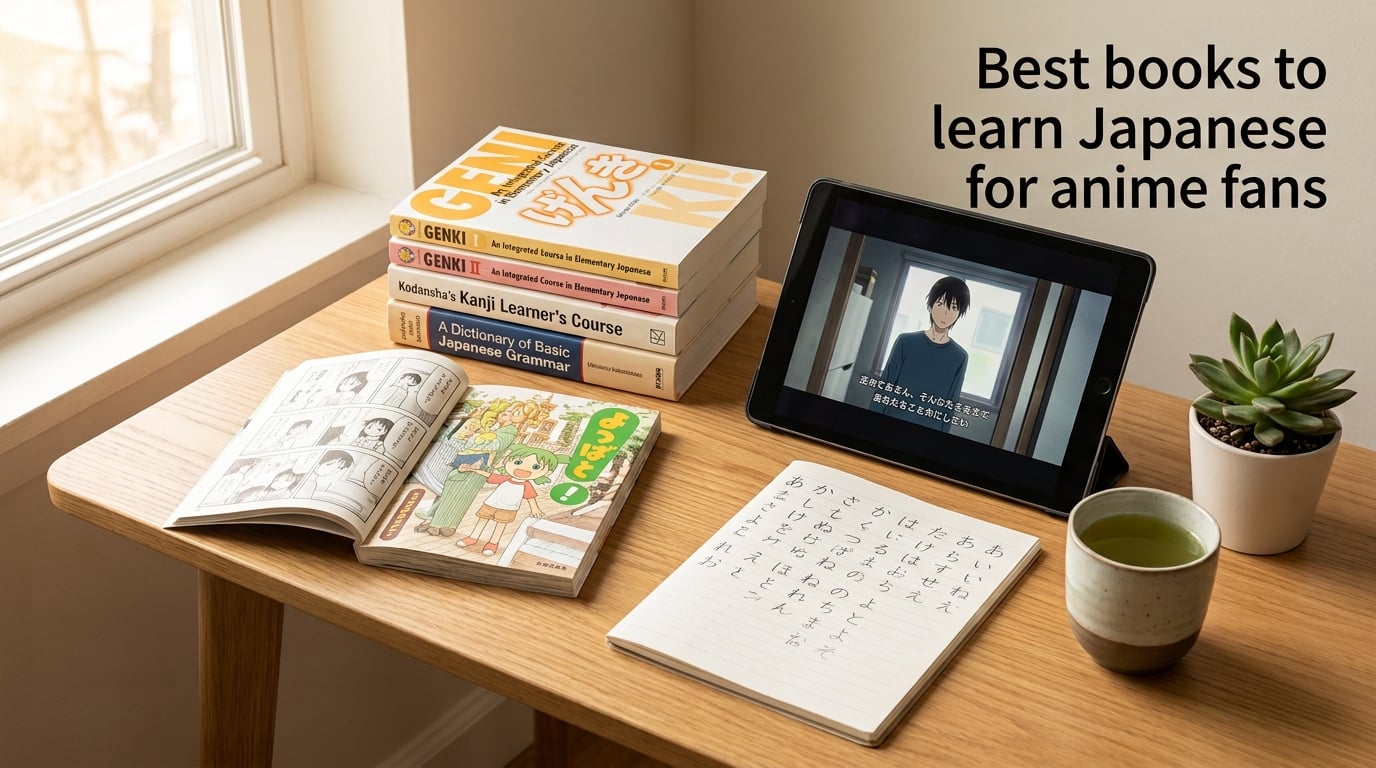
If you got into Japanese through anime and manga, you already have the strongest motivation engine a language learner can ask for. The catch is that anime alone will not teach you the language, no matter how many hours you put in. To actually read manga raw and watch anime without subs, you need a stack of well-chosen books that turn passive exposure into structured progress.
After spending months testing beginner and intermediate textbooks against real anime dialogue, our team put together this guide to the best books to learn Japanese for anime fans in 2026. It covers what to read first, what to pair it with, and how to use each book so that your favorite shows stop being background noise and start becoming a study tool.
Table of Contents
TL;DR: The Best Books to Learn Japanese for Anime Fans
- Genki I and II — the most widely used beginner Japanese textbook pair, ideal as your core curriculum.
- Minna no Nihongo — the Japanese-language classroom standard, best with a teacher or translation guide.
- Tae Kim’s Guide to Learning Japanese — a free online grammar reference that complements any textbook.
- Japanese from Zero — the most beginner-friendly self-study series, especially for visual learners.
- Tobira: Beginning Japanese — the standard bridge from beginner to intermediate.
- Kodansha Kanji Learner’s Course — the structured kanji curriculum that pairs with any textbook.
- A Dictionary of Basic Japanese Grammar — the long-term grammar reference every self-study learner reaches for.
Why Anime Fans Should Learn Japanese Differently
Anime fans who want to learn Japanese are not a generic beginner cohort. You already have hundreds of hours of native audio sitting in your watch history, an intuitive feel for sentence-final particles like ね and よ, and a clear end goal: read manga without flipping to the translation notes, play visual novels unpatched, and stop staring at subs.
The danger is treating anime as a study method by itself. Watching a show you love feels productive, but without a grammar spine and a vocabulary base you are essentially memorizing vibes. Most learners who skip textbooks and try to absorb Japanese purely from anime plateau around the 200-hour mark and stall there for years. That is the passive viewing trap the r/LearnJapanese community keeps warning about.
The flip side is that anime fans actually have an advantage most learners do not. You already know how Japanese is supposed to sound. You already recognize common set phrases, onomatopoeia, and casual contractions before you ever study them. The right book stack leans into that. Use textbooks for the grammar and kanji, and use anime to lock the patterns into muscle memory through massive listening input.
So when picking the best books to learn Japanese for anime fans, prioritize textbooks that expose you to natural-sounding dialogue, reference manga and pop culture where they can, and pair cleanly with a kanji-learning system. Skip the dry business-Japanese textbooks. Skip anything that treats reading as a chore. Below we walk through every layer of the stack.
The Japanese Writing System: What You Need to Learn First
Before opening any textbook, you need a working knowledge of the Japanese writing system. Japanese uses four scripts at once: hiragana, katakana, kanji, and romaji (Latin letters used as a stepping stone).
Hiragana is the 46-character cursive syllabary used for native Japanese words, grammatical particles, and verb conjugations. It is the first script every learner should master, and it takes most people one to two focused weeks.
Katakana is the angular syllabary used mainly for foreign loanwords, onomatopoeia, plant and animal names, and emphasis. Anime fans recognize katakana instantly because it is everywhere in titles, attack names, and character names. You can learn it alongside hiragana, in the same one-to-two-week window.
Kanji are the Chinese-derived logographic characters. The jōyō list contains 2,136 kanji for daily use, and the kyōiku list narrows that to 1,026 taught across Japanese schools. You do not need all of them to enjoy anime, but you need at least the first 300 to 500 to read manga without constant dictionary lookups. Plan on a structured kanji curriculum running in parallel with your textbook.
Romaji is just the romanization of Japanese sounds. It is fine for absolute beginners as a crutch, but you should transition off it within a few weeks, because real Japanese material almost never uses romaji. Train your ears and eyes on kana from day one.
The order to learn them is straightforward: hiragana first, katakana second, then begin kanji on a structured schedule. Most learners spend one week on each kana syllabary using a kana workbook or Anki deck, then start kanji the same week they start their main textbook.
How Long Does It Take to Learn Each Writing System?
For a fully focused beginner, hiragana and katakana together take about 10 to 14 days of 30-minute daily drills. Kanji is a much longer project. Reaching the 300-kanji level takes roughly 3 months of daily SRS practice. Reaching the 1,000-kanji level needed for most manga takes 12 to 18 months. The JLPT estimates roughly 325 hours of study for N5 and 950 hours for N4, and kanji density is the largest single factor in those hour counts.
Best Beginner Japanese Textbooks for Anime Fans
Beginner textbooks do the heavy lifting. They teach grammar in a logical order, expose you to high-frequency vocabulary, drill the writing systems, and give you dialogues close enough to natural speech that you start to hear them in anime within a few months. For anime-fan learners, the top picks are Genki, Minna no Nihongo, Japanese from Zero, and the free Tae Kim guide.
Genki I and II: The Community Consensus Pick
Genki is a two-volume beginner textbook series published by The Japan Times, with the third edition released in March 2020. It is the most widely used Japanese textbook in North American universities and the most recommended starting point on the r/LearnJapanese starter’s guide. Each volume covers 23 lessons on grammar, vocabulary, kanji, and reading, with companion workbooks and an audio companion delivered through OTO-Navi.
The dialogues in Genki are conversational, the cultural notes occasionally reference Japanese pop culture, and the lesson structure is clean enough to self-study from. For anime fans, the biggest plus is that Genki’s grammar points line up directly with patterns you hear constantly in slice-of-life and shonen anime. By the time you finish Genki II, you are sitting around JLPT N4 readiness, which is the level where casual anime comprehension begins to click.
Genki is not perfect. It is academic in tone, the dialogues are polite-formal rather than the casual speech anime fans actually want, and the audio companion ships separately from used copies. Pair it with a casual-speech resource if you want to bridge the politeness gap faster.
Minna no Nihongo: The Classroom Standard
Minna no Nihongo is the dominant beginner textbook in Japanese language schools in Japan. It is published by 3A Corporation and uses a translation-only approach: the main textbook is written entirely in Japanese, with a separate English translation and grammar notes volume.
For anime fans, the appeal is that Minna no Nihongo exposes you to Japanese-only reading from lesson one, which trains your brain to think in Japanese rather than translating back and forth. The dialogues lean slightly more varied than Genki’s, and the lesson progression is widely understood by tutors and conversation schools.
The big caveat is that Minna no Nihongo is genuinely difficult as a pure self-study resource. Without the translation volume you will be lost, and the audio companion is sold separately. If you can stretch to a tutor or a study partner, Minna no Nihongo rewards the effort. If you are flying solo, Genki is the safer pick.
Japanese from Zero: The Most Beginner-Friendly Self-Study Series
Japanese from Zero by George Trombley and Yukari Takenaka is a five-volume beginner series built specifically for English speakers with no prior Japanese. It uses romaji early and gradually phases it out, has a relaxed, friendly tone, and includes cultural notes that lean heavily into anime and pop culture references.
For absolute beginners who feel intimidated by Genki or Minna no Nihongo, Japanese from Zero is a real on-ramp. The pacing is gentle, the explanations are simple, and the first book alone carries you through hiragana, katakana, and basic grammar. Once you finish book 3, transitioning into Genki or another intermediate textbook is straightforward.
The trade-off is depth. Japanese from Zero does not cover as much grammar per volume as Genki, and the JLPT alignment is loose rather than explicit. Treat it as a confidence-builder and bridge, not as your terminal textbook.
Tae Kim’s Guide to Learning Japanese: The Best Free Reference
Tae Kim’s Guide to Learning Japanese is a free online grammar textbook hosted at guidetojapanese.org. It covers everything from basic particles to advanced sentence structures, with concise explanations and example sentences pulled from real Japanese.
For anime fans, Tae Kim is most useful as a companion reference, not as a standalone curriculum. Use it to look up grammar points you encounter in anime or manga, especially the casual contractions and sentence-final particles that textbooks tend to under-cover. The fact that it is free, well-organized, and searchable makes it a permanent bookmark for most self-study learners.
The honest critique is that Tae Kim lacks the drill exercises, audio, and vocabulary lists you need to actually internalize the grammar. Pair it with a textbook like Genki for structure and an SRS deck like Anki for vocabulary, and you have a complete low-cost stack.
Yookoso: An Invitation to Contemporary Japanese
Yookoso is a university-level beginner textbook used in many American programs. It has a slightly more communicative approach than Genki, with content-based chapters that touch on Japanese culture, geography, and contemporary life.
For anime fans, Yookoso’s appeal is the cultural framing. The chapters include cultural notes that touch on Japanese pop culture more often than Genki does. The drawback is that Yookoso is harder to find new, used copies often ship without audio, and the second edition has not been updated in over a decade. If you can get a complete set with audio, it is a fine alternative to Genki.
Best Intermediate Japanese Textbooks to Reach Anime Comprehension
Beginner textbooks get you to roughly JLPT N4. From there, intermediate textbooks push you through N3 and into the range where casual anime, manga, and light novels start to feel natural. The two main picks are Tobira and Quartet, with Authentic Japanese as a strong alternative.
Tobira: Beginning Japanese
Tobira is the standard bridge textbook from beginner to intermediate. It assumes you have completed Genki I and II (or equivalent) and walks you through 10 chapters of intermediate grammar, around 1,000 new vocabulary words, and roughly 300 new kanji.
For anime fans, Tobira is where the dialogues start to feel closer to the language you actually hear in anime. The reading passages include newspaper-style and essay-style content alongside conversational scenes, which exposes you to multiple registers at once. By the end of Tobira you are sitting at JLPT N3 readiness, which is the threshold where slice-of-life anime becomes genuinely watchable without subs.
The catch is the well-known Tobira wall. Lesson 7 onward jumps in difficulty, and most self-study learners need 6 to 12 months to complete the book. Pair Tobira with an SRS deck and a grammar dictionary, and you can push through.
Quartet: Intermediate Japanese
Quartet is a two-volume intermediate textbook series published by The Japan Times. It uses a content-based, task-based approach that emphasizes real communication over grammar drills. The dialogues and reading passages are noticeably more natural-sounding than Tobira’s, which makes Quartet especially attractive for anime fans who want exposure to actual speech patterns.
Quartet is a strong alternative if you find Tobira too dry, and it pairs well with Tobira’s grammar focus. The trade-off is that Quartet is less JLPT-aligned than Tobira, so if you have a specific JLPT target, Tobira is the safer pick.
Authentic Japanese
Authentic Japanese by Naoko Chino is a shorter intermediate reader that exposes you to real-world Japanese texts at progressive difficulty. Each chapter pairs short reading passages with grammar explanations and comprehension questions.
For anime fans, Authentic Japanese is a great supplementary reader rather than a main textbook. It exposes you to the kind of conversational Japanese and casual phrasing you hear in anime, and the reading passages are short enough to fit into a daily 20-minute practice.
Best Kanji Books and Study Systems for Anime and Manga Readers
Textbooks teach kanji gradually, but most learners need a dedicated kanji curriculum to reach the volume needed for manga. The two main textbook-based picks are Kodansha Kanji Learner’s Course and Remembering the Kanji, with WaniKani as the leading app-based alternative.
Kodansha Kanji Learner’s Course
Kodansha Kanji Learner’s Course (KLC) by Andrew Hensel et al. is a single 720-page volume that teaches 2,136 jōyō kanji in a structured order designed for English speakers. It teaches each kanji through mnemonic stories, vocabulary examples, and progressive exercises.
For anime fans, KLC is the strongest single kanji resource because it pairs each character with vocabulary you will actually encounter. The course is self-paced, structured, and integrates cleanly with a daily 20-minute SRS practice. Most learners aim to finish it in 12 to 18 months.
The honest critique is that KLC is heavy. The book is large, the readings are dense, and you will not finish it without a daily commitment. Pair it with an SRS app to lock retention.
Remembering the Kanji (RTK)
Remembering the Kanji by James Heisig is a three-volume series that teaches 2,200 kanji through mnemonic stories built around English keywords. Volume 1 covers all 2,200 kanji in a strict order designed for rapid recall.
RTK is famous for producing fast kanji recognition, but it does not teach readings or vocabulary, only how to write and recognize characters. For anime fans who care more about reading than writing, RTK is a useful foundation but must be paired with a separate vocabulary and readings curriculum. The standard follow-up is Kodansha’s KLC or an Anki Core 6K deck.
WaniKani and Anki: App-Based Kanji Systems
WaniKani is a web app that teaches kanji and vocabulary through SRS, paced over 12 to 18 months. It is the most popular app-based kanji curriculum for English-speaking anime fans. WaniKani pairs especially well with Genki and Tobira, since its vocabulary deck overlaps heavily with those textbooks.
Anki is a free, open-source SRS app that lets you build or download decks. The two most-used decks for anime-fan learners are the Core 2K (top 2,000 frequency words) and the Core 6K. Anki is more flexible than WaniKani but requires you to set up your own deck and daily routine.
How Many Kanji Do You Need to Read Manga?
For casual manga, you need around 300 to 500 kanji to read with frequent dictionary lookups. For comfortable reading of shonen and slice-of-life manga, aim for 1,000 kanji. For light novels and most visual novels, you need closer to 1,500 to 2,000 kanji. Plan your kanji curriculum to match your actual reading goal rather than chasing the full jōyō list.
Best Grammar Dictionaries and References for Self-Study
Grammar dictionaries are reference books you keep open next to your textbook for years. They explain grammar points in depth, give multiple example sentences, and let you look up patterns you encounter in anime rather than hunting through forum threads.
A Dictionary of Basic Japanese Grammar
A Dictionary of Basic Japanese Grammar by Seiichi Makino and Michio Tsutsui is the single most-recommended grammar reference for English-speaking learners. It covers hundreds of grammar points from beginner through early intermediate in alphabetical order, with English explanations, example sentences, and cross-references.
For anime fans, this is the book you reach for when a sentence in an anime does not parse with your textbook grammar. It is dense, but it is the kind of resource you can use for a decade without outgrowing it.
Intermediate and Advanced Companions
After you finish the basic volume, the same authors published A Dictionary of Intermediate Japanese Grammar and A Dictionary of Advanced Japanese Grammar. Together, the three cover most of what you will encounter in anime, manga, and light novels. The price tag is real, but these are buy-once-use-for-years references.
IMABI and Other Free References
IMABI is a free online Japanese grammar and vocabulary reference with deep explanations that go well beyond what a single textbook covers. It is especially strong on particles, counters, and the casual contractions anime fans encounter constantly. Pair it with Tae Kim as your free grammar reference stack.
How to Use These Books With Anime and Manga Practice
Buying the right books is half the work. The other half is integrating them into a study routine that uses anime and manga as deliberate input rather than background noise. Here is the workflow our team uses.
Step 1: Build a Daily Textbook + SRS Routine
Spend 30 to 45 minutes a day on your main textbook (one lesson per week is a healthy pace), 15 minutes on Anki or WaniKani, and 15 minutes on grammar dictionary reading. Do this 5 to 6 days a week. Consistency beats intensity here.
Step 2: Add Active Listening With Anime
Pick one episode of an anime you have already seen with subs. Watch it first without subs, noting words you cannot catch. Then watch it with Japanese subs on. Then watch the same scene with English subs on. The triple-pass method converts passive viewing into deliberate input. Even 10 minutes per day adds up fast.
Step 3: Add Manga Reading at Your Level
Once you have around 300 kanji, start reading manga in Japanese with a popup dictionary extension like Yomichan (now Yomitan) on a desktop browser, or on a tablet with an OCR reader. Read a few pages per day. Look up unknown words only when they appear three times in the same chapter.
Step 4: Write and Speak Weekly
Textbooks only build passive knowledge. To convert recognition into production, write a short journal entry in Japanese three times a week and post it for correction on a site like LangCorrect or r/LearnJapanese’s weekly submission thread. Speaking practice with iTalki tutors or a study partner accelerates this further.
What Anime Cannot Do For You
Anime cannot teach you grammar explicitly. It cannot teach you kanji readings in a structured order. It cannot give you production practice. Treat anime as your reward and your input engine, not as your teacher. The textbook does the teaching. Anime does the locking-in.
Best Manga to Read as a Beginner Japanese Learner
Not all manga is beginner-friendly. Avoid anything with dense kanji, archaic grammar, or heavy visual-novel-style narration. Start with manga specifically recommended by the r/LearnJapanese community for low difficulty and high natural-frequency vocabulary.
- Yotsuba&! — slice-of-life comedy by Kiyohiko Azuma. Simple vocabulary, short sentences, and tons of everyday phrases. The single most recommended first manga.
- Shirokuma Cafe — slice-of-life comedy centered on a polar bear cafe. Conversational dialogue, simple grammar, and recurring characters make vocabulary stick.
- Chi’s Sweet Home — a heartwarming cat manga aimed at children. Tiny vocabulary list, repetitive phrases, and kanji with furigana throughout.
- Pokemon Adventures — the long-running Pokemon manga by Hidenori Kusaka. Repetitive phrasing, plenty of action, and widely available in Japanese.
- Shinkomi (新米姉妹のふだんごはん) — modern slice-of-life cooking manga with everyday vocabulary and clear dialogue.
All of these ship with furigana (small kana above kanji), so you can read them from your first kanji lesson onward. Move to higher-difficulty manga (Slam Dunk, Naruto, Hikaru no Go) only once you have 800 to 1,000 kanji and a few hundred vocabulary words under your belt.
Quick Comparison: Top Books at a Glance
The table below summarizes where each book fits in your stack. Use it to choose your core textbook first, then layer in the rest.
| Book | JLPT Level | Approach | Audio Included | Anime Relevance |
|---|---|---|---|---|
| Genki I and II | N5 to N4 | Grammar + dialogue, university standard | Yes (OTO-Navi) | High — covers dialogue patterns used in anime |
| Minna no Nihongo | N5 to N4 | Japanese-only textbook, translation guide separate | Yes (CD sold separately) | High — natural-sounding dialogues |
| Japanese from Zero | N5 | Visual, romaji-then-kana, gentle pacing | Yes (download) | Medium — pop-culture references, light dialogue |
| Tae Kim’s Guide | N5 to N3 | Free online grammar reference | No | High — strong on casual particles |
| Tobira | N4 to N3 | Intermediate grammar + reading | Yes (download) | High — registers beyond polite form |
| Quartet I and II | N4 to N3 | Task-based, communicative | Yes (download) | High — natural-sounding dialogues |
| Kodansha KLC | N5 to N1 | Single-volume kanji curriculum | No | Very high — manga-ready vocabulary |
| Remembering the Kanji | N/A (recognition only) | Mnemonic kanji stories | No | Medium — recognition only, no readings |
| A Dictionary of Basic Japanese Grammar | N5 to N4 | Alphabetical grammar reference | No | Very high — covers anime grammar patterns |
| Yookoso | N5 to N4 | Content-based beginner textbook | Yes (CD often missing used) | Medium — cultural notes on Japan |
Sample Study Schedule: 6, 12, and 24-Month Paths
Realistic timelines matter more than optimistic ones. The JLPT estimates 325 hours of study for N5 and 950 hours for N4. At 1 hour per day, that is roughly 11 months to N4 and 32 months to N3. Here are sample schedules tailored for anime-fan learners.
6-Month Plan: Build the Foundation
Learn hiragana and katakana in weeks 1 and 2. Start Japanese from Zero or Genki I from week 3. Add Anki Core 2K from week 4. Begin Kodansha KLC at 5 kanji per day from month 2. By month 6 you should be 60 percent through Genki I, sitting on around 300 kanji, and starting to recognize common anime phrases.
12-Month Plan: Reach Genki II Completion
Continue Genki I to lesson 12 in months 1 to 6. Move into Genki II in months 7 to 12. Push KLC to 1,000 kanji. Start daily active listening with anime and weekly manga reading. By month 12 you should be sitting around JLPT N5 readiness with 600 to 800 kanji.
24-Month Plan: Reach Anime Comprehension
Complete Genki II by month 12. Move into Tobira in months 13 to 18. Push KLC to 1,800 kanji. Start raw manga reading of slice-of-life titles. By month 24 you should be sitting around JLPT N4 readiness, watching most slice-of-life anime without English subs, and reading beginner manga with only light dictionary use.
Frequently Asked Questions
What is the best Japanese textbook for beginners who watch anime?
Genki I and II is the most recommended beginner textbook for anime fans, because it covers the grammar, vocabulary, and kanji you need to reach JLPT N4 in a structured way and pairs cleanly with active anime listening practice.
Can you learn Japanese just from watching anime?
No. Anime alone teaches you how Japanese sounds, but it does not explain grammar, kanji readings, or production. Most learners who rely solely on anime plateau after roughly 200 hours of input. Pair anime with a textbook and an SRS vocabulary deck for real progress.
Should I learn hiragana or katakana first?
Learn hiragana first, since it is used for native Japanese words, grammatical particles, and verb conjugations. Learn katakana immediately after, in the same 1 to 2 week window, since it covers loanwords, onomatopoeia, and many character names you will see in anime.
Is Genki good for learning Japanese?
Yes. Genki is the most widely used beginner Japanese textbook in North American universities and the most recommended starting point on the r/LearnJapanese starter’s guide. Its dialogues, grammar progression, and JLPT N5 to N4 alignment make it a strong core textbook for self-study.
How long does it take to learn Japanese from anime?
Reaching casual anime comprehension with textbook support typically takes 18 to 24 months at 1 hour of study per day, including active anime listening. The JLPT estimates roughly 950 hours of study for N4, which is the threshold where most slice-of-life anime becomes watchable without subs.
Is Minna no Nihongo better than Genki?
Both are strong beginner textbooks. Minna no Nihongo is written entirely in Japanese and is best with a teacher or translation guide, while Genki is more beginner-friendly for solo self-study because it explains grammar in English throughout.
What is the easiest way to learn Japanese for anime fans?
Combine Genki I and II as your core textbook, Anki Core 2K for vocabulary, Kodansha Kanji Learner’s Course for kanji, and 15 minutes of active anime listening per day. This stack covers grammar, vocabulary, kanji, and listening in a single self-study routine.
Are manga and anime a good way to learn Japanese?
Manga and anime are excellent input once you have a beginner textbook base. They expose you to natural dialogue, casual contractions, and sentence-final particles that textbooks under-cover, which makes them a strong supplement rather than a primary method.
What order should I learn Japanese writing systems?
Learn hiragana first, katakana second, then begin kanji on a structured schedule alongside your main textbook. Most learners finish both kana syllabaries in 1 to 2 weeks and reach 300 kanji within 3 months of daily SRS practice.
How many kanji do I need to know to read manga?
Around 300 to 500 kanji lets you read manga with frequent dictionary lookups, while 1,000 kanji gives comfortable reading of most shonen and slice-of-life titles. Light novels and visual novels typically require 1,500 to 2,000 kanji for fluent reading.
Final Verdict: Building a Book Stack That Works for Anime Fans
The best books to learn Japanese for anime fans are not the most academic or the most comprehensive. They are the ones that turn your existing motivation into measurable progress. Start with Genki I and II as your core textbook, add Kodansha Kanji Learner’s Course for kanji, keep A Dictionary of Basic Japanese Grammar on your desk as a permanent reference, and use anime as your daily listening input rather than your teacher.
Pick up your first book today, schedule your first 30-minute study block, and bookmark this guide. Every chapter you finish is another 50 to 100 words you will recognize the next time you press play on your favorite show. Six months from now you will be surprised how much of the dialogue you can already catch.