
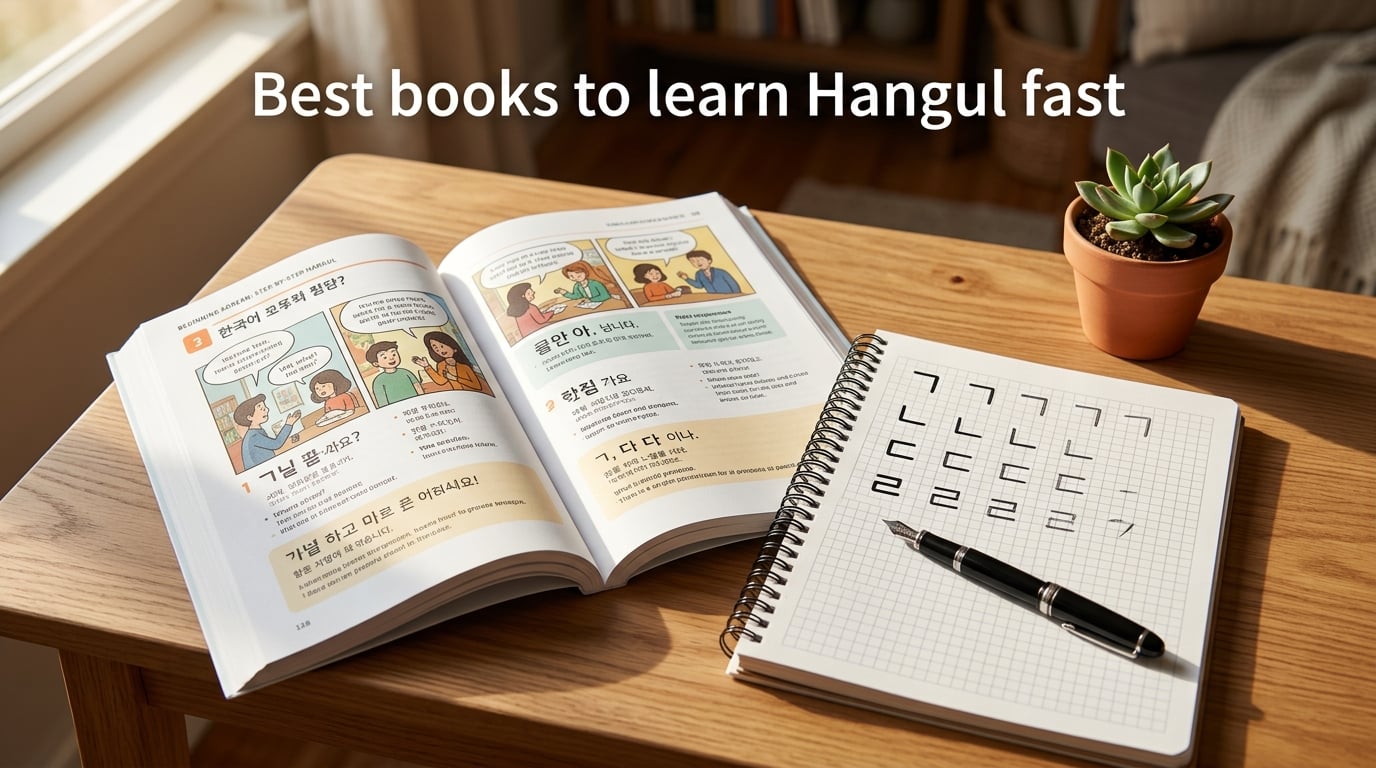
Most beginners can learn to read Hangul in 1 to 7 days with the right book and 30 minutes of daily practice. The Korean alphabet has just 24 letters, no tones, and a logical shape-sound mapping, which is why learners on r/Korean report reaching 80 percent reading fluency in under a month.
If you want to skip romanization and read signs, lyrics, and textbooks for real, here is the roundup of the best books to learn Hangul fast, plus a 7-day study plan that pairs any of them with a free flashcard app.
We focused on Hangul-specific workbooks and beginner textbooks that teach the alphabet in the first chapters. Each pick below includes stroke order guidance, audio companions, and enough practice pages to lock the letters into muscle memory.
Table of Contents
Best Books to Learn Hangul Fast
The fastest way to learn Hangul is to use a Hangul-focused writing workbook with stroke order diagrams and at least 30 practice pages, paired with a free flashcard app like Anki for 15-30 minutes a day. Most learners can recognize all 24 letters within a week and read simple syllable blocks within two weeks.
Books beat apps for Hangul because writing the letters by hand builds the muscle memory that anchors recognition later. Apps are best used as a supplement, not a replacement. The picks below cover writing-focused workbooks, beginner textbooks that teach Hangul first, and self-study guides built for adults.
What Is Hangul and Why It’s Learnable in Days
Hangul is the alphabetic writing system used to write the Korean language. It was created in the 15th century under King Sejong the Great and consists of 14 basic consonants plus 10 basic vowels that combine into square syllabic blocks.
Each block represents one syllable and is read left to right, then top to bottom inside the block. A block can have 2 or 3 letters, and the shape of each consonant mimics the shape of the mouth or tongue used to pronounce it. That phonetic design is why linguists call Hangul one of the most logical writing systems ever created.
Because every letter maps to exactly one sound, there are no silent letters, no tones, and no spelling exceptions to memorize. This is the foundation that makes “fast” possible with a good book.
Key Hangul facts to remember:
- 24 basic letters: 14 consonants and 10 vowels
- 5 double consonants and 11 compound vowels expand the set for advanced reading
- Each syllable is written as one square block, not a string of letters
- Stroke order matters because the block layout depends on it
Many learners confuse Hangul with the Korean language itself. Hangul is the script; Korean is the language you write in it. Think of it like the Latin alphabet versus English: learning Hangul is the same kind of unlock that learning the Latin alphabet is for English.
How Long Does It Really Take to Learn Hangul?
Real learner timelines from r/Korean and r/LTL_Korean show a consistent pattern. With a focused book and daily practice, you can recognize all 24 basic letters in 1 to 3 days, read simple syllable blocks in 5 to 7 days, and reach comfortable reading speed for non-fiction in 3 to 4 weeks.
Here is the breakdown most self-study guides skip:
Day 1 to 2 – Recognize the letters. Most learners cover the 10 basic vowels and 14 basic consonants in two focused sessions. One r/Korean user reported learning all 24 in 2 hours using Anki alone, though writing them by hand takes longer.
Day 3 to 5 – Combine letters into syllables. This is where beginners stall. A syllable block like 한 looks like one shape, but it is actually 3 letters. Practice pages inside a writing workbook are what make this click.
Day 6 to 7 – Read simple words. By the end of week one, you should be able to read Hangul aloud even if you do not know what the words mean. That is the real “I learned Hangul” milestone.
Week 2 to 4 – Build reading speed. Expect each syllable to take 2 to 5 seconds at first. By week four, you should be reading simple signs, menu items, and song lyrics at conversational speed.
Month 2 to 3 – Break the romanization habit. Many learners keep mentally translating Hangul to roman letters for months. Conscious practice without romanization is the only way through this phase.
What Makes a Good Book for Learning Hangul Fast
A Hangul book built for speed has five features that separate it from generic Korean textbooks. Use this checklist before you buy anything.
1. Stroke order diagrams for every letter. The shape of a syllable block depends on correct stroke order. Books without diagrams force you to guess, and bad habits are hard to break.
2. At least 30 practice pages. Writing each letter 50 times by hand is the most reliable way to lock recognition. Anything under 30 practice pages is a reference, not a workbook.
3. Audio files for pronunciation. Hangul letters map to one sound each, but Korean sounds like ㄱ (g/k) and ㄷ (d/t) are easy to mix up. Native-speaker audio is non-negotiable.
4. Progression from letters to words within 20 pages. A good Hangul book gets you reading real syllable blocks fast. If a book spends 80 pages on vowels alone, it is not built for speed.
5. An answer key. Self-study without an answer key means you cannot tell if you wrote batchim (final consonants) correctly. Always check for an included key or free PDF download.
Bonus features include flashcards, cultural notes, and Anki-compatible QR codes. Nice to have, but the five above are the baseline.
Top Books for Learning Hangul Fast
Here are eight books that meet the criteria above. We grouped them by use case so you can pick based on your goal.
Korean Alphabet with Writing Workbook (Chul Soo Kim)
The most direct Hangul-focused book on this list. It devotes its first 40 pages to the alphabet with stroke order, practice grids, and audio downloads. The remaining pages cover syllables, basic vocabulary, and short reading passages.
It is the closest thing to a “learn Hangul in a week” book in print. The pace is fast, the format is clean, and the answer key is included. Best for absolute beginners who want a writing-first approach.
Korean From Zero! (George and Seungyeon Hage)
Korean From Zero teaches Hangul in the first three chapters before moving into vocabulary and conversation. The free YouTube lessons and online audio make it a strong self-study pick.
The tone is conversational and adult-friendly, which helps adult learners who find children’s textbooks patronizing. The hangul section covers stroke order and includes handwritten practice prompts. Best for self-study adults who want one book to cover Hangul plus early conversation.
Korean Made Simple (Billy Go)
A popular beginner textbook that opens with a Hangul primer in chapter one. The grammar explanations are clear, the cultural notes are warm, and the audio is free.
Billy Go writes in plain English and avoids academic jargon, which is exactly what most adult learners need. The Hangul section is not as deep as a dedicated workbook, but if you want one book that takes you from zero to mid-beginner, this is a strong choice. Best for adult self-study from zero to TOPIK I level.
Talk To Me In Korean Level 1
TTMIK is the most widely recommended Korean course among r/Korean learners. The Level 1 textbook starts with Hangul pronunciation and gets you reading simple sentences within the first five lessons.
Note that TTMIK is not a Hangul-focused book. It uses romanization in early lessons to ease beginners in, then phases it out. Pair it with a Hangul-only workbook if your goal is pure alphabet speed. Best for learners who want a full beginner course with a strong podcast and video library.
Korean Stories for Language Learners (Julie Damron)
Once you know Hangul, this book is the best way to build reading speed. It pairs 60 short Korean stories with English summaries and vocabulary notes, graded by difficulty.
This is not a Hangul-teaching book, but it is the natural next step. If you already know the alphabet and want to push reading speed in 30 days, this is the one we recommend most. Best for reading-speed practice after finishing a Hangul workbook.
Hangul Writing Practice Workbook (Mochi Publishing)
A no-frills Hangul-only practice book. It covers all 24 basic letters plus double consonants and compound vowels with stroke order, dotted-line tracing, and blank practice grids.
There is no grammar, no vocabulary, and no cultural content. That is the point. If you want pure muscle-memory practice for the alphabet, this is the most affordable option. Best as a supplement to a textbook or audio course.
Let’s Speak Korean (TalkToMeInKorean)
A standalone beginner book from the TTMIK team, designed for learners who want more reading practice than the Level 1 textbook provides. It includes Hangul charts, key sentence patterns, and audio.
It is more reading-focused than the main TTMIK textbook, which makes it useful as a Hangul reinforcement tool once you finish the alphabet. Best for learners already using TTMIK courses who want extra Hangul drills.
Read and Speak Korean for Beginners (Living Language)
A four-skill book that opens with a Hangul primer and moves into vocabulary, grammar, and short dialogues. The audio is downloadable and the layout is clean.
It is less Hangul-intensive than a dedicated workbook but better integrated than most general Korean textbooks. Best for learners who want print + audio + a structured curriculum in one package.
How to Use a Book to Learn Hangul in a Week
This 7-day plan works with any Hangul-focused book from the list above. The book is your primary tool, and Anki is your reinforcement tool. Both are free or near-free.
Day 1 – Vowels only. Cover the 10 basic vowels. Write each one 20 times by hand. Add them to Anki as flash cards. Spend 20 minutes on pronunciation using the book’s audio.
Day 2 – Basic consonants. Cover the 14 basic consonants. Same routine: write each 20 times, add to Anki, drill with audio. By the end of day 2, you should know all 24 letters.
Day 3 – Syllable blocks. Practice combining one consonant and one vowel into a 2-letter block. Korean Made Simple and Korean From Zero both have dedicated practice pages for this. Spend 30 minutes on Anki review.
Day 4 – Syllables with final consonants (batchim). This is where beginners slow down. Follow your book’s stroke order rules and write at least 30 example blocks by hand.
Day 5 – Read your first real words. Open any beginner chapter in your book and try to read the Korean words aloud before looking at the romanization. Compare your pronunciation to the audio.
Day 6 – Read simple sentences. Work through 10 to 15 sentences from your book without romanization. Look up only the words you do not know.
Day 7 – Read a short story or song lyrics. Korean Stories for Language Learners is the perfect follow-up here. Read one short story slowly, then again at natural pace.
After day 7, your daily maintenance should be 15 minutes of Anki review plus one short Korean text. This is the routine that separates learners who retain Hangul from those who forget it within a month.
Apps vs Books for Hangul: Complementary, Not Competitive
Apps like Duolingo, LingoDeer, and Anki are excellent Hangul tools, but they do not replace a book. Here is the honest breakdown.
Books win at writing. No app teaches stroke order as well as a physical workbook. Writing the letters by hand is what cements recognition for most adults.
Apps win at spaced repetition. Anki is free and uses a learning algorithm that books cannot match. Pair any book on this list with the free Anki Hangul deck and your retention will be higher than book alone.
Duolingo and LingoDeer are supplements. They teach Hangul through gamified repetition, which works for some learners. They are not substitutes for a writing workbook because they do not build muscle memory.
The fastest learners use a book for writing, Anki for review, and one app (Duolingo or LingoDeer) for extra pronunciation practice. That is the combination our team has seen produce consistent 7-day Hangul results.
Common Beginner Mistakes When Learning Hangul From a Book
Most beginners who fail to learn Hangul fast make one of these five mistakes. Avoid them and you will save weeks.
1. Skipping stroke order. Letters look similar until you write them in the right order. The shape of a syllable block depends on it.
2. Romanization dependence. If your book offers romanization, cover it with a sticky note. Reading romanization is not reading Hangul.
3. Memorizing letter names instead of sounds. Korean letters do not have separate names and sounds like English letters do. Learn the sound first.
4. Skipping audio. Letters like ㄱ (g/k) and ㄲ (kk) sound different in ways the book cannot show. Always use audio.
5. Not reviewing after day 7. Many learners abandon Hangul after the first week and forget it within a month. Daily Anki review for 15 minutes is the only insurance.
Free Resources and Hangul E-books Worth Knowing About
If you want a free start before buying a book, these three resources come up consistently in r/Korean and r/LTL_Korean threads.
Sogang Korean free PDF. Sogang University publishes a free PDF of its beginner Korean textbook. The Hangul section is short but the rest of the book is university-quality material at zero cost.
TalkToMeInKorean free lessons. TTMIK’s YouTube channel and podcast cover Hangul pronunciation in the first 10 lessons, all free.
TTMIK Hangul master book (free PDF). A short Hangul-focused PDF available from the TTMIK website. Not as deep as a paid workbook, but a solid primer.
Anki Hangul deck. The free Anki app has community-built Hangul decks with audio. Search for “Korean Hangul” in the Anki shared decks.
Free resources can get you to a basic reading level. A paid book is the better investment once you are committed to writing practice and longer study.
Frequently Asked Questions
What is the fastest way to learn to read Hangul?
The fastest way to learn Hangul is to use a Hangul-focused writing workbook with stroke order diagrams and audio, paired with the free Anki app for 15 to 30 minutes a day. Most beginners recognize all 24 basic letters within one to three days and read simple syllable blocks within a week.
How long does it take to learn Hangul from scratch?
Most learners can recognize all 24 letters in 1 to 3 days, read simple syllable blocks in 5 to 7 days, and reach comfortable reading speed for signs and simple texts in 3 to 4 weeks. Reaching 80 percent reading fluency for non-fiction typically takes 4 to 8 weeks with daily practice.
Can you learn Hangul in a week?
Yes. With a Hangul-specific workbook, audio, and 30 minutes of daily practice, you can recognize all 24 letters in a week and read simple words aloud by day 7. Reading speed and full fluency take longer, but the core alphabet is learnable in seven days.
What is the best book to learn Hangul?
The Korean Alphabet with Writing Workbook by Chul Soo Kim is the most direct Hangul-focused book for absolute beginners. For learners who want one book that covers Hangul plus early conversation, Korean From Zero and Korean Made Simple are the strongest self-study picks.
Do I need to learn Hangul before learning Korean?
Yes. Every Korean textbook, app, sign, and song assumes you can read Hangul. Learning the alphabet first removes the romanization crutch and makes every later study method faster, including apps, classes, and media immersion.
Is there a free e-book teaching Hangul?
Yes. Sogang University publishes a free PDF beginner textbook, TTMIK offers free Hangul lessons on YouTube and a short Hangul PDF, and the Anki app has free shared Hangul decks with audio. Free resources can take you to a basic reading level, but a paid workbook is the better investment for writing practice.
What is the difference between Hangul and Korean?
Hangul is the alphabetic writing system used to write the Korean language. Korean is the language itself. Learning Hangul is the same kind of unlock that learning the Latin alphabet is for English: it is the script, not the language, but it is required to read anything in Korean.
How can I read Hangul faster?
Build reading speed with graded readers like Korean Stories for Language Learners, do 15 minutes of Anki review daily to keep the letters automatic, and practice reading real-world Hangul like signs, menus, and song lyrics without romanization. Expect each syllable to take 2 to 5 seconds at first, dropping to under a second by month two.
Conclusion
The best books to learn Hangul fast share one trait: they get you writing the letters by hand within the first ten pages. Start with the Korean Alphabet with Writing Workbook if your goal is pure alphabet speed. Pick Korean From Zero or Korean Made Simple if you want one book to take you from zero into early conversation.
Pair any of them with the free Anki app for 15 to 30 minutes a day, follow the 7-day study plan above, and you will be reading simple Hangul by the end of the week. Once you can read, the rest of Korean – grammar, vocabulary, media immersion – opens up. Hangul is the unlock, and a good book is the fastest way to get there.