
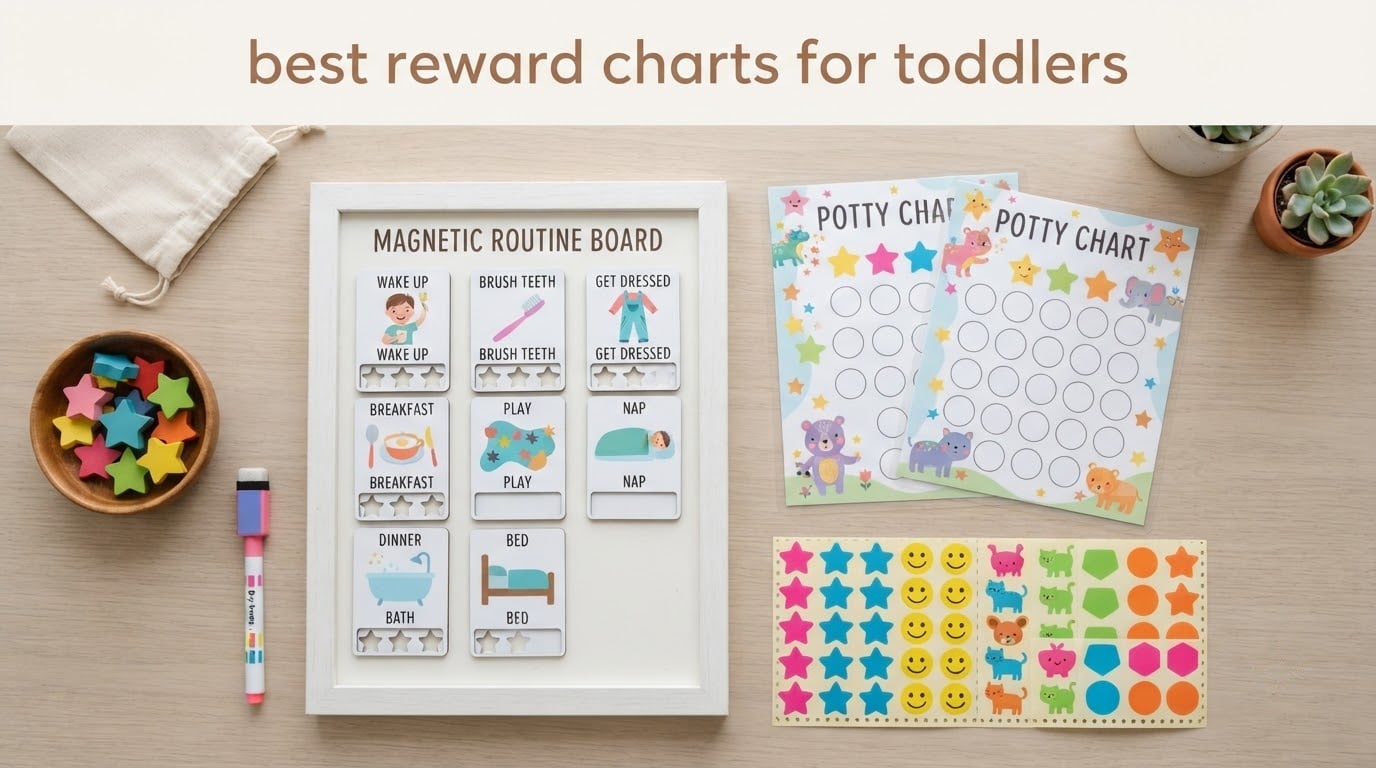
A magnetic, wipe-clean reward chart is the best reward chart for toddlers because it can be reset every night, moved between the fridge and the bathroom door, and reused for the next routine without printing anything new. Paper sticker charts still work well for potty training, but the reusable boards are the ones that survive past week three.
We looked at ten of the highest-rated reward charts for toddlers on the market, checked what actually ships in the box, and read the reviews closely for the complaints nobody puts on the front of the listing. The category is thinner than it looks: most charts are aimed at children aged three and up, and only one format combination holds up for a real household routine.
This guide covers the ten picks we trust, the honest age floor for charts, what to actually put on the rows, and what to do when your toddler walks past the chart like it is not there. We updated every pick for 2026.
Table of Contents
Top 3 Best Reward Charts for Toddlers (October 2026)

Melissa and Doug Mickey Magnetic Board
- Wood-framed double-sided magnetic board
- 90 wooden magnets
- 15.5 by 11.5 inch board
- Ages 3 plus

Kenson Kids 45 Star Reward Chart
- 45 reusable 3D stars
- 20 interchangeable task cards
- Hook-and-loop fastening
- Ages 3 to 10

Cozy Greens Dinosaur Potty Chart
- 194 stickers
- Two crowns and a certificate
- Instruction cards
- Erasable pen included
All 10 Best Reward Charts for Toddlers Compared in 2026
Every pick below appears in this table with its format, what it includes, and the routine it suits best. The two magnetic boards lead because they reset instantly. The four paper charts lead on sticker volume and on price per week of use.
| Product | Specs | Action |
|---|---|---|
| Melissa and Doug Disney Mickey Magnetic Responsibility Chart |
|
Check Latest Price |
| Kenson Kids I Can Do It Chart with 45 Stars |
|
Check Latest Price |
| Cozy Greens Dinosaur Potty Training Chart |
|
Check Latest Price |
 PUTSKA Laminated Potty Chart with 35 Stickers PUTSKA Laminated Potty Chart with 35 Stickers |
|
Check Latest Price |
 Paper Projects Peppa Pig Potty Chart Paper Projects Peppa Pig Potty Chart |
|
Check Latest Price |
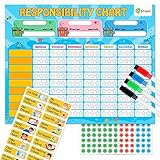 D-FantiX Magnetic Dry Erase Responsibility Chart D-FantiX Magnetic Dry Erase Responsibility Chart |
|
Check Latest Price |
 Kenson Kids I Can Do It Token Board Kenson Kids I Can Do It Token Board |
|
Check Latest Price |
 inamio Magnetic Responsibility Chart with 3D Stars inamio Magnetic Responsibility Chart with 3D Stars |
|
Check Latest Price |
 Hadley Designs 10 Potty Training Charts Hadley Designs 10 Potty Training Charts |
|
Check Latest Price |
 PUTSKA 26 Board Sticker and Reward System PUTSKA 26 Board Sticker and Reward System |
|
Check Latest Price |
Do Sticker Charts Work for 2-Year-Olds?
Sometimes, but less reliably than most charts promise. A two-year-old understands an immediate consequence far better than a delayed one, and a chart asks them to hold a goal in mind across a whole day. On a two-year-old, tracking a single act, such as sitting on the potty, works better than tracking a full day of rows.
Under three, the interest in the chart itself matters more than the behavior it tracks. Parents on Reddit forums like r/Parenting and r/toddlers describe children who could not care less about reward charts, stickers, and checklists, and those are the families where a chart makes resistance worse rather than better. If your child ignores the board, the problem is rarely the board.
One safety note before you hang anything up. Many of the boards below use small wooden or plastic magnets, which are a genuine choking risk for children under three, and the wet-wipe and marker components are not toys either. Hang any magnetic board well above head height, keep the magnets out of reach, and never let a toddler under three handle loose reward pieces unsupervised.
If you are starting at two, pick the simplest option on this list and give it two weeks. If the interest is there, keep going. If it is not, move to immediate verbal praise and try again around three.
1. Melissa & Doug Disney Mickey Magnetic Responsibility Chart – Our Pick for Most Toddlers
Melissa & Doug Disney Mickey Mouse Clubhouse My Magnetic Responsibility Chart – Toddler Routine, Kids Reward Board, Reward Chart for Toddlers and Kids Ages 3+
Wood-framed double-sided magnetic board
90 wooden magnets
15.5 by 11.5 inch board
Ages 3 plus
Pros
- Wood-framed board feels durable and premium
- 90 magnets give a wide range of task and reward options
- Disney artwork makes routine tracking feel like play
- Double-sided so one side can be reset while the other is in use
Cons
- Wooden magnets are a choking hazard for very young children
- Fixed task layout leaves little room for custom goals
- Small board for tracking several weeks at once
This is the chart we hand to a family with a three-year-old and one routine they want to fix. The board is framed in wood rather than thin plastic, and it is double-sided, which means the morning routine can live on one face while bedtime lives on the other. That single design decision is why it keeps working after the novelty fades.
Ninety magnets is a lot of pieces in a small box, and that turns out to be an advantage rather than a problem. You can build rows for shoes on, breakfast finished, and toys in the basket without stretching one row to cover three jobs. Reviewers report the same thing, describing tooth-brushing and getting-dressed routines that started sticking within weeks.
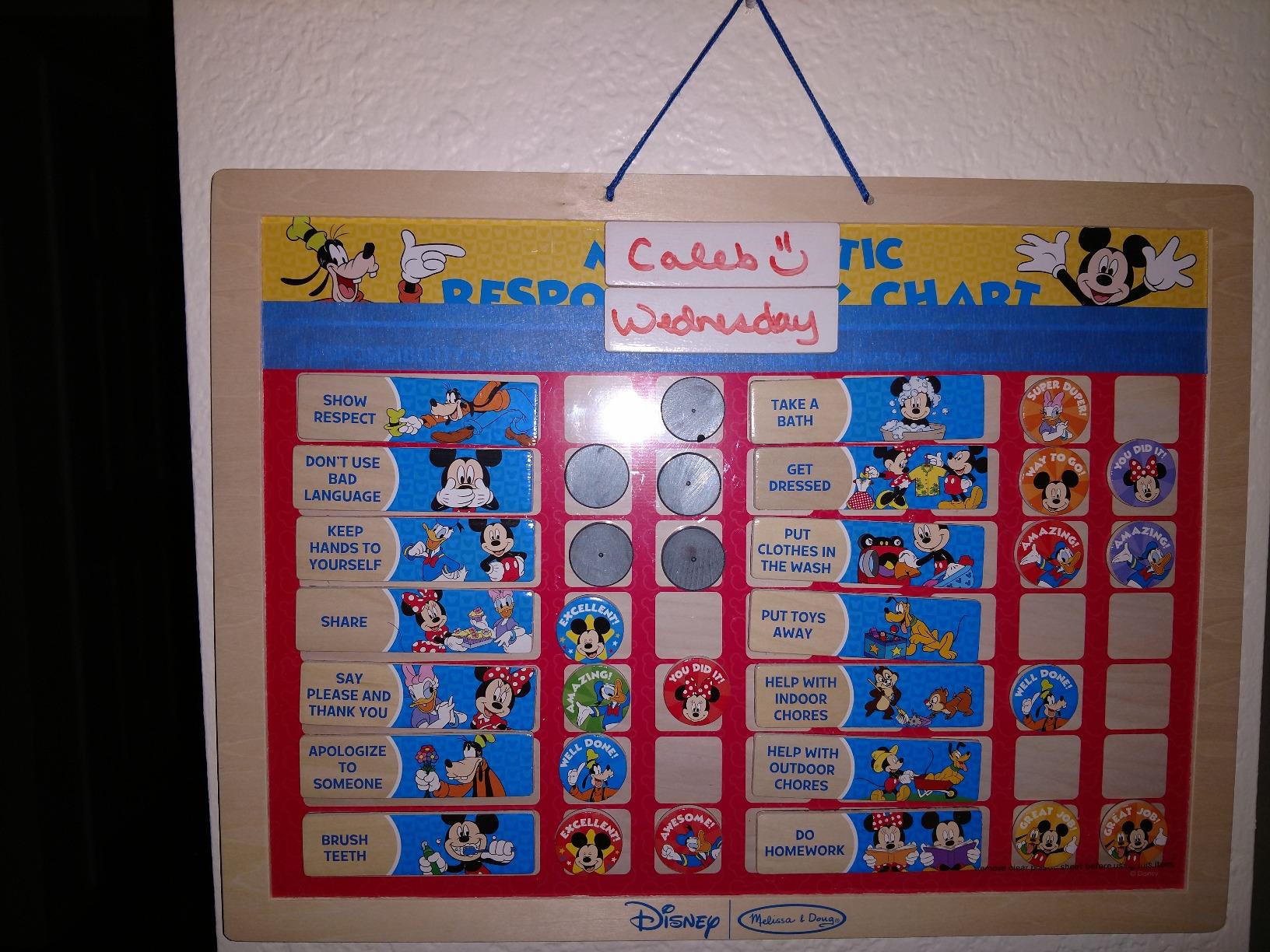
The board measures 15.5 by 11.5 inches, which is big enough to read from across a kitchen and small enough to not take over a wall. The magnets are chunky wood pieces, so a toddler with developing pincer grip can actually place one without adult help, which matters more than it sounds. A row the child cannot fill is a row the child walks past.
The main limitation is that the task layout is fixed. You get what the manufacturer printed, and if you want to track something like handwashing before meals rather than one of the built-in rows, you are improvising. The double-sided design also means you have to flip the whole board over to reset, so some families keep a second set of magnets in the other position to avoid the daily flip.
Who this chart suits
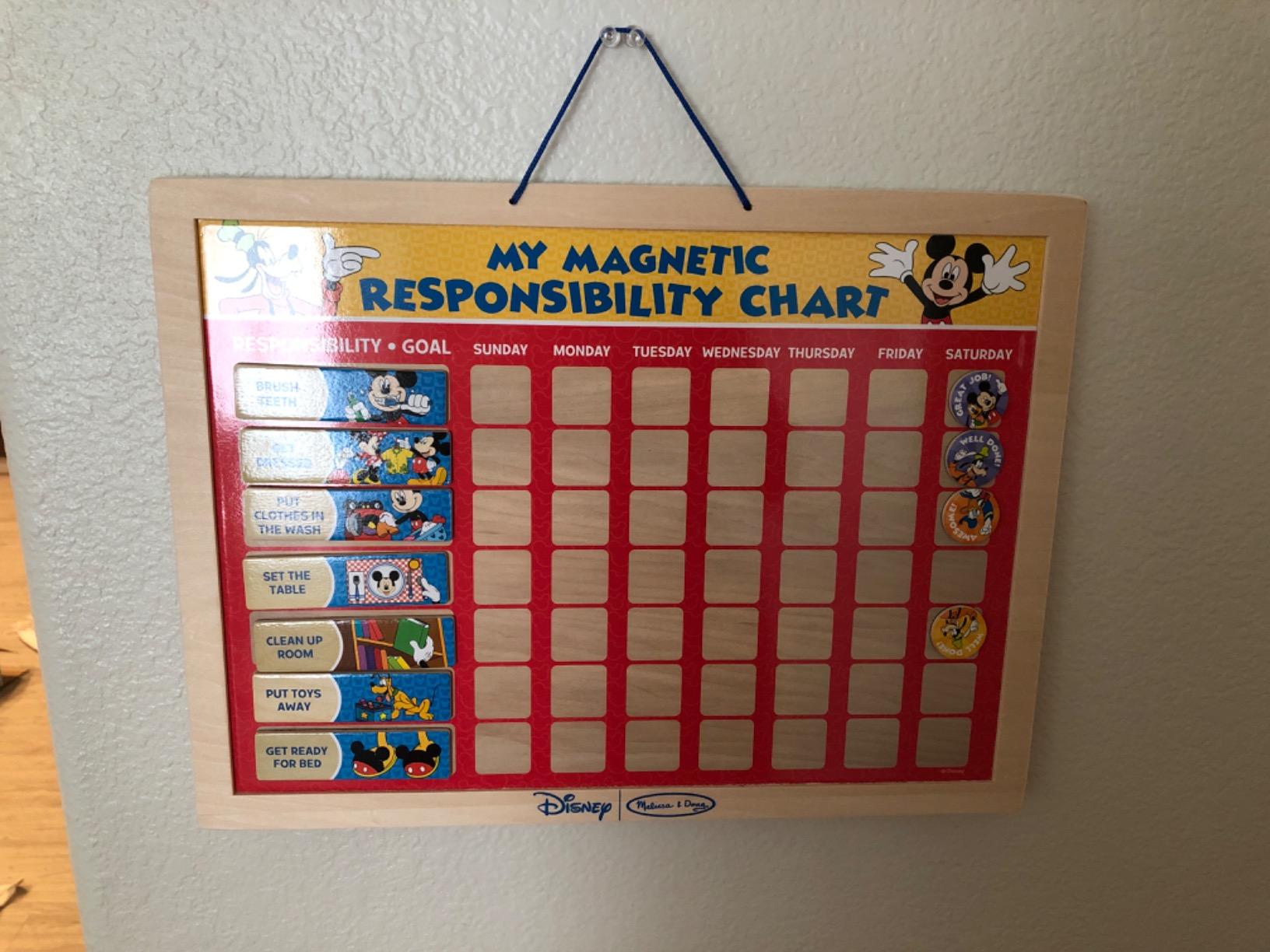
It suits a household that wants one board to run two or three routines at a time, and a child who responds to a familiar character rather than to a plain grid. Parents using it for morning and bedtime tasks report that the character artwork makes the tracking feel like play rather than a chore, which is the single biggest predictor of whether a chart gets used.
It also suits anyone who has already tried a laminated paper chart and watched it curl at the corners within a week. Nothing here needs laminating, and nothing needs replacing when the stickers run out.
Who should skip it
Skip it if you have a child under three who mouths small objects, because the wooden magnets are the size that triggers the choking rule. Also skip it if you need a fully custom chart, since the task rows cannot be rewritten and the board is smaller than the dedicated chore boards in this roundup.
If your toddler is the type who grabs a magnet and puts it in her pocket instead of on the board, wait. A board with pictures but no loose pieces is a better first attempt at that age.
2. Kenson Kids I Can Do It Chart with 45 Reusable Stars – Best Value Pick
Kenson Kids I Can Do It Reward & Responsibility Chart for Kids — Magnetic Chore & Behavior Chart with 45 Reusable 3D Stars, 20 Tasks, Potty Training & Routines, Ages 3-10, 11 x 15.5 in.
45 chunky 3D reusable stars
20 interchangeable task cards
11 by 15.5 inch magnetic board
Ages 3 to 10
Pros
- Stars are easy for small hands to pick up and place
- 20 task cards can be swapped week to week
- Works for one child or as a family teamwork chart
- Clear columns and goal rows give visible progress
Cons
- Backing mat is thin and a toddler can peel it off the fridge
- Velcro dots must be applied to the stars by a parent first
- Extra task and star packs have no velcro pre-applied
- No dry erase marker included despite the writable area
This is the chart we recommend when a family wants one purchase to cover potty training first and then three months of chores. Twenty task cards slide in and out, so when the potty goal is finished you swap the cards rather than buying a new board. That reusability is the reason it ranks so well for the money.
The 45 stars are three-dimensional plastic pieces that attach with hook-and-loop dots, and they are big enough for a three-year-old to handle independently. Long-term users report measurable improvement within weeks on tooth brushing, bedtime, and sibling cooperation, which are the routines this format handles best.
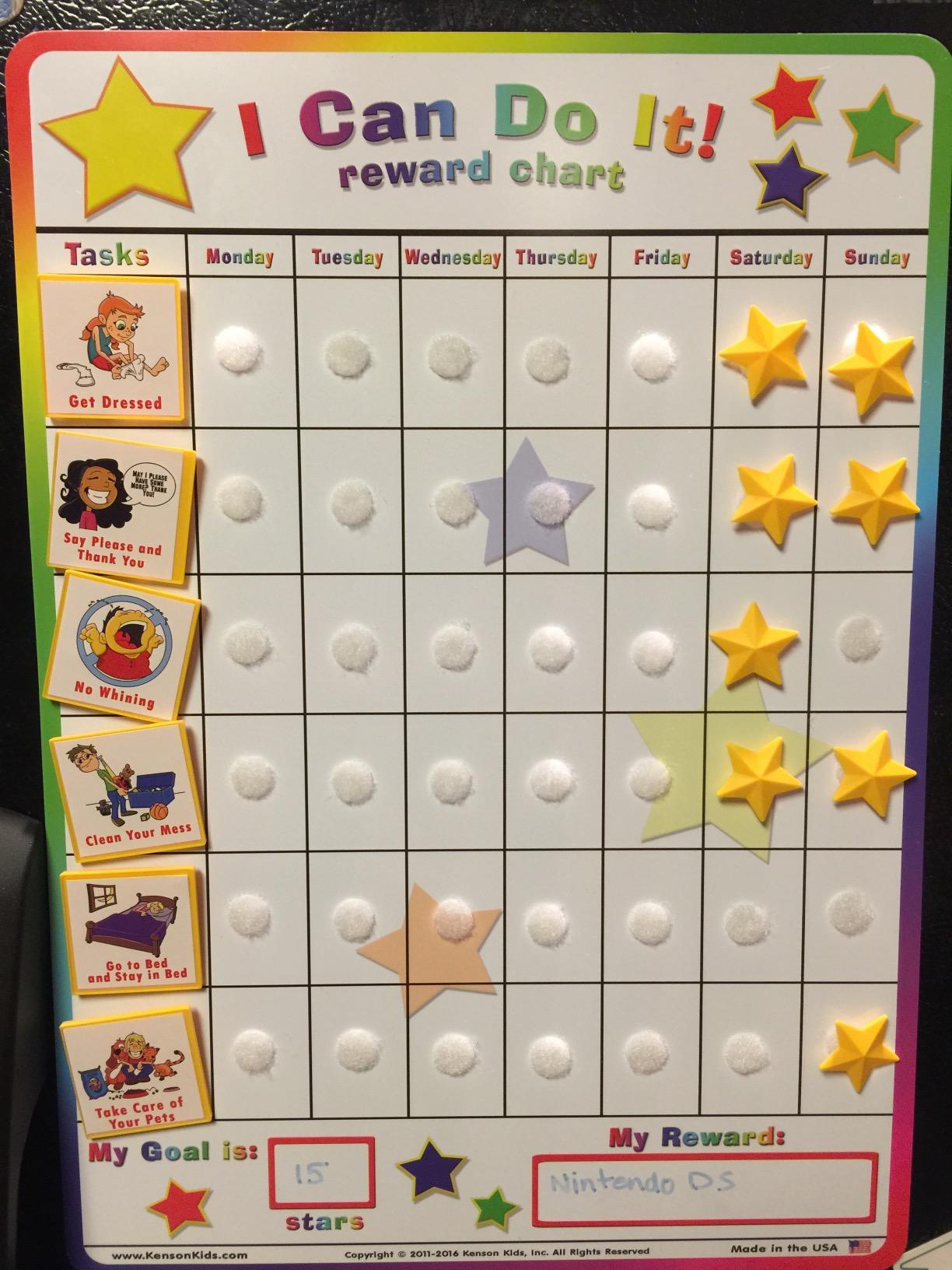
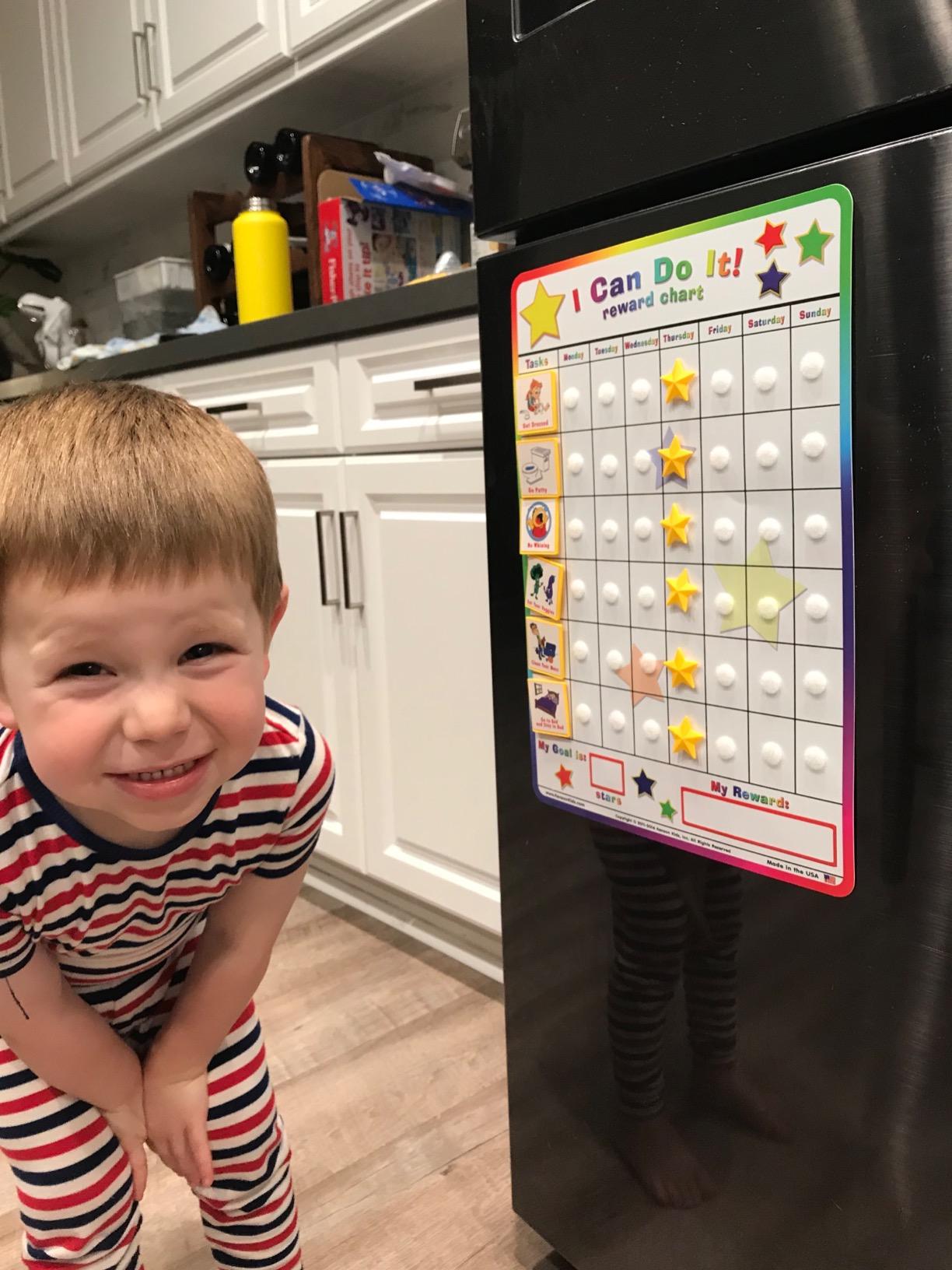
Set aside ten minutes before you start. The velcro dots have to be stuck onto the back of each star by an adult, and skipping that step is the most common reason people conclude the chart does not work. Once the stars are dressed, the system itself is simple: child places a star, parent moves it back to a storage spot at the end of the day.
The real-world complaint worth knowing about is the backing. It is thin enough that a determined toddler can get a corner of it up and peel the mat off the fridge, and if your fridge has a stainless steel face, a magnetic chart will not hold on the door at all. Several families move the board to a whiteboard or the inside of a cabinet door for exactly this reason.
Who this chart suits
It suits a family that plans to reuse the same board for potty training, then morning dressing, then chores. The interchangeable cards are the deciding factor here, and no other pick in this roundup offers that many swappable task labels at this size.
It also suits two or three children, since the board works as a shared family chart with a goal for everyone. Parents who like having one small job for each child found the column layout handles that well.
Who should skip it
Skip it if you want a pen-and-wipe system, because the board has a writable area but no marker in the box. Also skip it if you will not spend the setup time on the velcro, since the stars will simply not attach without it.
And skip it if the fridge is your only mounting surface. A thin magnet mat plus a stainless steel door is a losing combination that shows up again and again in the reviews.
3. Cozy Greens Dinosaur Potty Training Chart – Top Rated Choice for Potty Training
Potty Training Chart for Toddlers, Dinosaur Design Reward Chart – 194 Cool Stickers, 2 Fun Crowns, Motivational Certificate, Bonus Instruction Cards, Booklet & Erasable Pen for Boys and Girls
194 stickers
Two finish-line crowns
Motivational certificate and instruction cards
Erasable pen and booklet included
Pros
- 194 stickers cover extra tasks and more than one training cycle
- Two crowns and a diploma give a clear finish line
- Instruction cards keep the plan consistent
- Children enjoy choosing and placing the stickers
Cons
- Chart is not laminated so stickers tear when repositioned
- Daily columns fill up after about four stickers
- Some packages arrive with stickers missing
- Included erasable pen can make buyers expect a reusable board
This is the pick for families whose single goal is toilet training and who want the reward sitting in the bathroom. The 194 stickers are the headline number, and it is a real advantage: you can reward every attempt including the accidents, which is what most potty-training plans ask you to do, without rationing.
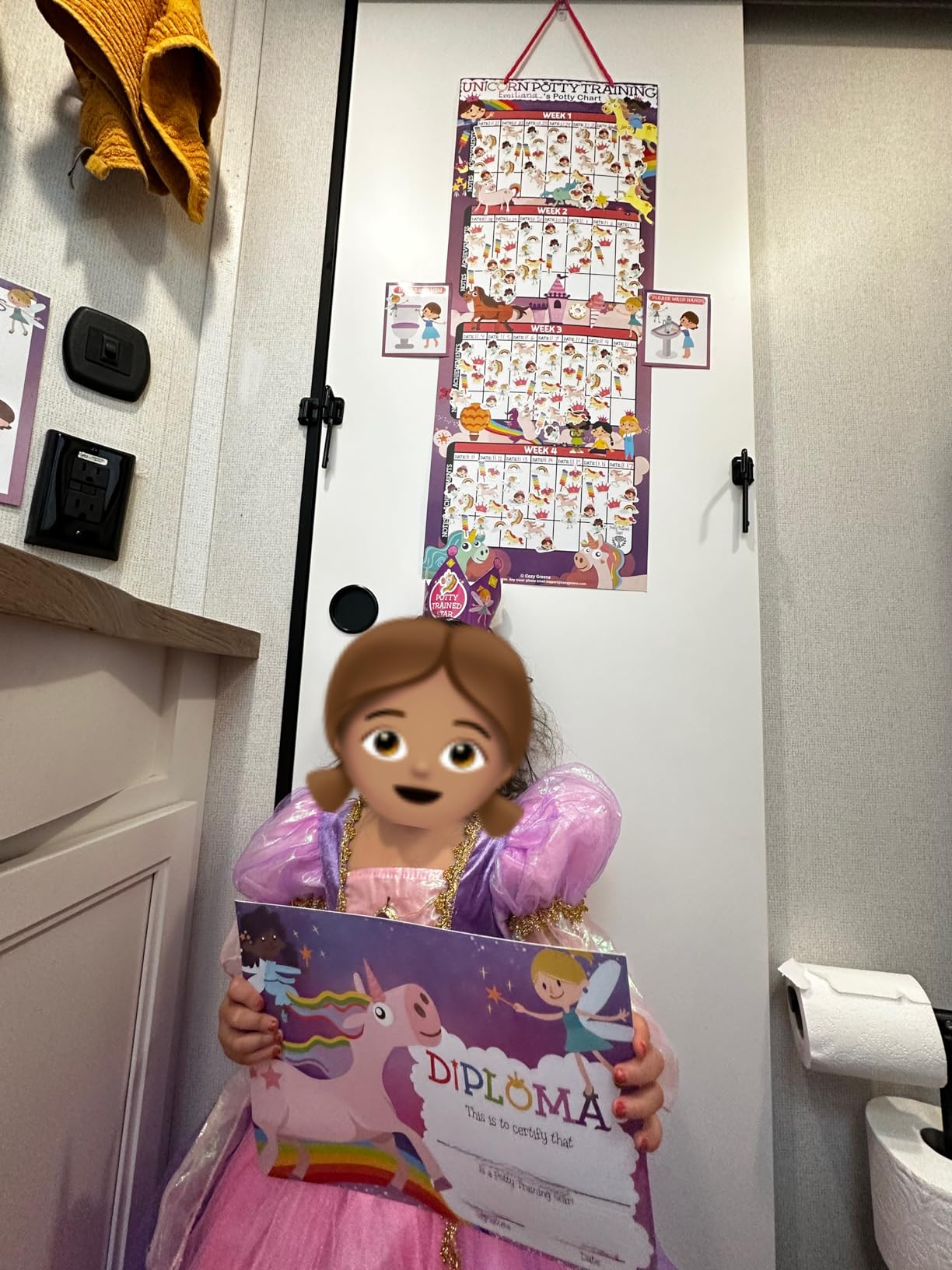
The two crowns and the certificate create a finish line that a toddler can understand. A parent on r/UKParenting described a star-based system that ended in a small treat after five stars and worked for a previously resistant two-year-old, and the crown-plus-certificate structure follows the same idea without needing a parent to remember when to hand over the prize.
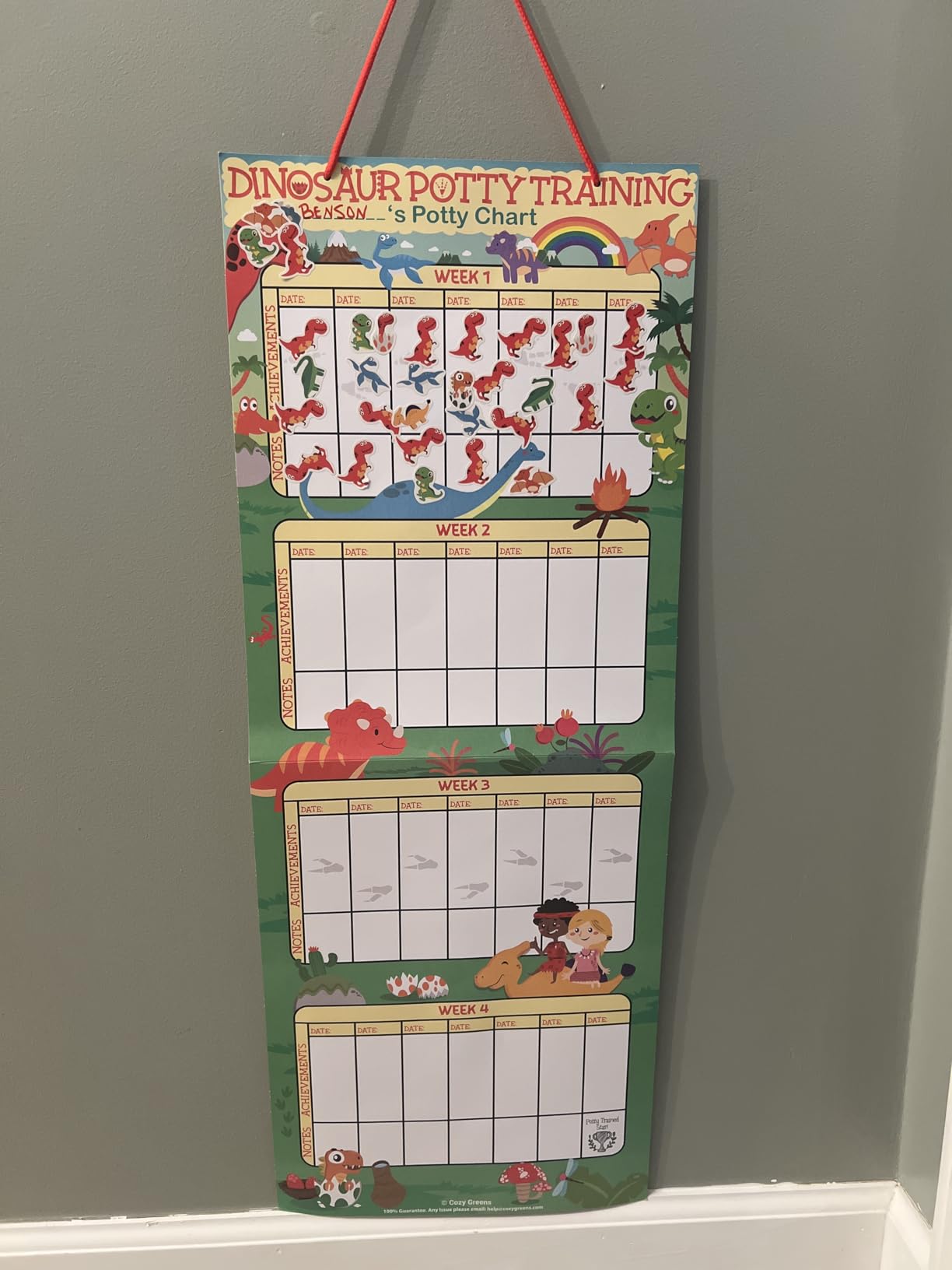
Be clear-eyed about the paper. It is not laminated, so a sticker that goes down slightly crooked stays crooked, and peeling one up can take a layer of the chart with it. The grid is also tight, and parents report a column filling after about four stickers a day, which some toddlers exhaust in a single enthusiastic morning.
The erasable pen in the box is worth flagging because it sets the wrong expectation. It is a pen for writing the date or a note, not a way to wipe and reset the board, and buyers expecting a reusable surface are disappointed. There is no way to start a fresh chart without printing a new one.
Who this chart suits
It suits a family starting one clear, dated goal with a fixed end point. A child who loves choosing a sticker from a large sheet gets more out of this than a child who does not care about the physical token, and the dinosaur and unicorn artwork gives you two themes to pick from.
It also suits parents who want the plan written down for them. The instruction cards and booklet keep everyone using the same approach, which matters more than it sounds when one adult is rewarding and another is nagging.
Who should skip it
Skip it if training is going to take more than two or three weeks, because you will run out of chart space before you run out of motivation. Skip it if your child is a sticker-peeler, since the surface tears when stickers are removed. And skip it if you expect to reuse this for bedtime routines later on.
Parents who have already tried a chart and had it fail are usually better served by a magnetic board. Paper works for a fixed sprint; it does not work for a rolling habit.
4. PUTSKA Laminated Potty Training Chart – Best for the Bathroom Itself
PUTSKA Potty Training Chart Toddler Boys, 35 Stickers, Crown, Firefighter
35 reusable stickers
3 reminder stickers
Crown reward
Laminated splash-proof paper
Pros
- Laminated surface resists smudges wrinkles and splashes
- Stickers are reusable so one chart spans the training period
- Small enough to mount directly on the potty or a sink
- Very light and easy to move between rooms
Cons
- Only 35 stickers which runs out if every attempt is rewarded
- Themed designs limit long-term appeal
- Thin card stock may not sit perfectly flat
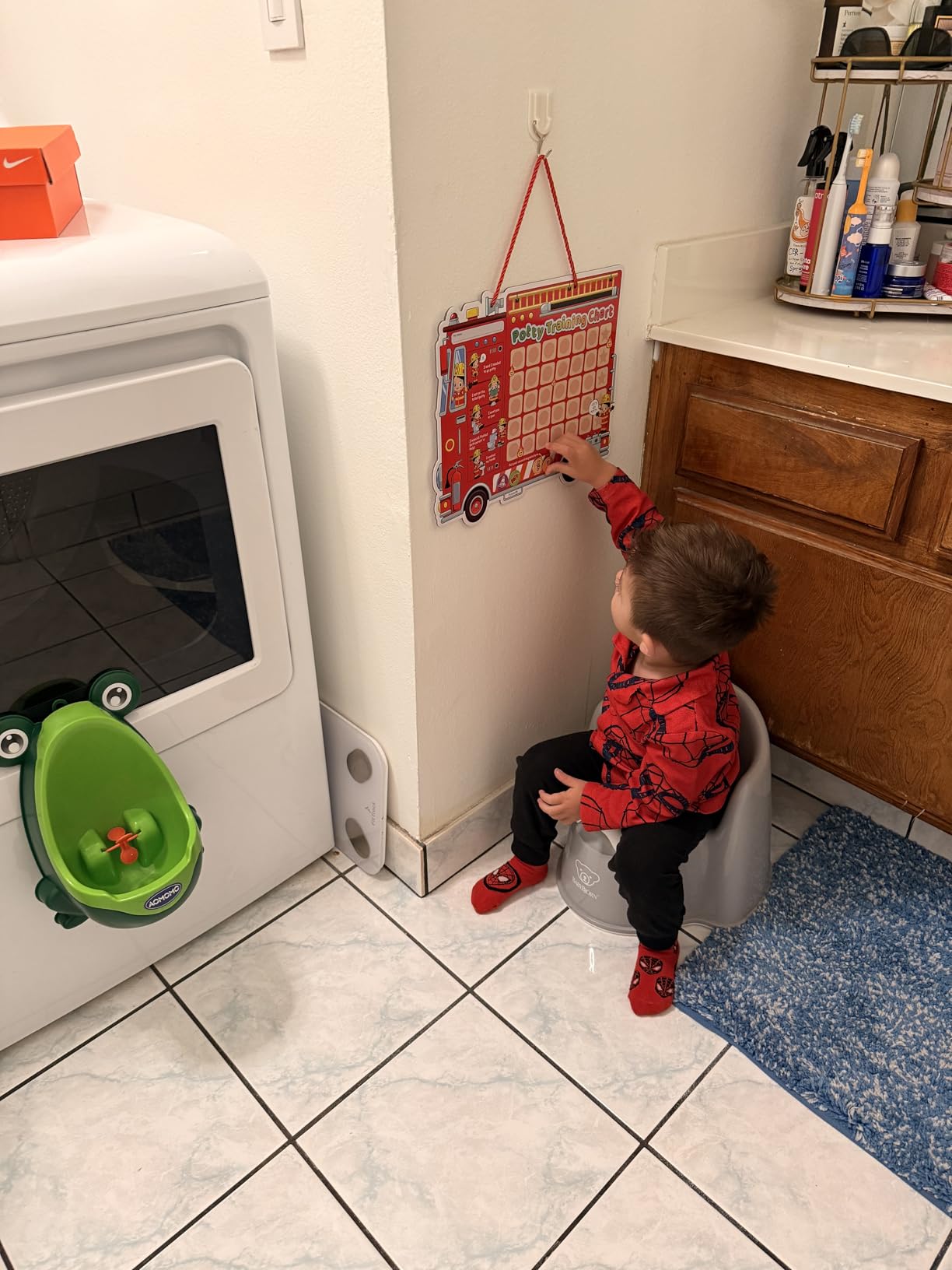
The whole design argument for this chart is placement. At 10.6 by 12.2 inches it is small enough to stick to the side of a potty or to sit beside a hand-washing sink, which keeps the reward inside the toddler’s line of sight at the exact moment it matters. Most other charts live on the fridge, in a different room from the behavior.
The lamination is the reason we picked it over similar paper charts. It resists smudges, wrinkles, and splashes, and the 35 stickers are reusable, so the same sheet can carry a child through a full training period instead of a single good week. The crown gives a clear finish line, and the three reminder stickers let a parent point at the goal rather than repeat it.
Thirty-five stickers sounds generous until you reward every attempt, which is standard advice for potty training. On a bad week that supply disappears quickly, and there is no refill sheet in the box. Plan to reward the successful tries rather than every attempt, or keep a separate sticker book for the rough days.
The fireman, dinosaur, zoo animal, and tractor themes are well executed, but a themed chart has a shelf life. Once the character stops being exciting, the chart becomes one more piece of bathroom furniture, and at this size there is no writable area to update the goal in the way a dry-erase board would allow.
Who this chart suits
It suits a family that wants the reward at the point of the behavior rather than on the kitchen door. Parents of toddlers who wander off mid-task report that a chart they can actually see from the potty changes the morning far more than a better-looking one in another room.
It also suits families that move between a home bathroom and a grandparents house, since the chart weighs almost nothing and packs flat in a bag.
Who should skip it
Skip it if your child rewards himself for every attempt rather than every success, because 35 stickers will not last. Skip it if the child is at the stage where a character theme is the only thing that would have worked and you have already burned through that interest.
And skip it as a general behavior chart. This is a potty tool, and while it will accept a sticker for tidying up, it has no rows for that job.
5. Paper Projects Peppa Pig Potty Chart – Best for a Character-Obsessed Preschooler
Paper Projects 01.70.30.022 Peppa Pig Potty and Toilet Training Reward Chart and 56 Sparkly Stickers, Pink
Official licensed Peppa Pig artwork
56 sparkly foil stickers
Wipe-clean glossy surface
6.51 by 4.6 inch chart
Pros
- Sparkly foil stickers are highly motivating for a Peppa fan
- Official licensed art with the familiar characters
- Small chart fits on a fridge or a bathroom wall
- Wipe-clean glossy surface
Cons
- Foil stickers tear and lose adhesion after the first removal
- Not laminated so removing stickers can damage the chart
- Character theme loses appeal once interest fades
- Sticker supply can run out near the end
This chart works for one narrow situation and does it very well: the child who is currently fully committed to Peppa Pig. Families using it report toilet training finishing in a matter of days, and the sparkly foil stickers are the feature that does the work, not the chart design.
At 6.51 by 4.6 inches it is the smallest board in this roundup, which is a genuine advantage on a fridge or a bathroom wall where a full-size chart looks like paperwork. The glossy surface wipes clean, so crumbs and fingerprints come off without scrubbing.
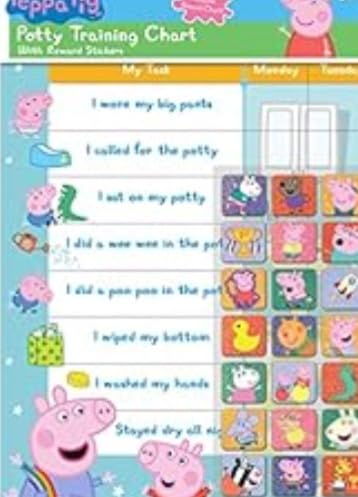
The honest weakness is the sticker durability. The foil stickers are advertised as reusable, and in practice they curl and tear at the edges after the first removal, which is exactly the moment a parent needs to move a sticker from one day to another. Many families end up substituting their own supply, which defeats the point of the included sheet.
It is also not laminated, so a misaligned sticker leaves a mark and a removed one can take the printed surface with it. Treat the 56 stickers as single-use and the chart still works, but you should know that going in.
Who this chart suits
It suits a three-year-old with a current Peppa fixation and a short training window ahead. The character art is officially licensed and includes the whole family, which is the kind of detail that matters at this age when accuracy is the point.
It suits small spaces too. On a narrow fridge door or a tiled bathroom wall, a chart this size is far easier to mount and keep flat than a full-size board.
Who should skip it
Skip it if the character interest is fading or has never been there, because that is the only thing carrying the motivation. Skip it if your child is a sticker-peeler or if you want to move stickers around between days.
Skip it for anything beyond potty training. A 6.5 by 4.6 inch sheet has no room for a bedtime routine or a chore row, and this is the one pick on the list we would not expect to survive a second habit.
6. D-FantiX Magnetic Dry Erase Responsibility Chart – Best for Multiple Children
D-FantiX Magnetic Responsibility Chart, Chore Chart for Multiple Kids, My Star Reward Chart Daily Routine Good Behavior Charts Dry Erasable for Toddlers at Home
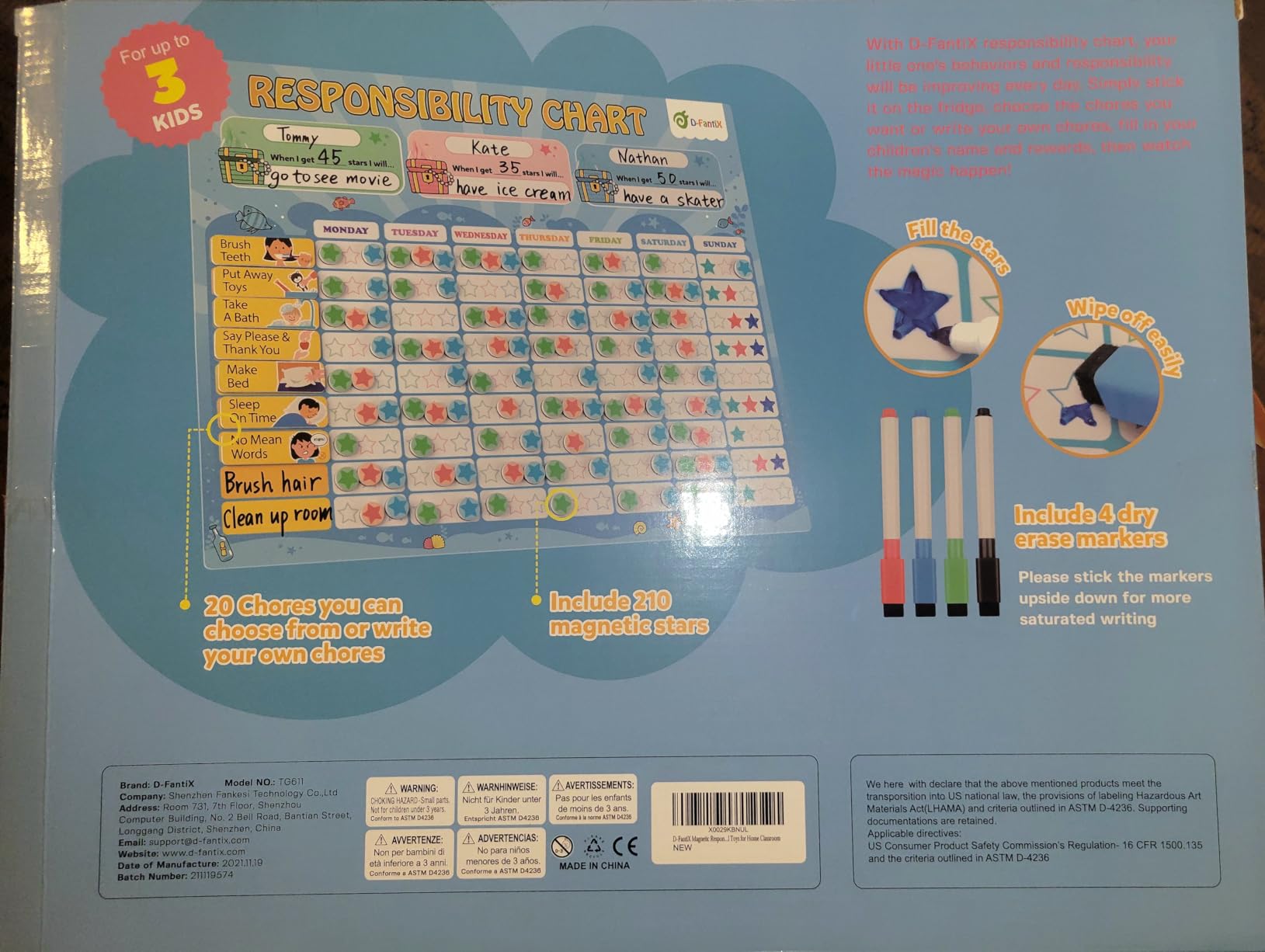
16.2 inch square magnetic dry erase board
20 illustrated task magnets
210 star magnets across 3 sheets
Includes marker
Pros
- Largest board here with room for several children and a full week of tracking
- 210 star magnets mean rewards rarely run short
- Dry erase surface wipes clean and reuses indefinitely
- Illustrated task magnets work for children who cannot read yet
Cons
- Most expensive board in this roundup
- Dry erase surface ghosts over time and needs regular cleaning
- Bulk size is excessive for a single toddler
- Marker wears out and is not always replaced easily
This is the one to buy if you are tracking two or more children at once. At 16.2 inches square it is by far the largest surface in the roundup, and 210 star magnets across three sheets means you stop rationing, which is the fastest way to make a reward system feel unfair between siblings.
The twenty illustrated task magnets are the detail we like most. A child who cannot read yet can still recognise the picture of the laundry basket or the toothbrush, and that means the board works as a prompt rather than something a parent has to translate out loud every time.
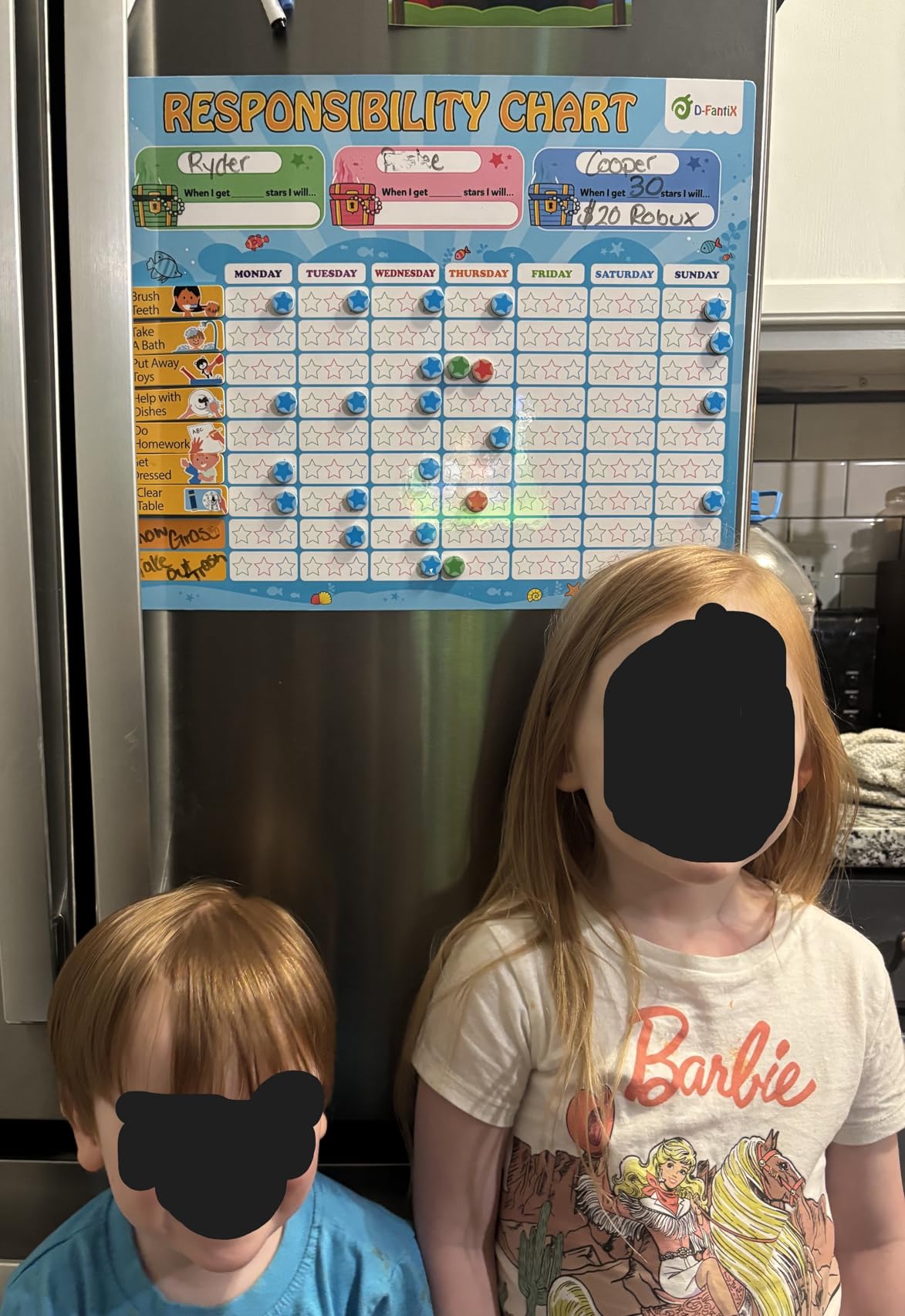
Because the surface is dry erase, the number of behaviors is not limited to what was printed. You can write a custom row with the included marker and change it as the child moves on, which makes this the most flexible board here for a family whose routines change from week to week.
Two practical notes. The dry erase layer does ghost with use, and it needs a proper wipe rather than a dry cloth every week or two, otherwise the writing underneath becomes hard to read and children stop trusting the row. And at this size, a single toddler can walk past a wall of stars without noticing which ones are theirs, so name the child or use a colored magnet for their column.
Who this chart suits
It suits families with two or three children, a classroom, or a daycare-style setup where one board has to serve everyone. The large surface and the volume of stars are wasted on a single three-year-old with one routine, and that is a fair criticism of an otherwise very capable product.
It also suits anyone whose toddler cannot read yet, since the illustrated magnets carry the meaning without a parent narrating it every time.
Who should skip it
Skip it if one child and one routine is the whole plan. The extra space and the bulk pack become clutter rather than capacity, and this is the priciest board in the set for what is essentially a surface plus magnets.
Skip it if you will not commit to the weekly clean. A ghosting dry erase surface is worse than a paper chart for a child who is learning to read the rows independently.
7. Kenson Kids I Can Do It Token Board – Best Portable Board for Travel and Out-of-Home Use
Kenson Kids “I Can Do It!” Token Board. Colorful Magnetic Rewards Chart with Positive-Reinforcement Stars and Customizable Goal Box. Great for Ages 3-10. Measures 5-Inches by 11-Inches
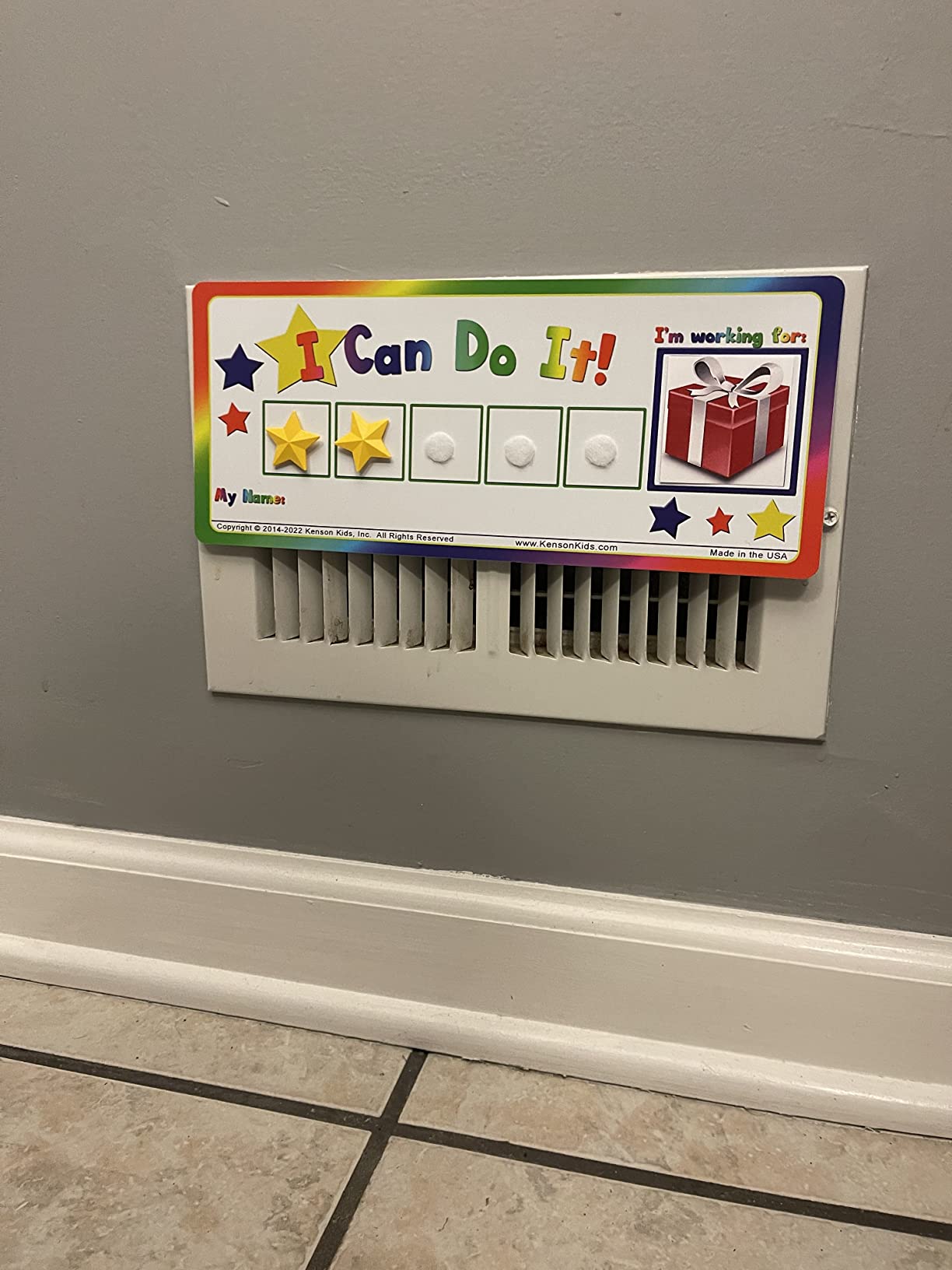
Compact 5.5 by 11 inch token board
Sturdy plastic hook-and-loop stars
Name field and customizable goal box
Dry erase fillable
Pros
- Small and light enough to live in a diaper bag or travel folder
- Sturdy plastic stars hold well with hook-and-loop fasteners
- Name line and goal box keep the reward personal
- Recommended by behavior therapists as a token-economy tool
Cons
- Stars are plastic rather than magnetic despite the product name
- Cardboard body is thin and feels flimsy
- Each star needs a velcro square applied by hand before use
- Small board means fewer daily slots than a full-size chart
This is the pick for routines that do not happen at home. At 5.5 by 11 inches and 1.6 ounces, it goes into a diaper bag, a stroller caddy, or a grandparents house without becoming one more thing to carry, and the name field means two children can each have their own board in the same bag.
The goal box is the part that earns its place. You write the reward once with a dry erase marker, and the child can see the target without a parent re-explaining it, which is the difference between a system and a nag in most households.
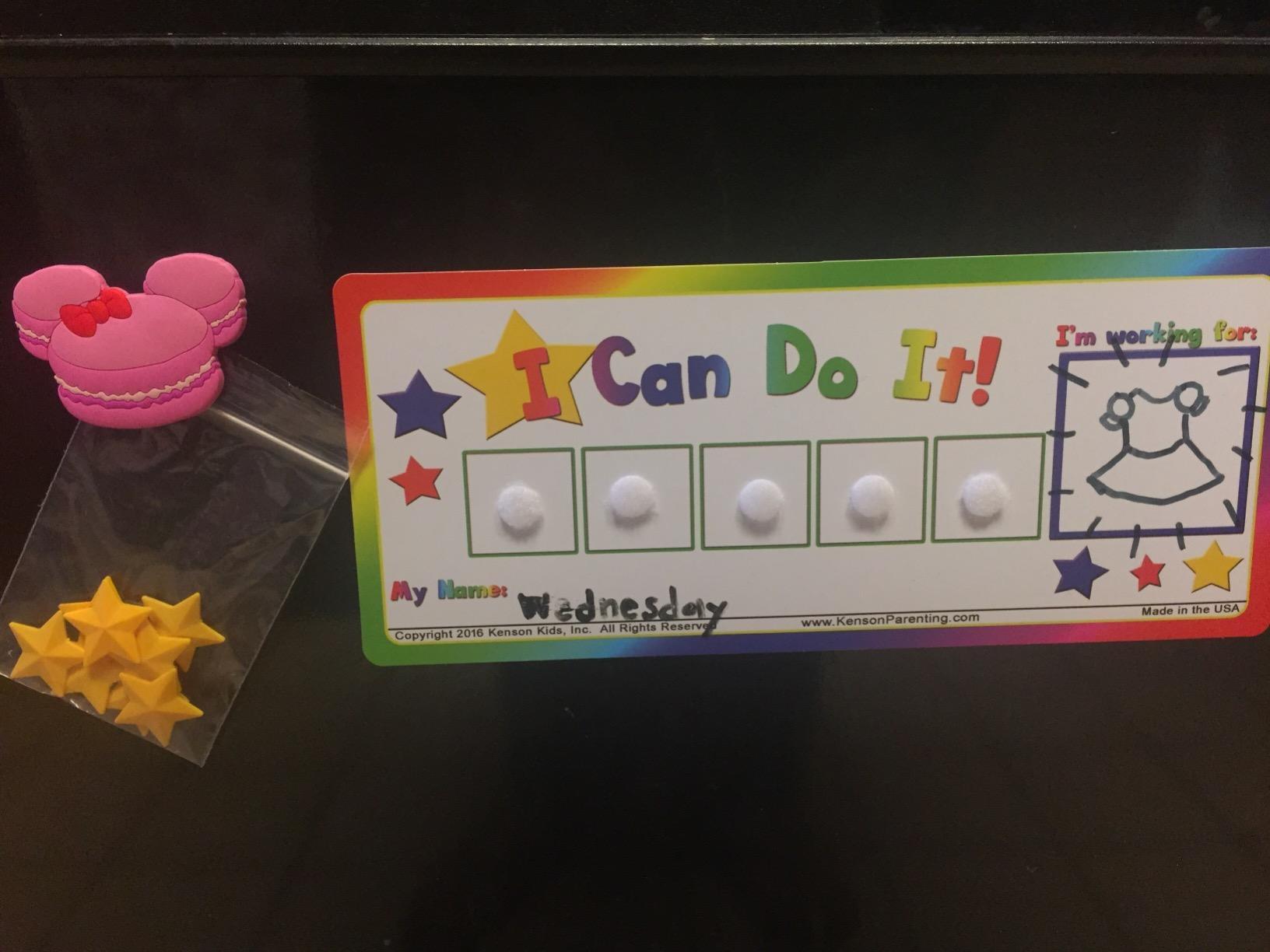
It is worth correcting one thing in the listing language, because buyers are regularly confused by it. The stars are plastic and attach with hook-and-loop, not magnets, so nothing on this board is magnetic and it will stick to a fridge by its own weight and a fridge magnet. That is fine for a small board, but it is not the heavy-duty mount the name suggests.
The stars also need a small velcro square applied to each one before use, the same setup task as the larger Kenson board. The cardboard body is thin, and reviewers describe it as flimsy in the hand, so treat it as a travel tool rather than the main board on your kitchen wall.
Who this chart suits
It suits families tracking a behavior that happens on the move, such as sitting in the car seat, handwashing in a public bathroom, or quiet time at a waiting room. Parents of children with sensory and attention differences report that a small, low-detail board with an immediate and predictable reward is easier for a child to engage with than a large colorful one.
It also suits shared custody. Two identical boards, one per household, with the same goal written on each, mean a child does not have to re-learn the system every time the houses swap.
Who should skip it
Skip it if you need to track a full day of routines. The surface is small enough that you are choosing one or two rows, which is the right way to use it and the wrong way to use a whole-day chart.
Skip it if you dislike assembly tasks. Applying velcro squares to ten stars before the first session is a genuine setup step that trips people up, and the extras arrive in a small bag with no dedicated storage spot.
8. inamio Magnetic Responsibility Chart with 3D Stars – Best for Custom Tasks That Change Weekly
inamio Magnetic Kids Responsibility Reward Chart – Engaging 3D Stars & Chore Tasks – Behavior Chart for Home & School – Ideal for Ages 3-9, Multiple Kids
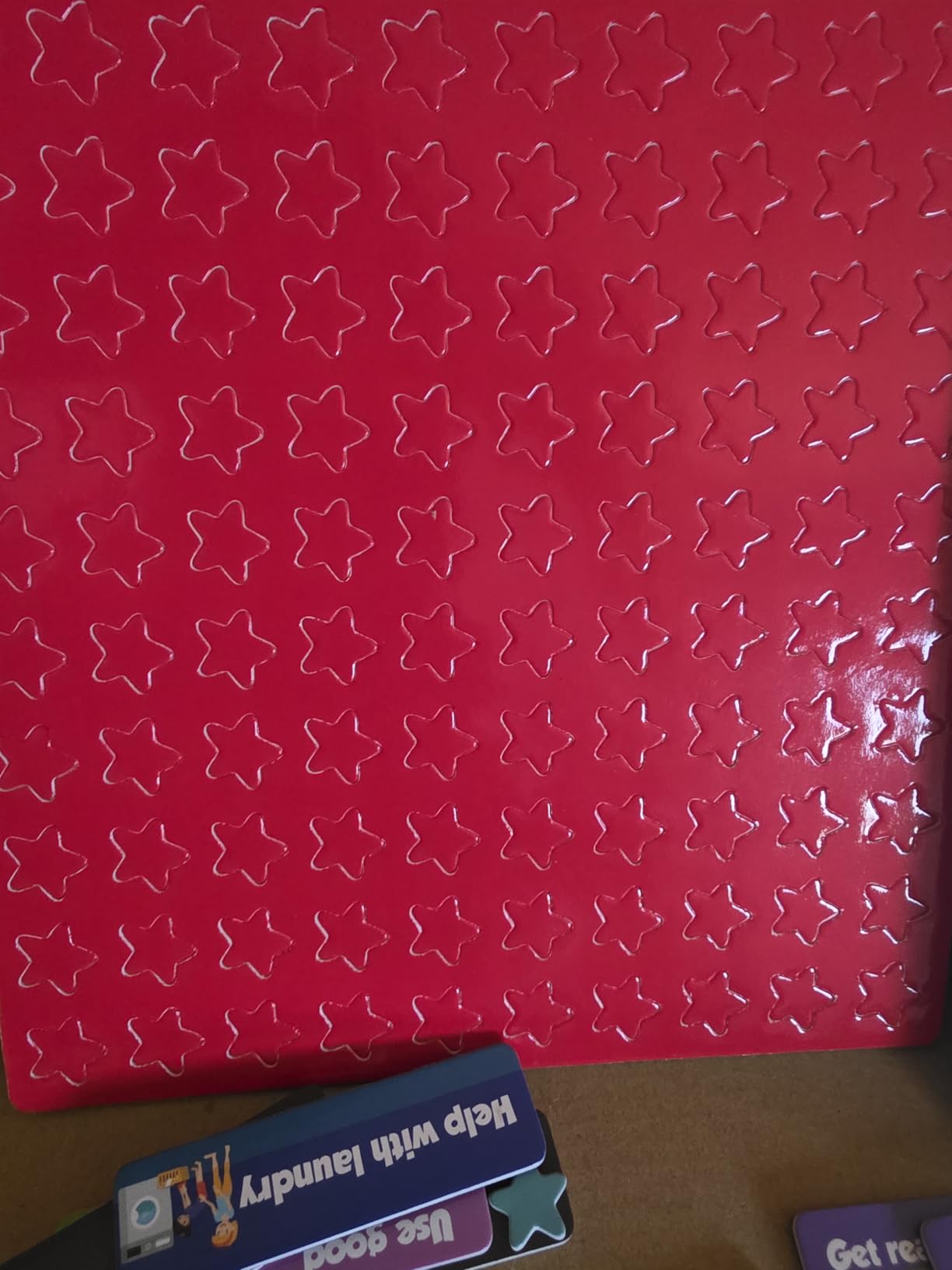
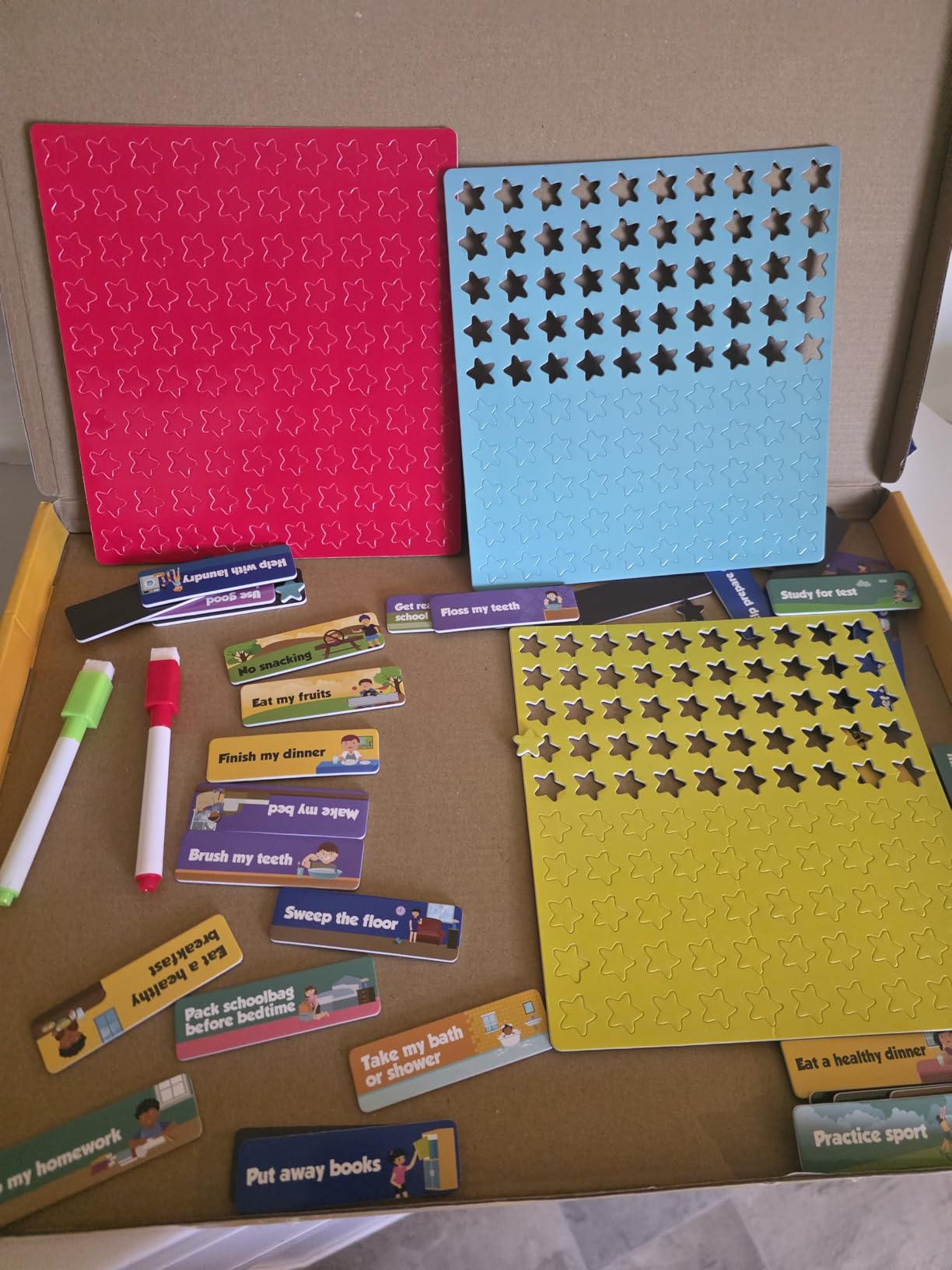
Magnetic board with 80 plus chore and task magnets
Tactile 3D reward stars
Dry erase writing surface with marker
Storage bag and cleaning cloth included
Pros
- 80 plus chore magnets cover manners emotions and household tasks
- Dry erase area lets parents write new tasks as the child grows
- Works for multiple children with different colored stars
- Storage bag and cloth are useful extras
Cons
- Magnets are weak and can slide or fall off the board
- Board can warp after being mounted on a wall
- Small magnet illustrations are hard for little eyes to read
- Included marker sometimes arrives dried out
This is the board to buy if your routines are not settled. The library of 80 plus chore and task magnets covers manners, emotions, and household jobs as well as basic tidying, and the dry erase area lets a parent add a specific goal like putting the shoes away without printing a new sheet.
The 3D stars are the reward piece, and they are tactile in a way flat paper stickers are not. For a child who likes handling objects more than sticking things, that physical quality does more work than the artwork does. Reviewers consistently note that the breadth of the magnet library is what makes the board keep working as the child grows.
Build quality is the weak point. The magnets are not especially strong and can slide or drop off the board, and some users report the board warping after being mounted flat on a wall, which then makes the magnets sit unevenly. If you are putting it on a wall rather than a fridge, check it after the first week.
Two smaller issues. The magnet illustrations are small, so a three-year-old may not be able to interpret the picture without a parent naming it, which partly undercuts the self-directed idea. And some buyers reported the red marker arriving dried out, so have a working dry erase marker on hand before the first session.
Who this chart suits
It suits a family that wants one board to cover behavior and chores together, rather than a dedicated potty tool plus a separate routine board. Parents of toddlers who are learning manners alongside daily tasks find the emotion and manners magnets useful, since those are the hard ones to name out loud every time.
It also suits a home with multiple children, since the different colored stars let each child track their own column on the same surface, and the included storage bag makes resetting fast.
Who should skip it
Skip it if you need a surface that stays perfectly flat on a wall, since warping shows up in the reviews and undermines the whole point of a magnetic board. Skip it if your child needs large, obvious images to self-direct the routine, because the artwork here is small.
And skip it if you want magnets that stay put under a toddler hand. These are decorative-strength magnets, and a determined two-year-old will move them.
9. Hadley Designs 10 Potty Training Charts with 252 Stickers – Best Paper Set for Long Training Runs
10 Potty Training Chart for Toddler Girls Sticker Reward Chart for Kids
10 charts at 8.5 by 11 inches
252 stickers across 4 sheets
Instruction sheet included
Unicorn princess mermaid boho and retro themes
Pros
- Ten charts give far more tracking capacity than single-sheet designs
- Five themes let the child pick the design that works
- Instruction sheet helps parents follow one consistent plan
- Screen-free and inexpensive per week of use
Cons
- Uncoated paper is not laminated so stickers are hard to reposition
- Single design per sheet with no magnetic or interactive element
- Novelty can fade after the first few days
- Some themes run out of stickers sooner than others
Ten full-size sheets and 252 stickers is the practical answer to the most common paper-chart complaint, which is running out. A child who rewards himself generously or who has a long training runway will exhaust a single sheet in a week, and this set is designed so that never happens.
The five themes matter more than they look. Unicorn, princess, mermaid, boho, and retro give a child who has strong preferences a real choice, and parents report the design choice itself sometimes does the convincing when the parent cannot. The instruction sheet keeps the household on one plan, which is the same benefit we flagged on the dinosaur chart.
The paper is uncoated text stock, not laminated, so stickers do not reposition cleanly and a lifted one can damage the printed row. That is a real limitation, but with ten sheets you can simply move to a new one rather than fighting a used chart, which turns the weakness into a non-issue.
This is also a purely paper product. There is nothing magnetic, nothing interactive, and no way to reset without a fresh sheet, so it works well for a dated goal and badly as rolling infrastructure. It was designed by a former preschool teacher and made in the USA, which explains the instruction sheet.
Who this chart suits
It suits a family whose training window is unpredictable. If your toddler is in and out of diapers for months rather than days, ten sheets and 252 stickers remove the moment where the chart ends and the tracking stops.
It suits families with a strong theme preference, since five designs give a real choice, and it suits households that want a completely screen-free system that can be handed to a grandparent without an explanation.
Who should skip it
Skip it if you want to track a routine that has no end date. Every sheet eventually fills, and there is no reset beyond a new sheet. Skip it if your child needs an interactive element, because these are flat paper with nothing to move.
Skip it if sticker repositioning is part of your plan, since uncoated paper tears. And for families already through potty training, this is a better backup supply than a primary system.
10. PUTSKA 26 Board Sticker and Reward System – Best Sticker Supply for Multi-Child Homes
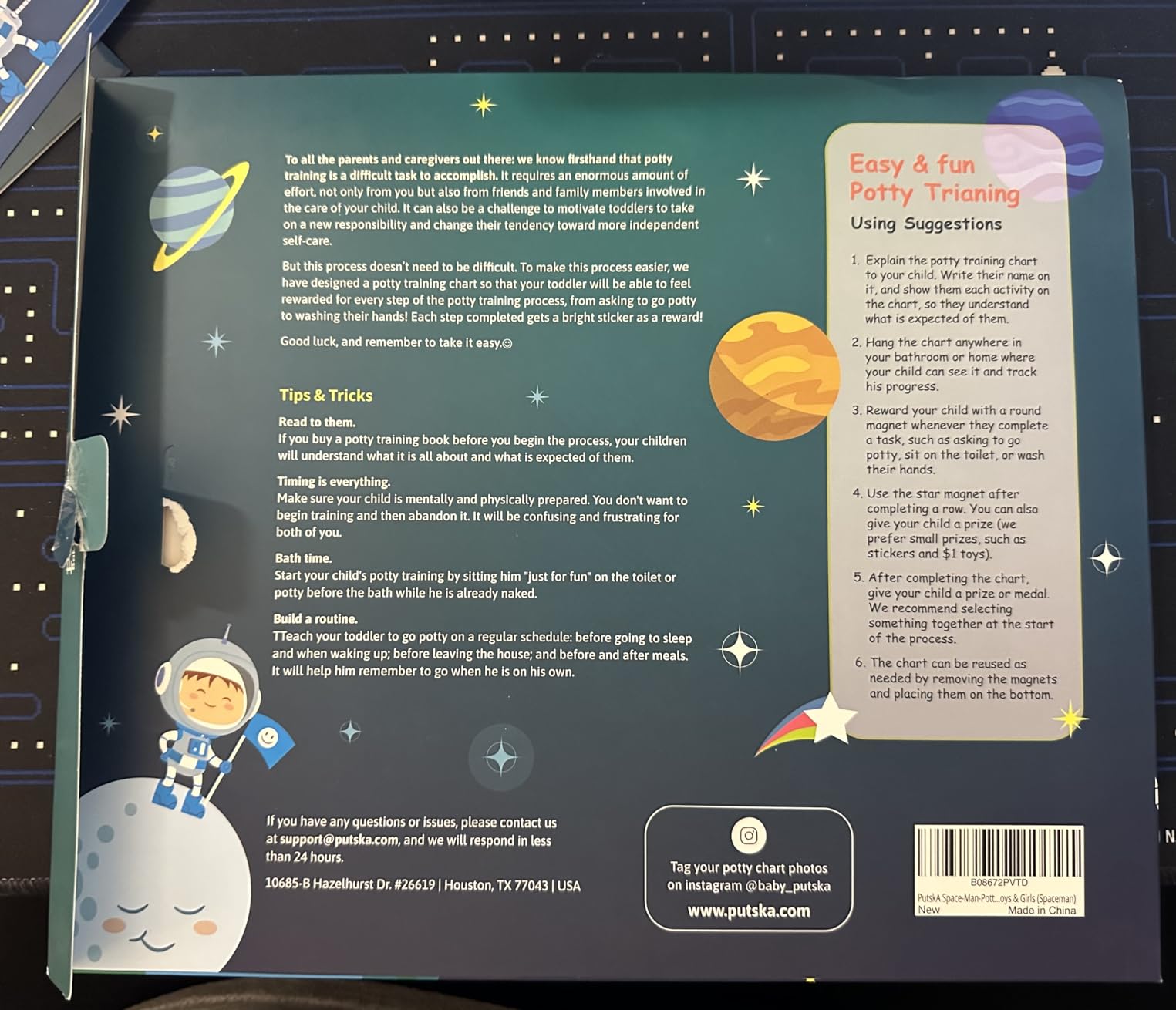
PUTSKA Potty Training and Chore Chart, 26 Boards, 1528 Stickers,Classic
26 perforated charts
1440 task done stickers
88 reward stickers
Perforated design built for weekly resets
Pros
- Enormous supply supports daily tracking for months without repurchasing
- Perforated boards make a weekly reset almost effortless
- Works for potty training then tooth brushing tidying and bedtime
- Separate reward stickers create a prize tier beyond routine tasks
Cons
- Paper format rather than magnetic or dry erase
- Heaviest item here at 12.5 ounces and bulky to store
- Single yellow colorway with limited design variety
- Not reusable once stickers are applied
One thousand five hundred and twenty-eight stickers is the supply argument, and for a family that tracks more than one child across more than one routine, it is a strong one. 26 perforated charts break cleanly along the week line, so the reset takes seconds instead of becoming a chore you skip.
The split between task-done stickers and reward stickers is the design detail we like most. Parents can reward the routine with a small star and reserve the larger reward stickers for a completed week or a finished goal, which creates a second tier of recognition without any extra effort from the parent.
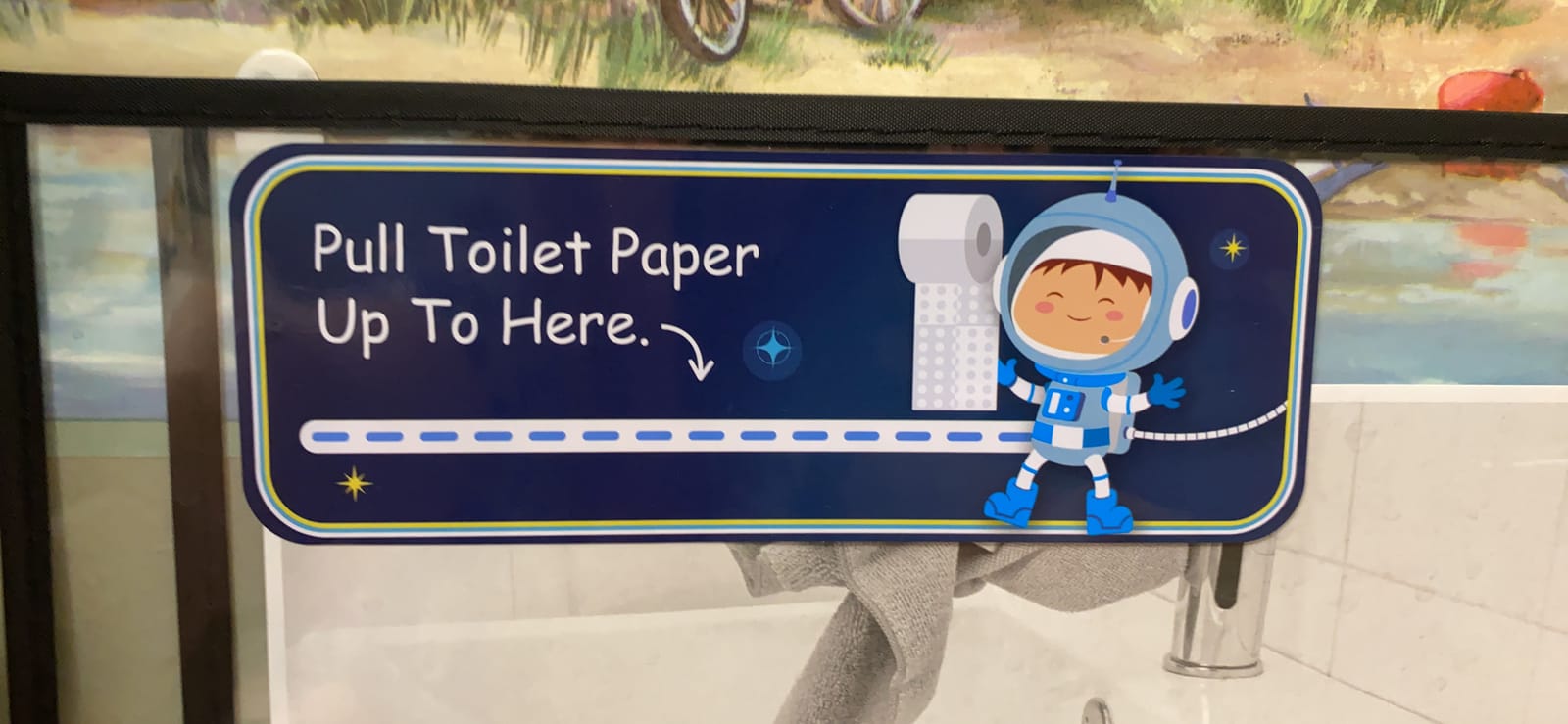
Be realistic about bulk. At 12.5 ounces and 11.4 by 9.8 by 2.2 inches, this is the heaviest item in the roundup and it is a box, not a board. Families who finish a routine in a month end up with most of the stack in a closet, and the sheer volume can outpace a child who loses interest quickly.
It is also not reusable. Once a sticker goes on, that section of the chart is done, and there is no surface to wipe. The single yellow colorway is the least charming design on this list, which matters more for a chart whose entire job is to make a child want to engage with it.
Who this chart suits
It suits families who want one purchase to cover potty training and then move straight into tooth brushing, tidying, and bedtime routines without buying anything else. The perforated weekly design suits a household that resets on a fixed schedule, like a Sunday evening reset ritual.
It also suits siblings, since a single child can exhaust a small supply in a week and two children will exhaust it in a day. When the supply question is the reason a chart keeps failing, volume is the fix.
Who should skip it
Skip it if storage matters, because a box of 26 charts and 1528 stickers is not something you tuck away quietly. Skip it if your child is motivated by a physical board rather than a piece of paper, since there is nothing to move or handle.
And skip it for a single four-week push. The system is built for months, and buying months of supply for a goal that ends next week is a mismatch we have seen families regret.
Magnetic vs Paper vs Printable: Which Format Wins for Toddlers
Magnetic boards win for rolling habits, paper charts win for dated goals, and printables win only when you want zero objects to lose. That is the short version of the decision, and the rest is detail.
Magnetic boards reset in seconds, which is the single biggest practical advantage. You wipe the surface or move the stars back at the end of the day, so there is no daily printing, no peeling damaged stickers, and no moment where the system stalls because the chart is full. The trade-off is loose parts. Every board on this list uses small magnets or hook-and-loop pieces, and those are the reason we keep repeating the hang-it-high advice.
Paper charts reward harder, and that is their real value. A sticker pressed onto a sheet cannot be lost, cannot be moved by a toddler, and cannot be quietly removed by a child who wants the reward to appear on its own. That makes paper the better tool for toilet training, where the goal is a clean run rather than a maintained routine.
Printables are worth one paragraph of their own. Roughly 60 percent of the search results for this topic are free printable templates, and for a family who wants a chart tonight, a print-and-stick template is a genuinely good answer. Laminate it before use, or the corners curl within a week and the stickers lift. Do not expect a printable to last longer than the routine it was printed for.
One failure mode deserves its own warning. A magnetic board will not stay on a stainless steel fridge door, and the thin magnet mats used on several of these charts can be peeled off a fridge by a toddler. If your fridge is stainless, mount on a whiteboard, a cabinet door, or the wall, and test it in week one.
Reward Charts for Toddlers for Potty Training
Yes, sticker charts work for potty training, and it is the single use case parents ask about most. It works because the reward and the behavior happen in the same room at the same moment, which is the situation where a chart has the best chance of landing with a young child.
Three of our picks are built specifically for it, and they suit different households. The laminated PUTSKA chart goes on the potty itself, which keeps the reward in sight at the exact moment of the behavior. The Cozy Greens dinosaur set brings volume and a clear finish line with two crowns and a certificate. The Hadley Designs set brings ten sheets and 252 stickers for a long or bumpy runway.
The 10, 10, 10 rule is a common timing structure worth knowing: about ten minutes of scheduled sitting on the potty, ten minutes of trying again after an accident, and ten minutes of praise or correction for the attempt itself. It works well with a sticker chart because it gives you a defined moment to place a sticker rather than an open-ended session that ends without reinforcement.
What to avoid is a chart that asks for thirty perfect days before any reward. A toddler cannot hold that goal, and a delayed reward with no intermediate marker is the fastest way to get a child who ignores the board entirely. Reward the attempt, keep the finish line inside two weeks, and keep the chart in the bathroom.
What to Put on a Toddler Reward Chart
Put one or two behaviors on the board, and make at least one of them something your child already does most days. A row for brushing teeth beside a row for putting shoes away is far easier to maintain than five rows that all have to change at once.
Good candidates for a three-year-old include: using the potty, getting dressed without a fight, putting toys in the basket, washing hands before eating, and finishing a bedtime sequence. For a two-year-old, keep it to a single row and only if the child shows real interest in the board itself.
Good rewards are immediate, small, and not money. A sticker the child gets to place, a specific song on the way to the shop, choosing dinner, an extra turn on the swing, or five minutes with a favorite book all work better than a treat from a jar, because they cost nothing and they are tied to the moment.
Leave these off the board. Anything the child already does without being asked, because tracking it can make them transactional about it. Anything the parent forgets to mark, since a missed day reads as the system not mattering. And anything with a reward more than a few days away.
One extra idea for families raising a bilingual toddler: use a spare row to log a word in the second language, with the child placing a star when they use it. It turns the same board into a small vocabulary log, and it costs nothing extra.
Why Reward Charts Stop Working (and the Fix)
Most charts do not fail. They get abandoned, usually somewhere in week three, and the reason is almost always novelty decay rather than a bad product. The excitement of a new board is doing the work in week one, and once that fades there is nothing underneath it.
Five problems cause most of the failures. One, too many behaviors tracked at once, so the child never completes a row. Two, rewards that are too big or too far away, which a young child reads as impossible. Three, tracking behaviors the child already does, which makes the board feel pointless. Four, no plan for fading the chart, so it becomes permanent furniture. Five, a static design that never changes, so the board is visually boring by week three.
Science-focused parents on r/ScienceBasedParenting generally advise using social praise first and treating a chart as short-term scaffolding rather than default infrastructure. That is the framing that works: the chart is a tool for building a habit, and the tool is supposed to be retired.
There is also the rejection problem, which is the most common complaint and the one no product page mentions. Some children do not want stickers, and on those children a sticker chart can make resistance worse. If your child walks past the board, swap the format rather than pushing harder. A token board with objects they want to handle, a marble jar, or simply immediate verbal praise can reset the pattern without a new chart.
The fix is a fade plan. Run the chart for four weeks. Then remove one row and keep the row that mattered. After another two weeks, move the board off the fridge and into verbal praise at the same moment the star used to go on. Most children keep the habit, because the cue was the visual, not the paper.
How to Choose a Reward Chart for Your Toddler in 5 Steps
Start with the goal, not the product. Write down the one routine you are actually trying to change this month, because a chart with a single clear job succeeds and a chart with four jobs stalls.
Then check the age floor honestly. The magnetic boards on this list are rated for ages three and up, and a large share of the negative reviews come from parents who started at two years old. If your child is two, pick a simple laminated paper chart for a dated goal, keep it in the bathroom, and expect to move to a board at three.
Third, match the format to the length of the job. A dated goal with a clear finish line, like toilet training, suits a paper chart with plenty of stickers. A rolling routine, like bedtime or morning dressing, suits a magnetic or dry erase board that you can reset in ten seconds.
Fourth, count the rewards, not the features. A chart that runs out of stickers in a week will fail regardless of how nice it looks, so check the included count against how generously you plan to reward. Multiplying your likely stickers per day by the number of training weeks is a quick way to see whether a single chart or a multi-pack is the right buy.
Fifth, check the mounting surface and the parts. Measure where you plan to hang it, and confirm it will hold on that surface, because a stainless steel fridge door defeats a magnetic board. Count the small pieces if your child is under three, and plan to hang anything magnetic well above head height.
One last step we would add: read the cons before the pros. The complaints on these listings are consistent and specific, and knowing that the Cozy Greens chart is not laminated or that the inamio magnets are weak tells you something no feature list will.
Frequently Asked Questions
Do sticker charts work for 2 year olds?
Sometimes, but less reliably than most charts claim. A two-year-old responds better to an immediate consequence than a delayed goal, so keep the chart to one row, reward the attempt rather than the perfect day, and place it where the behavior happens. If the child shows no interest in the board itself, stop and use immediate verbal praise instead, then try again around age three.
What are the downsides of sticker charts?
The main ones are that stickers run out, they tear when removed from non-laminated paper, and a missed day is read by the child as the system not mattering. Charts also fail when they track too many behaviors at once or when the reward sits too far in the future. For many children the sticker itself is not motivating at all, which makes the chart a source of negotiation rather than progress.
Do sticker charts actually work for potty training?
They are the most commonly reported success case, because the reward and the behavior happen in the same room at the same moment. A laminated chart that mounts on the potty works better than one on the fridge. Reward the attempt, keep the finish line inside two weeks, and expect the child to lose interest in the chart before the habit is fully formed.
What are some good rewards for toddlers?
Pick rewards that are immediate, small, and free: choosing dinner, a special song on the way to the shop, an extra turn on the swing, five minutes with a favorite book, or choosing the family activity. Physical rewards like a marble jar or a token the child can hold often work better for toddlers than food, because the token is the object the child is reaching for.
What to use instead of reward charts?
Try a marble jar or token system where the child physically moves a piece each time, a picture-based routine card reviewed at the same time each day, or immediate verbal praise given within seconds of the behavior. For children who do not respond to visual systems at all, a simple routine checklist read aloud with the child can work better than any chart. Many families alternate rather than replace.
Conclusion
The best reward charts for toddlers are not the ones with the most stickers. They are the ones your child will still look at in week four, and that is why the Melissa & Doug wood-framed magnetic board takes the top spot for 2026: it resets in seconds, it survives being handled, and the character artwork gives a routine a reason to exist beyond the reward itself.
Pick a magnetic board for a rolling routine, a laminated paper chart for toilet training, and start at age three unless your two-year-old is already interested. Give it four weeks, then fade it out on purpose, and replace the habit with praise rather than a bigger prize.